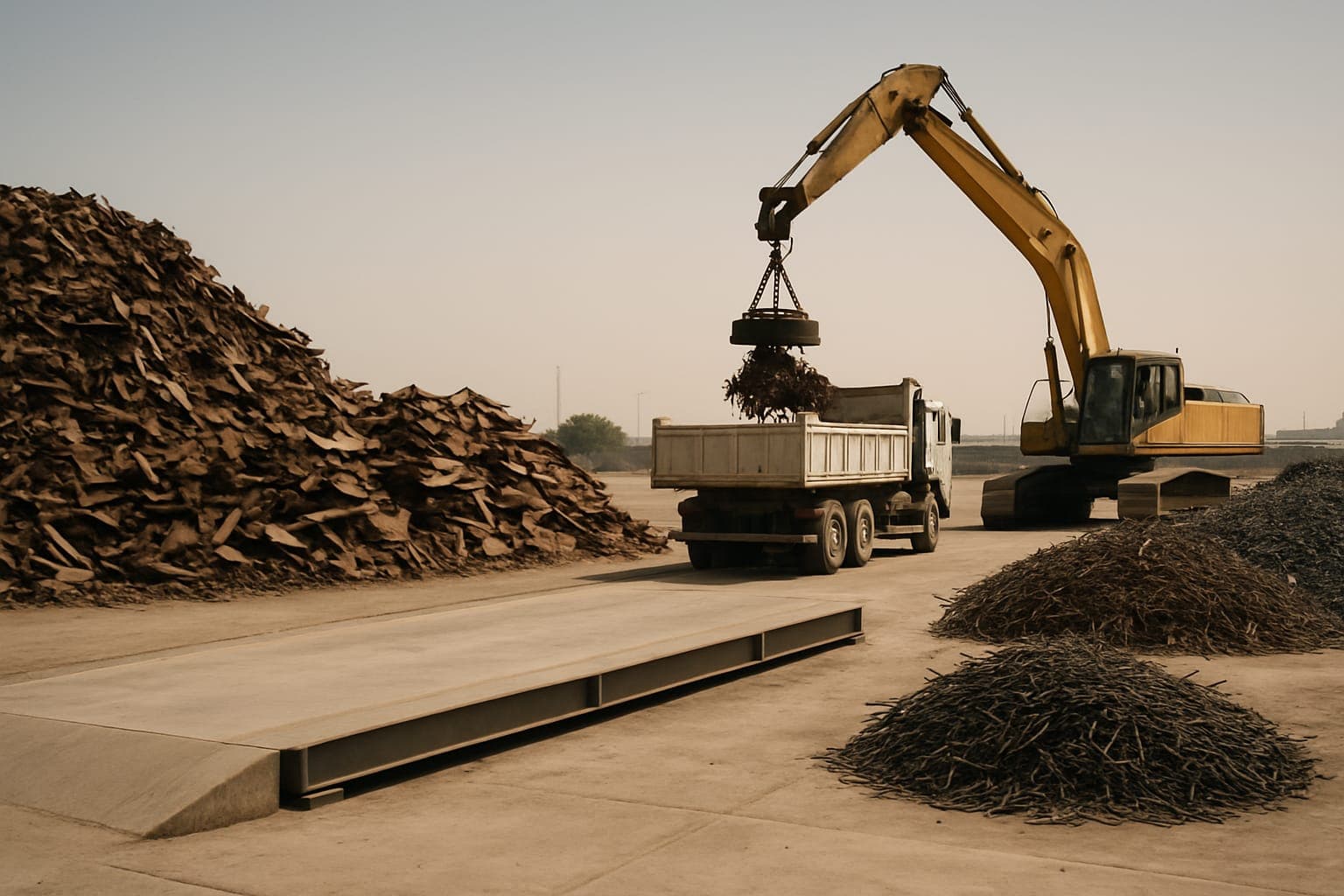
The UAE swapped its ferrous scrap export ban for duties in January 2024. Ferrous under HS 7204 and copper under HS 7404 carry AED 400 per tonne, aluminium under HS 7602 carries AED 100. On ferrous that is 28 to 38 percent of gross value, which usually puts the local mill netback ahead of the export netback.
What exactly changed, and is the duty still in force?
The restriction started as an emergency measure. Trade press reported that the Ministry of Economy banned exports of ferrous scrap from 15 May 2020 for four months, covering HS 720410, 720421, 720429, 720430, 720449 and 720450, to keep feedstock inside the country for UAE steelmakers during Covid-19. It was then rolled over repeatedly: another four months from September 2020, an extension to 30 September 2022, a six month extension running 21 March to 21 September 2023, and a final three month extension to 19 December 2023.
Then the policy tool changed. The export duties were published in the Official Gazette on 15 December 2023 and came into force 30 days after publication, with the ban on ferrous scrap, waste paper and other goods cancelled in favour of tariffs. The rates reported by the trade press are AED 400 per tonne on the 7204 ferrous lines, AED 400 per tonne on copper waste and scrap under 74040000, and AED 100 per tonne on aluminium scrap under 76020000. Note the aluminium number. A lot of yard talk in Al Quoz and Musaffah still repeats AED 400 across all metals, and that is wrong.
One honest caveat before you price anything off this article. We traced the rates through trade press reporting rather than the Cabinet Decision text itself, and we could not independently confirm the schedule as it stands in mid 2026. Pull the current line from the Integrated Customs Tariff or ask your broker to print the tariff screen for your exact code before you sign an export contract.
Does the export duty push local mill prices up?
No, and this is where sellers lose money. A duty removes the exporter's competing bid from your gate, which lets domestic buyers bid lower rather than higher. Kallanish reported that when the change landed, local scrap buyers cut purchase prices by AED 75 per tonne week on week, effective 27 January 2024. Headline AED per tonne fell. The local trade still won, because what reaches your bank account is the netback, not the quote.
There is a second ceiling above the mill. In October 2023, induction furnace route billet producers in the UAE were targeting USD 530 to 535 per tonne delivered in country for 150mm 3sp billet, while Omani EAF mills offered rebar grade billet at USD 525 fob or USD 530 to 535 cpt Dubai and Iranian billet worked out to roughly USD 507 to 515 cfr UAE. A mill cannot pay a scrap price that puts its billet above imported parity. That is nearly three years old, so treat it as mechanism rather than as today's number, but the mechanism has not changed.
How much of your gross value does AED 400 per tonne actually take?
The duty is flat. Your material is not. Run the flat charge against verified domestic price points and the picture is regressive by grade.
| Grade | Reference price AED/t | Assessment date | AED 400 as share of gross |
|---|---|---|---|
| Light and HMS blended scrap | 1,050 | Week of 27 Jan 2024, Kallanish | 38.1% |
| HMS 1/2 80:20 | 1,125 | 12 Feb 2025, SteelRadar | 35.6% |
| HMS 1/2 80:20 | 1,225 | Week of 27 Jan 2024, Kallanish | 32.7% |
| Fabrication scrap | 1,320 | Week of 27 Jan 2024, Kallanish | 30.3% |
| HMS sheared | 1,325 | Week of 27 Jan 2024, Kallanish | 30.2% |
| Fabrication, 500 t booked DAP Abu Dhabi | 1,390 | Biweekly SteelMint assessment, week 51 | 28.8% |
All of those are ex VAT and delivered to the buyer's yard. All of them are also historic. The most recent firmly dated assessment we hold is 12 February 2025, when HMS 1/2 80:20 sat flat at AED 1,125, processed HMS moved up to AED 1,170 to 1,200, manufacturing scrap traded at AED 1,220 to 1,240 and D-bar end cut gained AED 20 week on week to AED 1,290. Refresh before you quote.
Which grades still make sense to export?
Read the table backwards. Because the charge does not scale with quality, the material that can no longer profitably leave the country is the light, mixed, low density, contaminated end of your pile. Clean, dense, high value material keeps the most export optionality, because AED 400 is 28 percent of a shredded quote and 38 percent of a blended one. If you run a mixed yard in Al Sajaa or Ras Al Khor, the practical answer is usually to split the stream rather than sell it as one lot.
How do you build a netback that survives an audit?
Never compare an exporter's FOB quote with a mill's DAP quote. They are different goods at different places on different payment terms. Build both sides down to the same line.
- Convert the export offer to dirhams at the peg, AED 3.6725 to the dollar.
- Deduct AED 400 per tonne duty for 7204 or 7404 material, AED 100 for 7602 aluminium.
- Deduct yard to port trucking, container stuffing, terminal handling at Jebel Ali and your broker's documentation fee. Use your own invoices. We do not publish these because we have no independently verified 2026 rate card for them.
- Deduct any grade or moisture deduction taken at the load port, which lands after your material has already left your control.
- On the local side, start from the mill gate DAP price ex VAT, then deduct inland freight if you are quoted ex works and any weighbridge contamination deduction.
- Compare payment terms in days, then price the gap. Cash against documents on a container shipment to Pakistan is a different working capital cost from settlement on a domestic lot.
Worked illustration, with the cost lines flagged as your figures rather than market data. Say an exporter quotes you the dirham equivalent of AED 1,500 per tonne FOB Jebel Ali for HMS 80:20. Subtract AED 400 duty and you are at 1,100 before a single truck moves. Add trucking, stuffing, handling and documentation and you are competing against a domestic assessment that sat at AED 1,125 delivered in February 2025 and AED 1,280 to 1,290 processed in a later biweekly survey. The export side has to clear a very high bar on gross price just to draw level.
The two variables that decide the trade are grade and deductions, not headline price. Every kilogram of moisture, dirt or non metallic attachment cuts the numerator while the AED 400 stays fixed, so a downgrade at the load port hurts an export netback disproportionately. That is the arithmetic argument for selling closer to home, and it is why we push sellers on the metals category of our marketplace to publish honest grade descriptions and photographs before the first bid arrives.
Where do the customs and documentation traps sit?
Three of them cost real money.
First, classification depth. Cabinet Resolution No. 119 of 2024 approved the Integrated Customs Tariff Nomenclature built on the GCC Harmonized System, and the 12 digit tariff took effect from 1 January 2025. Dubai Customs issued Customs Notice No. 10 of 2025, dated 23 July 2025, setting out flexible implementation. If your paperwork still runs on eight digit legacy codes, expect queries.
Second, the stainless trap. HS 720421 is stainless steel scrap, not ordinary ferrous. Putting stainless into an HMS netback, or declaring it on an HMS line, is a valuation and compliance problem in the same breath.
Third, VAT symmetry. Exports are zero rated while domestic sales carry 5 percent, which is a timing effect on cash rather than a cost, but it is the single most common reason two netbacks are compared as apples to oranges. Local assessments are quoted ex VAT. Keep them that way in your model.
Worth saying plainly: enforcement has lagged the rule. Exports continued to Pakistan and Bangladesh after the change, containerised volumes to Pakistan stayed meaningful, and Kallanish reported in October 2023 that material was still moving out via Bahrain. In May 2024 authorities told steel sector participants that a customs crackdown on misclassified scrap exports might start the following Monday, and industry players said they were used to verbal promises that were yet to be followed through. If you are a compliance owner, that history is the reason to keep your own documentation clean rather than to assume nobody checks.
What does selling locally do to your payment cycle?
A domestic lot settles against a weighbridge ticket in the same jurisdiction, in dirhams, with no bill of lading, no stuffing schedule and no load port survey standing between you and the money. That is the underrated part of the trade. The duty compresses the export margin, and the payment cycle compresses the export advantage further.
What still goes wrong domestically is the post weighbridge dispute, when a buyer reweighs, calls a contamination deduction and pays 40 tonnes worth on a 42 tonne ticket. We built for that specific failure. Counterparties are KYC verified through UAE PASS, funds sit in escrow with MyFatoorah until the material is accepted, and the buyer has a 48 hour inspection window to raise a grade or weight issue inside the platform instead of three weeks later over the phone. Every completed lot leaves an audit ready tonnage record you can hand to your ESG or landfill diversion reporting without rebuilding it from delivery notes. If you want the mechanics before you listour FAQ walks through escrow release and the inspection window step by step.
How do you keep track of a price that moves weekly?
Anchor to a published assessment rather than to what a buyer told you on WhatsApp. Fastmarkets launched a UAE shredded steel scrap index priced in dirhams per tonne, specified as shredded scrap compliant to ISRI specifications 210-212, minimum 100 tonnes, delivered consumer UAE, timing within four weeks, payment cash or letter of credit, published on Tuesdays between 4pm and 5pm. Kallanish, SteelMint and BigMint, SteelOrbis and SteelRadar all assess UAE domestic grades on weekly or biweekly cycles.
Two habits are worth building. Quote your material against a named grade and a named assessment date, so a buyer disputes the grade rather than your integrity. And do not sell a mixed lot on a single blended price when the duty is punishing exactly the fraction that drags your average down. More background on how we approach verified trading is in our introduction to AlKhiidma.
One last framing point for anyone modelling copper or aluminium. AED 400 against copper, or AED 100 against aluminium, is roughly one to two percent of gross value at any plausible LME linked price. The export arbitrage story here is a ferrous story. If someone tells you the duty has reshaped the UAE copper trade, ask them to show you the percentage.
Frequently asked questions
How much is the UAE scrap export duty per tonne?
Trade press reporting on the January 2024 change put ferrous scrap under the HS 7204 lines at AED 400 per tonne and copper waste and scrap under HS 74040000 at the same AED 400, while aluminium scrap under HS 76020000 was set at AED 100 per tonne. The duties were published in the Official Gazette on 15 December 2023 and took effect 30 days later. Confirm the current line against the Integrated Customs Tariff before you contract, because we could not verify the 2026 schedule from primary text.
Is exporting ferrous scrap from the UAE still banned?
No. The ban that ran in rolling extensions from 15 May 2020 to 19 December 2023 was cancelled and replaced by export duties, with mills repricing from 27 January 2024. Many reference pages online still say exports are suspended, which is out of date. Export is now a tariff question, not a prohibition question.
Does the duty mean local mills pay more for scrap?
The opposite happened on announcement. Kallanish reported local buyers cutting scrap purchase prices by AED 75 per tonne week on week effective 27 January 2024, because removing the exporter's bid lets domestic mills bid lower. The local sale wins on netback after duty, freight, handling and payment terms, not on headline price per tonne.
Which scrap grades are hit hardest by the duty?
The flat AED 400 is regressive by grade. Against verified assessments it takes about 38 percent of gross on light and HMS blended scrap at AED 1,050 per tonne in January 2024, and about 29 percent on fabrication scrap booked at AED 1,390 DAP Abu Dhabi in a later survey. Low value, light and contaminated material is effectively the material that can no longer travel profitably.
How does AlKhiidma stop post weighbridge disputes on a scrap lot?
Counterparties are KYC verified through UAE PASS before they can transact, and payment sits in escrow with MyFatoorah rather than moving on trust. The buyer has a 48 hour inspection window to raise a grade or weight issue inside the platform, so deductions are settled against a documented process. Completed lots produce audit ready tonnage records for ESG and landfill diversion reporting.

Comments(0)
Sign in to join the conversation.