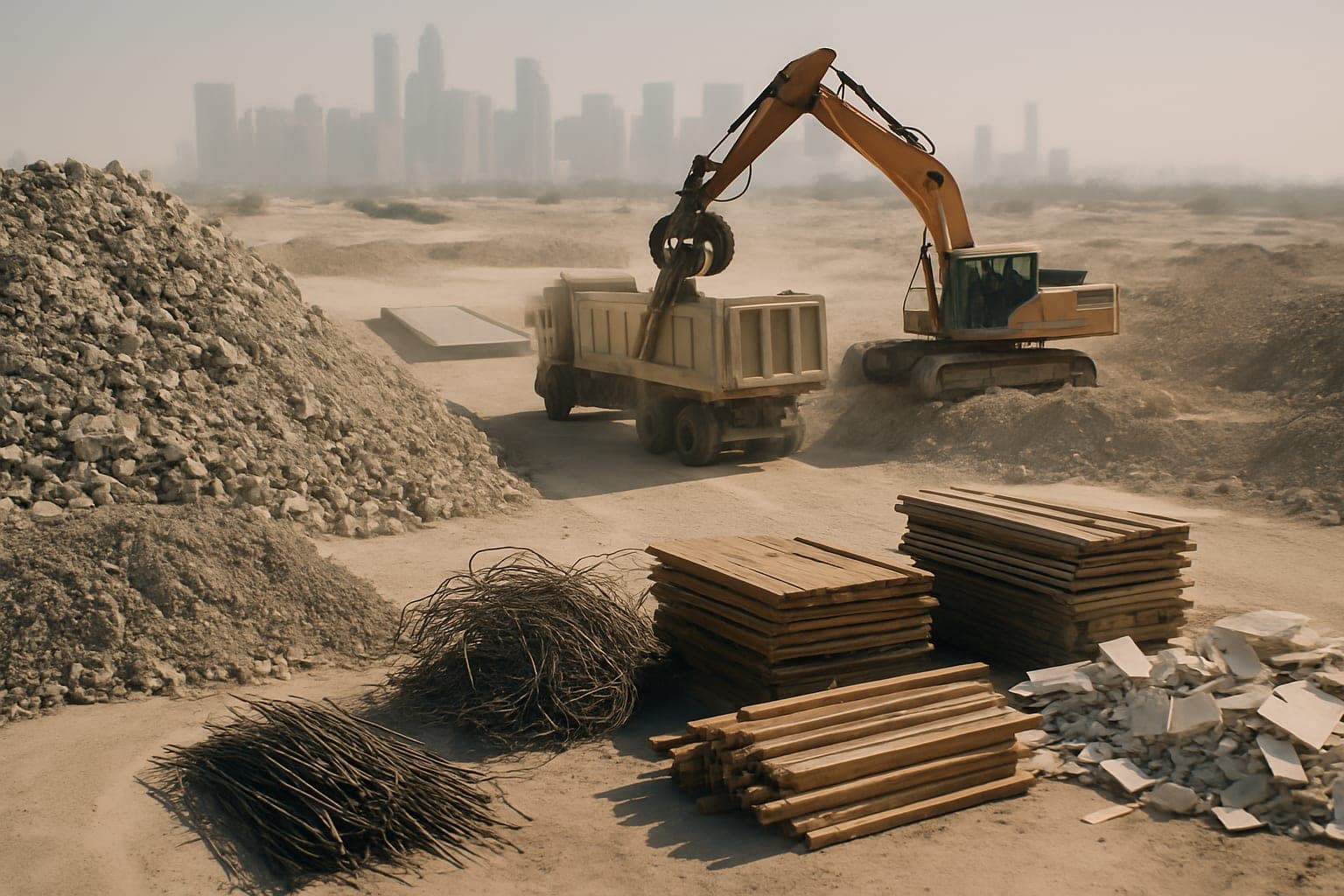
Abu Dhabi ties demolition and construction NOCs to documented waste management, not to a headline diversion percentage. Since 29 May 2024 the Environment Agency, not Tadweer or the municipality, issues them. Your file needs a Construction and Demolition Waste Management Plan, licensed haulers, stamped receiving facility receipts and manifest weights that reconcile across the construction, demolition and commissioning phases.
Who issues the Abu Dhabi construction waste NOC now?
The Environment Agency Abu Dhabi. On 29 May 2024 the Abu Dhabi Media Office announced that EAD had expanded its licensing and permitting services into waste, and the permit categories that moved across explicitly included waste export outside the emirate and construction and demolition NOCs. EAD also took over licensing of environmental service providers in waste collection and transport, waste trading and waste treatment, plus inspection and violation tasks covering service providers, waste generators and illegal dumping.
That one change breaks most of the guidance circulating online. Consultancy pages, contractor blogs and even some government adjacent material still tell you to apply to Tadweer or to the municipality. The emirate's own Standard Operating Procedure for Management of Construction and Demolition Waste, hosted on EAD's document library and marked as the property of the Center of Waste Management, still reads that NOCs are obtained from the municipalities of the emirate. The document carries no visible revision date. Read it for the substance and the annexures, then apply through the current channel.
In practice that channel is TAMM, where the service "Request an NOC for Construction or Demolition Projects" now sits in EAD's namespace under service code TT-70 and is accessed with UAE PASS. A separate TAMM service covers small construction projects, which confirms a two tier split by project size. The threshold between the two is not something we will guess at. Check it against your gross floor area and scope before you assume the lighter route applies to your job.
The part contractors underestimate: transport is watched
EAD's remit includes continuous monitoring of waste routes from start point to final destination, GPS devices fitted to waste vehicles, tracking of vehicle movements at facilities and disposal sites, and identification of illegal dumping locations. A manifest that names a recycling facility while the vehicle trace says otherwise is now a detectable discrepancy rather than a theoretical one. Build your chain of custody on the assumption that someone can replay the route later.
What must the NOC file contain?
The named deliverable is the Construction and Demolition Waste Management Plan, the CDWMP. The SOP puts the duty on the general contractor, working with all subcontractors including specialist demolition subcontractors, to develop it before work starts, and states plainly that a project proponent must obtain a NOC before starting construction. Any new construction, demolition or infrastructure project is in scope. So is any new addition to an existing project.
- Projected arisings by stream. Tonnes of concrete and blockwork, rebar and structural steel, timber formwork, gypsum, mixed fines and any hazardous fraction, with the method you used to estimate each one.
- Contracted licensed haulers. The SOP splits duties between waste producers, transporters and recycling facilities, and transporters require a licence to collect and move waste. Keep licence numbers and expiry dates in the file, not in somebody's inbox.
- Receiving facility acceptance. Annexure 4 of the SOP sets waste acceptance criteria at Tadweer C&D facilities. It decides whether the loads you segregated on site are actually taken at the gate.
- Stamped manifests and weighbridge tickets. A 2019 study of Abu Dhabi practice found that only a certified hauler may move waste off site, documenting amounts by weight or volume through an online e-manifest, and that all records must be stamped by the receiving destination, landfill or recycler. That study named the system as Bolisaty, managed by Tadweer. Confirm with EAD whether it is still the operative route after the 2024 transfer before you design your reporting around it.
- Reconciliation. Plan tonnes against manifest tonnes, stream by stream, with a written variance note wherever the two diverge beyond your own tolerance.
The SOP also tiers projects. Annexure 5 is a CDWMP development guideline for Category A projects, which tells you other categories exist with different requirements. Certain asset classes, hotels and mosques among them, additionally follow Urban Planning Council requirements. Pull the PDF and read the annexures rather than trusting a template someone forwarded you three projects ago.
Which phases need evidence, and why does commissioning matter?
The SOP covers the construction, demolition and commissioning phases. Most files we see are strong in the middle and thin at both ends. Demolition arisings get weighed because they are large, dusty and impossible to ignore. Commissioning and fit out waste, meaning packaging, offcuts, plasterboard trim and surplus finishes generated after the structure is done, tends to leave site on somebody else's truck with nobody collecting the ticket.
That gap costs programme time, because the waste file is wired into the permit chain rather than sitting beside it. The SOP cross references Abu Dhabi Municipality's Building Completion Certificate and Building Demolition Certificate services. Missing tickets from the last six weeks of a job can hold the handover of a building that is otherwise finished and tenanted.
Which materials must be segregated at source?
| Stream | Why it leaves separately | Typical destination | Evidence line in the file |
|---|---|---|---|
| Concrete and blockwork | Only clean inert material crushes into saleable aggregate grades | Licensed C&D recycling facility | Weighbridge ticket per load, stamped, matched to crusher intake |
| Rebar and structural steel | Highest value per tonne on the site, and it cannot enter the crusher | Scrap yard or steel recycler | Sale record with weighbridge slip and buyer licence details |
| Timber formwork | Reuse first, then recovery, and it contaminates inert loads | Reuse on site, biomass or board recovery | Reuse log plus transfer note for anything leaving site |
| Gypsum and plasterboard | Sulfate bearing, routinely excluded from inert aggregate acceptance | Separate receiving route per Annexure 4 | Dedicated manifest, never merged with concrete loads |
| Mixed fines and sweepings | Residual fraction that sets your real diversion rate | Sorting or landfill, depending on contamination | Tonnage logged honestly, with a variance note |
Be realistic about site behaviour. The same 2019 research found that common practice in Abu Dhabi was to sort after collection in an area nominated by the project consultant, with segregation at source chosen mainly when there was not enough space for a central sorting area. The paperwork assumes a discipline many sites do not have. That mismatch, not malice, is why manifests fail to reconcile.
How much material does a mid rise demolition produce?
Estimate it from the structure, not from a benchmark you found online. Take gross floor area, apply an arisings factor per square metre drawn from your own completed jobs, then sense check the concrete tonnage against volume from the structural drawings at roughly 2.4 tonnes per cubic metre of reinforced concrete, with rebar content commonly quoted in the 80 to 120 kilogram per cubic metre range. Those coefficients are industry rules of thumb rather than UAE published figures, so label them as assumptions in the CDWMP and correct them after the first fortnight of weighbridge data.
For emirate scale context, Tadweer reported 1,915,724 tonnes of C&D waste recycled in 2020, described as 80 per cent of the total handled at its facilities, against roughly 2.4 million tonnes collected across the emirate that year, figures published in March 2021. The same reporting put recycled aggregate output at 11 million tonnes between 2016 and 2020. These are the most recent public numbers we could verify and they are now several years old, so treat them as order of magnitude rather than current performance.
Where does the money actually sit?
In five line items, and only one of them is revenue. Avoided gate fees on diverted inert tonnage. Avoided haulage, which improves when loads are clean, fully laden and never re-tipped. Revenue from rebar and structural steel, which tracks the Turkish import scrap index rather than local sentiment, so ask any buyer which index date their offer is built on. Recovered concrete, which for most contractors is a disposal saving rather than a profit line. Then the procurement flip, buying recycled aggregate back for subbase and fill.
We are not going to publish per tonne rates we cannot date. The public Abu Dhabi tariff record is old: a disposal fee of AED 225 per tonne for commercial, industrial and professional waste producers, capped at AED 50,000 and tied to business licence renewal under the Nadafa programme, which sits on Decree No. 24 of 2009, with reporting from that era describing a requirement to demonstrate a 20 per cent cut in waste volume. In January 2023 Khaleej Times reported that Tadweer was proposing a pay as you throw per tonne charge, quoting a municipality official that the fee would be per tonne, not per truck, subject to Executive Council approval. We have not been able to confirm its status since.
So get dated written quotes for five things before you price the job: gate fee by stream and contamination level, the charge for a rejected load, round trip haulage per 20 to 30 tonne tipper to the receiving facility, the scrap buying price with its index reference and validity window, and recycled aggregate delivered by grade against virgin gabbro. The rejected load charge is the number that makes source segregation pay, and almost nobody publishes it.
When a demolition throws off clean crushed concrete, heavy structural sections or bundled rebar that your own project cannot absorb, put it in front of buyers with the tickets attached. Listings on our construction category sit behind UAE PASS verified counterparties, escrow through MyFatoorah and a 48 hour inspection window, which means the sale record you file with the regulator is the same record the buyer accepted.
Do you have to buy recycled aggregate back?
Probably, and the exact percentage is where the public record gets messy. Reports in March 2021 attributed to an Abu Dhabi Executive Council decision a requirement for at least 40 per cent recycled materials in road and construction projects across the emirate's three regions, with one July 2021 account phrasing it as 40 per cent recycled material if available. Separately, MEED has reported a 10 per cent recycled aggregate requirement on government projects, on an undated page that reads older. Both figures are in circulation. Do not assume either one governs your contract until you have read the specification clause your employer actually issued, and pay attention to the availability qualifier, because that is the clause contractors lean on.
The supply side is real. Tadweer operates C&D recycling facilities in Abu Dhabi, Al Ain and Al Dhafra, producing four recycled aggregate sizes from 0 to 37.5 millimetres plus treated sand, with sand also used as landfill cover. Recycled material from that network has been cited in Etihad Rail, Khalifa Port, Abu Dhabi Airports, Sheikh Zayed Grand Mosque, Louvre Abu Dhabi, Saadiyat Island, the Ghweifat International Highway and ADNOC oil field works. The Ghayathi facility in Al Dhafra, near the Ruwais fields and the Saudi border, was commissioned in 2018 with a minimum production capacity of 31,000 tonnes a month and a throughput of 150 to 200 tonnes an hour, built to relieve Al Dhafra landfill which was then taking 60,000 to 70,000 tonnes a month of C&D waste.
How does Abu Dhabi differ from Dubai?
| Question | Abu Dhabi | Dubai |
|---|---|---|
| What the requirement attaches to | Documented waste management evidenced across construction, demolition and commissioning | A stated diversion percentage measured against site arisings |
| Who decides | Environment Agency Abu Dhabi, since 29 May 2024 | Dubai Municipality, covered in our separate briefing |
| Named plan document | CDWMP, prepared by the general contractor before works start | Waste management plan submitted under the municipality's diversion rule |
| Primary failure mode | Evidence gaps and unreconciled manifests | Missing the percentage, whatever the paperwork quality |
The practical consequence for a contractor running sites in both emirates is that one compliance process will not cover both. An Abu Dhabi file can be perfectly reconciled and still miss a diversion target, and a Dubai file can hit its percentage while lacking the phase by phase evidence Abu Dhabi expects. If you also build in Dubai, read our breakdown of the 50 per cent diversion rule and building completion alongside this one and keep the two checklists physically separate.
Which documentation failures hold up NOCs and handover?
- A hauler whose licence lapsed mid project, with nobody checking the expiry date until the file was assembled.
- Receipts that were never stamped by the receiving destination, which the SOP era guidance treats as the proof, not the truck driver's word.
- Manifest tonnes that do not reconcile against projected arisings, with no variance note explaining the gap.
- Loads rejected at the gate on acceptance criteria, then re-tipped somewhere else with no paper trail for the second journey.
- A phase gap, usually demolition documented in detail and commissioning waste undocumented entirely.
- Subcontractors self hauling small loads in unlicensed pickups because a skip was full on a Thursday.
- A declared destination that does not match the GPS trace of the vehicle that carried the load.
Does the same file earn Estidama credit?
Structurally, yes. Research into Abu Dhabi practice records that the Estidama team reviews and approves CDWMPs, and that Pearl Qualified Professionals are the people preparing them. We are not going to quote credit codes or diversion thresholds from the Pearl rating manuals without checking the current version, and neither should your consultant. The defensible point stands on its own: one evidence pack of licensed hauler contracts, stamped manifests, weighbridge tickets and a stream by stream reconciliation serves the NOC file, the Pearl submission and your corporate reporting at the same time.
That third use is growing. Waste tonnages and their destinations are exactly the data that feed value chain emissions reporting, and the same verified counterparty records that satisfy EAD will carry into Scope 3 disclosure under UAE climate law. Build the file once, digitally, with the weighbridge trail intact. Assembling it retrospectively from a folder of crumpled tickets is where projects lose weeks.
Frequently asked questions
Who issues the construction and demolition NOC in Abu Dhabi?
The Environment Agency Abu Dhabi. On 29 May 2024 the Abu Dhabi Media Office confirmed that construction and demolition NOCs were among the permit categories transferred to EAD, along with waste export permits and the licensing of waste collection, transport, trading and treatment providers. The service is requested through TAMM under code TT-70 using UAE PASS. Older guidance naming Tadweer or the municipality is out of date.
What documents are required for a demolition NOC in Abu Dhabi?
A Construction and Demolition Waste Management Plan prepared by the general contractor with all subcontractors before works start, projected arisings broken down by stream, contracts and licence details for the haulers moving the material, acceptance evidence from the receiving facility, and stamped manifests or weighbridge tickets reconciled against the plan. Evidence is expected across the construction, demolition and commissioning phases. Annexure 5 of the emirate's SOP sets out plan development for Category A projects.
Is recycled aggregate allowed on Abu Dhabi government projects?
It is more than allowed. Reports in March 2021 described an Abu Dhabi Executive Council decision requiring at least 40 per cent recycled material in road and construction projects across the emirate's three regions, with one account adding the qualifier if available, while MEED has separately reported a 10 per cent recycled aggregate requirement on government projects. Both figures circulate, so verify the specification clause in your own contract. Tadweer facilities supply four aggregate sizes from 0 to 37.5 millimetres plus treated sand.
How much does it cost to dispose of construction waste in Abu Dhabi?
We will not publish a current rate we cannot date. The verifiable public record is historic: a AED 225 per tonne disposal fee for commercial, industrial and professional waste producers, capped at AED 50,000 and linked to business licence renewal under the Nadafa programme built on Decree No. 24 of 2009. In January 2023 a pay as you throw per tonne charge was reported as a Tadweer proposal awaiting Executive Council approval, and we cannot confirm its status. Ask EAD or your receiving facility for a dated written tariff before you price the job.
Can a Dubai C&D compliance process be reused in Abu Dhabi?
No. Dubai works on a stated diversion percentage measured against site arisings, while Abu Dhabi conditions the NOC on documented waste management evidenced across construction, demolition and commissioning phases. A file that satisfies one can fail the other. Multi emirate contractors should run two checklists and keep the hauler licence and manifest requirements separate for each site.
Does EAD really track waste trucks?
Yes. EAD's expanded remit announced in May 2024 includes continuous monitoring of waste routes from start point to final destination, GPS devices on waste vehicles, tracking of movements at facilities and disposal sites, and identification of illegal dumping locations. That makes a mismatch between a declared destination and an actual route a detectable discrepancy. Treat chain of custody as something that can be replayed and audited after the fact.

Comments(0)
Sign in to join the conversation.