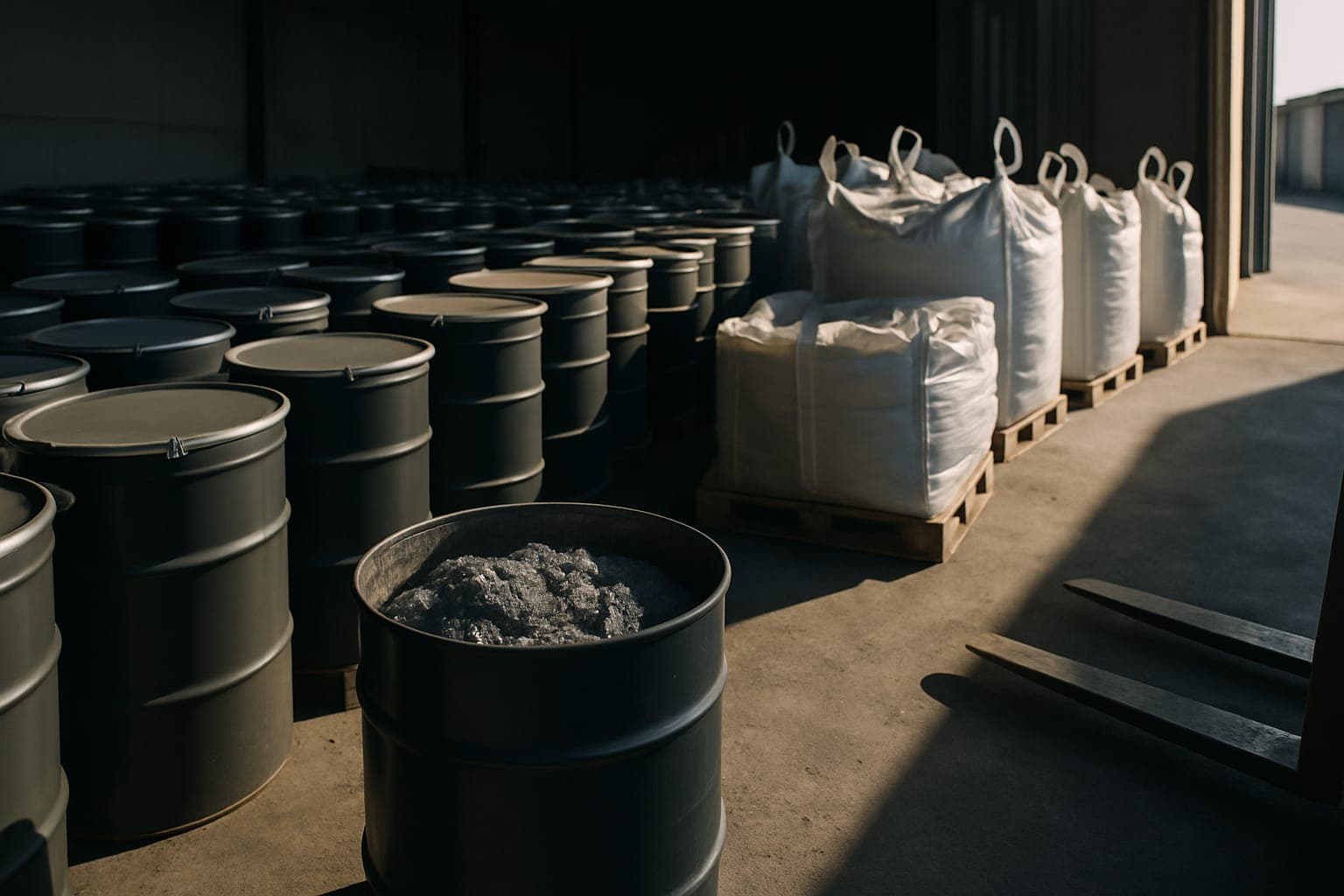
Aluminium dross sits on the UAE federal list of recyclable materials that must go to recycling factories, so it is a product, not a disposal problem. Local recovery plants pay on assayed metallic content rather than gross weight. Cool it under cover, keep white and black streams apart, sample before you offer it, and seal it in lidded drums or lined big bags.
Why does the UAE want your dross kept inside the country?
The UAE Policy for Integrated Management of Recyclable Materials names aluminium dross explicitly, alongside used tyres, electronic waste, plastic waste and used cooking oils, as material that should be sent to recycling factories. The same policy covers licensing of facilities that collect, manage, recycle and export recyclable materials. The UAE Government portal publishes the list without a date stamp, so if you need the Cabinet approval reference for an internal compliance file, request it from the Ministry of Climate Change and Environment rather than quoting a year you cannot source.
Underneath that sits Federal Law No. 12 of 2018 on Integrated Waste Management, which governs sorting, transport, storage, recycling, treatment and disposal, and puts the competent local authority in each emirate in charge of enforcement in its own area. The Executive Regulations, approved by Cabinet and detailed by MOCCAE in reporting dated 4 July 2021, carry the sentence that matters most to a foundry finance manager: the waste generator is responsible for proper disposal of what it generates and bears the financial cost. Every kilogram of dross you let oxidise is a kilogram you pay to move.
Is aluminium dross hazardous waste or a recyclable?
It is both, depending on its condition, and that is the whole commercial argument for handling it properly. Under the Basel Convention, aluminium skim and dross excluding salt appears as entry B1100. A Kaiser Aluminum safety data sheet dated 1 April 2021 spells out the catch: wastes that exhibit an Annex III characteristic must be managed as hazardous and moved under Amber control procedures, and aluminium skim and dross meets characteristic H4.3, emitting flammable gases on contact with water.
Other jurisdictions have gone further. China classifies secondary aluminium dross as hazardous waste under HW48, citing heavy metals, fluorides and reactive phases such as aluminium nitride, per a review published in MDPI's Processes on 10 April 2026. EU rules assign aluminium-rich by-products hazard property codes HP10 to HP13 for their ability to generate flammable gases and form explosive mixtures with air, per MDPI's Applied Sciences, 28 February 2025. Neither is UAE law. Both tell you how a receiving plant, an insurer and a transport permit officer will look at a leaking drum.
The one yard practice that destroys value
Quenching hot skimmings with a hose. Wet dross reacts, gives off ammonia and flammable gas, can self-heat, and converts recoverable free metal into oxide that nobody pays for. If your yard team has been cooling dross with water because it clears the pan faster, that habit alone is the difference between a purchase order and a disposal invoice.
White dross, black dross or skimmings: what are you actually selling?
Processors do not buy "dross". They buy a defined stream with a known free-metal fraction and a known contaminant load. Mixing streams in the same skip pulls the whole load down to the value of its worst component, because the plant assays a composite sample.
| Stream | Typical origin | What drives the price | Main handling risk | Likely outcome if mixed or wet |
|---|---|---|---|---|
| White dross | Skimming from primary and clean secondary melts, extrusion billet furnaces, die casting holding pots | Highest free-metal fraction of the common streams, low salt | Oxidises fast while hot, reacts with water | Downgraded to black dross pricing |
| Black dross | Rotary or salt furnace operations, remelt of mixed scrap | Lower metal fraction, salt and oxide content set the deduction | Soluble salts, dust, gas generation when damp | Quoted as treatment feed or refused |
| Salt cake | Salt flux furnace residue after metal recovery | Rarely a purchase stream, treated as a processing residue | Leachable salts, gas on contact with moisture | Disposal route with a gate fee |
| Floor sweepings and pan scrapings | Casthouse floor, spill pans, refractory changeouts | Refractory and sand dilution decide everything | Sharp debris, unknown composite | Contaminates any good load it enters |
Standard recovery is not simply remelting. The plant crushes the dross, separates aluminium-rich from oxide-rich particles by density, then melts the metal-rich fraction to drive off remaining oxide. That separation step is precisely why a processor samples and assays before committing to a number, and why gross weight tells them nothing.
How do you cool, seal and sample dross so it holds its value?
- Skim into a dedicated steel pan or dross press, never into a mixed scrap bin.
- Press or compact hot skimmings if you have the equipment, then let the puck cool under a hood. Compaction squeezes free metal back into the furnace and reduces the surface area available to oxidise.
- Cool by air, under cover, on a dry concrete pad. No water, no rain exposure, no washdown near the cooling area.
- Give each stream its own labelled container. White in one, black in another, sweepings in a third.
- Let the material reach ambient temperature before it goes into a sealed container. Warm material inside a closed drum builds pressure and moisture.
- Take a representative sample when the batch closes, not from the top of the drum. Multiple increments across the batch, combined, quartered down, split into two bags. One goes to the processor, one stays with you as an umpire sample.
- Log date, furnace, alloy family and batch weight against the sample number. A processor who can trace your samples will quote faster and re-quote with less argument.
- Pack into steel drums with clamp-ring lids, or UV-stable big bags with an inner liner, on pallets, wrapped. Keep unit weights consistent so the buyer can plan a truck.
- Store indoors or under a solid roof with the pallets off the slab. Sharjah and Dubai humidity does the same damage as a hose, only slower.
- Move the material on a documented transport arrangement with the emirate authority that licenses your site, and keep the manifest with the weighbridge ticket and the assay.
If you already run a disciplined segregation programme on other streams, this is the same logic applied to a reactive material. We see the same pattern with cable, where the prep work rather than the metal price decides the payout, as covered in our guide on stripping copper cable before you sell it.
How do processors price dross, and why will nobody quote per gross tonne?
Because two drums of identical weight can hold very different amounts of recoverable aluminium. The commercial mechanic used across the industry is a percentage of the metal price applied to assayed recoverable content, minus a treatment charge and minus deductions for moisture, salt and refractory. That is how the global trade works. We could not verify a published UAE-specific formula or an AED per tonne buy rate for white or black dross as of August 2026, so treat any number you are quoted verbally as that plant's offer on that day, get it in writing against a stated assay basis, and compare at least two.
What you can do is control the variables the formula punishes. Moisture, salt carryover, refractory dilution and mixed streams are all yours to fix in the casthouse. The metal price is not.
If a buyer offers you a flat rate per gross tonne with no sample, they are pricing their own downside risk into your load. That is a disposal quote wearing a purchase quote's clothes.
Can you still export aluminium dross from the UAE?
Assume the answer is no until you have checked, and budget for a domestic buyer. The Ministry of Foreign Trade issued Ministerial Decision No. 105 of 2026, introducing a four-month temporary export ban on certain industrial wastes and scrap metals, including aluminium scrap under several HS 7602 codes. It took effect seven working days after issuance, with an exemption route for shipments under previously signed international contracts. Reporting by IndexBox dated 26 June 2026 quoted Mir Mujtaba, president of the Dubai-based Bureau of Middle East Recycling, describing the restrictions as negative for scrap recyclers and traders, coming as Strait of Hormuz traffic and export flows were restarting, and suggesting the measure followed pressure from local smelters seeking to retain feedstock.
Two caveats you must resolve before you book a container. First, the timing. A four-month measure notified around mid-2026 lapses in the autumn unless extended, and the earlier ferrous rounds were extended repeatedly, from the first four-month ban in May 2020 through the 21 March to 21 September 2023 period and on to 19 December 2023 per Dubai Customs. Second, and more technical, aluminium dross, skimmings, slag and ash containing mainly aluminium are conventionally classified under HS 2620.40, while the 2026 decision is reported against HS 7602 aluminium waste and scrap. Whether your dross falls inside the annex is a question for the decision's own text and your customs broker, not for a blog. Note also that the old AED 100 per tonne export fee on aluminium scrap, which SMM reported as the previous regime, is history rather than a live cost line.
Even if the decree does not capture dross, Basel Amber controls do, because of the H4.3 characteristic. Amber means prior notification and consent, which is slower and more expensive than selling to a licensed plant inside the country. Domestic pull is also strengthening, as we discussed in our piece on EGA's Al Taweelah recycling capacity and its effect on UAE aluminium scrap supply.
Who buys dross in the UAE, and what should you ask them?
The aluminium cluster around KEZAD in Abu Dhabi was built to host downstream and recovery operations, and dross recycling was named among the activities attracted there when the zone was still branded KIZAD. That reference is old, well before the KEZAD rebrand and before Dubal and Emal became Emirates Global Aluminium, so verify current operating status directly rather than relying on any published list, including this one. Ask any prospective buyer four things:
- Which authority licenses you to receive and treat aluminium dross, and can I see the permit number?
- Do you assay on site, and will you accept an umpire sample if we disagree?
- What is your treatment charge and what deductions apply for moisture, salt and refractory?
- Who holds the transport permit and who signs the manifest at collection?
Listings on our metals marketplace put a KYC-verified counterparty on the other side of that conversation, with payment held in escrow through MyFatoorah and a 48-hour inspection window so a disputed assay does not become a disputed payment. If your finance team is also working through how scrap purchases sit in your returns, our note on the scrap metal VAT reverse charge covers the cash flow side.
What to put in the listing
Give buyers the four data points that let them price without a site visit: stream type, batch weight, cooling and storage method, and your latest assay with its date. Add the emirate, the packaging format, the number of pallets and whether a 20-foot or curtain-side truck can reach your loading bay. Sellers who publish an assay get firm offers. Sellers who publish "aluminium dross, good quantity" get inspection requests and low anchors.
Frequently asked questions
Is aluminium dross classified as hazardous waste in the UAE?
Aluminium dross is named on the UAE Policy for Integrated Management of Recyclable Materials as a material that should go to recycling factories, so it is treated as a recyclable stream rather than pure waste. That said, it carries the Basel H4.3 characteristic of emitting flammable gases on contact with water, which is why storage, transport and permitting are handled with hazardous-material discipline. Your emirate-level authority sets the specific manifest and transporter requirements under Federal Law No. 12 of 2018.
Why will processors not quote a price per gross tonne of dross?
Because payment is based on recoverable metallic content, and two loads of the same weight can differ enormously in free metal, salt, moisture and refractory dilution. Plants crush and density-separate the material before melting the metal-rich fraction, so they sample and assay first, then apply a treatment charge and deductions. A flat gross-tonne offer made without a sample usually prices the buyer's risk into your load.
Can I export aluminium dross from the UAE right now?
Check before you commit. Ministerial Decision No. 105 of 2026 imposed a four-month temporary export ban on certain industrial wastes and scrap metals including aluminium scrap under several HS 7602 codes, effective seven working days after issuance, with exemptions for shipments under previously signed contracts. Dross is conventionally classified under HS 2620.40 rather than 7602, so confirm the decision's annex with your customs broker, and remember Basel Amber controls apply regardless.
What is the difference between white dross and black dross?
White dross comes from skimming primary and clean secondary melts and carries the higher free-metal fraction with little salt, which makes it the more valuable stream. Black dross arises from rotary or salt furnace operations, holds more oxide and soluble salts, and is often priced as treatment feed rather than a purchase. Mixing them in one container drags the composite assay down to black dross economics.
How should aluminium dross be packaged for collection?
Cool it by air under cover on a dry pad, never with water, and only seal it once it reaches ambient temperature. Pack into steel drums with clamp-ring lids or lined big bags on wrapped pallets, keep unit weights consistent, and store under a solid roof off the slab. Label each container with stream type, batch number and date so the assay can be traced back.
Does compacting dross at the furnace actually pay?
Pressing hot skimmings squeezes free metal back into the furnace and shrinks the exposed surface that oxidises during cooling, so you keep metal you would otherwise sell at a discount. It also produces a denser, more consistent product that is easier to sample and easier to load. The trade-off is capital cost and an extra step in the casthouse routine.

Comments(0)
Sign in to join the conversation.