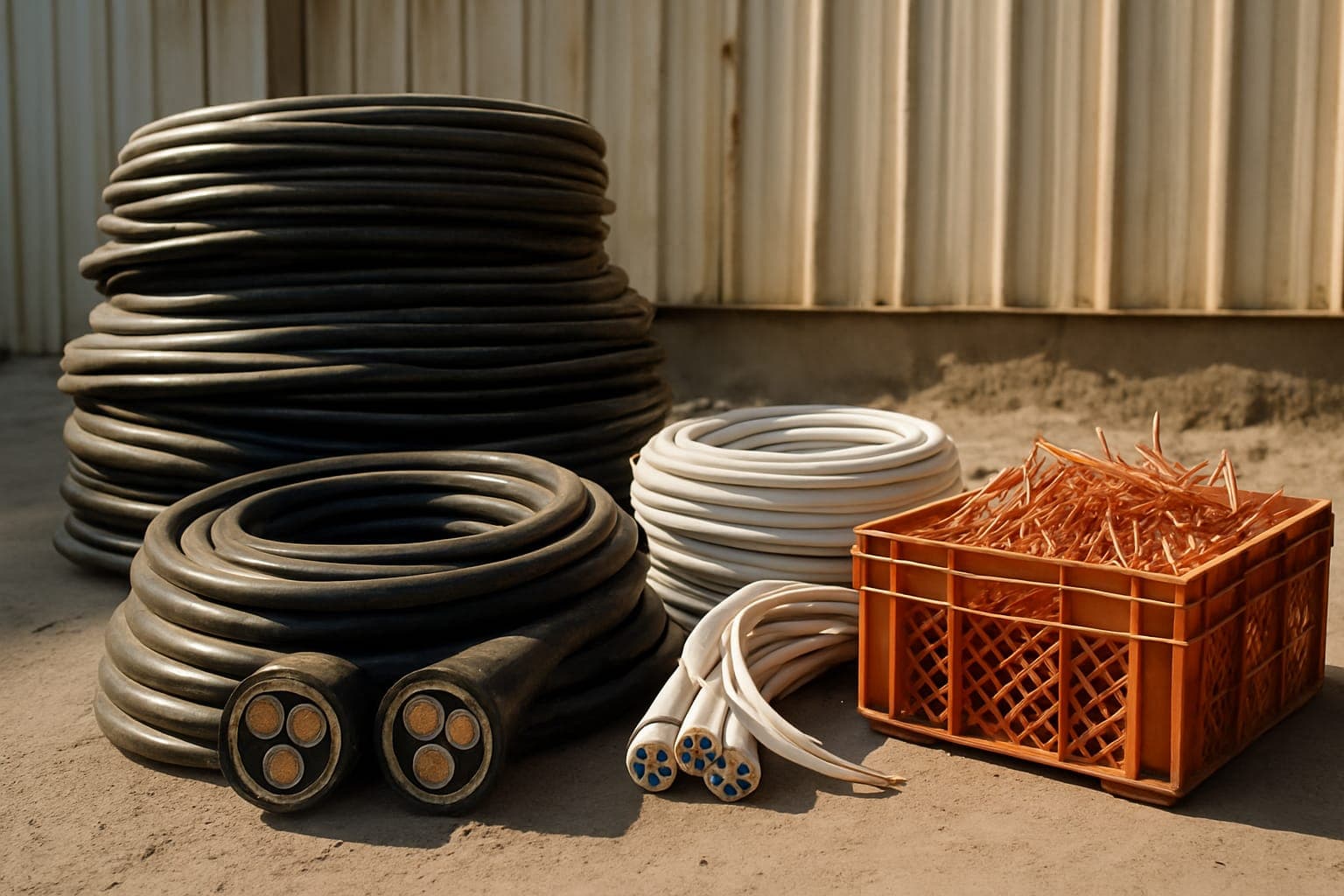
Bare bright copper trades in the UAE at roughly AED 25 to 40 per kg in 2026, against AED 8 to 14 for insulated cable, but that gap only becomes profit if your cable carries more than about 45% recoverable copper by weight. Below that, stripping destroys value once labour is counted. Grade the cable first, weigh it, then decide.
What is the copper scrap price per kg in the UAE right now?
Start with the benchmark, because every honest yard works back from it. LME copper closed at US$14,290 per tonne on 10 August 2026 (MacroMicro), after touching a record US$14,455 on 6 August (IndexBox, citing CNBC, around 12 August 2026). The metal first crossed US$14,000 in May 2026. At the pegged rate of 3.6725, US$14,290 per tonne is AED 52.48 per kg of cathode. That is your ceiling. Nothing you sell as scrap will beat it.
Now the local numbers, and a warning. There is no government or exchange index for UAE scrap copper. Every AED figure below is a buying rate published by a scrap dealer with a commercial interest in the number, so read them as trade-marketing ranges, not verified market data.
| Grade as published | AED/kg | Source and date | Share of cathode value |
|---|---|---|---|
| Bare bright copper wire | 35 to 40 | Green Metal Recycle UAE, 16 Feb 2026 | 67% to 76% |
| Copper, stripped wire | 26 to 47 | Raseen, published 18 Jul 2026 for April 2026 rates | 50% to 90% |
| Bare bright copper | 25 to 32 | Al Kasir Scrap, 3 Jul 2026 | 48% to 61% |
| Clean bare bright, top of range | 18 to 26 | dubaiwaste.com estimator, 3 Apr 2026 | 34% to 50% |
| Insulated copper wire | 20 to 30 | Green Metal Recycle UAE, 16 Feb 2026 | 38% to 57% |
| Insulated / insulation-covered wire | 8 to 14 | dubaiwaste.com, 3 Apr 2026 | 15% to 27% |
| Copper, insulated wire | 8 to 12 | Raseen, April 2026 rates | 15% to 23% |
Two things jump out. First, AED 26 for bare bright is only 50% of cathode value at a record LME, and it sits at the bottom of every UAE range we found. Treat AED 26 as a floor, not a target. Second, "insulated wire" is quoted at AED 8 to 12 by one dealer and AED 20 to 30 by another in the same year. Both cannot be describing the same material. The explanation is that insulated cable is not one grade, it is a family of grades separated by recovery percentage, and the price follows the copper inside, not the label on the invoice. The same benchmark-plus-discount logic governs ferrous grades, as we set out in our note on UAE HMS 80:20 pricing.
One more correction while we are here. A widely copied line says stripping earns "up to 35% more per kg". That figure contradicts the same page's own published ranges, which imply 85% to 125% more per kg of bare metal before any yield loss. Do not price off it.
How much copper is actually inside your cable?
This is the number that decides your margin, more than the headline copper price does. The best available yield data is from UK processors, and grade names differ from the labels used in Musaffah or Al Quoz, but the metallurgy travels. Reported recovery bands (Cable Wire Recycling, around July 2026):
- Dry bright wire, 99% and above. Clean single conductor, thin insulation, almost all metal.
- High grade "60%" cable, roughly 55% to 65%. Larger conductors, moderate sheathing.
- Household cable, roughly 40% to 50%. Twin and earth, flex, appliance leads.
- Low grade armoured, around 25% to 40%. Steel wire armour and thick sheath add weight and no copper.
Corroborating detail matters here. A standard 2.5mm twin and earth PVC cable may hold only 35% to 45% copper by weight (Global Ardour, 16 June 2026), and fine or light cable can fall to 30% to 50%, at which point one UK processor states plainly that "stripping light cable is rarely economical" (NM Recycling, 10 March 2026). A metre of 1.5mm twin and earth and a metre of 95mm single core armoured are different products in every way that matters to your weighbridge ticket.
When does stripping pay, and when does it burn money?
Run the arithmetic before you run the machine. The table below values one kilogram of as-found cable at bare bright AED 26 per kg after recovery, against insulated bids of AED 12 and AED 8. These are our calculations from the sourced rates above, and they exclude labour, power and fluff disposal.
| Recovery yield | Value of 1 kg cable once stripped | Uplift vs AED 12/kg bid | Uplift vs AED 8/kg bid |
|---|---|---|---|
| 30%, low grade armoured | AED 7.80 | minus AED 4.20 | minus AED 0.20 |
| 40%, light household | AED 10.40 | minus AED 1.60 | plus AED 2.40 |
| 45%, 2.5mm twin and earth | AED 11.70 | minus AED 0.30 | plus AED 3.70 |
| 55% to 65%, high grade | AED 14.30 to 16.90 | plus AED 2.30 to 4.90 | plus AED 6.30 to 8.90 |
| 95% and above, dry bright | AED 24.70 | plus AED 12.70 | plus AED 16.70 |
Break-even against a AED 12 per kg insulated bid lands at roughly 46% recovery, before you pay anyone to do the work. Against a weak AED 8 bid, break-even drops to about 31%, which is why the same drum of armoured cable is worth stripping in one week and not the next. If your insulated bid is already AED 20 to 30, as one Dubai dealer published in February 2026, stripping only makes sense on the dry bright fraction. Sort by grade family at the tip of the pile, not after it is all in one skip.
Granulator or manual stripping: what does the capital look like?
We could not source UAE landed cost, customs, installation, three-phase power tariffs or hourly labour rates for stripping crews, so what follows is a labelled model with stated assumptions, not a market quote. Machine prices found in listings, all undated and indicative: a used QJF-600 granulation plant at €25,000 net, ex works, excluding shipping and installation, rated 53 kW and 150 to 200 kg/h on dry cable only, with up to 98.7% copper recovery claimed; benchtop units of 50 to 90 kg/h at US$8,700 to 9,500; mid-sized lines of 300 to 700 kg/h in a US$20,000 to 40,000 band; a complete industrial recovery system at US$57,000; and one Chinese manufacturer offering twelve models from US$2,998 to US$55,319 at 20 to 1,800 kg/h.
Model it on gross uplift per tonne. One tonne of 60% recovery cable sold insulated at AED 12 per kg returns AED 12,000. Stripped, it yields 600 kg of bare bright: AED 15,600 at AED 26 per kg, or AED 19,200 at AED 32. So the gross uplift is AED 3,600 to 7,200 per tonne of that specific grade. A US$30,000 mid-sized line is about AED 110,000 at the peg, so you need roughly 15 to 31 tonnes of 60% cable through it just to cover the metal, ignoring power, labour, wear parts and residue disposal. At 150 to 200 kg/h, one eight-hour shift processes 1.2 to 1.6 tonnes of input. Manual stripping stays the right answer for irregular volumes, thick single core and anything under a tonne a month.
The residue question you must answer before you buy
Granulation does not make the insulation disappear, it turns it into PVC or XLPE fluff, and older cable can carry lead-stabilised PVC. We were unable to verify how UAE authorities classify that residue, so confirm the current position with MOCCAE and your local municipality, Tadweer in Abu Dhabi or Bee'ah in Sharjah, in writing, before you commit capital. A machine that pays back in 20 tonnes stops paying back if the fluff has to go out as regulated waste with a manifest for every load. Digital load documentation is already the direction of travel, as we covered in Dubai's move to digital waste transfer notes.
What deductions will the yard take off your weight?
Assume three, and price for them. UAE buyers say they build a quote from the daily LME close in USD per tonne, convert to AED per kg, then adjust for grade and cleanliness, moisture and contamination, and load size, with bigger loads carrying a smaller per-kg logistics deduction (Al Kasir Scrap, 3 July 2026). UK yards describe buying at 20% to 50% below LME spot to cover grading, stripping, granulation, transport and margin, which is a useful structural analogy even though the percentages are not local.
- Moisture. Cable pulled from a flooded basement or hosed down on a demolition site in Ras Al Khor weighs more and pays less. Let it dry under cover, on pallets, before it goes on the weighbridge.
- Attachments. Steel wire armour, lead sheath, plugs, glands, junction boxes, tape and the timber drum are all weight without copper. Cut them off and weigh them separately, or accept a blanket deduction set by someone else.
- Load size. Quantities above one tonne may qualify for preferential pricing (dubaiwaste.com, 3 April 2026), loads of five tonnes and above are said to attract premium pricing, and small loads may carry a collection fee (Raseen, July 2026). Consolidate across sites in SAIF Zone, Al Sajaa or Dubai Industrial City before you call anyone.
How do you publish a lot so buyers bid on spec rather than sight?
A competent buyer does not need you to strip anything. They need to know the recovery percentage they are buying. One UK yard says it outright: bring the cable as it is and it gets graded on site. The problem is that on-site grading is the buyer's judgement, applied to your metal, with no second opinion. Declare the spec yourself and you shift that argument to before the truck moves.
- Split the pile into grade families. Dry bright, high grade at 55% to 65%, household at 40% to 50%, armoured at 25% to 40%. Four lots beat one mixed lot every time.
- Weigh each family net. Record tare of drums, pallets and cages. Put the weighbridge ticket or calibrated scale reading in the listing.
- State the recovery basis you are claiming and how you got it. Cut a one-metre sample from each family, strip it, weigh conductor against total, and publish that ratio. It takes twenty minutes and it is the most persuasive number you own.
- Photograph cut ends and cross sections not the top of the heap. Conductor diameter and insulation thickness are visible in a cut end and invisible in a wide shot.
- Disclose attachments, moisture and storage including whether the lot is indoors, and quote the LME date you priced against.
- Set the commercial terms. Collection point, loading responsibility, minimum lot, and a price mechanism tied to a stated LME date rather than a fixed number that goes stale in a week.
- Keep the provenance file. Work order, demolition permit, asset disposal note. Bare copper is anonymous once it leaves the reel, and serious buyers ask where it came from.
On AlKhiidma, counterparties are KYC-verified through UAE PASS, payment sits in escrow with MyFatoorah until release, and the buyer has a 48-hour inspection window after delivery. That combination is what makes a declared recovery percentage worth publishing: if the lot arrives at 42% when you claimed 60%, the buyer has recourse, which is precisely why the honest seller gets the better bid. Post the graded lots in the metals category and let the yards compete on your spec sheet instead of their eyeball.
One last framing point on the market itself. Copper's 2026 move is being attributed to constrained supply, grid investment, US tariff uncertainty and electrification demand, with data centre and power grid load tied to AI expansion named as the main driver. Futures slipped to around US$6.55 per pound in mid-August as high prices cooled Chinese buying (Trading Economics, around 11 August 2026). If you are still forecasting your scrap rate off global GDP headlines, you are using a model the market stopped following. Price off the LME date, in writing, every time. More trading playbooks sit in our guides section.
Frequently asked questions
What is the copper scrap price per kg in the UAE in August 2026?
UAE dealers published bare bright copper buying rates between AED 25 and AED 40 per kg during the first half of 2026, and insulated cable between AED 8 and AED 30 per kg depending on grade. For reference, LME cathode closed at US$14,290 per tonne on 10 August 2026, which is AED 52.48 per kg at the peg. There is no official UAE scrap index, so always confirm a quote against the LME date it was priced on.
Is it always worth stripping copper cable before selling?
No. Against an insulated bid of AED 12 per kg and bare bright at AED 26 per kg, stripping breaks even at about 46% recovery before any labour cost. Low grade armoured cable at 25% to 40% copper by weight usually loses money when stripped, while dry bright wire at 99% recovery almost always gains.
How much copper is in armoured cable compared to twin and earth?
Low grade armoured cable typically recovers 25% to 40% copper by weight because steel wire armour and thick sheathing add mass without metal, while household twin and earth and flex recover roughly 40% to 50%. A 2.5mm twin and earth PVC cable may hold only 35% to 45% copper. These bands come from UK processors reporting in 2026, so cut and weigh a one-metre sample of your own cable to confirm.
Why do UAE yards quote so far below the LME copper price?
Buyers work back from the daily LME close, then deduct for grade and cleanliness, moisture and contamination, and load size, since collection, sorting and export processing all cost money. UK yards describe buying 20% to 50% below spot on the same logic. Loads above one tonne often attract better rates, and small loads can carry a collection fee.
Does a granulator pay for itself in a UAE yard?
On our model, one tonne of 60% recovery cable gains AED 3,600 to 7,200 gross when stripped rather than sold insulated at AED 12 per kg. A mid-sized line at around US$30,000, roughly AED 110,000 at the peg, therefore needs 15 to 31 tonnes of that grade just to cover the metal uplift, excluding power, labour and residue disposal. Confirm how PVC and XLPE fluff is classified with MOCCAE and your municipality before you commit.

Comments(0)
Sign in to join the conversation.