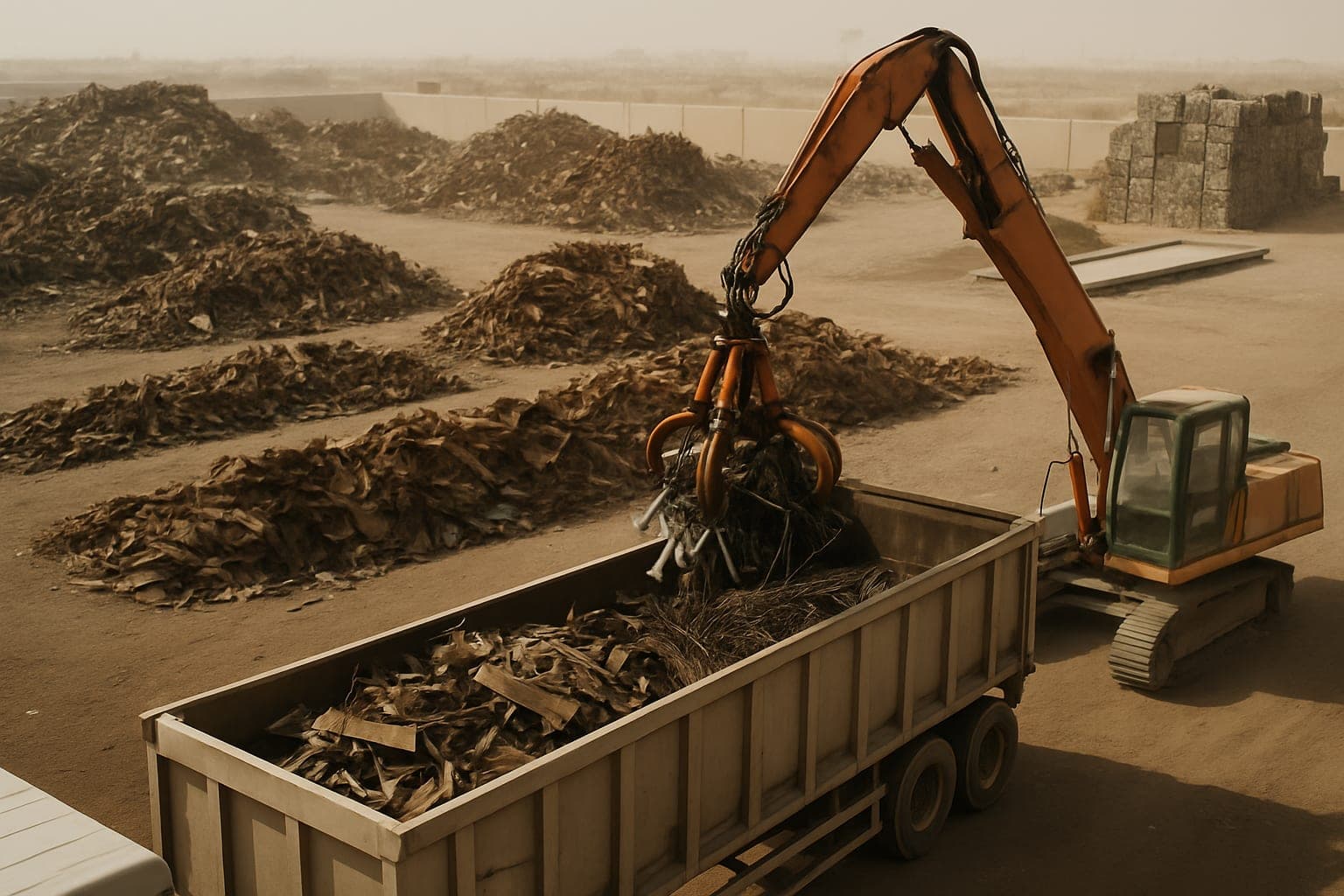
UAE HMS 80:20 processed scrap last printed at AED 990 to 1,020 per tonne DAP, excluding 5% VAT on one week payment terms, for the week ending 12 June 2026, with delivered Abu Dhabi material assessed near AED 1,027. That print landed two days after Dubai closed scrap exports under Customs Notice No. 13/2026, so arbitrage maths built before 10 June 2026 no longer holds.
What is the UAE HMS 80:20 scrap price right now?
Be honest about the vintage of the number you are quoting. The most recent UAE figures we could verify are for the week ending 12 June 2026, and they came through a re-publication of a subscription market report rather than the primary assessment, so treat them as indicative. On that week the market was up roughly AED 25 per tonne week on week, attributed to firmer regional sentiment and supply chain disruption. Direction of travel was up, not flat.
| Grade | Price (AED/tonne) | Basis | Week ending |
|---|---|---|---|
| HMS 80:20 processed | 990 to 1,020 | DAP, excl. 5% VAT, 1 week payment | 12 Jun 2026 |
| HMS 80:20 processed | ~1,027 | Delivered Abu Dhabi | 12 Jun 2026 |
| HMS Super (90:10) | 950 to 980 | DAP | 12 Jun 2026 |
| LMS (light melting) | 740 to 750 | DAP | 12 Jun 2026 |
| PNS processed / mill yard | 1,050 to 1,070 | DAP | 12 Jun 2026 |
Now the longer arc, because it changes how you should read the word "holding". Kallanish assessed HMS 1&2 80:20 delivered at AED 1,270 to 1,280 per tonne on 22 May 2024, and AED 1,225 per tonne delivered buyer's yard, excluding VAT, in the week commencing 27 January 2024. Two years later the same grade sits close to AED 1,000. That is a fall of roughly a fifth. AED 1,000 is not a plateau anyone chose, it is the floor a long slide arrived at.
Can you still export ferrous scrap from Dubai after June 2026?
Not through Dubai, not for the listed codes, not without an exemption. Dubai Customs issued Notice No. 13/2026 under Cabinet Resolution No. 105 of 2026 and directives from the Ministry of Foreign Trade, banning export of the covered scrap codes from 10 June 2026 to 8 October 2026. The notice auto renews unless a cancelling notice is published. Anyone booking Q4 export contracts on the assumption that 8 October is a hard expiry is carrying unhedged regulatory risk.
The ferrous codes covered are 72041000, 72042100, 72042900, 72043000, 72044100 and 72044900, which take in cast iron scrap, stainless scrap, other alloy steel scrap, tinned scrap, turnings, shavings, chips, filings, trimmings and stampings, other ferrous waste and scrap, and remelting scrap ingots. Copper scrap under 74040000 and aluminium scrap under 76020000 are also covered. Exemptions are requested through the Ministry of Foreign Trade platform, and reporting from late June 2026 indicated pre-ban contracts and public interest cases were the intended route, though we have not seen the exemption criteria in the notice text itself. Penalties fall under the Unified Customs Law.
Mir Mujtaba, president of the Dubai based Bureau of Middle East Recycling, told Recycling International on 26 June 2026 that the measure is damaging for recyclers and traders, coming just as the Strait of Hormuz was reopening and export flows were restarting, and he attributed it to pressure from local smelters looking to hold onto feedstock. Whatever your view of the policy, the operational reading is simple. Jebel Ali is not an option for HS 7204 tonnage right now, and your only bid is the domestic one.
Why is CIF Turkey the wrong reference for UAE tonnage?
Because the correlation is not weak, it is negative. Fastmarkets published an analysis on 11 December 2025 comparing its Saudi domestic index with the cfr Turkey import index across the first 19 weeks of assessments, from 5 August to 2 December 2025. The correlation came out at minus 73.4%. The R squared was 20.6% over the first 14 weeks and 53.9% over 19 weeks. For contrast, Turkey's own domestic auto bundle price correlated at plus 83% with the cfr Turkey import number.
That study is Saudi, not Emirati, and we will not present it as a UAE finding. The logic still travels. Gulf domestic tonnage is priced by local mill appetite, local collection volumes and local freight, and Turkey is a sentiment input rather than a formula. If your tender documents still contain a clause pegging price to a percentage of cfr Turkey, that clause is doing something you probably did not intend.
Which index specification applies to you?
The UAE HMS 80:20 delivered index launched in October 2023 and the shredded index followed on 22 April 2025, so neither is new. What did change is the basis. On 10 February 2026 both UAE indices were respecified to delivered consumer Abu Dhabi, on the stated grounds that the great majority of domestically consumed tonnage goes to Abu Dhabi based steelmakers, with a much smaller volume consumed in Sharjah. Fastmarkets specifically cited major road closures during 2025 and 2026 inflating Sharjah to Abu Dhabi transport costs. If your contract still says "delivered UAE", you are quoting a specification that no longer exists, and the freight gap between a Sharjah yard and a Musaffah gate is exactly where that ambiguity costs you money.
How much does preparation change the price?
In the June 2026 window, LMS at AED 740 to 750 and PNS mill yard material at AED 1,050 to 1,070 sat about AED 300 apart. That is roughly 40% on sorting and preparation alone, before anyone argues about tonnage or payment terms. Demolition contractors who tip mixed ferrous into one pile are financing the sorting margin of whoever buys it.
Shear length is the second gate, and it decides which Gulf mill can even bid. Fastmarkets reported in July 2026 that all steelmakers in Riyadh and Al Kharj run induction furnaces requiring scrap sheared to around 0.6 m, while EAFs in the Eastern Province, the West and the South West accept HMS pieces exceeding 1 m because of larger bucket sizes. Cutting to a 2 to 3 ft by 1 ft spec and cutting to 1.0 to 1.5 m are two different sales strategies aimed at two different customers. Decide which one you are before the torches come out.
When do DAP terms beat an export offer?
For Dubai cleared HS 7204 material, the question is currently academic. For everything else, the comparison has to be run on landed net, not headline price. Work it in this order:
- Take the domestic bid on a delivered consumer Abu Dhabi basis and confirm whether 5% VAT and payment terms are inside or outside the number. One week payment on AED 1,000 is worth real money against 60 day export paper.
- Deduct inland freight from your yard. The Sharjah to Abu Dhabi leg has been inflated by road closures through 2025 and 2026, and that is a line item, not a rounding error.
- On any export comparison, deduct the federal export duty of AED 400 per tonne on ferrous codes 720410 through 720450, AED 400 per tonne on copper under 74040000, and AED 100 per tonne on aluminium under 76020000. These were announced in January 2024, replacing the earlier outright ban and a prior AED 250 per tonne tariff.
- Add port handling, container availability at Jebel Ali and demurrage exposure, then compare against the domestic net.
- Price the regulatory risk of a shipment that cannot clear. Under the current notice, that risk is not theoretical.
One correction worth making, because it is circulating on pages that rank for UAE scrap price searches. The export duty did not start in January 2025. It was announced in January 2024 and mills cut scrap purchase prices by about AED 75 per tonne week on week effective 27 January 2024 in direct response. We set out the arithmetic of that shift in our piece on how the UAE scrap export duty makes local metal sales pay better, and the same mechanism is at work now, only harder.
How should you time a tender on regional EAF demand?
Do not time it on UAE demand growth, because there is not much. UAE crude steel production was 3.7 million tonnes in 2024, down 1.4% year on year, described by Fastmarkets in April 2025 as stagnating. The growth is Saudi. Fastmarkets reported Saudi production up 12.9% in 2025, and June 2025 output alone at 913,000 tonnes, up 23.5% year on year, even though the first half was down 2% at 4.8 million tonnes.
So the domestic bid firmness you are seeing is supply restriction, not demand expansion. That has a practical consequence for tender timing. Restriction driven strength holds only while the restriction holds, and this one has a renewal date on it. If you are sitting on prepared HMS 80:20 and your yard cost is real, selling into a restricted domestic market is usually better than waiting for an export window that may not reopen on 8 October. If you are a fabricator or shipyard generating steady offcut volumes, index linking to the delivered Abu Dhabi assessment with a monthly reset protects you both ways.
The same read applies across non ferrous, where local consumption is expanding rather than merely captive. Emirates Global Aluminium has been ramping a 185,000 tonne per year recycling plant, and the pull from extruders chasing In-Country Value points is a separate demand story we cover in our note on aluminium scrap demand and ICV points.
What compliance still catches sellers out?
Misclassification. In May 2024 Kallanish reported that UAE authorities had assured the steel sector a customs crackdown on misclassified scrap exports was imminent, and noted industry scepticism given earlier verbal promises. With a live export ban attached to specific HS codes, the incentive to code creatively goes up and so does the exposure. Get the code right at the yard, not at the port.
On environmental permitting, scrap yard licensing and demolition waste segregation, requirements differ between Dubai Municipality, Tadweer in Abu Dhabi and Sharjah's authorities, and we are not going to publish specifics we have not verified against the issuing body. Check with the regulator for the emirate where the material is generated and the one where it is processed, because they are often not the same. If you want the counterparty side handled, verified buyers for prepared ferrous are listed on the metals marketplace, with KYC checks through UAE PASS, escrow settlement and a 48 hour inspection window on delivered loads.
Frequently asked questions
What is the current UAE HMS 80:20 scrap price per tonne?
The most recent figure we can verify is AED 990 to 1,020 per tonne DAP, excluding 5% VAT on one week payment terms, for the week ending 12 June 2026, with delivered Abu Dhabi material around AED 1,027. That was up roughly AED 25 per tonne week on week. Prices move weekly, so ask your buyer for a dated assessment rather than working from a published range.
Is ferrous scrap export from Dubai banned in 2026?
Yes. Dubai Customs Notice No. 13/2026, issued under Cabinet Resolution No. 105 of 2026, bans export of ferrous scrap codes 72041000, 72042100, 72042900, 72043000, 72044100 and 72044900, plus copper under 74040000 and aluminium under 76020000, from 10 June to 8 October 2026. The notice auto renews unless a cancelling notice is issued, so do not plan Q4 shipments around the October date.
How much is the UAE scrap export duty and when did it start?
It is AED 400 per tonne on ferrous scrap codes 720410 through 720450, AED 400 per tonne on copper scrap under 74040000, and AED 100 per tonne on aluminium scrap under 76020000. It was announced in January 2024, not 2025, replacing an earlier outright export ban and a prior AED 250 per tonne tariff. UAE mills cut scrap buying prices by around AED 75 per tonne in the week the duty took effect.
Should UAE scrap be priced off CIF Turkey?
No, not as a formula. A Fastmarkets analysis published on 11 December 2025 found the Saudi domestic index correlated at minus 73.4% with the cfr Turkey import index over 19 weeks of assessments, while Turkey's own domestic auto bundle price correlated at plus 83%. That study covers Saudi Arabia rather than the UAE, but it shows Gulf domestic tonnage responds to local mill appetite and freight, with Turkey acting as sentiment only.
Why does delivered Abu Dhabi matter in a scrap contract?
Since 10 February 2026 the UAE HMS 80:20 and shredded indices settle delivered consumer Abu Dhabi, because most domestically consumed tonnage goes to Abu Dhabi steelmakers and a much smaller volume to Sharjah. Road closures through 2025 and 2026 pushed up Sharjah to Abu Dhabi haulage costs. A contract still written on a generic delivered UAE basis leaves that freight difference unallocated.
What shear length do Gulf mills require?
Fastmarkets reported in July 2026 that steelmakers in Riyadh and Al Kharj operate induction furnaces needing scrap sheared to roughly 0.6 m, while EAFs in Saudi Arabia's Eastern Province, West and South West accept HMS pieces over 1 m thanks to larger charge buckets. Deciding your cut length before processing determines which mills can bid on the parcel at all.

Comments(0)
Sign in to join the conversation.