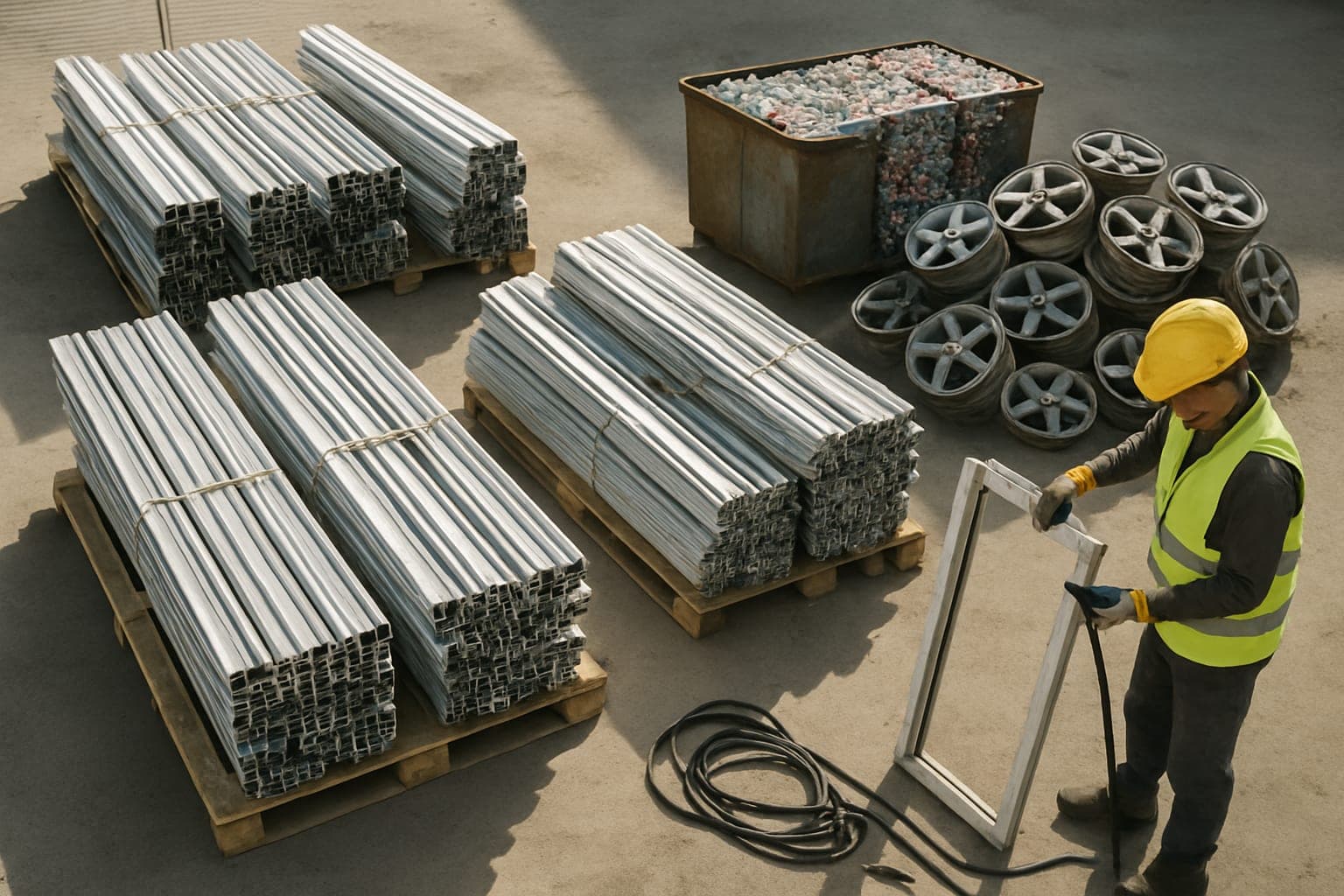
EGA's 185,000 tonne a year recycling plant at Al Taweelah opened in June 2026, making the group the UAE's largest buyer of aluminium scrap. Clean 6063 extrusion was fetching roughly AED 5 to 7 per kg from Dubai and Abu Dhabi yards in July 2026, against AED 2.8 for mixed cast. Grading is where the money sits.
Why are UAE remelters suddenly bidding harder for local scrap?
Three things changed at once. Emirates Global Aluminium inaugurated its recycling plant at Al Taweelah in Abu Dhabi in June 2026 with 185,000 tonnes a year of capacity, and reporting at the time described the project as ending the long-standing practice of shipping significant volumes of UAE-generated scrap overseas for processing. Gulf Business, on 24 June 2026, put it bluntly: EGA is now the country's largest consumer of aluminium scrap. That is a domestic offtake floor that did not exist two years ago.
The second change is less comfortable. EGA declared force majeure in April 2026 after its Abu Dhabi production centres were damaged, and The National reported on 24 June 2026 that repairs are expected to take up to a year. Final commissioning of the recycling plant itself was suspended after the 28 March attack on Khalifa Economic Zone Abu Dhabi, then resumed in April. Constrained primary output and a live remelt line pull in the same direction for anyone holding scrap: the metal is wanted here.
Third, the policy pressure is now measurable rather than aspirational. Operation 300bn targets lifting the industrial sector's contribution to GDP from AED 133 billion to AED 300 billion by 2031, and the Abu Dhabi Industrial Strategy, launched in June 2022 by Sheikh Khaled bin Mohamed bin Zayed Al Nahyan, commits AED 10 billion to more than doubling manufacturing output to AED 172 billion and raising non-oil exports by 143% by 2031. Dr Amna Al Dahak, Minister of Climate Change and Environment, attended the Al Taweelah opening, which tells you the circular economy file and the industrial file are being run together.
What is aluminium scrap actually worth in the UAE right now?
Start with the benchmark, because every serious buyer prices off it. LME aluminium was trading around USD 3,195 a tonne in a day range of USD 3,167 to 3,204.50 at the start of August 2026, according to a vendor price tracker, after rebounding from a four-month low near USD 3,085 in July. Trading Economics attributes the strength to LME inventories falling below 300,000 tonnes for the first time since 2022, disrupted shipping through the Strait of Hormuz in a region that accounts for roughly 9% of global supply, and China's 45 million tonne production cap starting to bite. At the pegged AED 3.6725 to the dollar, USD 3,195 a tonne is about AED 11.73 per kg of primary metal.
Physical contracts rarely quote a flat number. More than 75% of them use an LME basis plus a regional premium of roughly USD 80 to 300 a tonne, plus an alloy-specific surcharge. Scrap is then priced as a discount to that stack. So when a yard offers you AED 5.00 per kg for clean extrusion, it is offering about 43% of primary metal value, and that discount is the negotiation.
| Grade | Indicative yard bid, AED/kg (July 2026) | Share of primary value at USD 3,195/t | What downgrades it |
|---|---|---|---|
| Clean 6063 extrusion, uncoated | 4.50 to 7.00 | 38% to 60% | Any paint, thermal break, steel or plastic left in |
| Painted or mixed profile | Falls to the lowest grade in the load | Well below 38% | Coating, mixed alloys, gaskets |
| Clean uncoated sheet | Quoted by yards, published figure incomplete | Ask for a fresh bid | Lacquer, adhesive, laminated backing |
| Used beverage cans (UBC) | 3.00 to 4.50 | 26% to 38% | Liquid residue, moisture, non-aluminium cans |
| Cast, wheels, mixed aluminium | 2.80 to 5.00 | 24% to 43% | Tyres left on wheels, iron inserts, contamination |
Two caveats you should carry into any negotiation. These ranges come from scrap buyers' own published pages in July 2026, not from an index; there is no official MOIAT, Tadweer or DED aluminium scrap price in the UAE, and any yard that tells you otherwise is selling you a story. The same sources note aluminium moves in 3% to 6% weekly swings, which is a real argument for timing a listing rather than sitting on a standing yard rate you agreed last quarter. You can see what is currently posted across the emirates on the metals category of the marketplace.
The grading gap in one number
A sorted load of clean 6063 versus the same tonnage tipped in as mixed painted aluminium is a difference of roughly AED 2,000 to 4,000 per tonne. Yards state that clean extrusion pays 40% to 60% more than mixed painted material. On a 12 tonne strip-out from an office fit-out in Al Quoz, that is AED 24,000 to 48,000 decided by whether your labour spent four hours with a screwdriver.
How do you grade profiles, sheet and cans to smelter spec?
Al Taweelah's front end tells you what the buyer's process expects. EGA describes a sorting system that shreds and segregates up to 150,000 tonnes a year using magnetic, mechanical and x-ray separation, feeding a 90,000 tonne per year melting furnace running at around 750°C, with liquid metal moving to two 90 tonne holding furnaces where it is blended with primary from the neighbouring smelter and the chemistry is adjusted. Feedstock scope is post-consumer scrap, specifically including used window frames, plus pre-consumer scrap from extrusion production. If you run a facade replacement or an extrusion line, you are already in spec category terms.
- Separate at the point of arising, not at the skip. One bin for uncoated 6063 profile, one for painted or powder-coated profile, one for sheet, one for cast and wheels, one for cans. Once they mix, the whole load prices at the lowest grade present.
- Strip window and curtain wall frames. Remove steel screws, rubber gaskets and glass. Thermal breaks are polyamide and count as contamination.
- De-tyre wheels before you weigh them. Yards will not pay aluminium rates on rubber, and some will discount the whole line for the inconvenience.
- Keep UBC dry and free of liquid. Moisture is a melt-loss and safety issue, and it is the fastest way to lose the top of the AED 3.00 to 4.50 range.
- Aggregate to over 500 kg before you sell. Buyers publish a per-kg premium above that threshold, and consolidating three sites into one collection also cuts your transport cost per tonne.
- Photograph and weigh each grade separately. A weighbridge ticket per grade is what turns a yard's verbal offer into a defensible price, and it is what a smelter's QA team will ask for.
- Time the listing against LME. With weekly swings of 3% to 6%, a fortnight of storage is often worth more than an immediate collection.
Does selling or buying local scrap really earn ICV points?
Be careful here, because this is where a lot of LinkedIn advice is wrong. The In-Country Value programme was introduced by ADNOC in 2018 and later nationalised under MoIAT in 2021, and Abu Dhabi separately runs its own Local Content programme through ADDED. Two frameworks, not one. MoIAT reports that investments by ICV-certified companies reached AED 205 billion, up 20% year on year, with local spend on products and services rising from AED 53 billion at end-2022 to AED 67 billion at end-2023, a 26% growth rate. The MoIAT page carrying those figures is undated, so treat them as full-year 2024 reporting rather than a live number.
What is verifiable is that the National ICV formula includes an Advanced Technology and Sustainability bonus administered through ITTI. What we cannot confirm from any primary source is the exact mechanism by which purchasing UAE-origin recycled feedstock lifts a Goods Manufacturer's score, or by how much. Ask your ICV certifying body that question in writing before you build a procurement case on it. Ask them two more while you are there: whether a scrap trader in your supply chain is treated as a Service Provider rather than a Goods Manufacturer under the ADLC guideline, and whether your entity now needs stand-alone audited financial statements, since secondary reporting on the 2025 MoIAT guideline update says bifurcated management accounts drawn from consolidated statements are no longer accepted for financial years ending after 31 December 2024.
The commercial logic still holds even if the point count is unconfirmed. A buyer sourcing billet from a domestic remelter instead of importing has UAE-origin spend on the invoice, a local supplier chain, and a documented material trail. That is the raw material of an ICV submission whatever the weighting turns out to be. Our earlier piece on why local metal sales pay better in 2026 covers the trade-flow side of the same decision.
What does domestic scrap do for a Scope 3 story?
Recycling aluminium requires up to 95% less energy than producing primary metal from ore, a figure The National and AlCircle both used in their 2026 coverage of Al Taweelah. Note the wording: up to 95%, not a flat 95%. Aluminium is also one of the few industrial metals that can be recycled indefinitely without losing its technical properties, which is why a window frame stripped in Musaffah can legitimately re-enter a billet.
EGA sells the blended output as RevivAL, with CelestiAL-R for recycled metal fused with solar-powered primary and MinimAL-R for the nuclear-powered equivalent. Do not put a carbon intensity number for any of those products into your own report unless your supplier gives you a verified declaration with a stated boundary. We have not seen a published, assured kgCO2e per tonne figure for RevivAL, and an unsourced number in a Scope 3 Category 1 inventory is worse than no number at all. What you can document today is straightforward: tonnage sold, grade, counterparty, destination facility and date. That is the audit trail an assurance provider will actually test.
How should you take a load to market?
Yards advertising free pickup across Abu Dhabi, Dubai and Sharjah are convenient, and for a 300 kg monthly arising they are probably the right answer. For a demolition package, a facade replacement or a factory clear-out running into double-digit tonnes, a single verbal offer is not a market test. List the grades separately, with weights and photographs, and let verified buyers bid. Every counterparty on our platform is KYC-verified through UAE PASS, payment sits in escrow with MyFatoorah until release, and the buyer has a 48-hour inspection window, which is exactly the mechanism that lets a remelter pay a clean-extrusion price to a seller it has never traded with before.
One open question we will not answer for you: whether an export permit, duty or restriction applies to aluminium scrap leaving the UAE. We could not verify the current position against a primary source, and the rules around scrap movement sit across MOCCAE, Tadweer, Dubai Municipality and the free zone authorities. Check with your licensing authority before you plan an export, and if the domestic bid is within a few hundred dirhams a tonne, the local sale is usually the shorter path anyway. Our FAQ page covers how listing, escrow and inspection work in practice.
Frequently asked questions
Does selling aluminium scrap locally increase my ICV score?
It plausibly helps, but the exact mechanism is not something we can confirm from a primary source. What is verified is that the National ICV formula includes an Advanced Technology and Sustainability bonus administered through ITTI, and that UAE-origin spend is central to the formula generally. Put the question to your ICV certifying body in writing before you build a procurement case on it.
What is clean 6063 extrusion scrap worth per kg in the UAE?
UAE scrap buyers published indicative bids of roughly AED 4.50 to 7.00 per kg for clean uncoated 6063 extrusion in July 2026. At an LME aluminium price near USD 3,195 a tonne, that is about 38% to 60% of primary metal value. These are yard marketing figures rather than an index, so get two fresh quotes before you commit a load.
Do I have to remove screws, gaskets and glass from window frames?
Yes, if you want the extrusion rate. Steel screws, rubber gaskets, glass and polyamide thermal breaks all count as contamination, and a load with them in will be priced at the lowest grade present. Yards state that clean extrusion pays 40% to 60% more than mixed painted material, which on a 12 tonne strip-out is a difference of tens of thousands of dirhams.
Is EGA still buying scrap after the April 2026 force majeure?
The Al Taweelah recycling plant was inaugurated in June 2026 and has been producing recycled aluminium since February 2026, with 185,000 tonnes a year of capacity. EGA declared force majeure in April 2026 after damage to its Abu Dhabi production centres, and repairs were reported as taking up to a year. Constrained primary output does not reduce demand for scrap into remelt; if anything it sharpens it.
Can I export aluminium scrap from the UAE?
We could not verify the current permit, duty or restriction position against a primary source, and the rules sit across MOCCAE, Tadweer, Dubai Municipality and the free zone authorities depending on where you are licensed. Check with your own licensing authority before planning an export shipment. With domestic remelt capacity now open at Al Taweelah, the local bid is often competitive enough to make the question academic.
How large a load do I need before selling is worth it?
UAE yards publish a per-kg premium on loads above 500 kg, so consolidating small arisings across sites is usually worth the storage. Below that, free pickup services across Abu Dhabi, Dubai and Sharjah are the practical route. For double-digit tonnage from a demolition or fit-out package, list the grades separately and take competitive bids rather than accepting one verbal offer.

Comments(0)
Sign in to join the conversation.