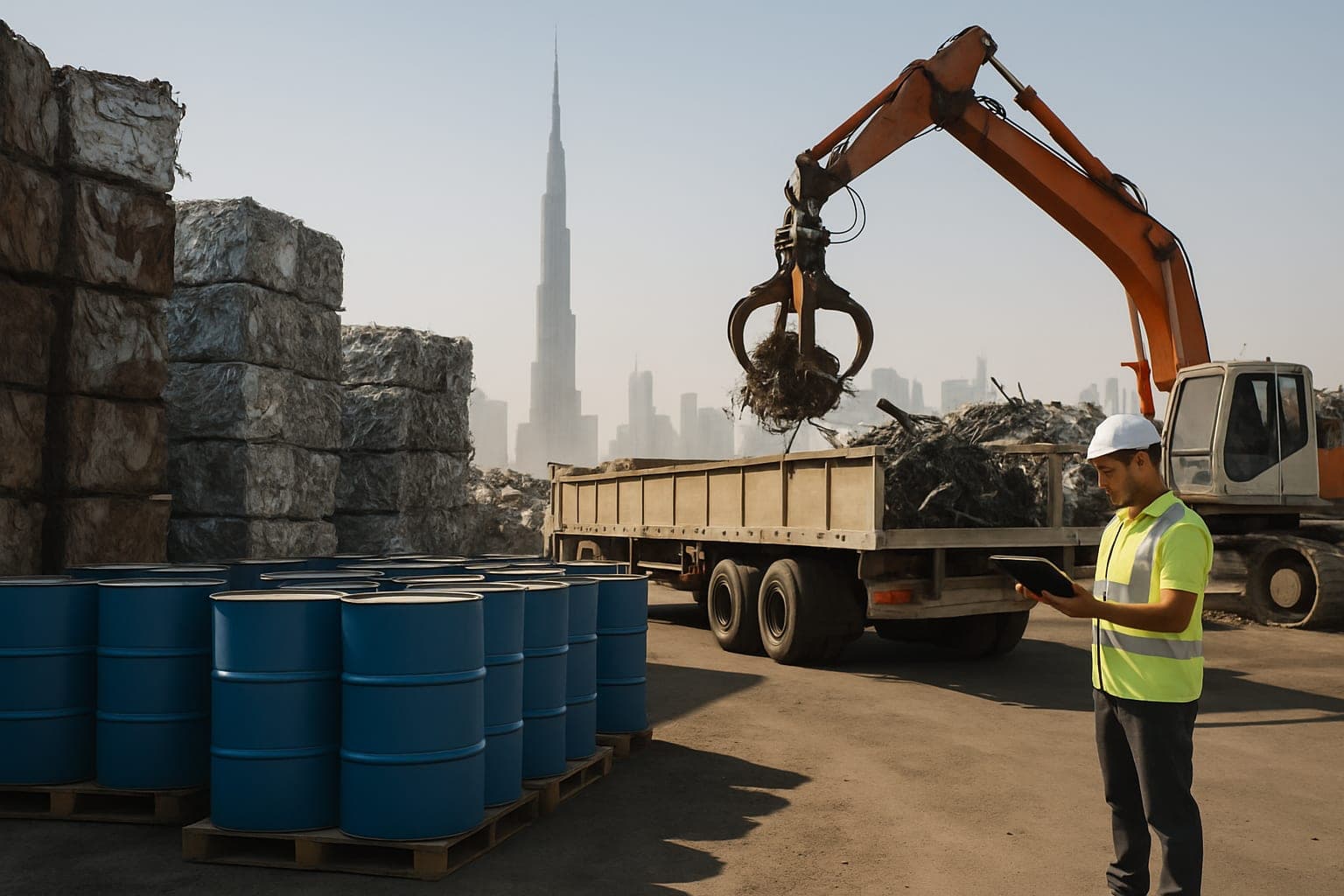
Dubai Law No. 18 of 2024 makes it unlawful to carry out any waste related activity without a permit from Dubai Municipality, and Administrative Resolution No. 253 of 2025 sorts permitted establishments into three classes: collection and transport, trading, and treatment or recycling. A broker who takes title but never touches a load sits in class two. Verify the class, not just the trade licence.
What did Administrative Resolution 253 of 2025 actually do?
It is an administrative resolution issued under Dubai Municipality authority, not an Executive Council resolution, and the distinction matters if you are quoting it in a contract. Its full title on the Dubai Legislation Portal is the resolution approving the Technical Guidelines for the Evaluation and Classification of Establishments Engaged in Waste-related Activities in the Emirate of Dubai. It approves three separate sets of guidelines, one for collection and transport establishments, one for trading establishments, and one for treatment and recycling establishments.
So 253 does not create the permit. Law 18 of 2024 does that, at Article 30(a): no person may conduct any waste management related activity without first obtaining the relevant permit from DM. Resolution 253 is the classification and technical standards layer that sits underneath. The law itself was issued on 4 September 2024, published on 10 October 2024, and came into force thirty days after publication, so roughly 9 November 2024.
Resolution 253 gives DM-authorised establishments six months from its entry into force to comply, and allows the Agency Chief Executive Officer to extend that grace period once, for the same period. The resolution is dated 7 Safar 1447 A.H. which converts to approximately 1 August 2025. That conversion is arithmetic, not a citation, so confirm the Official Gazette issue date before you rely on a specific deadline. On that arithmetic, first compliance fell due around February 2026, extendable once to roughly August 2026.
One more point that is quietly important. The guidelines, including the technical requirements, conditions and standards inside them, are published on DM's website, the Agency reviews them periodically, and updates take effect once the Agency CEO approves them and they are published. Any conflicting provision in other administrative resolutions, guidelines or instructions is repealed to the extent of the contradiction. In plain terms, the technical bar can move without a new law.
Is Resolution 253 still the current framework in 2026?
Not on its own. The implementing bylaw of Law 18 of 2024 is Administrative Resolution No. 34 of 2026, published on the Dubai Legislation Portal, which sets the permit procedure, disposal site requirements at Article 12 and a recycled content framework at Article 13. Trade reporting in June 2026 put its effective date at around 10 March 2026. We have seen the bylaw text but the effective date is secondary sourced, so treat it as approximate. Resolution 34 of 2026 also folds medical waste into the unified permit system and closes out the 1997 medical waste bylaw regime.
Two opposite myths circulate in yards and procurement teams. The first is that the old rules are dead. They are not: Article 30(b) of Law 18 of 2024 expressly keeps earlier bylaws, resolutions and manuals alive to the extent they do not conflict, until they are superseded, which is why the fee and fine schedule in Executive Council Resolution No. 58 of 2017 is still operative nine years after it was issued. The second myth is that nothing has changed. Local Order No. 115 of 1997 on medical waste and Local Order No. 7 of 2002 on waste disposal sites were both repealed by Article 30(a).
Which of the three permits does each counterparty in your chain need?
| Class under Res. 253 of 2025 | Who falls inside it | Other approvals in play | What to ask for before you release material |
|---|---|---|---|
| Collection and transport | Hauliers, skip and roll-on operators, in-house fleets moving waste off a generator site | Vehicle level approvals reported as separate from the establishment permit, including RASID telematics registration and hazardous waste transport vehicle permits; NAFITH smart gate clearance appears in DM Technical Guideline No. 10 for disposal site access | Permit showing the collection and transport class, plus the plate numbers of the vehicles that will actually arrive |
| Trading | Scrap traders, aggregators, brokers and agents who take title or arrange sale without operating a vehicle or a site | DET or free zone licence carrying a matching economic activity; for metals, VAT reverse charge documentation before the first purchase | Permit showing the trading class, and the entity name on the permit matched to the entity on your purchase order |
| Treatment and recycling | Sorting lines, shredders, balers, washing plants, processors and recovery facilities | Environmental authorisation from the Dubai Environment and Climate Change Authority, created by Law No. 11 of 2024, with an environmental impact assessment; Civil Defence approval for the facility | Permit showing the treatment and recycling class, plus the DECCA authorisation for the specific site your load is going to |
We are not going to paraphrase the operational specifications inside those three guideline documents, because the published files are the only reliable source for container specs, vehicle specs and site buffer distances, and secondary blogs quoting them do not agree with each other. Pull them from DM's site before you write a specification into a tender. If you are moving process residues, off-spec batches or plant clearance material, the categories above decide who can legally quote you, and you can see what is currently trading on industrial listings on the marketplace.
Does a broker who never touches the load need a permit?
Yes. This is the single most useful thing in Resolution 253 for a procurement team. Waste trading establishments are a discrete classification with their own technical guidelines, which means the regulator has already decided that taking title, aggregating and reselling is a waste management activity in its own right. Read that alongside Article 30(a) of Law 18 of 2024, which captures any waste management related activity by any person, and the familiar line from an intermediary, that they are only an agent and the licensed hauler is the regulated party, stops working.
It matters commercially too. Scrap metal buyers in Dubai already carry a separate compliance step at the tax layer, and getting the reverse charge declarations in place before a first purchase is now standard practice for anyone buying ferrous or non-ferrous material, as we set out in our note on how the scrap metal VAT reverse charge shifts cash flow for UAE buyers. A counterparty that has neither the DM trading class nor the tax paperwork is telling you something about how the rest of the deal will be run.
Are free zone companies exempt?
No, and the law goes out of its way to say so. Law 18 of 2024 applies to all areas within the Emirate of Dubai, including Special Development Zones and Free Zones, with the DIFC named explicitly in the text. A buyer holding a JAFZA or Dubai Industrial City licence is inside the permit perimeter in the same way a mainland yard in Al Quoz or Ras Al Khor is. The practical jurisdiction rule reported by Dubai advisory firms in 2026 is to pick your licence by where you physically operate rather than by licence cost, and collection work on the mainland means a mainland licence.
How do you verify a permit before you hand over material?
- Ask for the DM waste activity permit, not the trade licence. A DET or free zone licence proves the company exists and can trade. It does not prove Dubai Municipality's Waste and Sewerage Agency, created by Decree No. 34 of 2022, has permitted the waste activity.
- Match the class to the transaction. A treatment and recycling permit does not authorise a fleet to run collections, and a collection and transport permit does not authorise a company to buy and resell your material.
- Use the ten working day clock as a lie detector. Administrative Resolution 34 of 2026 sets the procedure as application, registration and notification, verification, then a decision by the Agency within ten working days from the date the applicant is notified of registration, once conditions and documents are complete. Notification is by email, and reasons are given on rejection. A supplier whose permit has been pending for months either has an incomplete file or does not have an application at all.
- Ask for the digital waste transfer note reference. Reporting through 2025 and 2026 says regulated movements must be filed via Montaji within 24 hours of collection and that paper transfer notes are no longer accepted. We have not confirmed the 24 hour window with DM directly, so verify it, but the test is sound: a counterparty who cannot file a WTN against your movement is not operating inside the system.
- Check the vehicles separately from the company. Vehicle level approvals appear to be a distinct layer from the establishment permit, so a permitted hauler can still send you a non-compliant truck.
- Write it into the contract. A warranty that the counterparty holds the correct permit class for the duration, a right to suspend loading if it lapses, and an indemnity for remediation costs. Then keep the evidence pack.
One honest gap. We could not confirm that DM publishes a public register of permitted establishments searchable by trade licence number, which is exactly what a procurement manager wants. Until that is confirmed, verification means asking for documents and checking them against the issuing agency, and the identity rail is already familiar because DM waste services authenticate through UAE PASS. On AlKhiidma we run counterparty KYC on the same UAE PASS identity, hold funds in escrow through MyFatoorah, and give the buyer a 48 hour inspection window after delivery, so the permit check sits inside a transaction record you can hand to an auditor.
What happens to the generator if the trader is unlicensed?
Start with the powers that are visible in the law text, because they are stronger than most summaries suggest. Dubai Municipality may revoke licences and permits, impound a non-compliant vehicle until compliance is achieved, deport the driver of a non-compliant vehicle from the UAE, and disconnect water and electricity to the violating building or establishment for up to three months. A violator must remedy the violation and restore the situation at his own expense, and if he does not, DM may do the work and charge 25 per cent of the cost as an administrative fee, with DM's cost estimate deemed final. DM employees and nominated community members hold law enforcement officer capacity.
Read the utilities power carefully. It attaches to the violating building or establishment, which on its face can reach a generator's own site rather than only a contractor's yard. Several Dubai advisory blogs state flatly that using an unlicensed contractor makes the generator liable for the fines, and a fine ceiling of AED 500,000, doubled for a repeat within a year, is widely reported from Law 18 of 2024. Both claims are secondary sourced and we have not matched them to a specific article, so we will not present them as settled. What is settled is that the material is traceable to you, the movement is supposed to be filed digitally, and the cost recovery mechanism does not need a court to start running.
What is coming next that changes your buying decisions?
Article 13 of Administrative Resolution 34 of 2026 creates a framework for mandatory minimum recycled content percentages in specified projects and activities, with the actual percentages left to future resolutions. Nothing is quantified yet. That is still a demand signal worth planning around if you generate steady industrial or construction streams, because a mandated percentage creates buyers for material that currently moves on price alone. Separately, MOCCAE has appointed Tadweer Group as the national Producer Responsibility Organisation for an extended producer responsibility pilot that covers Dubai as well as Abu Dhabi, which is the one legitimate link between the Abu Dhabi authority and Dubai operations. Producer-funded schemes tend to arrive first in electronics, and we have written about how UAE WEEE rules will put e-waste costs on electronics importers. More instrument by instrument coverage sits in our regulation articles.
Frequently asked questions
Which of the three Dubai waste permit categories does a scrap trader need?
The trading class. Administrative Resolution No. 253 of 2025 approves separate Technical Guidelines for the Evaluation and Classification of Waste Trading Establishments, which is a standalone category from collection and transport and from treatment and recycling. If the same company also hauls or processes, it needs the relevant additional class, not a single general permit.
Does Resolution 253 of 2025 replace Law No. 18 of 2024?
No. Law No. 18 of 2024 is the umbrella law and Article 30(a) is the provision that bans unpermitted waste activity. Resolution 253 of 2025 approves the technical guidelines used to evaluate and classify establishments, and the implementing bylaw is Administrative Resolution No. 34 of 2026, reported as effective around 10 March 2026.
Are free zone companies exempt from Dubai waste permits?
No. Law No. 18 of 2024 applies to all areas within the Emirate of Dubai, including Special Development Zones and Free Zones, and names the DIFC explicitly. A JAFZA or Dubai Industrial City buyer needs the same Dubai Municipality permit class as a mainland yard in Al Quoz.
How long does Dubai Municipality take to decide a waste permit application?
Under Administrative Resolution No. 34 of 2026, the Agency determines the application within ten working days from the date the applicant is notified of registration, once all conditions and documents are met. The applicant is notified by email, and reasons are given if the application is rejected. That makes a permit said to be pending for months a red flag rather than a normal delay.
Can Dubai Municipality act against my site if my waste contractor is unlicensed?
The powers in Law No. 18 of 2024 include disconnecting water and electricity to the violating building or establishment for up to three months, impounding non-compliant vehicles and recovering remediation costs plus a 25 per cent administrative fee, with DM's cost estimate deemed final. Whether a generator is directly fined for a contractor's failure is asserted by advisory blogs but we have not matched it to a specific article. Either way, checking the permit class before loading is cheaper than testing it.
What is a Montaji waste transfer note and do I need one?
Reporting through 2025 and 2026 says regulated waste movements in Dubai must be filed digitally via Montaji within 24 hours of collection and that paper transfer notes are no longer accepted. We have not confirmed the 24 hour window with Dubai Municipality directly, so verify it for your stream. As a practical test, a counterparty who cannot produce a digital transfer note reference for your load is probably not inside the permit system.

Comments(0)
Sign in to join the conversation.