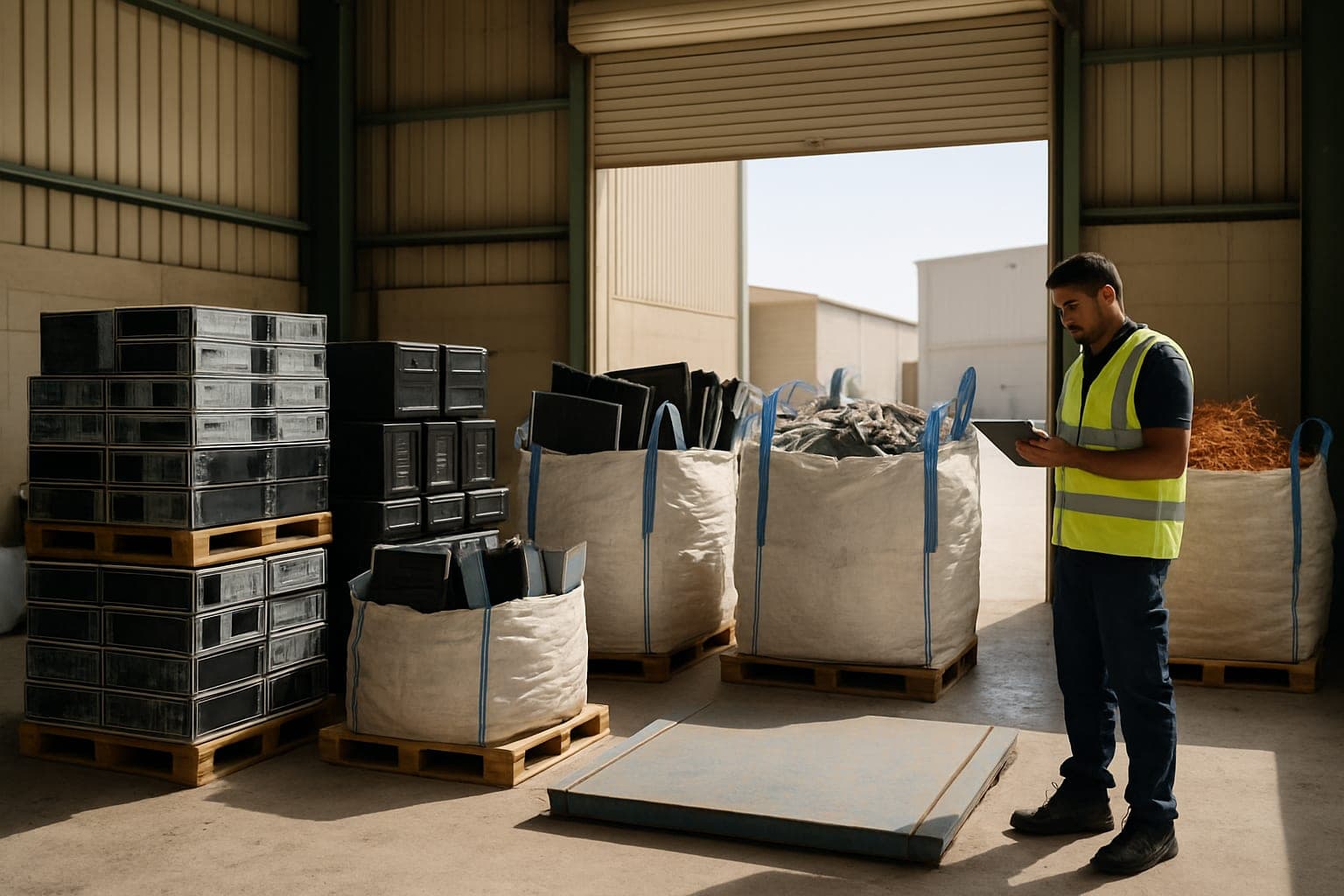
Electrical and electronic equipment sits inside the UAE's extended producer responsibility framework alongside packaging and batteries, not behind it. MOCCAE named all three categories when it announced the framework in December 2024, then put them into a six-month pilot with Tadweer Group as producer responsibility organisation on 3 July 2025. Registration, market reporting and financed take-back are the likely duties. No fee schedule has been published.
Is UAE e-waste EPR already law, or still a draft?
Both, depending on which layer you look at. The parent statute is Federal Law No. 12 of 2018 on Integrated Waste Management, which covers municipal, industrial, construction, agricultural and hazardous waste streams and requires the Ministry to build a national waste database fed by local authorities on a regular basis. Article 5 of that law, together with Cabinet Resolution No. 39 of 2021, is the stated legal grounding of the EPR framework. That much is settled.
What is not settled is the operating detail. As far as we can establish from published material, there is no binding WEEE-specific ministerial decision, no published fee schedule, no confirmed collection or recovery targets and no public producer registration portal. If a consultant quotes you a per-unit EPR levy for laptops or air conditioners landing in Jebel Ali, ask for the gazette reference. There isn't one yet.
One point of housekeeping that catches importers out repeatedly: retailer take-back is not new. When the executive regulations of Federal Law No. 12 of 2018 were approved by Cabinet and announced in July 2021, suppliers were mandated to collect electronic waste and batteries from consumers free of charge by providing collection boxes at their retail outlets. So if your commercial model includes a UAE retail footprint, the obligation has been on the books for more than four years. What the EPR framework adds is the financing, registration and reporting architecture on top, plus a monitoring mechanism that produces numbers someone can audit.
What did the July 2025 pilot actually set up?
MOCCAE signed a memorandum of understanding with Tadweer Group at a Dubai event on 3 July 2025 to implement a pilot for managing targeted product waste under the UAE's EPR initiative. Attendees included HE Dr. Amna bint Abdullah Al Dahak, Minister of Climate Change and Environment, and Engineer Ali Al Dhaheri, Managing Director and CEO of Tadweer Group. The pilot covers electrical and electronic equipment, batteries and packaging. It runs temporarily in Abu Dhabi and Dubai, with Tadweer acting as the scheme's producer responsibility organisation.
Its stated objectives are worth reading closely, because they tell you what comes next: enhance regulatory readiness, develop understanding of the practical requirements for EPR monitoring, identify key influencing factors, and compile lessons learned. That is the language of a design exercise, not an enforcement campaign. Twenty-six companies spanning retail, production and waste management services signed the EPR Pledge on the same day, committing to raise public awareness, encourage consumer segregation and make collection systems work.
Do the arithmetic. A six-month pilot launched on 3 July 2025 concludes around January 2026, and the UAE Integrated Waste Management Agenda that houses the EPR initiative runs to 2026. Neither of those is an announced compliance date, and we are not presenting them as one. They are the window in which the framework's design decisions get locked, which is a different and more useful thing for a procurement calendar.
Regional context matters for how seriously to treat this. The UAE introduced the region's first formal EPR pilot holding manufacturers and brand owners accountable for post-consumer waste. Globally, by 2023 around 81 countries had some form of e-waste legislation and 67 of them applied extended producer responsibility principles. The direction of travel is not in doubt. The rate is.
Where each element stands, as of publication
| Element | Status | Basis |
|---|---|---|
| Legal power to impose producer duties | In force | Federal Law No. 12 of 2018, Article 5; Cabinet Resolution No. 39 of 2021 |
| Retailer collection boxes, free to consumers | In force since 2021 | Executive regulations announced July 2021 |
| EEE inside the EPR framework | Announced | MOCCAE framework, December 2024 |
| Producer responsibility organisation | Piloted | Tadweer Group, MoU of 3 July 2025 |
| Geographic scope | Pilot: Abu Dhabi and Dubai | MOCCAE and Tadweer pilot design |
| Producer registration portal | Not published | No public instrument located |
| Fee per unit or per tonne | Not published | No public instrument located |
| Collection and recovery targets | Not published | No public instrument located |
Who counts as the producer if you import through a free zone?
This is the single largest unanswered question in the file, and it decides who pays. Under the EU model that MOCCAE is drawing on conceptually, and we are labelling it as the EU template rather than UAE law, the term producer usually covers manufacturers, importers, brand owners and sometimes retailers. Essentially anyone who first places electrical equipment on a market. Those parties register with the national authority, report the volume of equipment sold, and organise or finance collection, treatment, recycling and recovery. Since August 2018 all EEE in the EU, consumer and professional, has fallen inside those obligations.
Now map that onto how electronics actually reach the UAE market. A brand's regional office sits in JAFZA or Dubai Airport Free Zone. A distributor in Dubai Silicon Oasis sells to a mainland integrator. A trader in Hamriyah or RAKEZ moves mixed IT hardware into Sharjah retail. If placing goods on the mainland market from a free-zone entity triggers producer registration, which entity registers, the free-zone company or its mainland distributor? We could not find a published answer. Put the question to MOCCAE in writing and keep the reply on file, because the commercial consequence is a landed-cost line item, not a paperwork detail.
There is also a hard enforcement lever already sitting in the parent law. Under Federal Law No. 12 of 2018 the Ministry may prohibit importation of disposable, short-term use or environmentally harmful products, prohibit importation of products difficult to dispose of, prevent industries from using or importing such products, and require the use of waste suitable for recycling. That is what makes a producer registration regime enforceable at the border rather than at the landfill gate. Anyone re-exporting used or end-of-life equipment should also check transboundary movement controls before shipping, since re-export routes are where documentation gaps become expensive.
Why handover to a licensed facility becomes evidence, not etiquette
The reasoning is administrative rather than moral. The parent law obliges the Ministry to maintain a national waste database populated by local authorities. The pilot's stated purpose includes understanding the practical requirements for EPR monitoring. Monitoring under any producer responsibility scheme means reconciling tonnes placed on the market against tonnes recovered and treated. An informal collector who pays cash at your loading bay in Al Quoz or Musaffah produces nothing that can enter that reconciliation. No weighbridge ticket, no facility licence number, no treatment certificate, no tonnage line for your ESG report.
That is the shift. The value of a licensed treatment route stops being a preference and becomes the only version of the transaction that exists on paper. If you already handle waste transfer documentation digitally, you have most of the muscle memory for this, and the same logic that made every load traceable in Dubai applies to consignments of servers, displays and air conditioning units.
Two certificates, not one
IT and compliance managers routinely conflate the data destruction certificate with the environmental treatment certificate. They are separate documents, issued for separate purposes, and one does not substitute for the other. A certificate of destruction or erasure covers the media. A treatment or recovery certificate covers the material and its lawful handling by a licensed facility. Contract for both, in writing, per consignment. Our guide to selling retired IT assets without failing a data audit sets out how the two documents fit together in a disposal file.
How does this change the economics of end-of-life electronics?
Today most UAE importers treat end-of-life equipment as a scrap sale with positive revenue. Copper and aluminium content drive that, so cable, motors, transformers, chassis and heat sinks carry the value, and board grades sit at the widest spread of any category. We are not printing AED per kilogram figures in this article because none of the e-scrap quotes we could stand behind were current enough to date properly, and a stale number in a regulation piece is worse than no number.
Model the direction instead. Under a fee-based EPR scheme with documented handover, the same tonnage carries a levy at the point equipment is placed on the market plus a compliance cost at disposal. Treat it as a landed-cost adder rather than a recycling revenue line, and ask your contractor explicitly which streams pay you and which carry a gate fee, because not every WEEE category is revenue positive. Where a stream does hold value, the answer is competitive tension. Posting graded lots to verified electronics buyers gives you a price you can defend to finance and a counterparty record you can defend to an auditor.
The packaging side of the same framework offers a preview of how quickly cost allocation arguments start, and we covered that in detail in our piece on packaging EPR shifting waste costs to UAE producers.
What should go into your 2026 supplier contracts?
None of this is legal advice, and no binding WEEE rule text is confirmed. It is prudent drafting for a regime whose shape is already visible.
- Producer of record. State which party is deemed to place the equipment on the UAE market, and which party carries any resulting registration and reporting duty. Critical for free-zone, reseller and drop-ship structures.
- Licence warranty. Warrant that the disposal contractor holds a current licence from the relevant emirate authority, with the licence number and expiry date written into a contract schedule and refreshed annually.
- Per-consignment documentation. Require a weighbridge ticket plus a treatment or recovery certificate for every load, retained for a defined period, delivered within a fixed number of days.
- No onward sale to unlicensed intermediaries. Prohibit it outright and reserve audit rights, including a site visit to the treatment facility.
- Data destruction as a separate deliverable. Specify the erasure or physical destruction standard, the serial-level report and the issuing party.
- Cost pass-through trigger. A price adjustment clause that activates if and when a statutory EPR fee is introduced, so neither side is renegotiating mid-contract.
- ESG data clause. Tonnage by material category in machine-readable form, so your sustainability report is not rebuilt by hand each quarter.
Two more things worth doing before the pilot period closes. Ask MOCCAE or Tadweer for the list of the 26 EPR Pledge signatories and check whether your own suppliers are on it. And read the framework as an operations problem, not a legal one, because the compliance evidence is generated on your loading dock, not in your legal department. Our regulation coverage tracks each instrument as it moves from announcement to gazette.
Frequently asked questions
Do I need to register as an e-waste producer in the UAE right now?
There is no public producer registration portal for electrical and electronic equipment that we could locate as of publication. The EPR framework was announced by MOCCAE in December 2024 and a six-month pilot began on 3 July 2025 in Abu Dhabi and Dubai with Tadweer Group as producer responsibility organisation. Treat registration as imminent in design terms, and ask MOCCAE directly whether your entity type is in scope.
How much is the UAE EPR fee per unit for imported electronics?
No fee schedule has been published. Any per-unit or per-tonne figure circulating in the market is an estimate rather than a rate, and should not go into a 2026 budget as a fixed cost. Build a cost pass-through clause into supplier contracts instead, so the charge can be allocated when it is actually set.
Is selling e-waste to an informal scrap collector a problem?
The commercial problem is evidentiary. Federal Law No. 12 of 2018 requires a national waste database fed by local authorities, and any producer responsibility scheme reconciles tonnes placed on the market against tonnes recovered. A cash sale at your gate produces no weighbridge ticket, no licence number and no treatment certificate, so the tonnage cannot be counted in your favour.
Are retailers already required to take back old electronics in the UAE?
Yes. When the executive regulations of Federal Law No. 12 of 2018 were announced in July 2021, suppliers were mandated to collect electronic waste and batteries from consumers free of charge by providing collection boxes at retail outlets. The EPR framework does not create that duty, it adds registration, financing and reporting on top of it.
Does a data destruction certificate cover my environmental obligations?
No. A data destruction or erasure certificate covers the storage media only. A treatment or recovery certificate from a licensed facility covers the lawful handling of the material itself. Contract for both documents separately, per consignment, and keep them in the same disposal file.
Who is the producer if the importing entity sits in a free zone?
We found no published answer on whether placing equipment on the mainland market from a free-zone entity triggers producer registration, or which party registers. Given how much UAE electronics distribution runs through JAFZA, Dubai Airport Free Zone, Dubai Silicon Oasis, KEZAD and RAKEZ, put the question to MOCCAE in writing and keep the response with your compliance records.

Comments(0)
Sign in to join the conversation.