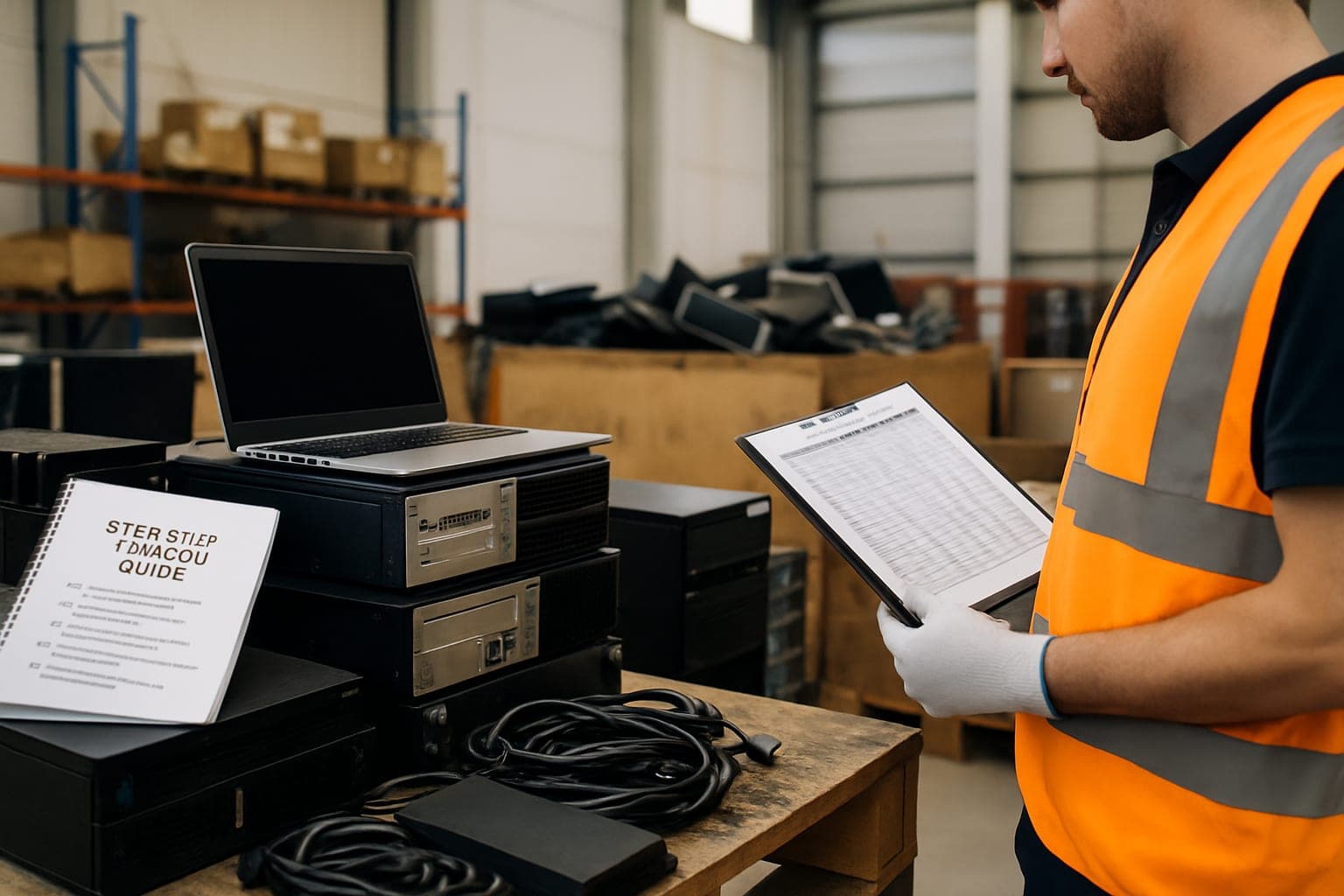
Wipe before you list. Build a serial level inventory, sanitise every data bearing drive to a documented standard, keep the certificate that references those serials, then grade and lot the working units separately from the scrap. Sell to KYC verified buyers with escrow and an inspection window, and keep the transport manifest. That chain, not a single PDF, is what survives an audit.
Why is a working laptop worth more than the same laptop shredded?
Once a machine goes through a shredder it stops being an asset and becomes a set of material fractions: aluminium chassis, copper from cables and power supplies, low grade and high grade board, a little precious metal in connectors and processor packaging. Those fractions price off LME aluminium, LME copper and the gold and silver fixes, converted at the dirham peg. A working, wiped, cosmetically honest corporate laptop prices off something completely different, which is what a refurbisher can resell it for.
We are not going to publish an AED price table in this guide. Verified August 2026 rates for used business laptops, three year old rack servers and mixed e-scrap were not available to us at the time of writing, and a made up range is worse than no range. Get three written quotes before you commit: one from a licensed processor for the scrap only fraction, one from a refurbisher or hardware broker for the working units, and one benchmark from the marketplace. The gap between the first and the second quote is the entire commercial argument for doing ITAD properly.
Which UAE rules apply when you retire IT hardware?
Federal Law No. 12 of 2018 on Integrated Waste Management is the frame. It applies the waste hierarchy and a circular economy approach, and according to academic analysis published in Sustainable Development (Wiley) in July 2024, the UAE is the only Middle East country to have written extended producer responsibility principles for WEEE into national legislation, in 2021, with waste electrical and electronic equipment addressed under Articles 5 and 13. Anyone still telling you e-waste is unregulated here is working from a decade old script.
Federal Law No. 24 of 1999 defines hazardous waste, and that matters more than people expect inside an IT refresh. CRT monitors, lithium batteries, backlight lamps and some capacitors sit in scope, which is why they cannot travel in a general pallet with your laptops. On the border side, the UAE Government portal (page updated 11 June 2026) states that MOCCAE has issued a ministerial decision prohibiting the passage and export of hazardous waste across UAE borders, and that the UAE is a party to the Basel Convention. Where working used equipment ends and waste begins is the whole legal question in any export plan, so get that classification confirmed in writing by your customs broker and the relevant authority before anything leaves the country.
The data side is separate and stricter for some of you. Federal Decree-Law No. 45 of 2021 on Personal Data Protection sits at federal level, DIFC and ADGM entities operate under their own data protection instruments, and banks, government suppliers and healthcare operators carry additional media sanitisation controls from their sector regulators. Confirm the current status of the federal executive regulations and your own sector rules with counsel rather than assuming, because those sector rules are what decide whether a verified wipe is acceptable or whether physical destruction is mandatory for you. If you are already tracking producer obligations on packaging, the direction of travel is the same one described in our guide to packaging EPR in 2026.
Local authorities are moving fast on WEEE
Dubai Municipality signed a memorandum of cooperation with Enviroserve on 26 June 2026 covering safe management, collection, recycling and recovery of WEEE across the emirate, announced during a visit by Director General H.E. Eng. Marwan Ahmed Bin Ghalita and framed by the Dubai Integrated Waste Management Strategy 2041 and Circular Dubai. In Abu Dhabi, Tadweer Group is working to an 80 percent landfill diversion target by 2031 (Aletihad, 15 June 2026) and has identified electronics as one of the strongest recovery opportunities. Enviroserve itself is now described by WAM (20 July 2026) as Tadweer Group's e-waste recovery subsidiary, and on the same date Abu Dhabi Islamic Bank agreed to route its e-waste and end of life IT assets through it. When a bank formalises ITAD publicly, your own auditors will start asking why yours is informal.
One practical item to resolve locally: whether your emirate requires a waste transfer permit or an electronic manifest to move the non resale fraction, and how your free zone treats the movement of retired assets to a mainland buyer. We have seen sellers in JAFZA and Dubai Silicon Oasis discover the customs question only after a buyer has already paid. Ask the zone authority first.
What does a destruction record that survives an audit look like?
A one page certificate with a company logo and a tonnage figure is the classic audit failure. What holds up is a linked chain, and every link references the one before it.
- Serial level inventory captured at collection, with make, model, asset tag and drive serial for every data bearing device.
- A per device sanitisation record showing the method used, the tool and version, the operator, the date and the verification result, not just a claim that it was done.
- A certificate of destruction or sanitisation that lists those serials, issued by the party that actually performed the work.
- A transport manifest naming the licensed carrier and the receiving facility for anything classified as waste.
- Downstream evidence: the processor's licence and recovery certificate, and identity verification of the buyer who took the working units.
On method, NIST SP 800-88 Rev. 1 and its Clear, Purge and Destroy framework remains the reference most auditors recognise, with IEEE 2883-2022 increasingly cited alongside it. The old DoD 5220.22-M three pass wipe is not the modern benchmark and quoting it dates your policy. Verified purge on a healthy SSD or HDD preserves the machine's resale value; destruction is for failed drives, drives that refuse verification, and any device covered by a sector rule that demands it.
The steps people forget
Strip asset tags and inventory decals. Clear BIOS and firmware passwords, remove devices from Intune, Jamf or your MDM, and release activation locks before the units leave your floor. Pull SIMs from mobile broadband cards. On servers, reset iDRAC, iLO and IPMI credentials and break the RAID configuration after drive sanitisation. On network gear, erase the running and startup configs, RADIUS shared secrets and VPN certificates. Multifunction printers hold internal drives that almost never make it onto the inventory, and they are a favourite finding for auditors.
Refurbish or recycle: how do you decide device by device?
| Asset | Data bearing | Route | Evidence to keep |
|---|---|---|---|
| Laptops 3 to 5 years, powers on, screen intact | Yes | Wipe, verify, grade, sell as refurbish lot | Serial level sanitisation record plus buyer KYC |
| Laptops with dead board, liquid damage or swollen battery | Drive only | Remove and destroy drive, battery out, unit to licensed processor | Destruction certificate plus processor manifest |
| Rack servers on a currently supported CPU generation | Yes | Drives out and sanitised, chassis to broker or refurbisher | Drive serial list plus resale invoice |
| Older servers past broker interest | Yes | Harvest RAM, CPUs, caddies and PSUs, then chassis and board to scrap | Parts inventory plus processor certificate |
| Switches and firewalls in support with transferable licence | Config only | Erase config, resell as network lot | Config erasure log plus buyer KYC |
| End of support network platforms | Config only | Parts, then high grade board scrap | Processor certificate |
| LCD monitors, working | No | Resale lot, palletised by size | Buyer KYC and delivery note |
| CRT monitors, batteries, backlight lamps | No | Hazardous stream, licensed handler only | Manifest under hazardous waste rules |
| Cables, adapters, PSUs | No | Copper bearing scrap, sold by weight | Weighbridge ticket |
The rule of thumb we use with sellers: if a refurbisher would pay more for the unit than the recovered material would fetch, and you can evidence the wipe, refurbish. If the unit needs a repair that costs more than the resale spread, or the drive fails verification, recycle it and keep the certificate.
How do you build lots that get bid up rather than discounted?
Mixed pallets attract scrap bids. Homogeneous lots attract refurbisher bids, and refurbishers pay for certainty. Group by model and configuration, then grade honestly: A for near new cosmetics and full function, B for visible wear and full function, C for functional with defects that need disclosure, F for parts only. Do not blend grades into one average and hope nobody looks.
Publish counts, model numbers, CPU generation, RAM, whether the drive is present or removed, battery health if you have it, whether power adapters are included, pallet count, gross weight, and the exact pickup point, whether that is Al Quoz, Dubai Industrial City, Musaffah or KEZAD. Give loading hours and say whether a forklift is on site. Photograph a representative sample and every unit with damage. Sellers who state that drives were removed and retained, rather than staying vague, get cleaner bids, because the buyer can price the missing SSD instead of guessing at it. You can see how live electronics lots are described on the electronics category before you write your own.
How do verified buyers and an inspection window protect the seller?
Chain of custody breaks at the point where you cannot name who received the hardware. An anonymous cash buyer at the yard gate ends your audit trail regardless of how well you sanitised the drives, which is why we verify counterparties through UAE PASS before they can transact. The name on the transaction is the name that goes in your file.
The 48 hour inspection window solves the other half of the problem. Used hardware buyers discount heavily for condition uncertainty, so a seller who grades honestly is normally punished by the same bid as a seller who exaggerates. A structured window lets the buyer verify what you described and lets you list at the grade you actually have. Payment sits in escrow through MyFatoorah until that window closes, which removes the reason most corporates default to a single lowball scrap deal. The diversion tonnage and counterparty record then feed straight into ESG reporting against the Abu Dhabi 2031 diversion target and Dubai's 2041 strategy. Our FAQ page covers how the escrow release and dispute steps work in practice.
What order should a fleet refresh actually follow?
- Freeze the asset register and reconcile it against what is physically in the store room.
- Segregate hazardous items, batteries, lamps and CRTs, on day one.
- Capture serial level inventory including drive serials.
- Sanitise and verify, or destroy where the sector rule or a failed drive requires it.
- Issue and file the certificate referencing those serials.
- Remove asset tags, clear firmware credentials and de-enrol from MDM.
- Grade, then build homogeneous lots by model and grade.
- List with photographs, weights, location and loading terms.
- Sell to a verified buyer, hold funds in escrow, allow the inspection window to run.
- Send the residual fraction to a licensed processor and file the manifest and recovery certificate with the rest of the chain.
Do steps three to five before step eight, never after. Sanitising a machine that has already been sold is how sellers end up with a buyer holding data bearing media and an auditor holding a question you cannot answer.
Frequently asked questions
Do I have to shred every drive, or is wiping enough?
It depends on your sector. NIST SP 800-88 Rev. 1 permits verified Clear and Purge methods for many media types, and that is exactly what preserves resale value, but banks, government suppliers and healthcare operators often sit under regulator specific controls that mandate physical destruction. Confirm your own obligation in writing before you build the wipe policy, and always destroy any drive that fails verification.
Is a certificate of destruction enough for an auditor in the UAE?
Not on its own. A certificate that does not list device or drive serial numbers proves very little, and it is the most common audit finding we hear about. Keep the full chain: serial level inventory, per device sanitisation record with method and verification result, the certificate referencing those serials, the transport manifest and the downstream processor certificate.
Can I export retired IT equipment out of the UAE?
Not freely. The UAE Government portal, updated 11 June 2026, states that MOCCAE has issued a ministerial decision prohibiting the passage and export of hazardous waste across UAE borders, and the UAE is a Basel Convention party. Whether your consignment counts as working used equipment or as waste is a classification question, so get it confirmed by your customs broker and the relevant authority before booking freight.
Why will nobody quote me a fixed AED price per laptop?
Because the price depends on the model, generation, cosmetic grade, whether the drive is included and how homogeneous the lot is, and because scrap fractions move with LME copper, LME aluminium and the precious metal fixes. Bulk lots of one model with honest grading attract firmer bids than mixed pallets. Request quotes for the resale fraction and the scrap fraction separately so you can see the spread.
Does my free zone entity follow the same rules as a mainland company?
Assume the federal waste framework applies and check the customs treatment separately. Moving retired assets from a free zone to a mainland buyer can raise a customs question that has nothing to do with waste law, and DIFC and ADGM entities also sit under their own data protection instruments rather than the federal one. Ask your zone authority before you list, not after a buyer has paid.
What should be in the listing to attract refurbishers rather than scrap dealers?
Model numbers, CPU generation, RAM, unit counts, a stated grade per lot, whether drives are present or removed, adapter inclusion, pallet count, gross weight and the exact pickup location with loading hours. Photographs of a representative unit plus every damaged unit. Vague listings are priced as scrap because that is the safest assumption for a buyer.

Comments(0)
Sign in to join the conversation.