The UAE's packaging EPR scheme is still a pilot, not a published fee. MoCCAE and Tadweer Group signed a six-month Extended Producer Responsibility pilot on 3 July 2025 in Dubai covering packaging, electronics and batteries in Abu Dhabi and Dubai. No fee schedule or registration portal has been gazetted since. What producers owe today is evidence: tonnes placed on market, where the material went, and who processed it.
Is EPR mandatory for packaging in the UAE in 2026?
Not on any public record we can point to. MoCCAE unveiled a national EPR framework around December 2024 covering three streams, packaging materials, electrical and electronic equipment, and batteries, grounded in Article 5 of Federal Law No. 12 of 2018 on Integrated Waste Management and in Cabinet Resolution No. 39 of 2021. The pilot itself came later. On 3 July 2025, H.E. Dr Amna bint Abdullah Al Dahak, Minister of Climate Change and Environment, and Eng. Ali Al Dhaheri, Managing Director and CEO of Tadweer Group, signed an MoU launching a six-month pilot in Abu Dhabi and Dubai, with Tadweer Group acting as the Producer Responsibility Organisation.
Six months from July 2025 ends in January 2026. As of early August 2026 we have not found a published pilot outcome report, a producer registration portal, or a gazetted fee schedule. An Anthesis Group regional page updated 20 March 2026 still describes the UAE scheme as a pilot. So if a consultant quotes you a UAE EPR fee per tonne, ask which official instrument it comes from before you budget against it.
Here is the part most producers miss. A duty of proper disposal already exists and predates EPR by years. Cabinet Resolution No. 39 of 2021, the executive regulations to Law 12/2018, runs to 13 articles and 2 annexes. Article 2 sets out the responsibilities of the waste producer and supplier to ensure proper disposal. Article 6 governs the movement of waste between emirates. Article 7 addresses reuse of by-products, and Article 10 covers administrative penalties. EPR does not create that duty. It formalises it, prices it, and asks you to prove it with numbers.
Does EPR apply to importers or only to manufacturers?
EPR schemes internationally define the producer as the entity that places the packaging on the market, which captures brand owners and importers alike, not only the factory that made the film or the carton (Anthesis Group, page updated 20 March 2026). Roughly 63 countries operate some form of packaging EPR, ranging from mandatory funded schemes to voluntary or pilot programmes, on the same source dated 15 December 2025. If the UAE follows that pattern, a distributor bringing finished goods into Jebel Ali for domestic sale is a producer for the packaging around those goods.
Second point, and it catches FMCG groups repeatedly: the pilot covered three streams. An importer whose catalogue includes small appliances and the batteries inside them has three sets of obligations to design for, not one. Whether free zone entities that import purely for re-export sit inside or outside a future scheme has not been clarified in anything we have seen, and it matters, because the federal single-use plastic ban already exempts products manufactured for export or re-export (MoCCAE, reported 16 December 2025).
What data must you capture per tonne of packaging placed on the market?
The 26 companies that signed the EPR Pledge at the July 2025 launch committed, among other things, to provide data to monitor collection rates and other performance metrics, and to ensure all collected waste is processed in line with approved procedures. Those two commitments define the shape of the record. Placed-on-market tonnage is only half of it. The other half is proof of fate.
| Data field | Why an auditor asks for it | Where it comes from |
|---|---|---|
| Material type and polymer or grade | Fees and recycling rates in most schemes are set per material, not per pack | Packaging specification sheet, supplier declaration |
| Net weight placed on market, per SKU per period | The base unit of any EPR calculation | Pack weight multiplied by units sold or imported, from ERP |
| Emirate of first sale or distribution | The pilot ran in Abu Dhabi and Dubai only; obligations may differ by emirate | Sales ledger, delivery notes |
| Import versus local manufacture | Determines whether you are the obligated party or your supplier is | Customs declaration, purchase orders |
| Tonnage recovered back, by stream | Collection rate is the headline metric of the pilot design | Weighbridge tickets from the receiving facility |
| Counterparty identity and licence | Proves the material went to a permitted processor, not a broker of unknown fate | Trade licence, waste carrier or recycler permit |
| Date, vehicle and consignment reference | Links tonnage to a movement so the chain can be reconstructed | Transfer note, gate record |
| Final processing outcome | Recycled, recovered or landfilled changes the value of the evidence entirely | Recycler declaration or processing confirmation |
Build this at SKU level from the start. Retrofitting pack weights across 400 SKUs after a reporting deadline is published is a six-week job that nobody has budgeted for.
Who can act as a compliance partner?
For the pilot, Tadweer Group was the named PRO, with a mandate to deliver take-back operations, manage data collection, assess system costs and coordinate between producers and recyclers. Outside that structure, your practical partners are licensed waste carriers, material recovery operators and recyclers permitted by the relevant authority, Dubai Municipality in Dubai, Tadweer in Abu Dhabi, Bee'ah in Sharjah. We have not been able to confirm whether any UAE body currently issues a standardised, recognised certificate of recycling for packaging, so do not assume the document your contractor emails you carries regulatory weight.
Three questions to put to any partner before you sign, in writing:
- Which authority licenses you, under what class of permit, and what is the expiry date?
- Does the material stay in your facility, or is it onward-sold? If onward, to whom, and will you name them on the transfer note?
- Will you issue a weighbridge ticket per load with material grade, net weight, date and vehicle plate, and will you retain those records for at least five years?
If the answer to the second question is vague, your evidence chain breaks at the first hop. That is the failure point in most of the files we see. A trader collects your baled film at a good price and the trail stops at the gate of an unnamed yard in Al Quoz or Musaffah.
How do post-industrial film and cartons build the paper trail?
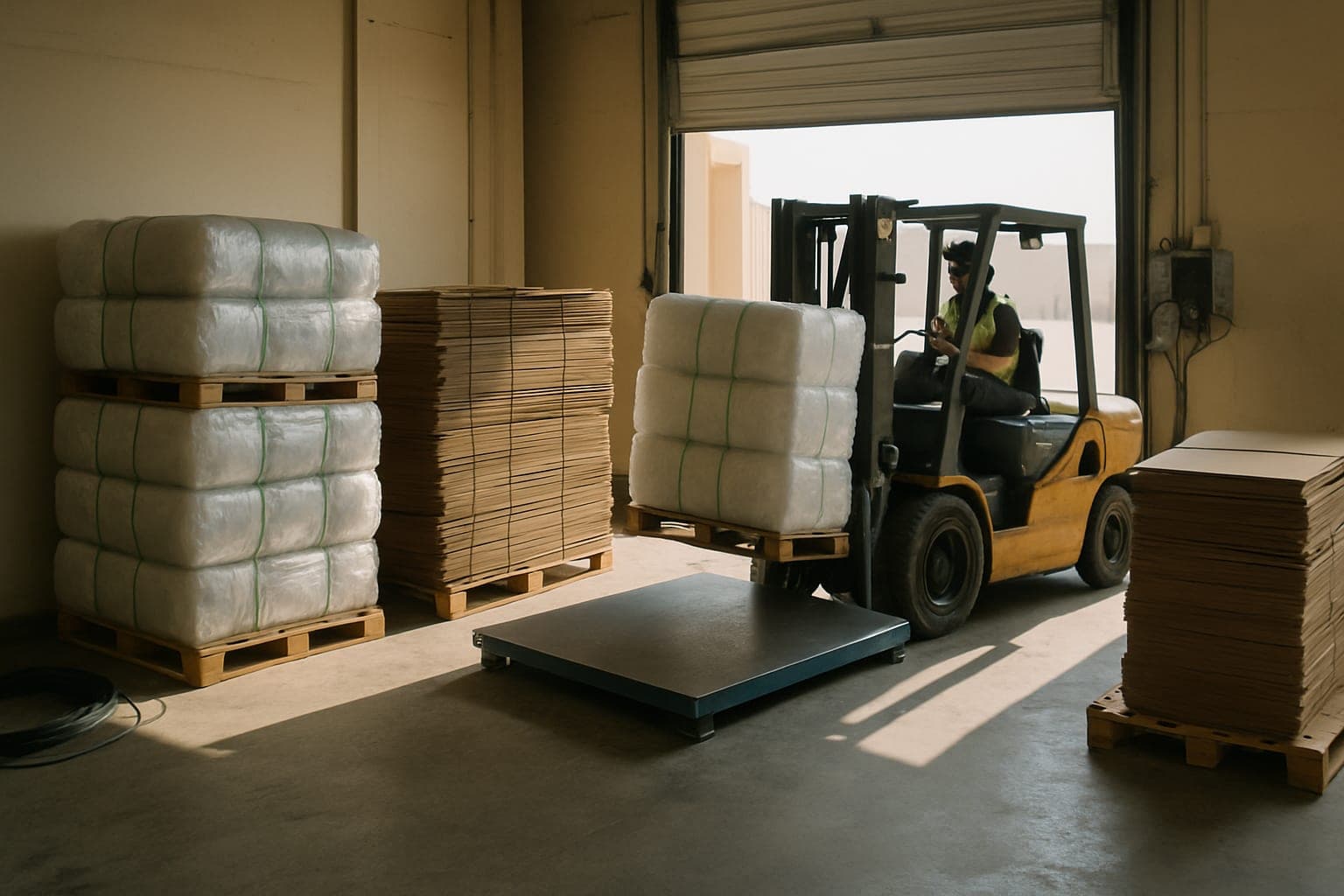
Post-industrial material is the easiest place to start because it is clean, single-polymer and already weighed. Stretch film off pallets, LDPE liners, shrink hoods, off-cuts from a converting line, flattened OCC from a distribution centre. It is homogeneous, it has a real market, and every load already crosses a weighbridge.
- Segregate at source by polymer and colour. Mixed bales of LDPE and PP destroy both the price and the clarity of the record.
- Bale and label with a consignment reference generated by your own system, not the collector's.
- Verify the buyer before the truck moves. Trade licence, permit class, physical address you have visited or can verify.
- Weigh in and weigh out, and keep both tickets. A gross and tare pair is the single most useful document an auditor will accept.
- Match the payment record to the consignment reference. Money movement that lines up with tonnage movement is very hard to dispute.
- Ask for a processing confirmation naming the outcome, recycled into what, or shipped where.
- Reconcile monthly against your placed-on-market figures so the two datasets are built in parallel, not stitched together later.
On our platform every counterparty is KYC-verified through UAE PASS, funds sit in escrow with MyFatoorah until the buyer's 48-hour inspection window closes, and the transaction record carries material, weight, date and both party identities. That record is not an EPR credit and we will not pretend otherwise, because no source supports that claim. It is a defensible commercial document showing where a named tonnage went and who took it. You can see current post-industrial film, rPET and PP listings on the plastics section of the marketplace, and the verification and escrow mechanics are set out on our about page.
What will EPR cost per tonne?
Nobody outside MoCCAE and Tadweer can answer that yet. Mark Siddorn, strategic planning and business performance director at Tadweer Group, told Packaging Insights on 14 July 2025 that the pilot would establish the management costs of collection and recycling, giving producers clarity on financing requirements. Read that plainly: the fee was an output of the pilot, not an input to it.
What you can model is the offset. Recovered fibre and recovered polymer both carry positive value in the UAE, so material you currently pay to remove can instead be sold. Be careful how you benchmark it. There is no LME for polymers; the LME prices aluminium, copper and metal scrap, and that framing belongs in a different category, as we set out in our note on local metal sales and export duty. UAE bale prices for OCC and film effectively track export parity to Asian mills and reprocessors, minus freight, with virgin polymer from regional producers setting the ceiling on what a buyer will pay for recyclate. We were unable to verify a current AED per tonne benchmark from a datable published source for this piece, so we are not printing one. Ask three buyers for a written quote with the date on it and you will have a truer number than any index.
For scale of the surrounding programme spend, Dubai's Integrated Waste Management Strategy 2041 is described on the Dubai Government portal as an AED 74.5 billion programme, of which AED 70.5 billion is direct private-sector contribution. That page is undated, so treat the split as indicative. The strategy targets 100 per cent diversion of all waste types from landfill by 2041 with recycling at no less than 56 per cent, per Dubai Municipality on 27 October 2025. Tadweer's target is 80 per cent diversion by 2030, stated on 3 July 2025.
Does the single-use plastic ban count as EPR?
No, and conflating the two produces bad compliance plans. Dubai Municipality Decision No. 124 of 2023 and the federal bans are product prohibitions with fixed penalties; the Dubai fine for a single-use plastic violation was AED 200, doubling on repeat within 12 months to a cap of AED 2,000, as reported in early 2024. The phasing ran from single-use plastic bags on 1 January 2024 through Styrofoam containers, straws and stirrers on 1 January 2025, to plastic plates, food containers, tableware, beverage cups and their lids from 1 January 2026. EPR is a different instrument entirely: a financing and reporting mechanism under Article 5 of Federal Law 12/2018. One tells you what you cannot sell. The other tells you what you must pay for and prove.
What about Sharjah and the northern emirates?
The pilot geography was Abu Dhabi and Dubai. Sharjah, Ajman, Umm Al Quwain, Ras Al Khaimah and Fujairah were not in it, and Sharjah's system runs through Bee'ah, which has reported a diversion rate around 75 per cent, though that figure appears in undated material and is likely at least two years old. If your distribution covers all seven emirates, your collection evidence for the northern emirates sits outside the pilot's PRO structure and you will be assembling it yourself from carrier and recycler records. Build the same fields anyway. A consistent dataset across seven emirates is easier to defend than a good one for two and nothing for five.
Meanwhile the collection infrastructure keeps moving. Tadweer's collection arm Tajmee'e expected to handle around 70 per cent of Abu Dhabi's municipal waste by the end of 2026, with its fleet growing from roughly 100 lorries to almost 300, and a two-bin household segregation pilot was due to start in Shakhbout City in September 2026 (The National, 17 July 2026). Dubai's Warsan waste-to-energy plant, a 400,000 square metre site built at a reported AED 2 billion, remains the emirate's residual backstop. Every tonne you divert upstream is a tonne that never reaches it.
Frequently asked questions
Is packaging EPR legally mandatory in the UAE right now?
There is no gazetted mandatory packaging EPR fee, registration portal or reporting deadline that we have been able to verify as of August 2026. MoCCAE and Tadweer Group ran a six-month pilot in Abu Dhabi and Dubai from 3 July 2025, and the underlying duty of proper disposal already exists under Federal Law No. 12 of 2018 and Cabinet Resolution No. 39 of 2021. Treat any quoted UAE EPR fee per tonne as unverified until you see the official instrument.
Who is the Producer Responsibility Organisation for EPR in the UAE?
Tadweer Group acted as the PRO for the MoCCAE pilot signed on 3 July 2025, with responsibility for take-back operations, data collection, cost assessment and coordination between producers and recyclers. That role was defined for the pilot in Abu Dhabi and Dubai. No permanent national PRO appointment has been published that we can confirm.
Does EPR apply to importers as well as manufacturers?
In EPR schemes internationally, the obligated producer is the entity that places the packaging on the market, which includes brand owners and importers, not only manufacturers. On that logic a UAE distributor importing finished goods for domestic sale would be the obligated party for the packaging around them. How free zone entities importing purely for re-export will be treated has not been clarified publicly.
What documents prove that packaging waste was actually recycled?
The strongest package is a weighbridge ticket pair showing gross and tare weights, a transfer note naming the licensed receiving facility, a payment record matched to the same consignment reference, and a processing confirmation stating the outcome. We have not confirmed that any UAE authority currently issues a standardised certificate of recycling for packaging, so build the chain from commercial documents rather than relying on one certificate.
How much is post-industrial LDPE film or OCC worth in the UAE?
We were not able to verify a current AED per tonne benchmark from a datable published source, so we are not printing one. UAE bale prices for recovered fibre and film broadly track export parity to Asian mills and reprocessors minus freight, with virgin polymer setting the ceiling. Get three written quotes with dates on them and treat that as your working price.
Is the single-use plastic ban the same thing as EPR?
No. Dubai Municipality Decision No. 124 of 2023 and the federal bans prohibit specific products and carry fixed fines, starting at AED 200 in Dubai and capped at AED 2,000 for repeat violations. EPR is a financing and reporting mechanism under Article 5 of Federal Law No. 12 of 2018. Products manufactured for export or re-export are exempt from the ban, which does not necessarily mean they will be exempt from EPR.

Comments(0)
Sign in to join the conversation.