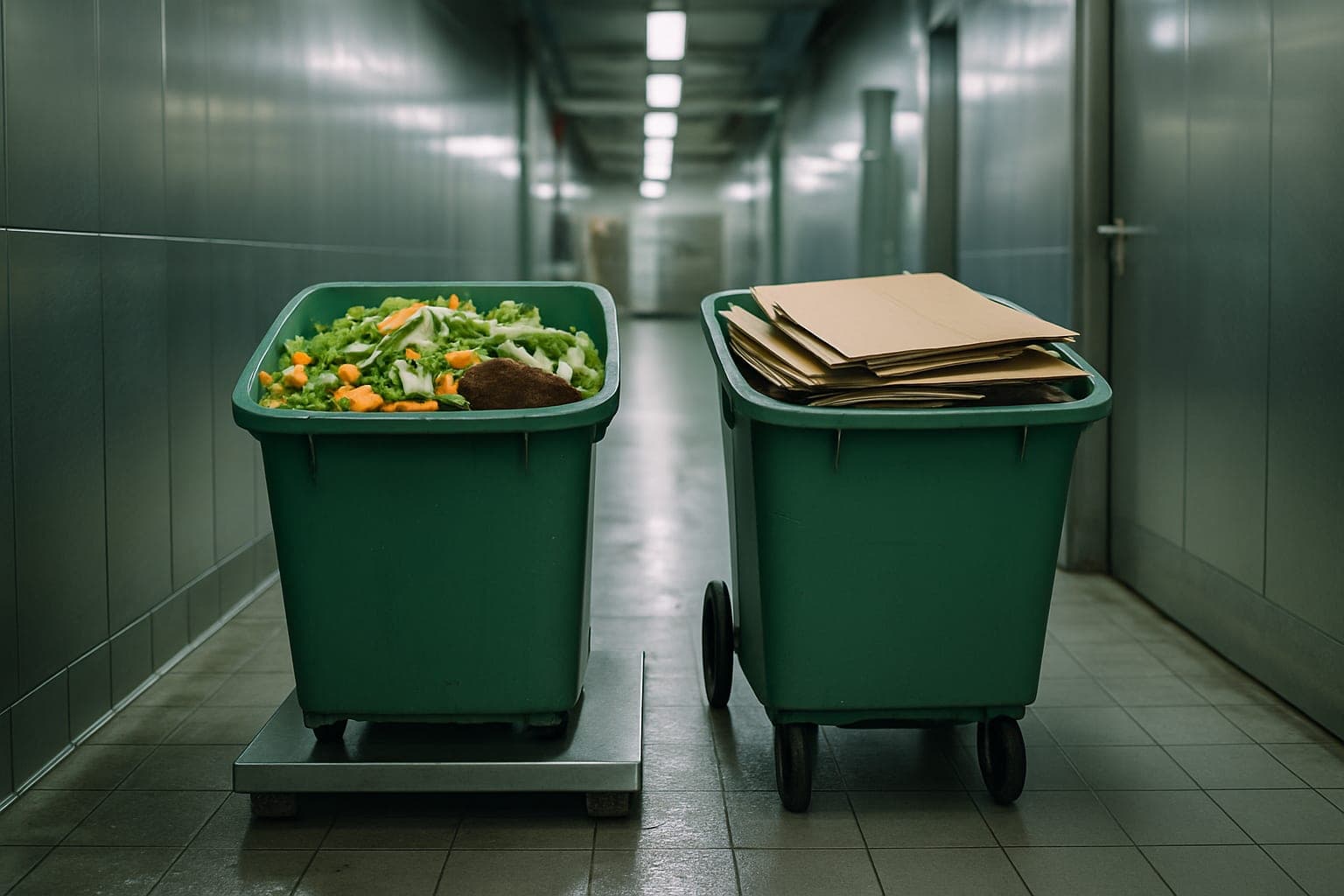
Dubai's last published tariff, Executive Council Resolution No. 58 of 2017, priced general waste sent to landfill at AED 100 per tonne from 2020 onward and organic waste delivered to treatment plants at AED 50. That AED 50 spread, not the AED 100 headline, is what a segregation programme actually earns you. It caps the gate-fee saving on organics at half your bill, and contamination can erase it.
How much does Dubai Municipality charge per tonne for food waste disposal?
The operative schedule comes from Executive Council Resolution No. 58 of 2017, which took effect on 17 May 2018. Gulf News, reporting the decree at the time, set out a three-year escalator with annual increases of AED 5 to AED 10, and stated that the 2020 rates would continue beyond that year.
| Year | General municipal waste to landfill (AED per tonne) | Organic waste to treatment plants (AED per tonne) |
|---|---|---|
| 2018 | 80 | 30 |
| 2019 | 90 | 40 |
| 2020 and beyond | 100 | 50 |
Be honest with yourself about the age of that table. It is more than seven years old. Executive Council Resolution No. 58 of 2017 is still cited in the preamble of Dubai Law No. 18 of 2024, which supports the view that it remained the operative tariff as of September 2024, but it does not prove the rates are unchanged today. Before you build a budget line on AED 100 and AED 50, get the current figures in writing from the Waste and Sewerage Agency at Dubai Municipality or from your licensed contractor.
One more piece of history matters, because it explains why older explainers mislead you. Before 17 May 2018, Dubai Municipality charged roughly AED 10 as a gate fee per truck trip. Per trip pricing rewarded compaction and hid composition. Per tonne pricing by waste type does the opposite, and that shift is the reason a kitchen's organic fraction is now a controllable cost rather than a rounding error.
Who actually pays the fee?
The municipality collects these fees from the companies authorised to collect and transport waste to its landfills and treatment plants. In practice the charge reaches you as a pass-through line on your contractor's invoice, which is why so many operators in Al Quoz, Dubai Industrial City and JAFZA have never seen the tonnage split behind their monthly total. The fees apply to waste generated by commercial establishments, factories, private and public institutions, and residential communities and freehold properties served by private collection companies.
Why segregating kitchen organics cannot cut your tipping bill by more than half
This is the arithmetic that vendor marketing skips. If organics are priced at exactly half the landfill rate, then even a theoretical stream that is 100% clean food waste saves 50% of the gate fee and no more. There is no configuration of bins that beats that ceiling on organics alone.
You will still see the claim that segregation saves up to 62% of tipping fees. It traces back to a single industry press release from 2018 about building owners and management companies, it covers all waste streams rather than food waste, and it is republished undated across UAE waste content. To get past 50% you have to move dry recyclables off the paid disposal route entirely, which means selling cardboard, glass, cans and pallets rather than tipping them. Baled OCC in particular has a market price rather than a gate fee, and current UAE cardboard bale levels are usually the fastest part of a hotel or catering waste bill to convert from cost to revenue.
What do the numbers look like for a 20-tonne-a-month kitchen?
The model below is arithmetic on the published gate fees, not a survey of invoices. Assume a mid-sized F&B or facilities operation moving 20 tonnes a month with 60% of the weight as kitchen organics.
| Stream | Mixed disposal | Segregated |
|---|---|---|
| Organics, 12 t | 12 x 100 = AED 1,200 | 12 x 50 = AED 600 |
| Residual, 8 t | 8 x 100 = AED 800 | 8 x 100 = AED 800 |
| Monthly gate fee | AED 2,000 | AED 1,400 |
| Annual gate fee | AED 24,000 | AED 16,800 |
| Annual saving | Baseline | AED 7,200, or 30% |
Capture rate drives everything from there. A kitchen that pulls only 40% of its weight into a clean organics bin gets a fifth off the gate fee. One that reaches 70% gets a third.
| Organic share captured clean | Monthly gate fee, 20 t | Saving versus mixed |
|---|---|---|
| 40% | AED 1,600 | 20% |
| 60% | AED 1,400 | 30% |
| 70% | AED 1,300 | 35% |
| 100%, theoretical | AED 1,000 | 50%, the hard ceiling |
What wipes out the saving before it reaches your P&L?
Two things, and both are operational rather than regulatory.
The first is that the gate fee is not the invoice. Your bill is haulage, labour, bin rental and gate fee. Wet organics need higher collection frequency than mixed waste because of moisture, odour and pest control, so a segregation programme often adds a second vehicle movement at a tighter interval. Those movements can consume a large share of the AED 50 per tonne spread. Model the haulage change before you present the saving to finance, or you will be defending a number you cannot deliver.
The second is contamination. A rejected organics load gets reclassified, pays the AED 100 landfill rate, and adds a re-haul charge on top. Put the break-even in front of your operations manager as a simple rule: the programme stops paying at a rejection rate of 50 divided by the sum of 50 and your re-haul surcharge per tonne. If rejection and re-haul cost AED 150 per tonne, which is illustrative rather than quoted, you break even at a 25% rejection rate. One careless shift per week on a busy line will get you there.
Can compost, digestate or animal feed offtake turn disposal into revenue?
Be careful here, because this is where most food waste business cases quietly overstate themselves. There is no exchange price for UAE food waste, compost or digestate the way there is for HMS scrap or PET bales. The economics are driven by the domestic gate-fee spread and by haulage, not by a traded commodity, and processors of wet mixed feedstock commonly charge a gate fee rather than pay for material.
Animal feed is the leg of the argument that needs the most caution. Whether food waste may legally be processed into feed in the UAE sits with federal rules administered by the Ministry of Climate Change and Environment, and we have not been able to verify the current position. Do not sign an offtake letter on the assumption that route is open. Ask for three documents before you commit: the processor's classification under Dubai's waste activity rules, written confirmation of the permitted end use, and a sample weighbridge ticket showing how your tonnage will be recorded. Where a genuine offtake does exist, whether that is compost, soil conditioner or biogas feedstock, list the volume and specification openly so more than one processor can bid, which is exactly what the organic listings on our marketplace are for.
Which law applies now in Dubai, and does it reach free zones?
Dubai Law No. 18 of 2024 Regulating Waste Management was issued on 4 September 2024, published on 10 October 2024 and came into force 30 days after publication. It repealed Local Order No. 115 of 1997 and Local Order No. 7 of 2002, with existing regulations, decisions and guides staying in force to the extent they do not conflict, pending replacement. If your compliance file still cites either repealed local order, it is out of date.
Two further instruments matter. Administrative Resolution No. 253 of 2025 sets technical guidelines for the evaluation and classification of establishments engaged in waste-related activities, with the Waste and Sewerage Agency of Dubai Municipality named as the responsible agency, so asking your contractor for its classification is now a fair and answerable question. Dubai Law No. 11 of 2024 established the Dubai Environment and Climate Change Authority, which means environmental reporting in the emirate now involves DECCA alongside the municipality. Dubai Municipality's Technical Guidelines No. 7 on mandatory waste segregation date from 13 September 2015 and their status under the 2024 law's transition clause is worth confirming rather than assuming.
On free zones, a compliance advisory has reported that Law No. 18 of 2024 applies across the emirate including special development zones and free zones such as the DIFC. We flag that as a secondary source. Verify it against the gazetted text if you operate restaurants or staff canteens inside DIFC, DMCC, JAFZA or Dubai South, because the assumption that free zone tenants sit outside municipal waste rules is exactly the kind of belief that produces an unbudgeted invoice.
Federally, the framework is Federal Law No. 12 of 2018 on Integrated Waste Management, issued on 18 December 2018, with executive regulations in Cabinet Resolution No. 39 of 2021 announced in July 2021. Under those regulations the waste generator is responsible for proper disposal of the waste it generates and bears the financial costs involved. The tipping fee is not a municipal quirk. It is polluter-pays policy landing on your profit and loss account.
How do weighbridge tickets become reportable diversion tonnage?
Here is the structural point that is worth more than the saving. Because Dubai's fees are set per tonne by waste type, every compliant movement has to be weighed and classified in order to be billed. The measurement infrastructure you need for ESG reporting already sits inside your disposal contract. You are paying for it whether or not you use the data.
- Ask your collector for its classification under Administrative Resolution No. 253 of 2025 and for the treatment facility that receives your organics.
- Split the contract into separate lines by stream so organics, residual and dry recyclables are invoiced and ticketed independently.
- Require weighbridge tickets, not estimated bin counts, for every movement, with date, vehicle, net weight and waste classification.
- Reconcile tickets to the invoice monthly. A tonnage total that does not tie to the charge is a reporting gap and usually a billing error too.
- Log rejected and reclassified loads in a separate column so your diversion figure survives an auditor's first question.
- Report diverted tonnes against a stated baseline month, and keep the transfer notes for the retention period your contract specifies.
Digital transfer notes make step three much harder to fudge, in both directions, since the movement is logged whether or not your bin was clean. Our note on Dubai waste transfer notes going digital covers what a properly documented load looks like.
National context is finally catching up with the paperwork. The ne'ma initiative was established in 2022, and the ne'ma Food Loss and Waste Reduction Roadmap announced on 19 November 2023 targets a 50% cut in national food loss and waste by 2030. The first UAE National Food Loss and Waste Baseline Study collected primary field data from 8 to 21 September 2025, bringing together more than 25 federal and local entities including MOCCAE, the Federal Competitiveness and Statistics Centre, ADAFSA, Tadweer Group, Dubai Municipality, DECCA and Aldar. That timing has a practical consequence: any UAE food waste per capita figure circulating before September 2025 is an estimate rather than a measurement, so cite your own weighbridge data instead. For a sense of how far a measured, contractual approach to diversion can go elsewhere in the country, look at Sharjah's diversion performance.
Frequently asked questions
How much does Dubai Municipality charge per tonne for food waste?
The last published schedule, Executive Council Resolution No. 58 of 2017 as reported when it took effect on 17 May 2018, set organic waste delivered to treatment plants at AED 50 per tonne from 2020 onward, against AED 100 per tonne for general waste to landfill. That schedule is more than seven years old. Confirm the current rate with Dubai Municipality's Waste and Sewerage Agency or your licensed contractor before you budget.
Can segregating food waste cut my tipping fee by more than half?
Not from organics alone. Because organics were priced at exactly half the landfill rate, even a stream that is 100% clean food waste caps the gate-fee saving at 50%. Anything beyond that requires moving cardboard, glass and metals onto zero-cost or buyback routes.
Is food waste segregation mandatory for restaurants in Dubai?
Dubai Municipality's Technical Guidelines No. 7 on mandatory waste segregation were issued on 13 September 2015, and Law No. 18 of 2024 keeps earlier regulations in force where they do not conflict with it. Specific thresholds circulating on contractor websites, such as cover counts or kilograms per day, are not verified against a primary source. Ask the Waste and Sewerage Agency in writing which duties apply to your licence category.
Will a composting or biogas plant pay me for food waste?
Treat that as unproven until you hold a written offer. There is no traded price for UAE food waste, compost or digestate the way there is for scrap metal, and processors commonly charge a gate fee rather than pay for wet mixed feedstock. The realistic gain is a lower gate fee plus verified diversion tonnage.
Can I send kitchen food waste to animal feed producers in the UAE?
Do not assume it is allowed. Whether food waste can legally be processed into animal feed falls under federal rules administered by MOCCAE, and we could not verify the current position. Get written confirmation from the regulator and from the processor's licence before you sign an offtake agreement.
What record proves a diverted tonne for ESG reporting?
The weighbridge ticket tied to your waste transfer note. Because Dubai's fees are set per tonne by waste type, every compliant movement is weighed and classified as part of billing, which gives you the primary record auditors ask for. Keep rejected loads recorded separately so your diversion figure stays defensible.

Comments(0)
Sign in to join the conversation.