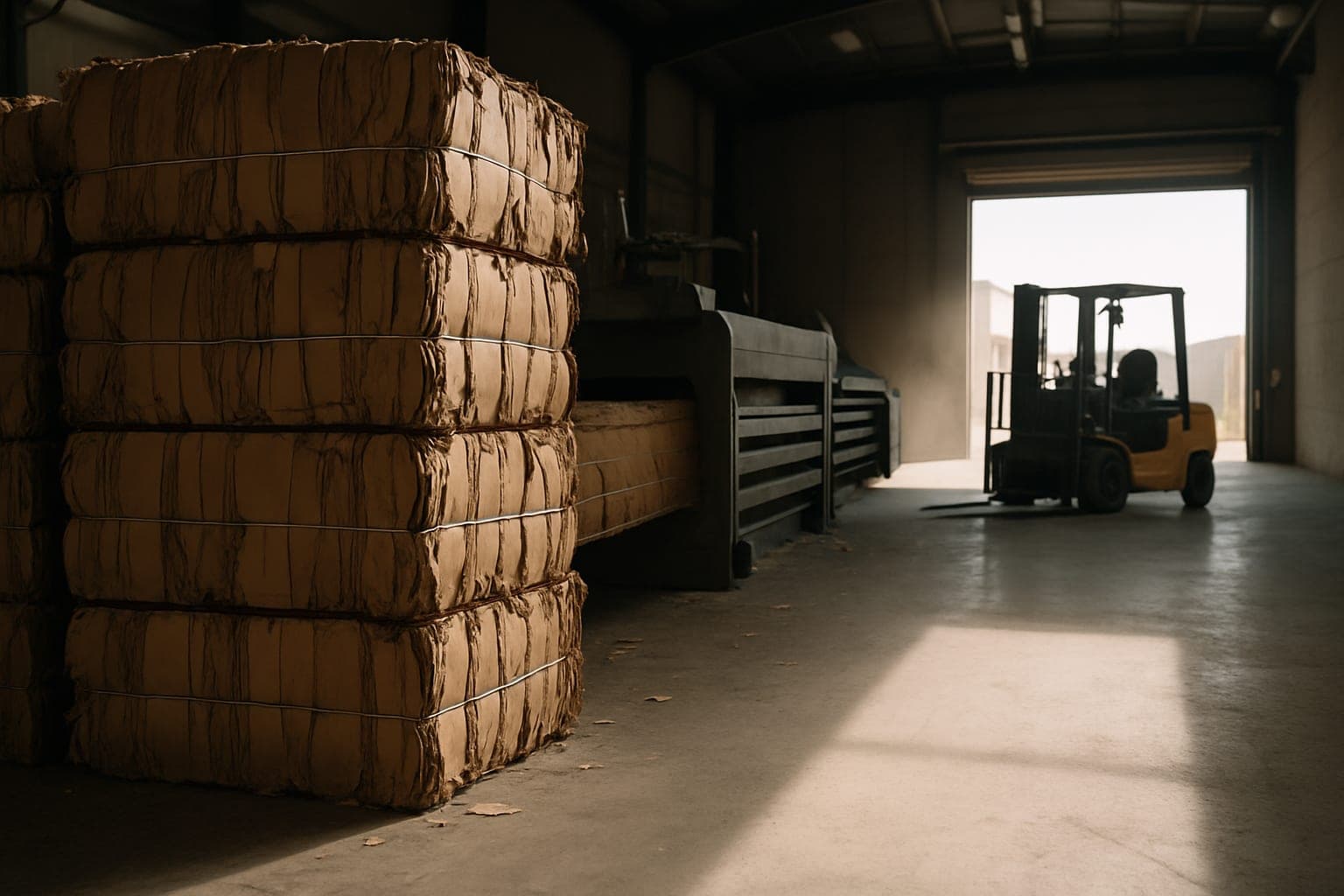
There is no exchange contract for old corrugated containers anywhere in the world. Gulf containerboard mills set the number instead, and baled OCC clears at a fraction of what those mills realise on finished board. In the most recent published assessment, PIX Testliner GCC sat at USD 479.81 per tonne, about AED 1,762. Your bale price tracks that line.
Who actually sets the OCC price in the UAE?
The mills do, and they do it through the price of the board they sell, not through any published scrap index. There is no LME, COMEX or SHFE contract for recovered fibre. Price discovery happens through subscription assessments, principally Fastmarkets RISI and Davis Index, and through bilateral negotiation between a mill's fibre buyer and whoever is standing in front of them with a container of bales.
For the Gulf, the two numbers that matter are the PIX Testliner GCC and PIX Fluting GCC indices. In the assessment Fastmarkets published on 13 March 2026, testliner stood at USD 479.81 per tonne, down USD 1.27, and fluting at USD 455.59, down USD 1.13. Small moves, but they were the first decrease since November 2023, arriving after a run of roughly USD 76 to 77 per tonne of gains over the preceding twelve months. Read the internal reporting week before you quote it in a contract discussion, because the published page date and the reporting week are not always the same.
Here is the mechanism in plain terms. A mill in the region buys OCC as an input cost against a board realisation it can forecast. When testliner is climbing, the fibre buyer has room to bid up. When board flattens and imported board is available, that room closes fast, and the first thing to go is the premium paid for marginal, wetter, poorly sorted bales.
What is baled OCC actually worth in AED per tonne?
We are going to be straight with you about something the rest of the market glosses over. There is no published UAE OCC price index. Anyone showing you a neat AED per tonne table by grade for Dubai this week has either built it from their own quote book, which is legitimate if they say so, or made it up. What exists publicly is a set of dated international reference points that bracket where a UAE gate price can sit, plus undated supplier asking prices on trade directories, which are marketing, not market data.
| Reference point | Level | AED per tonne at 3.6725 | As of | Source |
|---|---|---|---|---|
| PIX Testliner GCC (finished board) | USD 479.81/t | about 1,762 | published 13 March 2026 | Fastmarkets |
| PIX Fluting GCC (finished board) | USD 455.59/t | about 1,673 | published 13 March 2026 | Fastmarkets |
| Export baled #11 OCC, FAS major US ports | USD 136 to 139/net ton, or USD 150 to 153/t | about 551 to 563 | week of December 2025 | Davis Index via Recycling Product News |
| US domestic average OCC | USD 62.50/short ton, or USD 68.90/t | about 253 | May 2026 | Fastmarkets |
| US domestic average OCC | USD 44/short ton | about 178 | December 2025 average | Fastmarkets |
Every AED figure above is our conversion at the pegged 3.6725, from the USD original shown, so you can check the arithmetic yourself. Watch the units. US sources quote short tons and net tons at 0.907 of a metric tonne, and mishandling that puts a 10 percent error straight into your model.
For the UAE specifically, the only public numbers we found are undated asks on trade directories: one Dubai exporter listing OCC 11 at USD 200 per metric tonne, roughly AED 734, and another UAE origin listing at USD 260, roughly AED 955, on 500 tonne lots. Treat both as indicative ceilings for export-quality, container-loaded material, not as what a mill pays at the gate for your first two bales. One directory listing quoting USD 1.8 to 4.0 per kilogram for UAE waste paper is not a credible OCC number and should be ignored entirely.
The honest envelope: a well sorted, dry, mill-spec bale in the UAE prices somewhere between the US domestic floor and the FAS export level, adjusted for local freight and the trader's margin. Where inside that band you land is decided by grade, moisture and volume consistency, which are the three things you control.
Is the market really firming into Q3 2026?
The firming is coming from the global fibre cycle rather than from any Gulf print we can point to. The US national average OCC rose from USD 44 per short ton in December 2025 to USD 62.50 by May 2026, a 42 percent move in five months on Fastmarkets numbers. Behind it sits a wave of North American capacity closures, including roughly 450,000 tonnes of recycled containerboard taken out at St. Paul, Minnesota by Smurfit Westrock and around 900,000 tonnes at International Paper after the Riceboro and Savannah closures, plus 800,000 tonnes at Red River. Capacity cuts reshuffle where fibre flows, and exporters chase the better bid.
Set against that, the last GCC board assessment we can verify was marginally soft, not rising. So the accurate statement for a UAE seller in Q3 2026 is this: the international recovered fibre cycle turned up hard through the first half of 2026, Gulf board prices are near the top of a strong twelve month run, and freight is cheap enough at a Drewry World Container Index around USD 3,331 per 40ft box to keep export arbitrage open. That combination supports firmer bids for clean bales. It is not a guarantee, and anyone promising you a fixed price for twelve months is selling you something else.
How much does moisture cost you per tonne?
More than most warehouse managers assume, because water is the one thing you get paid nothing for and pay freight on. Mill specs in this region commonly sit at or below 12 percent moisture, and one Dubai supplier publicly states below 12 percent on its box-plant trimmings. Against a 10 percent contract spec, the arithmetic is fixed.
| Bale moisture | Excess water by weight vs a 10% spec | Value of that water on a notional AED 700/t |
|---|---|---|
| 15% | 5.6% | about AED 39 per tonne |
| 20% | 11.1% | about AED 78 per tonne |
| 25% | 16.7% | about AED 117 per tonne |
That is pure arithmetic, not a market claim, and it is before any de-rate or outright rejection clause a mill applies. A yard in Al Quoz or Ras Al Khor that stores bales uncovered through a humid August is not losing a few dirhams, it is shipping water at cardboard rates and inviting a quality dispute at the same time. Cover the bales. Bale dry material only. If a wash-down or a rain event soaks a batch, sell it as a separate lot rather than letting it drag down the grade of the whole load.
Which grade are you actually selling?
Get this specified in writing before anyone quotes you, because "cardboard" is not a grade. The grades traders in this market genuinely quote include OCC 11, OCC 12 double-sorted, DSOCC, NDLKC for box-plant corrugated trimmings, OINP, SOP and mixed grades. Contamination specs appear as 95/5, 90/10, 98/2 or 80/20, meaning the percentage of target material to permitted outthrows.
A retail distribution centre in Dubai Industrial City producing clean, tape-light, single-source cartons is generating a materially different product from a mixed commercial collection that includes waxed board, food residue and shrink wrap. The first can be specified as 95/5 and priced accordingly. The second gets bid as mixed and de-rated at inspection. The gap between those two outcomes is usually larger than the gap between two competing buyers on the same grade.
How much volume do you need before a mill will contract with you?
Think in containers, not tonnes. Baled OCC loads at roughly 24 to 26 metric tonnes in a 40ft container, which makes one container the practical minimum shipment for anything mill-linked or export-bound. If you cannot fill a box, you are selling into the trading layer, and that is fine, but price it accordingly.
Consistency matters at least as much as size. A mill fibre desk plans intake monthly. For scale anchors from public listings: one Fujairah collector advertises 75,000 to 80,000 tonnes a year of processing, and a regional supplier advertises 1,000 tonnes a month expandable to 2,000. That is the size of counterparty a mill signs annual terms with. A single warehouse generating 10 tonnes a month takes over two months to fill one container, by which time the earliest bales have absorbed humidity and lost grade. The Dubai Chamber directory lists 56 waste paper trading companies in Dubai alone, which tells you how thick the aggregation layer is between a mid-sized generator and a mill.
Here is the sequence we see working for a warehouse moving from paying for collection to being paid per tonne.
- Weigh what you actually generate, every week, for 60 days. Not an estimate from the waste contractor's invoice.
- Separate at source. Corrugated in one stream, no shrink wrap, no waxed board, no food-contact cartons.
- Bale on site. Loose cardboard is a transport cost problem and gets bid as mixed.
- Fix the grade and the contamination spec in writing before you ask for a price.
- Store bales under cover and load within days, not weeks.
- Sell to a KYC-verified buyer against a weighbridge ticket, with the payment held in escrow until inspection closes.
- Keep every ticket. The tonnage record is what turns a scrap sale into an ESG diversion number your auditor will accept.
If you want to see what is currently moving and at what specification, the paper category on the marketplace is the fastest way to read live demand rather than directory asking prices.
Why does a verified buyer beat a cash collector?
Not necessarily on the headline number, and we are not going to claim otherwise without our own survey to back it. The cash collector's pitch is that low overheads mean a better price. Sometimes true on a one-off pile.
What the cash collector cannot give you is any of the following: a grade and moisture spec you can hold someone to, a weighbridge ticket tied to a named legal entity, protection if the buyer collects and then disputes quality, or a tonnage record that survives contact with a sustainability audit. On AlKhiidma, counterparties are KYC-verified through UAE PASS, payment sits in escrow with MyFatoorah until the 48-hour buyer inspection window closes, and every completed trade produces an audit-ready record. For a procurement manager the escrow is the point. For a sustainability manager the record is the point. The same logic drives pricing decisions in metals, which we covered in our piece on how the scrap export duty changed local metal economics in 2026.
What paperwork stops these deals?
Permitting is the question most likely to kill a transaction late, and it is also where the published information is weakest. According to the Dubai Chamber business directory, waste paper collection and trading in Dubai requires a Dubai Municipality waste handling permit, storage and sorting facilities need Civil Defence clearance, MOCCAE oversees national recycling and waste policy, and export shipments require Federal Customs Authority documentation. That is directory-grade sourcing. Confirm each item with the issuing authority before you build a process around it, and do not rely on the AED fine figures circulating on recycling blogs, none of which we could trace to a legal citation.
One structural point worth checking with a customs broker early: a free zone warehouse in JAFZA or Hamriyah selling baled OCC to a mainland UAE mill and the same warehouse exporting through Jebel Ali or Khor Fakkan are two different documentation paths with different cost and timing. Decide which route you are on before you agree a price, not after the buyer books a truck. If you are new to trading on our platform, the FAQ covers how listing, verification and escrow work in practice.
One myth to retire
You will still hear that GCC anti-dumping duties shield Gulf mills from Spanish and Polish containerboard. Those duties came into force on 1 May 2019 at 24.6 percent for Saica of Spain, 31 percent for other Spanish producers and 34 percent for Polish producers, and they expired at the end of their five year term. Fastmarkets reported in October 2024 that contacts saw no import surge afterwards, consistent with Eurostat data for May to July. Anyone quoting those rates as current protection is working from a lapsed measure, and that matters because import competition is exactly what caps how high a mill can bid for your fibre.
Frequently asked questions
What is the OCC cardboard price in the UAE per tonne right now?
There is no published UAE OCC index, so no one can honestly give you a single verified number for this week. The credible envelope runs from the US domestic average of USD 62.50 per short ton in May 2026, about AED 253 per tonne, up to export baled #11 OCC at USD 136 to 139 per net ton FAS US ports in December 2025, about AED 551 to 563 per tonne. Undated Dubai exporter asks for OCC 11 sit near USD 200 per metric tonne, roughly AED 734.
How many tonnes do I need to sell directly to a paper mill?
Think in containers rather than tonnes, because baled OCC loads at about 24 to 26 metric tonnes in a 40ft box and that is the practical minimum shipment. Mills contract on monthly consistency, and public listings show regional counterparties operating at 1,000 tonnes a month or 75,000 tonnes a year. Below roughly one container a month you are realistically selling into the trading layer, not signing mill terms.
What moisture level do UAE buyers accept in OCC bales?
Specifications commonly sit at or below 12 percent, and at least one Dubai supplier publicly states below 12 percent for its corrugated trimmings. Against a 10 percent contract spec, a bale at 20 percent moisture carries 11.1 percent excess water by weight, which on a notional AED 700 per tonne is about AED 78 of water per tonne you are not paid for. Store bales under cover and load quickly.
Does baling cardboard on site actually pay for itself?
Run it as three lines rather than a rule of thumb: the avoided collection or tipping cost, the price uplift from selling a specified baled grade instead of loose mixed material, and the freight saving from loading 24 to 26 tonnes per container instead of air. Weigh your real arisings for 60 days before you size a machine. If you cannot fill a container within a month, the payback stretches and bale quality degrades in storage.
Is there an exchange or index price for cardboard like there is for copper?
No. OCC is not exchange traded on the LME, COMEX or SHFE, and any quote presented as an official cardboard exchange price is wrong. Price discovery runs through subscription assessments from Fastmarkets RISI and Davis Index, and in the Gulf the practical price setters are the PIX Testliner GCC and PIX Fluting GCC finished board indices, last published at USD 479.81 and USD 455.59 per tonne in March 2026.

Comments(0)
Sign in to join the conversation.