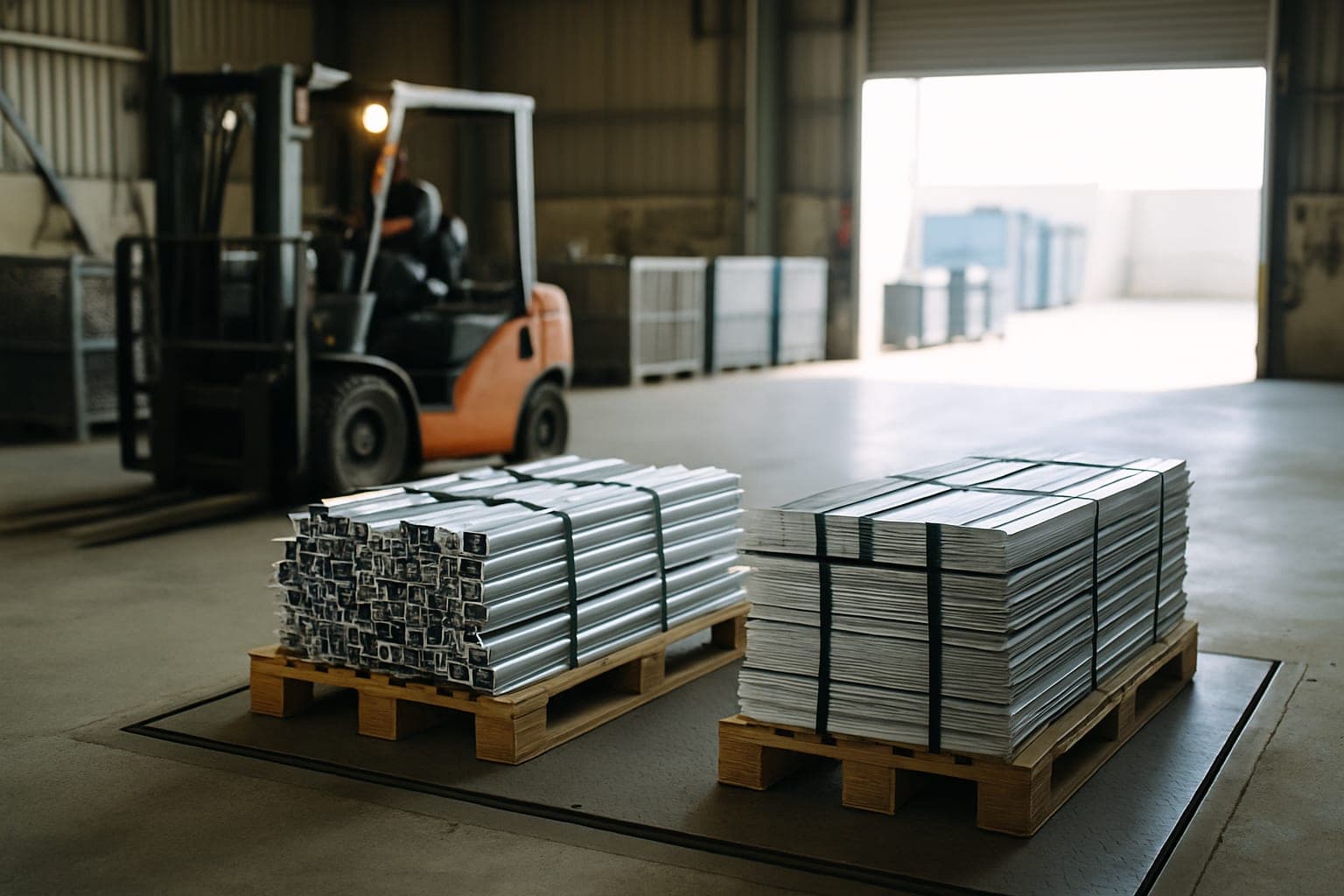
Operation 300bn pushes manufacturers to source inputs inside the UAE, and the reprocessing capacity to absorb them now exists domestically. Your prompt scrap, meaning the clean offcuts your own line produces, is the easiest material to put under contract. Forecast it by production run, grade it to one written spec, commit a minimum monthly tonnage, and report the diverted tonnes to your buyer.
What does Operation 300bn actually ask of a UAE manufacturer?
Operation 300bn was launched by the Ministry of Industry and Advanced Technology in March 2021. Its headline goal, as published on the UAE Government platform u.ae and reconfirmed in the IEA policy database on 24 June 2025, is to raise the industrial sector's contribution to GDP from AED 133 billion to AED 300 billion by 2031. That AED 133 billion is the 2021 baseline, not a current figure, and you will see it misquoted as today's number in a lot of trade coverage. The same strategy targets industrial R&D spending rising from AED 21 billion to AED 57 billion, equal to 2 per cent of GDP, and support for 13,500 industrial SMEs, according to reporting on the launch dated 27 March 2021.
Sitting beside it is the UAE Circular Economy Policy 2021 to 2031, approved by Cabinet in 2021. Its four priority areas, listed on uaelegislation.gov.ae, are sustainable infrastructure, sustainable transport, sustainable manufacturing and sustainable food production and consumption. Sustainable manufacturing is the one that lands on your plant. The policy language is about minimising waste and pollution in the manufacturing sector and supporting the private sector to move to cleaner production methods, including work on how materials are collected, sorted, separated, treated and redistributed.
The commercial lever that makes any of this move is the National In-Country Value programme. MoIAT reported that ICV had driven local procurement and services spending by major national companies to AED 48 billion by the end of the first half of 2024, with 31 local and federal entities and major national companies participating. That figure is roughly two years old at the time of writing. One compliance detail your finance team will already know: from 1 January 2025, ICV certificates issued for financial years ending after 31 December 2024 require stand-alone audited financial statements, per Grant Thornton UAE guidance dated 3 March 2025.
Why did export brokers stop being the default buyer for offcuts?
The AED 400 per tonne ferrous export duty
Plenty of supplier pages still say the UAE bans scrap metal exports. That has been wrong since January 2024. The ban, first imposed in May 2020 and repeatedly extended, was cancelled and replaced with export duties. GMK Center, citing SteelOrbis on 19 January 2024, reported the rate at AED 400 per tonne, roughly USD 109, on scrap under HS codes 720410, 720421, 720429, 720430, 720441, 720449 and 720450. Secondary trade sources put the effective date at 27 January 2024. Buyers quoted in the same coverage expected exporters to absorb the duty to stay internationally competitive, which is exactly what compresses a broker's bid at your gate.
There was an immediate knock-on inside the country too. Kallanish reported that local mills cut scrap purchase prices by AED 75 per tonne week on week effective 27 January, following the export duty announcement. We infer that date as January 2024 from the source; treat the exact week as indicative rather than settled.
The VAT reverse charge since 14 January 2026
Cabinet Decision No. 153 of 2025 introduced a reverse charge mechanism on the local supply of scrap metal between VAT-registered persons in the UAE. PwC Middle East dates the decision 4 November 2025, gazetted 26 November 2025, effective 60 days later on 14 January 2026, a timeline corroborated by Mondaq on 29 December 2025. The Ministry of Finance framed it on 14 January 2026 as part of efforts to strengthen tax system efficiency and to crack down on fraudulent practices in metal scrap trading. Practically, you now need to verify your counterparty's VAT registration status, update invoicing, and obtain the required written declarations. Our earlier piece on how the reverse charge shifts cash flow for UAE buyers works through the invoicing side in detail.
Read those two changes together. A cash broker with no verifiable VAT registration and no documentation trail became a liability, while a named domestic reprocessor buying on a repeat schedule became the lower-risk route for the same tonnes.
Which of your offcuts can actually be put on contract?
Mills sort scrap into three families. Home scrap is generated inside a steel mill during production, including trimmings and rejects. Prompt scrap, also called industrial scrap, comes out of manufacturing, such as excess material from automotive or appliance production. Obsolete scrap comes from end-of-life products. Your press offcuts, extrusion butt ends, punchings, edge trim and rejected billet are prompt scrap.
Prompt is the contractable grade for three reasons. Composition is known because you bought the input. Volume tracks a production plan rather than a collection round. Contamination is controllable at source, which matters because contaminated ferrous loads can be rejected outright at UAE recycling facilities. Mordor Intelligence, in a market assessment dated 5 March 2026, noted higher premiums for prompt material within 300 kilometres of mill gates as new furnaces reach full capacity, alongside limited short-haul trucking capacity. That is a research house estimate rather than a published index, so use it as direction, not as a price.
Distance genuinely matters here. A plant in Musaffah or Abu Dhabi Industrial City sits inside that radius of EMSTEEL's operations, which run direct reduced iron and electric arc furnace lines and host what Global Energy Monitor described on 19 June 2026 as the world's first fully commercial carbon capture steel project, with capacity to capture up to 800,000 tonnes of CO2 a year since 2016. Published capacity figures for the group differ between sources, so confirm current melt capacity directly before you build it into a supply plan.
What changed on the aluminium side?
EGA stated on 13 May 2025 that most aluminium scrap generated in the UAE was being exported for processing outside the country and lost to the national economy. That changed in June 2026. Zawya reported on 25 June 2026 that EGA inaugurated the Al Taweelah aluminium recycling plant in Abu Dhabi, the largest of its kind in the country, with 185,000 tonnes per year of capacity, processing post-consumer and some pre-consumer scrap into low-carbon billets and T-bars marketed as RevivAL. Note the number: an earlier 170,000 tonnes per year figure from the construction phase is superseded. Group recycling capacity across the UAE, Europe and the US now exceeds 400,000 tonnes a year, with a further 200,000 under development.
For a fabricator running aluminium extrusion, that is a domestic buyer for pre-consumer offcuts that previously had one realistic route out of the country. We covered the supply-side effect in our analysis of Al Taweelah tightening UAE aluminium scrap supply.
What are UAE buyers paying, and how old is the number?
Ferrous scrap moves weekly. Every figure below carries its date, and none of them should be pasted into a contract as a fixed price.
| Grade | Price (AED/tonne) | As at | Source and caution |
|---|---|---|---|
| HMS 80:20 processed | 1,245 | 2 Dec 2024 | Steel Radar, around 20 months old |
| HMS sheared | 1,325 | Jan 2024 (inferred) | Kallanish, ex-VAT, delivered buyer's yard |
| Fabrication scrap | 1,320 | Jan 2024 (inferred) | Kallanish, ex-VAT, delivered buyer's yard |
| HMS 80:20 | 1,225 | Jan 2024 (inferred) | Kallanish, ex-VAT, delivered buyer's yard |
| Light and HMS blended | 1,050 | Jan 2024 (inferred) | Kallanish, ex-VAT, delivered buyer's yard |
The spread between sheared fabrication scrap and a light blended load in that Kallanish set is around AED 275 per tonne. That gap is grading discipline, not market luck. At collector level the same logic shows up per kilo: a Dubai collector's own estimator page dated 3 April 2026 quotes rates ranging from about AED 0.8 per kg for iron up to AED 26 per kg for clean copper. It is a commercial estimator rather than an index, but the clean-versus-contaminated spread is the point. Sorting at source is where the money is, as we showed in the piece on stripping copper cable before you sell it.
How do you turn an irregular scrap sale into a scheduled offtake?
- Baseline twelve months of generation by grade. Weighbridge tickets, not estimates. Split by alloy or steel grade, and record the month, not just the annual total.
- Tie the forecast to your production plan. Express offcut generation as a yield loss percentage per product line, then run it against next year's order book. That gives a buyer a forecast they can audit rather than a promise.
- Write one page per grade. Alloy or grade designation, dimension range, maximum oil or coolant residue, no mixed fasteners, no painted or coated pieces unless declared, packaging format, and load size. Send it to the buyer before the first delivery, not after the first rejection.
- Commit a conservative minimum monthly tonnage. Take your lowest three months from the baseline, not the average, and contract at or below that floor. Sell the upside as declared additional volume at the same formula.
- Price by formula, not a fixed AED number. Reference a published benchmark plus or minus an agreed grade differential, reset monthly. Fixed prices break in a market that moved AED 75 per tonne in a single week in January 2024.
- Agree inspection and rejection in writing. Who samples, where, within how long, what happens to a rejected load, and who pays the return freight. Our marketplace runs a 48-hour buyer inspection window for exactly this reason.
- Fix the tax and payment mechanics. Verify VAT registration on both sides, hold the written declarations required under Cabinet Decision No. 153 of 2025, and settle through escrow rather than open credit on a new counterparty.
- Report every load. Tonnes by grade, contamination rejections, destination facility and haul distance, issued monthly.
What does the buyer need for their circular-economy reporting?
A recycler buying prompt scrap under a repeat agreement is usually reporting upward to a manufacturer that has sustainable-manufacturing commitments under the Circular Economy Policy, ICV obligations, or both. The data they need from you is unglamorous and specific: tonnage by material and grade, whether the material is pre-consumer or post-consumer, the generating facility and emirate, transport distance, contamination rate as a percentage of delivered weight, and a clean chain of weighbridge and transfer documents. Supply that as a monthly pack and you become difficult to replace.
One caution before you build a pitch around it. We have not verified whether purchasing recycled or locally reprocessed feedstock earns points under the current ICV Certification Guidelines. Check the guidelines with your certifying body first, and do not let a sales deck assert it. What you can say without risk is that the material stayed in the country, that a named domestic reprocessor consumed it, and that the tonnes are documented. On our side, KYC verification through UAE PASS, escrow settlement via MyFatoorah and audit-ready ESG records exist so that those claims survive an auditor's question. You can see live requirements from industrial buyers on the industrial category of the marketplace.
Spot broker or contracted domestic offtake?
| Factor | Spot sale to a broker | Contracted domestic offtake |
|---|---|---|
| Price basis | Bid at collection, often below index | Formula against a benchmark, reset monthly |
| Export duty exposure | Broker prices in the AED 400/t ferrous duty | Not applicable on domestic delivery |
| VAT handling | Risk if counterparty status is unverified | Reverse charge with written declarations on file |
| Volume certainty | None on either side | Minimum monthly tonnage, declared upside |
| Rejection risk | Discount applied at the gate | Defined spec, sampling and inspection window |
| Reporting value | Little to none | Monthly tonnage and destination data |
Frequently asked questions
Is exporting scrap metal from the UAE still banned?
No. The ban that ran from May 2020 was cancelled and replaced with export duties, with trade sources putting the change at 27 January 2024. GMK Center, citing SteelOrbis on 19 January 2024, reported a duty of AED 400 per tonne, about USD 109, on ferrous scrap under HS codes 720410, 720421, 720429, 720430, 720441, 720449 and 720450. Confirm current rates and code coverage with customs before you quote an export sale.
Do I still charge 5 per cent VAT on a domestic scrap metal sale?
Not between VAT-registered persons in the UAE. Cabinet Decision No. 153 of 2025 introduced a reverse charge mechanism on local supplies of scrap metal, effective 14 January 2026 after gazetting on 26 November 2025. Sellers need to verify the buyer's VAT registration and hold the required written declarations, and invoicing templates have to reflect the change.
What is prompt scrap and why does it price better?
Prompt or industrial scrap is generated during manufacturing, such as offcuts and excess material from production lines, as distinct from home scrap made inside a mill and obsolete scrap from end-of-life products. Its composition is known, it arrives clean, and volumes follow a production plan. Mordor Intelligence noted in a 5 March 2026 assessment that premiums for prompt material within 300 kilometres of mill gates had risen as new furnace capacity came online.
What minimum tonnage should I commit to in an offtake agreement?
Base it on your three weakest months from twelve months of weighbridge data, not the annual average. Contract at or slightly below that floor so a slow quarter never puts you in breach, then declare additional volume under the same pricing formula. Buyers value a small commitment they can rely on far more than a large one that misses.
Where can UAE manufacturers find repeat buyers for factory offcuts?
Domestic reprocessing capacity has grown, including EGA's 185,000 tonnes per year aluminium recycling plant at Al Taweelah, inaugurated in June 2026 per Zawya reporting on 25 June 2026. On AlKhiidma you can list industrial offcuts to KYC-verified counterparties, settle through escrow and use the 48-hour inspection window to keep grade disputes out of the relationship.

Comments(0)
Sign in to join the conversation.