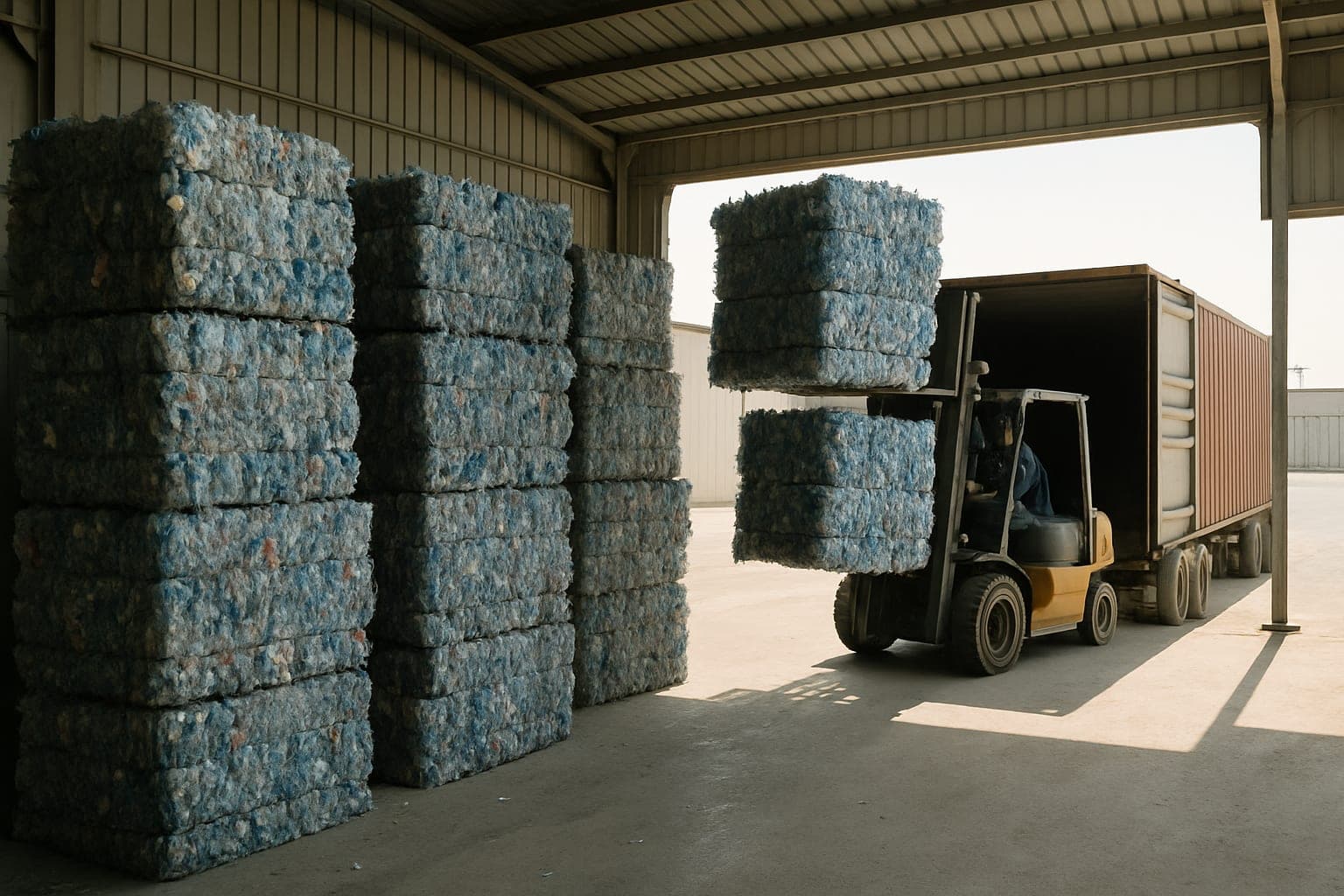
No public index quotes a PET bale price in the UAE, so every tonne is negotiated. What has changed is the spread: clear, dry, low-cap bales headed for food-grade lines attract real competition, while mixed-colour and wet bales soften. Colour, moisture, bale density and cap contamination decide where your tonne lands. Get the buyer's spec in writing before you bale.
Is there a published PET bale price in the UAE?
There is not. We looked for an AED per tonne assessment from a government body, an exchange or a trade publication covering the UAE, and found none as of August 2026. Dubai Municipality, Tadweer and Bee'ah publish operational data, not bale prices. Rebound Plastic Exchange, launched in Abu Dhabi on 5 September 2022 as a subsidiary of International Holding Company and headquartered in ADGM, was set up as a quality-assured B2B venue for recycled plastics, but it is a trading platform rather than a public price index.
PET is also not an exchange-traded commodity. There is no LME contract for it, and anyone who tells you otherwise is guessing. The real chain runs crude oil to paraxylene to MEG to virgin bottle-grade resin, and rPET then prices at a premium or a discount to that virgin number depending on whether the buyer needs food-contact certification. Live assessments exist from ICIS, S&P Global Commodity Insights, CCF Group and Resource Recycling, all paywalled.
The only properly attributed bale numbers we can publish are American and old, and we show them here purely to make a point about volatility, not to price your load.
| Basis | Reported figure | Source and date | Our conversion at AED 3.6725/USD |
|---|---|---|---|
| Post-consumer PET bottle and jar bales, US national average | 12.02 US cents/lb | Resource Recycling, 17 January 2023 | about AED 973 per tonne |
| Same, one year earlier | 20.22 US cents/lb | Resource Recycling, 17 January 2023 | about AED 1,637 per tonne |
| Same, regional high in that month | 14.00 US cents/lb | Resource Recycling, 17 January 2023 | about AED 1,134 per tonne |
| OCC/corrugated for comparison | USD 30 per ton, against USD 136 a year earlier | Resource Recycling, 17 January 2023 | about AED 110 per tonne |
Read that table as a warning. PET bales lost roughly 47 percent of their value in twelve months in a single market. In March 2026, Resource Recycling reported that some recycled-plastic bales were moving at the lowest possible prices and in a few cases at negative values as sorting facilities cleared floor space. That is US-grade commentary, but it is the most recent dated bale reporting available, and it argues for a two-tier market rather than a uniform rise.
Why are UAE reprocessors bidding harder for clean bales?
Because installed and announced rPET capacity has been built around specification, and specification is scarce. The Ministry of Industry and Advanced Technology announced an MoU on 23 January 2023 for a food-grade plastic recycling plant in Abu Dhabi, sized at 12,000 tonnes per year across a 40,000 square metre site with around 100 jobs. A separate PET recycling project at KIZAD was reported by Construction Week on 26 July 2021 with a 12,700 tonnes per year output target, backed by Environment Agency Abu Dhabi and Tadweer. We have not verified the current commissioning status of either, so treat them as announced rather than running.
Others are demonstrably operating. DGrade runs a 4,000 square metre plant in Abu Dhabi with capacity to process 3,000 kg of plastic per hour, converting PET into recycled polyester fibre through its Greenspun process, described in a peer-reviewed article published 21 December 2024. Bee'ah opened a commercial and industrial recycling facility in Sharjah in October 2022 using AI and robotic sorting across more than ten material streams including PET. Horizon Technologies FZC in Fujairah received a food-grade Certificate of Conformity from MoIAT for recycled PET granules in May 2023.
That certificate is the whole story on price. A bottle-to-bottle buyer holding a MoIAT Food Grade Certificate of Conformity under the UAE Regulation for Control on Food Contact Materials can pay more than a strapping or fibre buyer, because the resin it sells is worth more. A Ken Research page dated 29 December 2025 projected that a 15,000 tonne per year PET recycling plant would generate AED 160 million of local value annually, which works out to roughly AED 10,667 per tonne of output on our arithmetic. That is a vendor figure with undisclosed methodology, so treat it as indicative only, but the gap between output value in the thousands of dirhams and bale value in the hundreds explains why reprocessors will chase a clean load across three emirates.
What determines the price per tonne?
Colour
Clear natural PET sits at the top. Light blue tinted water bottle material sits just below it and is usually acceptable in bottle-grade lines at a small discount. Green and mixed colour drop to fibre and strapping economics, because colour cannot be removed. If your waste stream mixes clear water bottles from a hotel with green soft drink bottles from a food court, you are averaging your own price down for the sake of one less sorting station.
Labels and moisture
Full-sleeve shrink labels, adhesive residue and any liquid left in bottles all cost the reprocessor washing capacity and yield. Moisture is the one that catches sellers out, because a bale that sat uncovered on a loading dock in Ras Al Khor through a humid August night can gain weight the buyer refuses to pay for. Buyers set their own moisture tolerance and their own test method. Ask what it is, in writing, before the first load.
Bale density
You are paying freight on volume and getting paid on weight. A loose bale burns the same container space as a dense one and earns less, so a low-density bale is penalised twice, once on the freight bill and once on the bid. If you are producing a few tonnes a month from scattered sites, the baler specification matters more than the collection contract.
Caps, rings and out-throws
PP caps and PE rings separate in a sink-float stage, so most buyers tolerate them at some level. PVC, silicone, metal and non-bottle rigids are a different matter, and a small percentage of the wrong polymer can downgrade or reject an entire load. Confirm whether your buyer deducts on a stated percentage basis or rejects outright, because those two contract structures produce very different outcomes on a bad week.
How much tonnage does a buyer actually want each month?
Do the arithmetic from plant capacity, not from optimism. A 12,000 tonne per year line needs roughly 1,000 tonnes a month to run at nameplate. No single hotel, mall or logistics park in the UAE produces anything close to that in baled PET, which is why reprocessors buy from aggregators and why consistency beats size for a seller. A generator delivering 8 to 12 tonnes a month on a predictable schedule, to a fixed spec, is worth more to a buyer than an occasional 40 tonne windfall of unknown quality.
Geography helps you here. Workshops and warehouses in Al Quoz, Ras Al Khor, Dubai Industrial City, JAFZA, Musaffah, KEZAD and Al Sajaa sit close enough to each other that two or three mid-sized generators can present a combined monthly volume that a reprocessor will price properly. You can see who is currently moving material by browsing the live plastics listings on our marketplace before you commit to a baler purchase or a collection contract.
Do you need a permit to sell baled PET in Dubai?
Waste trading is a classified activity in Dubai, so yes, check your side of it. Law No. 18 of 2024 Regulating Waste Management in the Emirate of Dubai governs the sector, and Administrative Resolution No. 253 of 2025 approved technical guidelines for evaluating and classifying establishments engaged in waste collection and transportation, waste trading, and waste treatment and recycling, with the Waste and Sewerage Agency at Dubai Municipality as the competent body. Law No. 18 also prohibits moving waste into or out of Dubai Municipality disposal sites without a permit.
On the collection side, Dubai Municipality publishes a list of companies permitted to collect waste, and Circular No. 1 of 2024 covers hygiene standards for waste transport vehicles and bins. Federally, MOCCAE Ministerial Decision No. 380 of 2022 took effect on 1 January 2024 and bans the import, production and trade of single-use shopping bags including those labelled biodegradable, with a MOCCAE explanatory guide detailed publicly on 2 January 2025. The National reported on 16 December 2025 that an expanded ban on further single-use plastic items would begin in January 2026, and we have not been able to confirm the final product list, so verify it against the MOCCAE guide before you change any packaging spec.
How do you run a repeat offtake instead of one-off pickups?
One-off pickups are where value leaks. The collector prices for risk, you carry the quality dispute, and nobody builds a record you can show an auditor. A standing monthly offtake fixes all three.
- Write a one-page spec sheet: colour split, label type, permitted caps, maximum moisture, bale dimensions and target weight, and the polymer out-throws you will not send.
- Sample before you commit. Send one bale, let the buyer core it or wash-test it, and record the yield result as the baseline for the contract.
- Agree a price formula, not a fixed price. Tie it to the buyer's published or quoted rPET reference with a stated review date, monthly or quarterly, so neither side has to renegotiate from scratch after a resin move.
- Set a tonnage band with tolerance, for example 8 to 12 tonnes a month, rather than a single number you will miss in Ramadan or during a hotel refurbishment.
- Verify the counterparty. On AlKhiidma, both sides complete KYC through UAE PASS, so you know the trading licence behind the bid before material moves.
- Hold funds in escrow through MyFatoorah and use the 48-hour inspection window as your quality mechanism. The buyer inspects, the money releases, and a moisture argument becomes a documented deduction instead of a six-week collection call.
- Keep the paperwork. Weighbridge tickets, inspection outcomes and settlement records are what turn a diversion claim into an audit-ready ESG line item.
Escrow is not a formality on this material. PET bale quality is only fully known after the wash line runs, which is exactly why buyers discount unknown sellers, and exactly why a verified inspection window lets a new seller earn a better first price. Our FAQ sets out how the inspection window and payment release work in practice.
What could push prices the other way?
Freight and export arbitrage. Local bids are supported when exporters are competing for the same bales, and they weaken when the export route closes. Resource Recycling reported that on 13 March 2026 Maersk suspended bookings to and from the UAE, Iraq, Kuwait, Qatar, Salalah and Bahrain, while still accepting bookings from Sohar, Jeddah and King Abdullah ports. We have not confirmed whether that suspension was still in force in August 2026, so check current sailing availability with your forwarder before you assume an export floor under your price.
There is also competition from energy recovery. Dubai's Warsan waste-to-energy plant occupies 400,000 square metres and processes a daily volume the emirate describes as equivalent to the waste of three million people, which means the calorific fraction has a competing home. Sellers of metals have seen a related dynamic from the other direction, and our note on how export duty changed local metal economics in 2026 is a useful comparison for anyone weighing a local offtake against a container.
Frequently asked questions
What is the current PET bale price per tonne in the UAE?
No government body, exchange or trade publication publishes an AED per tonne PET bale assessment for the UAE, as of August 2026. Any number you are quoted is a private bid or a converted global proxy, so always ask for the date, the grade and the delivery basis. For scale only, US post-consumer PET bottle bales averaged 12.02 US cents per pound in the Resource Recycling report of 17 January 2023, about AED 973 per tonne on our conversion at the AED 3.6725 peg.
Why do clear PET bales sell for more than mixed colour?
Colour cannot be washed out, so green and mixed bales are locked out of clear bottle-grade and clear sheet applications and fall back to fibre and strapping economics. Clear natural and light blue material can feed food-contact lines, where the finished resin sells at a much higher value. Separating clear from coloured at source is usually the single highest-return change a generator can make.
Do I need a licence to sell baled PET in Dubai?
Waste trading is a classified activity under Law No. 18 of 2024 Regulating Waste Management in the Emirate of Dubai, and Administrative Resolution No. 253 of 2025 approved technical guidelines for classifying waste trading, collection and transport, and treatment and recycling establishments. The Waste and Sewerage Agency at Dubai Municipality is the competent body. Check your activity code and your hauler's permit status before signing an offtake.
How many tonnes a month do I need to interest a reprocessor?
A 12,000 tonne per year line, the size announced for the Abu Dhabi food-grade plant in the MOIAT MoU of 23 January 2023, needs about 1,000 tonnes a month at nameplate. No single UAE site generates that, so buyers work with aggregated supply. A consistent 8 to 12 tonnes a month at a fixed spec is generally more valuable to a buyer than a larger irregular volume of unknown quality.
Can recycled PET be used for food packaging in the UAE?
Yes, where the producer holds a Food Grade Certificate of Conformity issued by the Ministry of Industry and Advanced Technology under the UAE Regulation for Control on Food Contact Materials. Horizon Technologies FZC in Fujairah received such certification for recycled PET granules in May 2023. Buyers with that certificate can generally pay more for clean, low-contamination bales than fibre or strapping producers.
How does escrow protect a PET bale sale?
Bale quality is only fully proven after washing, which is why buyers discount sellers they do not know. Escrow through MyFatoorah holds the funds while the buyer uses a 48-hour inspection window, so disputes become documented deductions rather than unpaid invoices. It also gives a first-time seller a route to a fair price without a long trading history.

Comments(0)
Sign in to join the conversation.