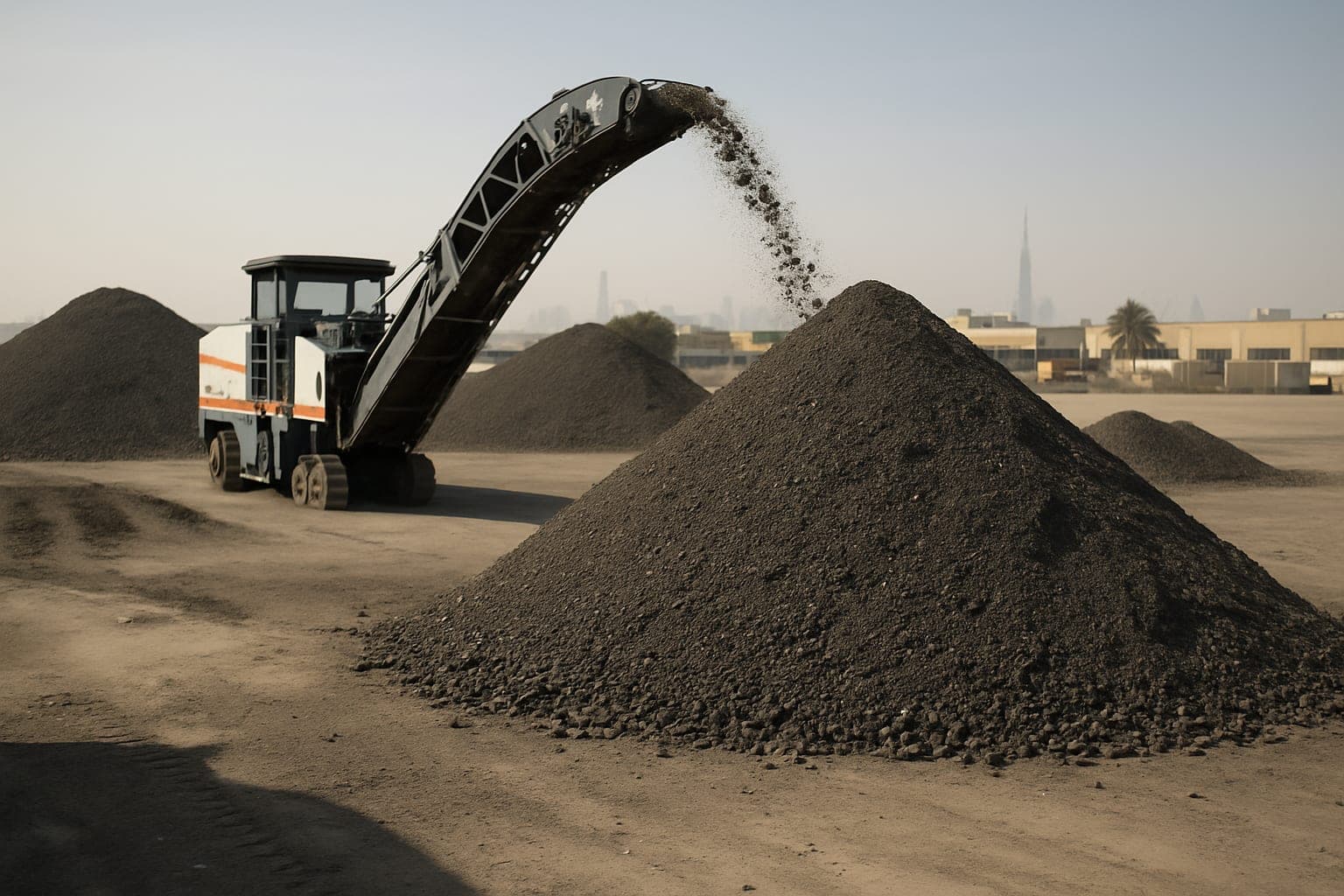
Milled asphalt from a Dubai resurfacing job is a saleable granular material, not spoil. The buyers are hot mix asphalt plants, base course and civils contractors, and crusher yards that process recycled aggregate. What you get paid turns on binder content, gradation after crushing, and whether the stockpile stayed single source and clean. Sell it segregated and you convert a disposal line into revenue.
Who buys reclaimed asphalt pavement in Dubai?
There are three real buyer groups, and they want different things from the same pile.
Asphalt plants want RAP they can meter into a hot mix, which means they care most about consistency of binder content and a predictable size fraction. Base course and yard contractors want a compactable granular layer for haul roads, laydown areas, parking and hardstanding, and they care most about gradation and the absence of clay, gypsum board, plastic sheeting and reinforcement. Crusher and recycled aggregate yards will take a wider range because processing is their business, but they price accordingly. They are buying your problem as well as your material.
Geography decides a lot of it. Dubai's Roads and Transport Authority finished 17 km of asphalt maintenance and rehabilitation across nine streets in six areas by early June 2026 under its annual preventive maintenance programme, including work on Sheikh Mohammed bin Zayed Road and Al Khawaneej Street and in Mirdif, Zaabeel 1, Margham, Al Thanyah Fifth, Al Garhoud and Jebel Ali Industrial Area 2, as reported by Gulf News on 23 June 2026 and Khaleej Times on 24 June 2026. That last location matters commercially. Millings generated inside an industrial area sit within a short haul of plant yards and crushers, and haulage is usually the single largest cost in the trade.
What makes one RAP stockpile worth more than another?
RAP is not one commodity. The engineering literature is blunt about this: material milled from a pavement has to be crushed and screened to reach a target binder content and gradation before it behaves predictably, which is why unprocessed, mixed source piles are a different and much cheaper product from segregated, tested, single source RAP.
Binder content
The aged bitumen coating the aggregate is the reason RAP is worth more than crushed concrete. A plant taking your material is displacing both virgin aggregate and a share of virgin binder. A review of cold recycled bituminous mixtures published in Road Materials and Pavement Design in 2025 sets out the point that both the aggregate skeleton and the aged binder govern how the mix performs, so binder content is not a nice to have on the test sheet, it is the pricing variable. Have it measured. A buyer who has to assume the worst will pay for the worst.
Gradation and fines
Milling machines produce a spread of particle sizes, and the fine fraction carries a disproportionate share of the binder. If your material has been dozed, tracked over and re-handled three times in a compound, the gradation you sampled in week one is not the gradation the buyer loads in week six. Screening on site, even a single deck, changes the conversation.
Segregation and contamination
This is where most UAE sellers lose money. One pile that mixes millings from a surface course, subgrade excavation, broken kerbstones and site sweepings is priced as fill. Two clean piles, one RAP and one crushed concrete, can be sold to two different buyers at two different prices. Summer heat is a further reason to keep stockpiles low, shaped and separated, because tall piles of binder rich material consolidate and are harder to reclaim without re-crushing.
What is a tonne of millings actually worth in the UAE?
Plainly: there is no published UAE benchmark for RAP, and anyone quoting you one confidently is quoting something else. There is no exchange price, no widely circulated regional assessment, and no UAE tonnage figure for RAP generation or consumption that we have been able to trace to a primary source. What does exist is a derived value. RAP is priced as a discount to the two things it displaces, virgin coarse aggregate, largely gabbro railed and trucked from Fujairah and Ras Al Khaimah quarries, and bitumen, which tracks crude and regional refinery economics.
Be careful with the numbers that come up first in a search. The USD 10 to 40 per ton figures widely published in 2025 and 2026 are American residential cost guides, aimed at homeowners buying millings for driveways, in a market where state highway contracts often release millings at nominal cost. Converting those to dirhams and presenting them as a UAE B2B price is misleading in both directions. If you want a real number, get two or three written quotes per tonne, stated ex site and delivered separately, from named plants or yards, and treat the spread between them as information about your material rather than about the market.
| Stockpile condition | What the buyer sees | Likely buyer | Main value driver |
|---|---|---|---|
| Single source millings, screened, binder content tested | A feedstock with a known specification | Hot mix asphalt plant | Binder content and consistency |
| Single source millings, unscreened, kept separate | Usable after their own crushing and screening | Crusher or recycled aggregate yard | Volume and haul distance |
| Millings mixed with excavated subgrade | Granular fill of uncertain quality | Yard, haul road or laydown contractor | Gradation and compaction behaviour |
| Millings mixed with general C&D and site sweepings | Waste with a sorting cost attached | Waste contractor, at a gate fee | Nothing. You pay |
The same logic applies across the inert stream, and the arithmetic is easier to follow on concrete, where the market is better established. Our note on how to sell crushed concrete in Dubai instead of paying tipping fees walks through the same segregate, test, list sequence with a material most sites already produce in bulk.
Can you reuse RAP in sub-base on a Dubai project?
Reuse in unbound sub-base and in bituminous layers is normal engineering practice internationally, and a life cycle assessment of UAE roadworks published in the Journal of Cleaner Production in February 2020 compared recycled construction waste, RAP, warm mix asphalt and blast furnace slag against conventional practice, which tells you the question has been studied here. That paper is now more than six years old, and it is not a specification.
The permitted percentage of RAP by layer, wearing course versus binder versus base, the testing regime and the approval route all sit in the client authority's works specification, whether that is RTA, Dubai Municipality, a free zone authority or a private developer's engineer. We are not going to print a percentage we cannot source. Get the clause number from the engineer in writing before you plan a reuse strategy around it, and get it early, because a mid-contract request to substitute recycled material into a base layer rarely survives a programme review.
The regulatory frame you are trading inside
Dubai's operative statute is Law No. 18 of 2024 Regulating Waste Management in the Emirate of Dubai, sitting under Federal Law No. 12 of 2018 on Integrated Waste Management. Administrative Resolution No. 253 of 2025 approved technical guidelines for evaluating and classifying establishments engaged in waste related activities, administered by the Waste and Sewerage Agency at Dubai Municipality. That last one has a direct commercial consequence: the classification of the yard you sell to is now a formal matter, and it belongs in your due diligence alongside the trade licence.
On fees, Executive Council Resolution No. 58 of 2017 approved the schedules for waste disposal fees and fines. Dubai Municipality announced in August 2021 that the resolution would take effect on 1 January 2022, and that it permits recycling facilities to charge for waste they receive and treat. Read that carefully if you are a contractor. Sending material to a recycler is not automatically free, and the difference between a gate fee and a purchase price is a negotiation, not a rule. The tipping fee figures circulating on commercial waste websites in 2026 vary so widely, from single digit dirhams to nearly AED 200 per tonne for C&D, that none of them should be used for budgeting. Pull the schedules from the Dubai Legislation portal or ask your waste contractor for the receipt.
Is there really a 70 per cent C&D recycling target?
Not that we can verify, and this is worth correcting because contractors act on it. The 70 per cent figure that circulates in UAE construction content describes construction and demolition material as a share of the total solid waste stream by weight, not a recycling rate or a legal target. The verified target language we can point to is Dubai Municipality's August 2021 statement of the Dubai Integrated Waste Management Strategy 2021 to 2041, which set out full diversion of waste from landfill by 2030 and per capita waste falling from 1.1 kg per day at the end of 2021 to 0.9 kg by 2030 and 0.65 kg by 2041. That statement is five years old and remains the most recent verified version we have. Project level diversion percentages quoted by contractors, commonly 50 per cent, appear in commercial guides without a named instrument behind them. Ask for the instrument.
How do you turn a tipping cost into revenue mid-project?
- Confirm ownership of the millings in your contract. On many road contracts the arisings belong to the client authority unless the documents say otherwise.
- Give RAP its own stockpile from day one of milling, on a hardstanding, away from excavated material and site sweepings.
- Take a composite sample and get binder content and gradation tested at an accredited lab. One test report changes the price band you can ask for.
- Estimate tonnage from milled area, depth and an assumed density, then reconcile against weighbridge tickets rather than truck counts.
- List the material with the test results, location, tonnage available and the date the stockpile must clear.
- Quote ex site and delivered separately, so buyers with their own tippers can bid against buyers who need haulage included.
- Keep the weighbridge tickets and the buyer's classification details. They are what makes the diversion tonnage defensible in an ESG or client sustainability report.
Timing is the part contractors underestimate. Millings have a natural buyer while the milling machines are still on site and the tonnage is visible and fresh. Six months later, the same pile is a compacted, contaminated obstruction that the demobilisation budget has to pay to remove. List it in week one of the milling programme, not in the final month.
How does AlKhiidma handle a RAP sale?
You post the material to the construction category with tonnage, location, test results and your clearance deadline. Counterparties are KYC verified through UAE PASS, payment is held in escrow through MyFatoorah, and the buyer has a 48 hour inspection window after delivery, which is exactly the protection a buyer needs when the difference between a good pile and a bad pile is visible only at the tipping point. Sellers pay a promotion package to publish. Browsing and sign up are free, and the diversion tonnage flows into audit ready ESG reporting you can hand to a client.
If you are working through a wider site waste plan rather than a single stockpile, the rest of our market insights coverage tracks how UAE prices and rules are moving across the other streams a project generates.
Frequently asked questions
Who buys asphalt millings in Dubai?
Hot mix asphalt plants, base course and civils contractors building yards, haul roads and hardstanding, and crusher yards that process and resell recycled aggregate. Asphalt plants pay most for consistent, tested material with a known binder content. Contractors and crusher yards will take a wider range but price it lower because they carry the processing and sorting risk.
What is reclaimed asphalt pavement worth per tonne in the UAE?
There is no published UAE benchmark price for RAP, and no exchange or regional assessment covers it. Value is derived as a discount to the virgin aggregate and bitumen it displaces, so it moves with quarry and bitumen economics. Ignore the USD 10 to 40 per ton figures in US cost guides, which come from a residential market with a different structure, and get written quotes ex site and delivered from named buyers instead.
Can recycled asphalt be used in road sub-base in Dubai?
Reuse in unbound sub-base and in bituminous layers is established practice, but the permitted percentage by layer, the testing regime and the approval route sit in the client authority's works specification rather than in general waste law. Ask the engineer for the specific clause in writing before you build a reuse plan around it. Requests raised mid contract are far harder to get approved.
Does Dubai have a 70 per cent construction waste recycling target?
The 70 per cent figure commonly quoted describes construction and demolition material as a share of the total solid waste stream by weight, not a recycling target. The verified target we can cite is Dubai Municipality's August 2021 statement under the Dubai Integrated Waste Management Strategy 2021 to 2041, aiming at full diversion of waste from landfill by 2030. Treat project level diversion percentages as contractual requirements to be checked, not as national law.
Which Dubai law governs selling construction material as a recyclable?
Law No. 18 of 2024 Regulating Waste Management in the Emirate of Dubai is the operative statute, under Federal Law No. 12 of 2018 on Integrated Waste Management. Administrative Resolution No. 253 of 2025 approved technical guidelines for classifying establishments engaged in waste related activities, administered by Dubai Municipality's Waste and Sewerage Agency. Check your buyer's classification as part of due diligence, not after the trucks have moved.
Is sending millings to a recycler free?
Not necessarily. Executive Council Resolution No. 58 of 2017, which Dubai Municipality confirmed took effect on 1 January 2022, permits recycling facilities to charge for waste they receive and treat. Whether you pay a gate fee or receive a purchase price depends on how clean and how well documented your material is, which is why segregation and lab testing pay for themselves.

Comments(0)
Sign in to join the conversation.