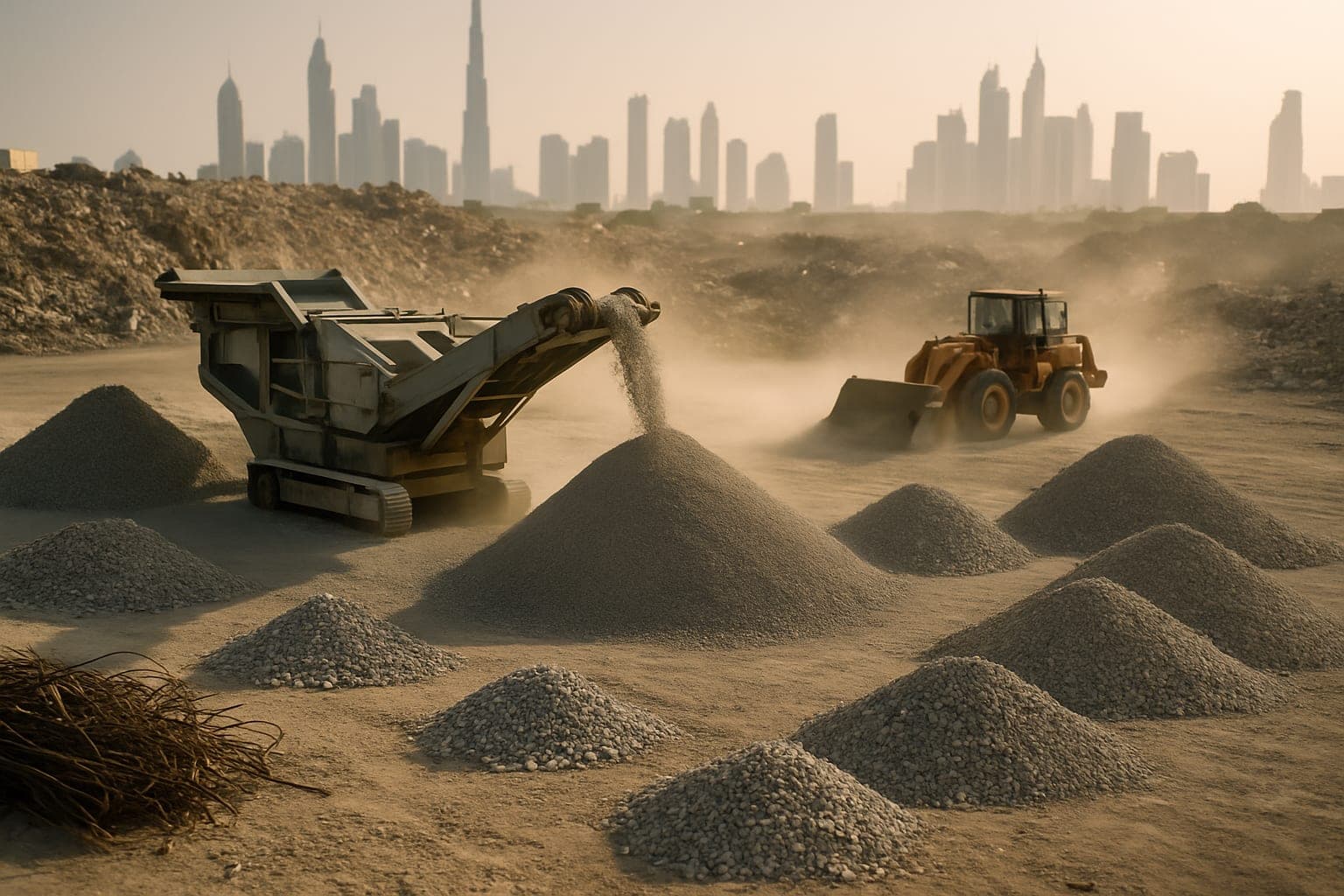
Dubai charges construction waste by the tonne, and a contaminated demolition load is reclassified at the higher general rate at the gate. Crushing clean concrete on site removes that bill and creates a sellable product: graded sub-base, pipe bedding or pit-run hardcore. The economics turn on contamination control, stockpile space and a firm buyer before the site closes.
What does it actually cost to tip construction waste in Dubai?
Start with what is documented. Dubai Municipality used to charge a flat gate fee of AED 10 per truck trip, then moved to a tonnage regime, announcing AED 80 per tonne for general waste rising by AED 10 a year to AED 100 per tonne by 2020, "and more beyond". That reporting, carried by Go-Green.ae and Technical Review Middle East, is now more than five years old, but it is the only clear, attributable trajectory we could stand behind. The practical reading: the AED 100 per tonne level is a fully phased-in number, not a 2026 shock.
Be sceptical of the fee tables circulating online. One commercial waste-services site publishes general waste at AED 50 to 90 per tonne on one page, AED 100 on another, and AED 100 to 250 on a third, with construction and demolition material ranging from AED 2 to AED 400 per tonne across the same domain, on pages dated within weeks of each other. None of that is a published municipal tariff. Before you build a business case, pull your own invoiced rate from your licensed hauler for the last three months, split by inert and mixed loads. That invoice is the only number that will survive a finance review.
Why does a mixed load cost multiples of a clean inert load?
Because reclassification happens at the facility, not on your paperwork. A skip declared as inert concrete that arrives with plasterboard offcuts, timber shuttering, plastic sheeting or a few bags of canteen waste gets charged at the higher rate for the whole load, and can attract a penalty on top. One bag ruins twenty tonnes. Dubai Municipality told building owners in the same era as the fee ramp that segregation could save up to 62% of tipping fees, with the discount applied at the landfill. Treat the percentage as historic and the mechanism as permanent.
That mechanism is the entire commercial case for crushing. Clean concrete is not waste at the gate, it is feedstock at your stockpile. Everything you do on site, from cutting the rebar out to keeping the shuttering pile fifty metres away from the crusher feed, is really about protecting the classification of the material.
How do you calculate the crush-and-sell position on one project?
The formula is short. Net position equals avoided tipping, plus sales revenue, minus crushing cost, minus any haulage you retain, minus testing and screening, minus your listing and promotion spend. Everything else is detail.
Conversion assumptions to survey, not to assume
- In situ reinforced concrete runs around 2.4 tonnes per cubic metre. Take the volume from the as-built drawings, not from a walk-round.
- Crushed material stockpiles loose at roughly 1.5 to 1.6 tonnes per cubic metre, so expect about a 1.5 times volume increase after crushing. On a tight plot in Al Quoz or Ras Al Khor, stockpile footprint, not price, is what kills the plan.
- Tipper payload of 20 tonnes is a reasonable planning figure. Confirm it against the fleet your buyer will send.
- Rebar content of 100 to 150 kg per cubic metre is a common planning band for a framed structure. Verify from the structural drawings, because the steel is often where the margin sits.
An illustrative worked example
Take a warehouse demolition with 2,000 cubic metres of in situ reinforced concrete. At 2.4 tonnes per cubic metre that is 4,800 tonnes, roughly 240 tipper loads either way, and around 3,100 cubic metres of loose stockpile once crushed. The rates below are your inputs, not published tariffs. Substitute your own invoice figures.
| Line | How you get the number | Illustrative at your confirmed rates |
|---|---|---|
| Tonnes arising | Concrete volume x 2.4 | 4,800 t |
| Avoided tipping | Tonnes x your invoiced mixed C&D rate | At AED 100/t, AED 480,000 |
| Sales revenue | Saleable tonnes x ex-site price by fraction | Quote-driven, see below |
| Crushing cost | Mobile crusher day or lump rate, operator, fuel, magnet separation | Three contractor quotes, minimum |
| Rebar recovery | Recovered tonnes x local scrap steel price on the day | Priced off scrap indices, moves weekly |
| Retained haulage | Only if you sell delivered rather than ex-site | Can exceed material value |
On sales revenue, be honest with your own board: we could not find a defensible published AED per tonne for recycled concrete aggregate in the UAE, and there is no exchange benchmark for it the way there is for scrap metal. What is available is a directional US contrast, where clean rebar-free crushed concrete traded around USD 25 to 35 per ton against USD 10 to 20 per ton for material with debris in it, in a February 2026 US pricing guide. Different market, different haulage economics, so do not convert it. Use it for one thing only: the clean-versus-contaminated spread is roughly two to one, and that spread is what your site discipline is worth.
The rebar line deserves separate treatment. It prices off regional steel scrap references, it moves week to week, and it is the one part of a demolition arising with a genuine index behind it. If you are weighing local sale against export, our note on how the UAE scrap export duty changes local metal economics covers the arithmetic.
Can you legally crush on site in Dubai?
Confirm this before you mobilise a crusher, not after. Dubai Law No. 18 of 2024 on waste management is the current framework, Dubai Municipality Technical Guideline No. 21 is the instrument commonly cited for defining construction and demolition waste, and the Dubai Integrated Waste Management Strategy 2021 to 2041 sits above both. We are naming these so your compliance team can pull the text. We are not paraphrasing obligations we have not read, and neither should your contractor's method statement.
Three practical checks. First, whether your demolition permit and environmental conditions cover mobile crushing on the plot, including dust suppression and permitted working hours. Second, whether the site sits inside a free zone with its own contractor framework: JAFZA and Dubai Investments Park operate separate arrangements, so the hauler and the recycler you use off-zone may not be usable inside. Third, the digital Waste Transfer Note trail. If an inspector traces material to an unapproved site, the exposure lands on the generator, not the truck.
Who buys crushed concrete in Dubai, and what sets the price?
Earthworks and infrastructure contractors buying capping and general fill. Utility contractors buying pipe bedding. Yard operators building hardstanding for laydown areas. Landscaping and site-formation contractors taking pit-run cheaply because they do not need a grading curve. Structural use is a separate conversation: recycled aggregate in structural concrete needs an approval route through the relevant Dubai Municipality, RTA or Trakhees specification, so treat ready-mix plants as a bonus market rather than your base case.
Price is local and haulage-bound. Four things set it: the delivered price of virgin crushed rock in the buyer's emirate, diesel and tipper cost over the distance involved, the tipping the buyer avoids by taking your material, and how far the nearest licensed recycling facility is. Virgin aggregate landed price is the ceiling. You will never sell above it, and on a long haul to Dubai Industrial City or Dubai South the haulage alone can swallow the margin on a low-value fraction.
One myth to kill before your engineer raises it. The 2021 life-cycle study in Sustainability that sourced 25 mm recycled aggregate from Al Dhafra recycling facilities in Abu Dhabi is routinely quoted as showing recycled aggregate concrete costs three times more. It showed no such thing. The three-times figure applied to steel-fibre-reinforced mixes, and the cost driver was the steel fibre. Mixes using fly ash, slag or microsilica came out broadly similar in cost to the natural-aggregate control.
What does a buyer need to see on the listing?
Buyers of aggregate do not haggle over sentiment. They read specifications and access constraints, and they walk away from anything vague.
- Size fraction and crusher setting. State the actual fractions produced: 0 to 20 mm, 20 to 40 mm, 40 to 75 mm, plus oversize hardcore or pit-run.
- Intended-use grade. Capping and fill, pipe bedding, sub-base, or non-structural aggregate. Be explicit that structural use is subject to approval.
- Contamination declaration. Rebar removed, and by what method. Presence of gypsum, plasterboard, timber, plastic, bitumen or soil fines. For any pre-2000s demolition, state your asbestos screening position. An undeclared load is not a discount, it is a rejected delivery.
- Test data if you have it. Grading curve, fines content, sulfate and chloride, water absorption, LA abrasion, MDD and OMC. Ask the buyer's consultant which specification they work to before you commission a single test.
- Quantity and availability window. Tonnes available now against total by end of demolition, and the hard site-closure date. This is the field that decides the deal on a demolition arising.
- Load-out access. Stockpile position, gate and internal road width, turning circle, overhead restrictions, working hours, whether you load with a wheel loader or the buyer brings plant, and where the nearest weighbridge is.
- Price basis. Ex-site or delivered, per tonne or per load. Say which, in the listing, in the first three lines.
- Documentation. Who issues the Waste Transfer Note and what the buyer gets for their own file.
How do you move the volume before the site closes?
A demolition arising is a wasting asset with a deadline. The buyer you need is the one whose earthworks programme happens to be live in the same eight weeks, and finding that buyer by phone is a lottery. Listing it publicly, with the fractions and the closure date stated, is how the volume clears. You can see what is currently trading in construction material listings before you commit to a crusher hire.
- Pull three months of hauler invoices and separate inert from mixed tonnage. That gives you the avoided-tipping figure your finance team will accept.
- Take the concrete volume off the as-built drawings and convert at 2.4 tonnes per cubic metre.
- Confirm permit conditions for on-site crushing, dust suppression and working hours, plus any free-zone contractor framework.
- Get three mobile crusher quotes and check the stockpile footprint against your plot at 1.5 times the in situ volume.
- Segregate at source: rebar out, timber and plasterboard away from the feed, no general waste bins near the stockpile.
- List each fraction separately with contamination declared, access described and the site-closure date visible.
- Sell ex-site by default and let the buyer's haulier carry the distance risk.
On the platform side, KYC verification through UAE PASS tells you the counterparty taking your material is a real, licensed business, which matters because the compliance exposure follows the generator. Escrow through MyFatoorah with a 48-hour inspection window maps directly onto the one dispute this trade always has, which is fines content and foreign material after delivery. The buyer verifies, then funds release. If you want the mechanics of how the window works in practice, our FAQ sets out each step. The diversion tonnage then lands in audit-ready reporting, which is useful because there is no reliable current official diversion statistic in the UAE to benchmark against. The most-quoted figure, roughly 5,000 tonnes of construction and demolition waste a day in Dubai, appears in sources dated 2024 and 2026 with no fresh primary attribution behind it. Your own weighbridge tickets are better evidence than any of them.
Frequently asked questions
How much is the tipping fee for construction waste in Dubai?
Dubai Municipality moved from a flat AED 10 gate fee per truck trip to a tonnage regime, announcing AED 80 per tonne for general waste rising AED 10 a year to AED 100 per tonne by 2020. That reporting is over five years old and the fee tables circulating on commercial websites contradict each other badly, with the same publisher quoting construction waste anywhere from AED 2 to AED 400 per tonne. Use your own hauler invoices for the last three months as your working rate.
Do I need a permit to crush concrete on site in Dubai?
Check your demolition permit and environmental conditions before mobilising any mobile crusher, because dust suppression, noise and working-hour conditions are usually attached. Dubai Law No. 18 of 2024 and Dubai Municipality Technical Guideline No. 21 are the instruments your compliance team should pull. If the site sits inside JAFZA or Dubai Investments Park, the free zone operates its own contractor framework that may override your usual arrangements.
What size fractions of crushed concrete sell fastest?
Graded material for sub-base and pipe bedding, typically 0 to 20 mm and 20 to 40 mm, moves fastest because it goes straight into an earthworks programme. Oversize hardcore and pit-run sell cheaper to yard and site-formation contractors who do not need a grading curve. List each fraction separately with the crusher setting stated, because buyers filter by specification.
Can recycled aggregate be used in structural concrete in the UAE?
Structural use requires an approval route through the relevant Dubai Municipality, RTA or Trakhees specification, so treat ready-mix demand as an upside rather than your base case. The common claim that recycled aggregate concrete costs three times more in the UAE is a misreading of a 2021 study where the cost driver was steel fibre reinforcement, not the aggregate. Mixes using fly ash, slag or microsilica came out broadly comparable in cost to natural aggregate.
Should I sell crushed concrete ex-site or delivered?
Sell ex-site by default. On a low-value aggregate the haulage can exceed the material value, so carrying the transport risk turns a positive net position negative on any long run. State the price basis and the collection window in the first lines of the listing, and describe gate width, turning circle and loading arrangements so the buyer's haulier arrives with the right vehicle.

Comments(0)
Sign in to join the conversation.