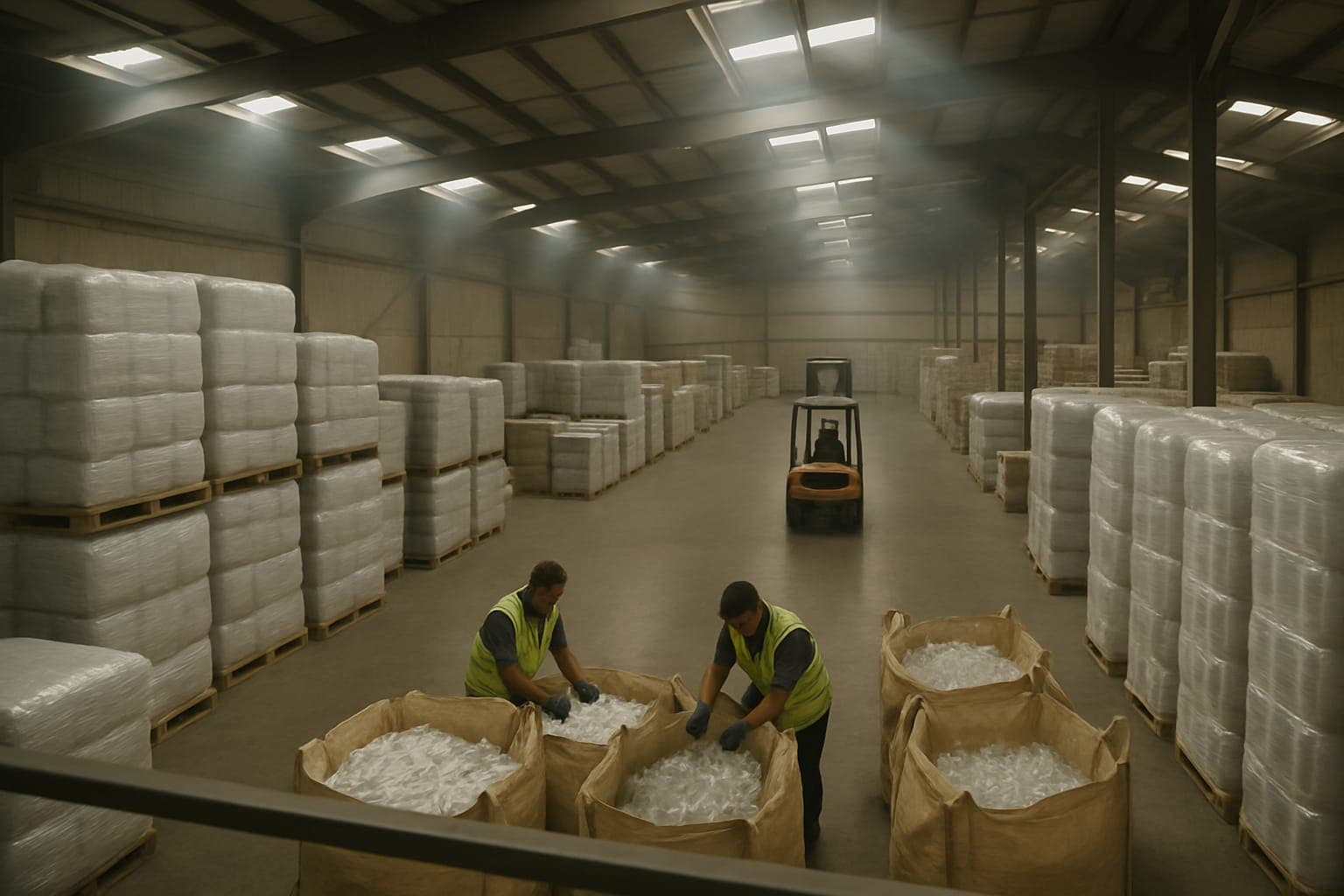
Dubai's final single-use plastic phase took effect on 1 January 2026 and covers plates, cutlery, beverage cups and lids. You cannot trade or use those items as products in the emirate, but the polymer is still a commodity. Sort it by resin, sell it as feedstock or send it to a UAE reprocessor, and keep the transfer paperwork.
What exactly did Dubai ban on 1 January 2026?
The instrument is Dubai Executive Council Resolution No. (124) of 2023 on the use of single-use products in the Emirate of Dubai, issued by Sheikh Hamdan bin Mohammed bin Rashid Al Maktoum. Dubai Municipality confirmed on 24 December 2025 that the final phase came into force on 1 January 2026. It covers single-use plastic plates, plastic cutlery including chopsticks, and plastic beverage cups together with their lids.
That sits on top of what was already prohibited. Phase 1 banned single-use plastic bags from 1 January 2024, Phase 2 extended the ban to all single-use bags from 1 June 2024, and Phase 3 took effect on 1 January 2025 covering Styrofoam cups, plastic straws, plastic cotton swabs, plastic table covers, Styrofoam food containers and plastic stirrers. Packaging Gateway reported on 20 February 2026 that the latest phase prohibits the import, production and trade of the 2026 items, not just their use at the counter.
Federally, the Ministry of Climate Change and Environment enforces a parallel regime. MOCCAE's own newsroom describes it as Ministerial Decision No. 380 of 2022, effective 1 January 2024, while Dubai Municipality and much of the trade press call the same instrument a Cabinet Resolution of the same number. Check the official UAE Legislation portal before you cite a number in a compliance file. The federal second phase, reported by The National on 18 December 2025 and by Sustainable Packaging MEA on 6 January 2026, brought cups and lids, cutlery, plates, straws, stirrers and Styrofoam food containers into scope nationwide from 1 January 2026, and banned bags under 50 microns regardless of material, paper included.
Can you run down existing stock first?
Assume not. We could not find a grace period, a sell-through window or a transitional allowance for existing inventory in any Dubai Municipality or MOCCAE document. Several UAE commercial sources published in mid-2026 state flatly that businesses cannot continue using existing stock after the effective date. They are low-authority sources, but they point the same way as the official texts, and nothing official contradicts them.
On penalties, be careful. The fine figures circulating online conflict badly. One commercial site quotes AED 2,000 rising to AED 10,000 for repeat offences with possible seizure of inventory, another quotes AED 200 per violation doubling on repeat and capped at AED 2,000 for bags. Neither is an official schedule and they may describe different offence classes. Do not budget against either. If you need a number for a risk register, request the current schedule from Dubai Municipality in writing.
The practical point is simpler. Prohibited items sitting in your store in Al Quoz or in a hotel back-of-house in Jumeirah are a compliance exposure every day they stay there in product form. Converting them into a sorted polymer stream removes that exposure.
What are the compliant exit routes?
The ban is on import, production and trade of the items as products. Selling the same material as recycling feedstock is a different transaction. That distinction is the whole opportunity here, and it is worth spelling out in your board note.
| Route | Best suited to | What it needs | Main risk |
|---|---|---|---|
| Bulk resale as single-polymer feedstock | Unopened cartons of PP cutlery, PP or PET cups and lids, PS plates | Sorting by resin, baling or bagging, a buyer with a valid recycling licence | Low value per kilo if mixed, printed or food-soiled |
| Toll reprocessing into UAE recycled-content product | Large single-SKU volumes from distributors and central kitchens | Written agreement with a licensed reprocessor, agreed yield and rejection terms | Yield disputes if contamination was understated |
| Export or re-export | Stock held in a free zone, or manufacturer stock produced for foreign markets | Written confirmation of eligibility, correct HS classification, customs clearance | Eligibility of stranded domestic stock is not settled, see below |
| Waste-to-energy or landfill | Contaminated, multi-layer or unsortable material only | Licensed transporter, weighbridge tickets, disposal certificate | Cost with no revenue, and a weak ESG story |
How do you prepare the stock so a recycler will actually pay?
Unsold inventory is the best material a plastics recycler ever sees. It is clean, it is one polymer per SKU, it is already palletised and it has no food residue. Do not let it degrade into mixed waste in a yard in Ras Al Khor while procurement decides.
Sort by polymer, not by product
Cutlery is usually polypropylene. Rigid clear cups may be PET, PP or polystyrene depending on the supplier. Lids are frequently a different resin from the cup they sit on, which is why cup and lid sets are worth separating before anyone quotes you. Foam plates and clamshells are expanded polystyrene, very light, very bulky, and normally worth close to nothing unless you densify them first.
Keep the cartons intact where you can
Shrink-wrapped inner sleeves of unused cutlery are easier to verify and easier to price than loose material tipped into a bulk bag. Strip the outer film, keep natural and printed items apart, and record the count per pallet. A buyer who can see exactly what is on the pallet will pay closer to the top of their range.
Watch the freight maths
Foodservice plastic is light and takes volume. A 40-foot container of loose cups can weigh very little, so transport cost per kilo of polymer can exceed the material value if you ship it loose across the emirates. Bale, densify, or sell to the nearest qualified buyer.
Can you export banned stock out of the UAE?
There is an export exemption, and it is real. Reporting on 18 December 2025 by The National and by The Finance 360 confirmed that products manufactured for export or re-export outside the UAE do not fall under the ban, provided they are clearly marked for export and are not distributed in the local market.
Read that wording closely. It addresses products produced for export. Whether a distributor can re-designate existing domestic-market stock and push it out as an export is not answered by any source we have seen, and we are not going to pretend otherwise. Put the question to Dubai Municipality and MOCCAE in writing and hold the reply on file before you book a booking. If the stock is sitting inside JAFZA and never entered UAE customs territory, your position may be materially simpler, but confirm that with your customs broker rather than assuming it.
One more distinction matters. Clean, sorted, single-polymer plastic destined for recycling generally moves as a commodity under standard customs procedures. Contaminated or mixed plastic waste is where transboundary movement rules bite, and MOCCAE operates a permit service for hazardous waste export under the Basel Convention requiring a matching trade licence, a valid environmental permit, an exporter-importer contract, insurance, a movement document and a notification document. Get your HS classification right at the start. If you are weighing an export sale against a domestic one, the same arithmetic we set out in our note on UAE scrap export duty and local metal sales applies here: landed cost and paperwork risk decide it, not the headline price.
What does the recycled-content exemption open up?
This is the most commercially interesting line in the whole regime. Exemptions apply to products manufactured locally using recycled content, a measure intended to support the domestic recycling industry, as reported by The Finance 360 on 18 December 2025 and Sustainable Packaging MEA on 6 January 2026. In plain terms, banned stock that is reprocessed inside the UAE into recycled-content product re-enters a legally exempt category.
That makes a toll reprocessing agreement worth pricing against a straight scrap sale. You supply the polymer, a licensed reprocessor pelletises it, and either you take the pellets back for a converter to use or you sell them into the local resin market. UAE converters are already realigning their portfolios around the new rules, so demand for compliant domestic recyclate exists. Note that PLA is treated differently again: MOCCAE recognises plant-based polylactic acid as a viable alternative and it is excluded from the ban, per Technical Review Middle East on 23 December 2025. Do not mix PLA into your PP stream, it contaminates the batch.
What is the material actually worth?
We are not going to publish an AED per kilo figure we cannot source to a UAE buyer with a date on it. What you can rely on is the direction of travel. Recycled polymer prices track virgin resin, and virgin PP and PS track naphtha and propylene feedstock. There is no exchange contract for polymers, so anyone quoting you an LME reference for plastic is wrong.
Set your expectation accordingly. Clean single-SKU PP cutlery in original cartons is genuinely saleable material. Mixed, printed, food-soiled foodservice waste is often a cost-avoidance exercise rather than a profit line, and the honest comparison is against your disposal tipping fee, not against a hoped-for windfall. Get three written quotes before you commit. You can see what is currently moving in the plastics category on our marketplace and benchmark from there.
What documentation satisfies an inspector and an ESG auditor?
There is no published list of evidence that Dubai Municipality inspectors formally accept for disposal of banned stock, so treat the following as chain-of-custody practice rather than a regulatory checklist. It is what we ask sellers to keep, and it is what survives an audit.
- A dated inventory of the affected stock by SKU, polymer, unit count and weight, signed off by your operations manager.
- A written internal decision memo recording why each lot went to resale, reprocessing, export or disposal.
- A copy of the buyer's or reprocessor's UAE trade licence showing recycling or waste activity, plus their environmental permit where applicable.
- The sale or service contract, including whether the material is sold as feedstock rather than as usable product.
- Weighbridge tickets for every outbound load, with vehicle plate and driver name.
- Delivery notes signed at the receiving gate.
- Photographs of the loaded pallets before dispatch, timestamped.
- For export, the customs declaration, the HS code used, and any written eligibility confirmation from Dubai Municipality or MOCCAE.
- A recycling or destruction certificate from the receiving facility stating tonnage and processing method.
- A single reconciliation sheet tying opening inventory to outbound tonnage to zero, with variances explained.
Keep that pack for at least the length of your ESG reporting cycle. Auditors do not want a story, they want tonnage that reconciles.
Can you move the stock to another emirate and sell it there?
Not as product. The federal phase that took effect on 1 January 2026 covers cups and lids, cutlery, plates, straws, stirrers and Styrofoam containers nationwide, so a warehouse in Sharjah's Al Sajaa or a distributor in Musaffah faces the same product-level prohibition. Abu Dhabi banned single-use plastic bags back on 1 June 2022 and other emirates have implemented similar measures. What does move freely between emirates is sorted polymer sold as feedstock, and that is the transaction to structure.
How we handle this on AlKhiidma
Counterparties on our platform are KYC-verified through UAE PASS, so you can see that the buyer holding out a recycling licence actually holds one. Payment sits in escrow through MyFatoorah until the buyer's 48-hour inspection window closes, which matters when a load is being judged on contamination. Every completed trade generates audit-ready tonnage records you can hand to a sustainability auditor without rebuilding the file from delivery notes. Sellers pay a promotion package to publish a listing, browsing and sign-up are free, and the details are set out on our FAQ page.
Frequently asked questions
Can I still use my existing stock of plastic cups in Dubai after 1 January 2026?
No official Dubai Municipality or MOCCAE document we have seen grants a grace period or sell-through window for existing inventory, so you should assume none exists. The final phase of Executive Council Resolution No. (124) of 2023 took effect on 1 January 2026 and covers plates, cutlery, beverage cups and lids. Move the stock out of product use and into a polymer stream.
Is it legal to sell banned single-use plastic items to a recycler?
The prohibition applies to the import, production and trade of those items as products for use in the market. Selling the same material to a licensed recycler as sorted feedstock is a different transaction and is the route the recycled-content exemption is designed to encourage. Keep the contract wording clear that the material is sold as feedstock, not as usable product.
Can I export banned single-use plastic stock out of the UAE?
An exemption exists for products manufactured for export or re-export that are clearly marked as such and not distributed locally, as reported in December 2025. Whether stranded domestic-market stock can be re-designated for export is not settled in any source we have found. Get written confirmation from Dubai Municipality or MOCCAE before you book freight.
What fine applies to a business caught using banned single-use plastic?
Figures circulating online conflict, ranging from AED 200 per violation for bag offences to AED 2,000 rising to AED 10,000 with possible inventory seizure. None of those is an official published schedule and they may cover different offence classes. Request the current schedule from Dubai Municipality in writing rather than relying on secondary sources.
Is PLA banned in Dubai?
No. MOCCAE recognises plant-based polylactic acid as a viable alternative and it is excluded from the ban, according to reporting in December 2025. Note that PLA must be kept out of your PP and PET scrap streams, because it contaminates the batch and can cost you the value of the whole load.
Are paper alternatives automatically compliant?
Not automatically. The federal ban on bags below 50 microns applies regardless of material, which extends the restriction to thin paper bags as well. Check the specification of any replacement product against the Dubai Municipality awareness guide before you place a large order.

Comments(0)
Sign in to join the conversation.