Austenitic stainless is priced off nickel, not off local rebar sentiment. LME nickel traded near USD 17,043 a tonne on 21 August 2026, up 13.81 percent on the year but slightly softer over the month, while UAE dealers were publishing AED 3 to 5 a kilo for stainless in July 2026. Your grade, cleanliness and timing decide where in that band you land.
What is the stainless steel scrap price in the UAE per kg right now?
Nobody publishes an independent UAE assessment for stainless scrap. There is no Fastmarkets or Argus print for 304 in Dubai the way there is for aluminium ingot or nickel cathode, so every number below comes from a dealer or aggregator page, and every one of those parties has an interest in the number. Read them as indicative buying ranges, then verify against two live bids before you sell.
| Published range | Coverage | Date on the page | Source type |
|---|---|---|---|
| AED 3,000 to 5,000 per tonne, by grade and sorting | Abu Dhabi, bulk lots | 17 July 2026 | Trader website |
| AED 3 to 8 per kg, mixed grades | Sharjah, Dubai, Abu Dhabi | 18 July 2026 | Trader website |
| AED 3.20 to 5.00 per kg | Dubai yards | 3 April 2026 | Aggregator estimator |
| USD 0.37 per lb for 304, about AED 3.00 per kg | United States, 21 yards averaged | 19 March 2026 | US price tracker |
| USD 0.55 per lb for 304 and USD 0.65 for 316 | United States, single dealer | 2026, page undated | US dealer quote |
Two things stand out. The UAE band is wide because it covers everything from clean 316 plate offcuts down to oily 430 swarf, and the local bid sits in the same neighbourhood as US yard prices once you convert. Bulk deals above a few hundred kilos in Abu Dhabi are normally priced and settled per tonne, quoted exclusive of 5 percent VAT unless the contract says otherwise.
Numbers still circulating that you should ignore
A page claiming AED 2.80 per kg as the current UAE metal scrap price is dated 24 November 2022. Another quoting steel at AED 600 to 900 per tonne is from 2 September 2024. Both still rank in search, and we still hear both repeated on workshop floors in Al Quoz and Musaffah. If a buyer anchors on a 2022 figure, that is not a market view, it is a stale web page.
Why does 304 move with nickel rather than with steel?
Because most of the money in the kilo is alloy, not iron. Under EN 10088-3, grade 1.4301, the 304 everyone calls it, must run 17.50 to 19.50 percent chromium and 8.00 to 10.50 percent nickel, and real production usually sits near the bottom of the nickel range. Mills recover that cost through an alloy surcharge calculated from ferro-chrome, nickel, molybdenum and scrap, added on top of a base price. When nickel moves, the surcharge moves, and every buyer down the chain reprices.
Look at the size of the swings. LME nickel cash was USD 19,325 a tonne on 30 April 2026, USD 16,275 on 30 June, and about USD 17,100 on 31 July. That is a 15.8 percent fall in two months, then a recovery. The monthly average in July 2025 was USD 15,023. LME stocks stood at 266,172 tonnes on 31 July 2026, falling for the first time in months, and the INSG expects a 32,000 tonne deficit in 2026, the first since 2021. Carbon steel scrap does not do this. HMS grinds; stainless jumps.
The transmission is visible in the published surcharge tables. On US flat-rolled stainless, the 304 surcharge fell from USD 1.0980 per lb in July 2026 to USD 1.0228 in August, a 6.8 percent drop in one month. We could not find any GCC or UAE published alloy surcharge. That gap matters: UAE traders reference US and European surcharge series plus the daily LME nickel close, so your local quote is a derivative of numbers published somewhere else.
Why is my quote below the nickel value inside the metal?
Run the arithmetic and the question gets sharper. At USD 17,043.63 a tonne and the pegged rate of 3.6725, contained nickel is worth about AED 62.59 per kg. A 304 offcut at 8 percent nickel therefore carries roughly AED 5.01 per kg of nickel units alone, before you count a single dirham of chromium. A 316 offcut at 10 percent carries about AED 6.26. Yet the local bid for stainless in July 2026 was AED 3 to 5 per kg.
The gap is not a scandal, it is the cost stack: collection, sorting, freight to a melt shop, melt loss, working capital and trader margin. What the gap does mean is that grading errors are expensive in both directions, and that undocumented deals leak value quietly. We could not verify any stainless melt capacity inside the UAE. On our reading, local bids are an export parity calculation routed through Jebel Ali and Hamriyah rather than a domestic melt price, which is exactly why they track an offshore nickel benchmark so closely. Treat that as our interpretation, not a confirmed fact.
The better UAE yards are open about the method. One Dubai buyer states plainly that prices change daily because they are indexed to the LME: take the daily close in USD per tonne, convert to AED per kg, then deduct for grade, cleanliness, moisture and contamination. If a buyer cannot describe that chain when you ask, you are being quoted on feel. Compare live bids for the same lot on our metals listings before you accept one.
Does a magnet tell 304 from 430?
Not on the forms most workshops actually sell. The line repeated on high ranking pages, that if a magnet sticks it is not stainless, is wrong in a way that costs money. Annealed 304 sheet is non magnetic, but cold work transforms austenite to martensite, so machining swarf, sheared edges and heavily bent offcuts in 304 are frequently magnetic. Meanwhile 430 is ferritic, always magnetic, and contains essentially no nickel.
So the magnet misclassifies exactly the two material streams this article is about: turnings and worked offcuts. A magnetic 304 turning graded as 430 by feel is being paid at roughly the 430 ratio. Using the August 2026 surcharge table as the value yardstick, 430 sits at 0.43 times the 304 level and 316 at 1.78 times. That is the spread you are gambling on when you let a magnet decide.
| Grade | Aug 2026 US flat-rolled surcharge, USD per lb | Converted, AED per kg | Ratio to 304 | Magnet behaviour |
|---|---|---|---|---|
| 316 / 316L | 1.8152 | 14.70 | 1.78x | Non magnetic annealed, magnetic when cold worked |
| 321 | 1.0767 | 8.72 | 1.05x | As above |
| 304 / 304L | 1.0228 | 8.28 | 1.00x | As above |
| 201 | 0.8187 | 6.63 | 0.80x | As above |
| 430 | 0.4384 | 3.55 | 0.43x | Always magnetic, no meaningful nickel |
| 410 / 410S | 0.4107 | 3.33 | 0.40x | Always magnetic |
Those surcharges are mill charges on new flat product, not scrap prices. Do not quote them as a bid. Use them only for the relationship between grades, which is stable even when the absolute level is not.
Ask for the assay, in writing
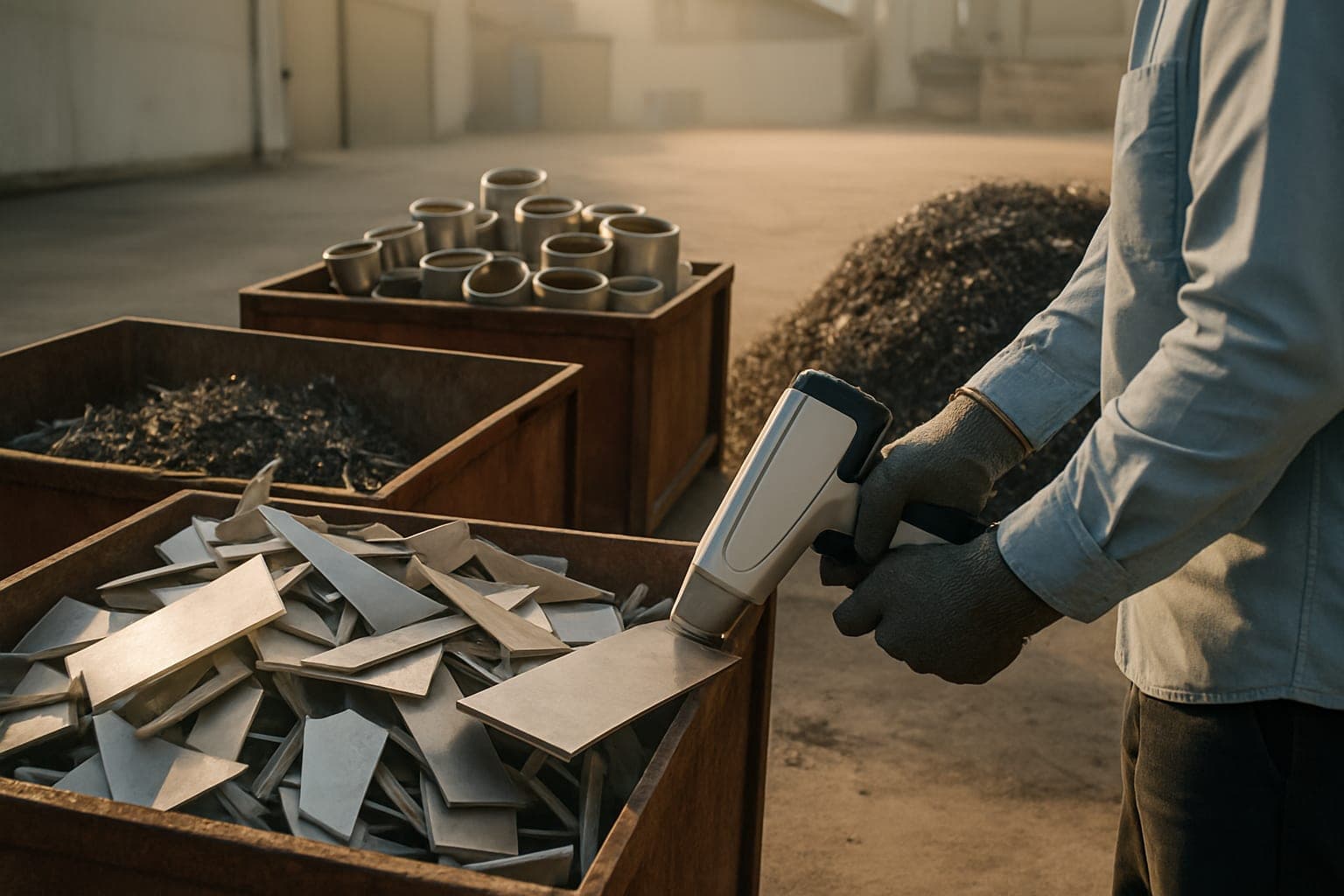
Handheld XRF settles the argument in seconds by reading chromium, nickel and molybdenum directly. Molybdenum is the tell between 304 and 316. We could not verify how many UAE yards run XRF at the weighbridge as standard practice, so make it a condition rather than an assumption: ask whether the buyer will XRF the load on arrival and issue a printed reading tied to the weighbridge ticket. A seller who declared 316 and a buyer whose analyser says 304 need evidence, not a shouting match, which is what our 48 hour inspection window and escrow release are built for.
When should a fabricator hold stainless and when should it release?
Stainless arisings are lumpy and event driven. They come out of fit outs, refits and shutdowns, not from a steady daily flow: commercial kitchen worktops, sinks and extraction hoods, hospital and lab equipment, water tanks and pipework, lift panelling, balcony and staircase railings. Marine and offshore workshops in Dubai Maritime City, Musaffah and RAK Maritime City generate 316L in bursts around a docking. Because the flow is lumpy, timing is genuinely possible in stainless in a way it is not for continuous mild steel offcut.
- Segregate at the source. Separate bins for 304, 316 and 430 at the saw and the press brake. Mixing a 316 pipe stub into a 304 skip converts 1.78x material into 1.00x material at the weighbridge.
- Drain and dry the turnings. Coolant soaked swarf is the worst priced stainless form there is, and UAE buyers openly deduct for wet or oily material. Whether a fixed moisture percentage applies varies by yard, so ask for the deduction rule before tipping.
- Strip attachments. Carbon steel brackets, plastic gaskets, rubber seals and copper fittings all pull the load into a mixed grade. Clean, analysed and attachment free is the top of the range.
- Watch the nickel print, not the rumour. Nickel was 13.81 percent higher year on year in August 2026 but down 0.62 percent over the month, and the 304 surcharge dropped 6.8 percent from July to August. Year on year up, month on month soft. Anyone telling you stainless prices are rising in August 2026 is not reading the same tape.
- Hold only if you can store it dry and safely. Plate offcuts and pipe stubs sit in a yard in Al Sajaa or Dubai Industrial City for a quarter without degrading. Turnings do not, because they oxidise and hold coolant. Release turnings quickly, time plate and stubs against nickel.
- Set a trigger, not a hope. Pick a nickel level and a minimum AED per kg, write both into your internal approval, and sell when they are hit. The April to June 2026 move of 15.8 percent shows how fast the window closes.
The same discipline that lifts a copper cable price applies here, and we walked through the mechanics of that in our piece on stripping copper cable before you sell.
What paperwork makes the price stick?
Three documents decide whether a quoted price survives to the bank transfer: the weighbridge ticket, the grade assay, and the tax invoice. Dealer quotes in the UAE are normally exclusive of 5 percent VAT unless agreed otherwise, and the treatment of scrap supplies between registered businesses has its own cash flow consequences, which we covered in the scrap metal VAT reverse charge explainer. Confirm the treatment for your own entity with your tax adviser before you invoice.
Those same three documents are the raw material for audit ready ESG reporting, which most stainless trades in this market simply never produce. A tonnage figure with a counterparty name, a date and a verified buyer behind it is worth more to a sustainability manager than any estimate. The structural pull that domestic smelting exerts on scrap flows is worth understanding too, and we looked at that dynamic in aluminium in our note on EGA's Al Taweelah recycler. Stainless has no such anchor in the UAE that we could verify, which is precisely why your 304 answers to a nickel price set in London.
Frequently asked questions
What is the stainless steel scrap price in the UAE per kg today?
UAE dealer pages published AED 3.20 to 5.00 per kg for stainless in April 2026 and AED 3 to 8 per kg across mixed grades in July 2026, with Abu Dhabi bulk lots quoted at AED 3,000 to 5,000 per tonne on 17 July 2026. No independent price reporting agency assesses UAE stainless scrap, so these are dealer indications rather than assessments. Always take two live bids on the same lot before selling.
Does a magnet stick to 304 stainless scrap?
It often does. Annealed 304 sheet is non magnetic, but cold working from machining, shearing or bending turns austenite into martensite, so 304 turnings and heavily worked offcuts are frequently magnetic. Grade 430 is ferritic, always magnetic, and carries essentially no nickel, so a magnet cannot separate a valuable 304 turning from a low value 430 one. Use handheld XRF instead.
Why is my stainless quote lower than the nickel price?
At USD 17,043.63 a tonne on 21 August 2026 and the pegged rate of 3.6725, contained nickel is worth about AED 62.59 per kg, so the nickel inside a 304 offcut at 8 percent is worth roughly AED 5.01 per kg on its own. The local bid sits below that because collection, sorting, freight, melt loss and trader margin all come out of the same kilo. The wider the gap, the more you should be asking what your buyer's cost stack actually is.
What is the price difference between 304 and 430 scrap?
Using the August 2026 US flat-rolled surcharge table as a value yardstick, 430 sits at 0.43 times the 304 level and 316 at 1.78 times. Those are mill surcharges on new product, not scrap bids, but the relationship between grades holds because it is driven by nickel and molybdenum content. Mixing 316 into a 304 skip, or letting 304 be graded as 430, destroys that premium at the weighbridge.
Do I pay VAT on scrap sales in the UAE?
UAE dealer quotes are normally stated exclusive of 5 percent VAT unless the contract says otherwise, so check whether a per kilo number you are given is gross or net before you compare offers. The treatment of scrap supplies between VAT registered businesses carries specific cash flow implications that are worth reviewing with your tax adviser. Never accept a verbal price without confirming the VAT basis in the purchase order.
Should I hold stainless turnings waiting for nickel to rise?
Generally no. Turnings oxidise and hold coolant, and wet or oily stainless attracts a deduction at every UAE yard we have seen quote, so storage cost usually beats the price gain. Plate offcuts and pipe stubs are different, since they store dry for months and can be timed against a nickel trigger you set in advance. Nickel moved 15.8 percent between 30 April and 30 June 2026, so windows open and close fast.

Comments(0)
Sign in to join the conversation.