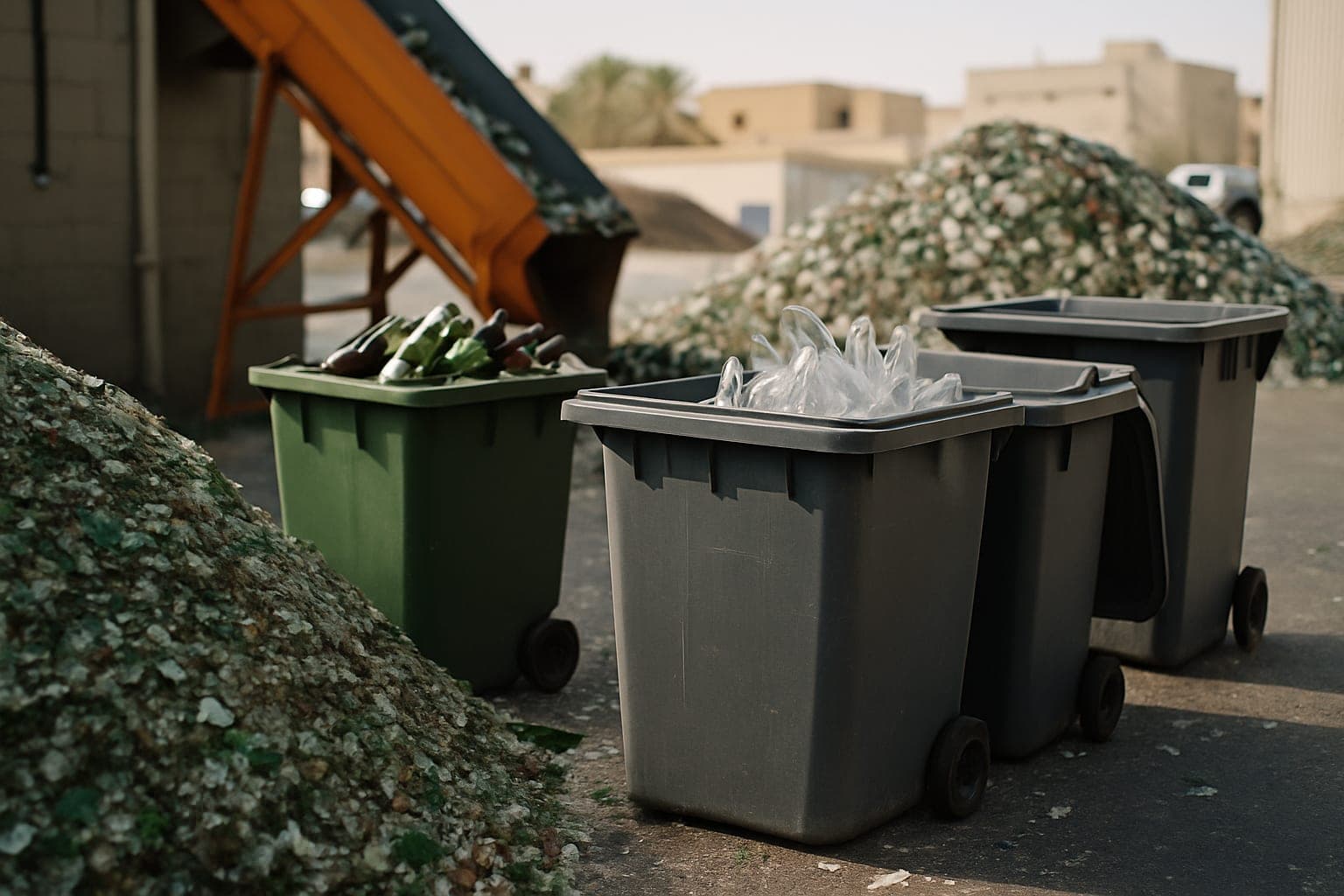
UAE cullet buyers pay for consistency, not for glass. Mixed, unwashed bottle glass is a disposal transaction where you pay a hauler to take it away. Single-colour, delabelled, closure-free cullet can be a sale, because a furnace can drop it straight into the batch. There is no exchange price for cullet anywhere in the world, so every rate is bilateral and driven by haul distance and contamination.
Who actually buys glass cullet in the UAE?
Two very different tiers, and confusing them is the most common mistake we see in procurement. Tier one is the processor who collects, delabels, removes closures, colour-separates and crushes. Tier two is the furnace that melts. Almost no UAE generator sells directly to a furnace, because furnaces buy to a batch specification and in tonnages that a hotel group cannot produce in a month.
The processors
Random Global FZCO in Dubai was profiled by greenfootprint.ae in July 2020 as the first and only glass processing and recycling facility in the UAE, producing colour-separated cullet free of impurities and ready for re-melt. That profile is now more than five years old and the word "only" no longer holds. Clear Earth Recycling states on its site, updated March 2025, that it produces cullet and collects glass from hotels, corporates and waste collectors. Green Arabia advertises client-specific bottle programmes. Green Land Recycling takes broken, damaged and overstock glass regardless of type or colour. Able Recycling works the industrial side, manufacturing trimmings and demolition glass rather than bottles. Before you contract, confirm the company is still trading and ask to see the site.
The furnaces and processors that could absorb the material
Emirates Float Glass LLC operates at ICAD-2 in Mussafah, Abu Dhabi, established in 2009 by Dubai Investments PJSC on a 320,000 sqm plot at a stated cost of AED 692 million, with a design capacity of 600 tonnes of clear molten glass a day. It is the largest single glass furnace in the country, but it is a float line, and float lines run flat-glass cullet, not post-consumer bottles. Whether it accepts third-party cullet at all is something we have not been able to verify, so treat it as a question to ask, not an outlet to assume.
RAK Ghani Glass LLC at Al Jazeera Al Hamra in Ras Al Khaimah has a stated capacity of around 43,800 tonnes a year of pharmaceutical glass containers. Pharmaceutical glass carries the tightest batch chemistry in the industry, which makes it the least likely UAE furnace to take mixed post-consumer bottle cullet. Emirates Glass LLC in Al Quoz Industrial Area 4, with a 60,000 sqm plant and a 32,825 sqm coating line in Dubai Investments Park, is a flat-glass processor that cuts, coats and tempers. Its offcuts are a cullet supply, not a cullet demand.
The honest read: the UAE has serious glass manufacturing capacity, but very little of it is publicly documented as buying external container cullet. That is why most saleable bottle volume moves through a Dubai-based processor, and why some of it is aggregated for export or for non-container uses such as foam glass insulation. One importer board listing dated 5 August 2025 showed a UAE foam-glass start-up seeking roughly 11,000 tonnes of cullet. It is self-reported and the company is unnamed, so use it as evidence that non-container demand exists, nothing more.
What is glass cullet worth per tonne in the UAE?
There is no LME, CME or ICE contract for glass. Anyone quoting "the glass index" is quoting a private subscription series such as the one businessanalytiq maintains, last updated 19 November 2025, which lists the price drivers as transport distance from the recycling facility to the glass plant plus quality factors including colour, cleanliness and size. Those are contract variables, not a market print.
Two structural facts set the ceiling. First, glass is low value per tonne. The standard reference overview on cullet puts the value of glass at roughly half that of ferrous scrap and about one twentieth that of aluminium. That ratio still holds even though the dollar figures in that source date from late-1980s US programmes and should not be converted into today's dirhams. Second, glass is heavy, so the same source's rule of thumb applies here: once the furnace is much more than 50 to 100 miles from the collection point, freight eats the entire material value. In practice a generator in Al Quoz, Ras Al Khor or Dubai Investments Park has a workable economic case. A generator in Fujairah or Al Dhafra usually does not, at least not on bottles alone.
So stop asking what the tonne is worth and ask a sharper question: is this an invoice I pay or an invoice I issue? That flip is the whole commercial story, and it is decided by colour and contamination rather than by market timing. If you want to see what UAE counterparties are actually offering and seeking right now, the glass listings on our marketplace are the fastest read on live demand.
Do I really need to separate glass by colour?
Yes, if you want to be paid. Colour is not cosmetic in glassmaking, it is chemistry. A flint furnace producing clear containers tolerates almost no cross-colour contamination, because a few percent of green or amber in the batch shows in the finished bottle. A green furnace is far more forgiving and can absorb mixed input that a flint furnace would reject outright. That hierarchy is standard industry practice worldwide. We have not been able to verify a published UAE-specific tolerance table, so get the percentages from your processor in writing.
| Stream | Typical UAE route | What destroys it | Commercial position |
|---|---|---|---|
| Flint (clear), delabelled, closures off | Processor cullet line, container batch or export aggregation | Any green or amber, ceramic, stone, porcelain | Highest value, best chance of a rebate |
| Amber (brown), single colour | Processor cullet line | Cross-colour, metal crown caps, foil neck wraps | Mid value, usually cost-neutral collection |
| Green, single colour | Processor cullet line, most tolerant furnace type | Ceramics and metal more than cross-colour | Lower value, but the easiest spec to hit |
| Mixed colour, unwashed, commingled | Municipal bin, MRF residue, landfill | Everything above at once | Pure disposal cost |
| Flat, mirror, laminated, Pyrex, CRT | Separate industrial or demolition route | Being mixed with bottles | Rejects the whole load if blended |
What contamination gets a cullet load rejected?
Ceramics, stones and porcelain are the first killers. They do not melt at container furnace temperatures and leave inclusions that fail the finished bottle, which is why a single dropped coffee mug in a 1,100 litre bin can downgrade the lot. Metal closures are the second, crown caps, screw caps, foil neck wraps and wire cages from sparkling bottles. Third is laminated and coated glass: windscreens carry a PVB interlayer and architectural Low-E glass carries a metallic coating, and neither belongs anywhere near bottle cullet.
After that come organics and liquid residue, which turn a hot skip into a fly and odour complaint within 48 hours in a Dubai summer, and paper labels, which most processors remove downstream but some price against. Ask your buyer for four numbers before you sign: allowable ceramic, stone and porcelain in ppm, allowable ferrous and non-ferrous in ppm, allowable cross-colour as a percentage, and the accepted particle size range. Also ask whether crushing on your site helps or hurts. Crushed glass ships denser, but once it is crushed you can never separate the colours again, and a buyer who suspects a mixed crush will price for the worst case.
How should a hotel, brewery or beverage distributor set up to hit spec?
- Count your bottles before you buy bins. A 200-key hotel with three F&B outlets generates a very different colour mix from a beverage distributor running returns, and the mix decides how many streams you can justify.
- Run three colour streams at the point of generation, behind the bar and in the dish pit, not at the loading bay. Sorting after the fact never works.
- Cap bin size at 240 litres for staff-handled containers. Glass is dense, and a full 1,100 litre bin becomes a manual handling and floor-loading problem that your team will solve by mixing streams.
- De-cap at the bar. Crown caps go to a separate ferrous tub, which is small, clean revenue in its own right.
- Empty the liquid. Residual beer, juice and syrup are the main reason storage areas fail hygiene inspections between collections.
- Keep storage covered. Rainwater and washdown water add weight you get paid nothing for and accelerate organic decay.
- Put a lidded, clearly separated ceramics and crockery bin next to the glass line. Breakage is inevitable, so give it somewhere legitimate to go.
- Weigh every collection and keep the ticket. Without weighbridge tickets you have a waste service, not a diversion record.
Why the green bin and the waste-to-energy plant are not the answer
Municipal green bins in Abu Dhabi collect general recyclables together, paper, cardboard, glass, plastic and metal in one receptacle, then send them to a Tadweer facility for mechanical segregation. Tadweer's Recyclable Material Collection Centres initiative, announced by the Abu Dhabi Media Office on 30 August 2023, started with 20 centres handling 16 waste types and set a target of a further 100 before the end of 2025. That deadline has passed and we have not seen a verified current count. Either way, commingled collection satisfies compliance reporting and destroys cullet value, because glass that has been tumbled with wet cardboard and food-contact plastic cannot be colour-recovered economically.
The waste-to-energy route is a separate misunderstanding. The Sharjah plant, a joint venture between Tadweer Group and BEEAH inaugurated in 2022 as the region's first commercial-scale facility of its kind, converts non-recyclable waste into energy. Glass is inert and has no calorific value. Sending it there makes it bottom-ash contamination, not recovery, even though the tonnage leaves your site as "diverted from landfill".
What is pushing UAE glass demand in 2026?
Cabinet Decision No. 124 of 2023 phases out single-use plastics, with a full ban on cups, lids, cutlery and food containers reported to take effect on 1 January 2026. That pushes hospitality procurement toward glass, which means more bottles on your loading bay whether or not you have a route for them. The UAE Circular Economy Policy's extended producer responsibility measures nominate Tadweer Group as a Producer Responsibility Organization with packaging collection targets attached. Both points come to us from a single market-research summary published on 25 September 2025, so verify them against the Official Gazette and Tadweer before you build a business case on the dates. Our note on how EPR shifts packaging costs onto UAE producers covers the mechanism in more detail.
The data gap is part of the trade
We could not verify a single authoritative UAE-specific figure for glass tonnage, glass share of municipal waste, or glass diversion rate. The most substantive public reporting on UAE glass recycling dates to 2020, and almost everything published since is vendor marketing. Directory listings make it worse: UAE waste-glass pages on international trade boards show a boilerplate "FOB 460 ~ 1 / Ton" field repeated across unrelated products, which circulates as if it were a market price. It is template noise.
For scale, Sibelco reports processing around 5 million tonnes of waste glass a year across more than 60 facilities in Belgium, France, Italy, the UK, Poland, Estonia, the USA, Canada and Mexico. No GCC site appears on that list. That absence, more than any statistic, tells you where the UAE glass chain currently sits. It also explains why buyers here price defensively: with no benchmark and no published spec, the only protection a buyer has is the reputation of the seller. Verified counterparties, escrow and a 48-hour inspection window are how we close that gap, and you can read more about how we work or browse other market insights before you list.
Frequently asked questions
Who buys glass cullet in the UAE?
In practice you sell to a Dubai-based processor rather than direct to a furnace. Named operators producing or collecting cullet include Random Global FZCO, Clear Earth Recycling, Green Arabia, Green Land Recycling and Able Recycling, though several of these profiles are old and you should confirm the company is still trading. The large furnaces, Emirates Float Glass at ICAD-2 Mussafah and RAK Ghani Glass at Al Jazeera Al Hamra, run flat and pharmaceutical batches that rarely accept post-consumer bottle cullet.
How much does glass cullet sell for per tonne in the UAE?
There is no exchange benchmark for cullet anywhere in the world, and no published AED price list in the UAE, so every rate is negotiated bilaterally. Price is set by haul distance to the plant and by quality, meaning colour purity, cleanliness and particle size. The realistic question is whether your material is a cost you pay or a sale you invoice, and that is decided by colour separation and contamination rather than market timing.
Do I need to separate glass by colour before collection?
Yes, if you want a rebate rather than a disposal bill. Clear flint glass carries the premium because a flint furnace tolerates almost no cross-colour contamination, while green is the most forgiving stream. Once mixed colours are crushed together they cannot be separated economically, so the sort has to happen at the bar and the dish pit, not at the loading bay.
What contamination gets a glass load rejected?
Ceramics, stones and porcelain top the list because they do not melt at container furnace temperatures and cause inclusions in the finished bottle. Metal closures, crown caps, foil neck wraps and wire cages are the next problem, followed by laminated windscreen glass and coated architectural glass, which are different materials entirely. Ask your buyer for written limits in ppm for ceramics and metals and a percentage limit for cross-colour before you commit to a contract.
Can I count glass recycling toward my ESG report?
Only if you can evidence it. A weighbridge ticket for every collection, the receiving facility's licence details and a signed transfer record are the minimum, because a bin emptied into a commingled municipal stream cannot be claimed as material recovery. Glass sent to a waste-to-energy plant is not recovery either, since glass is inert and ends up as bottom ash.

Comments(0)
Sign in to join the conversation.