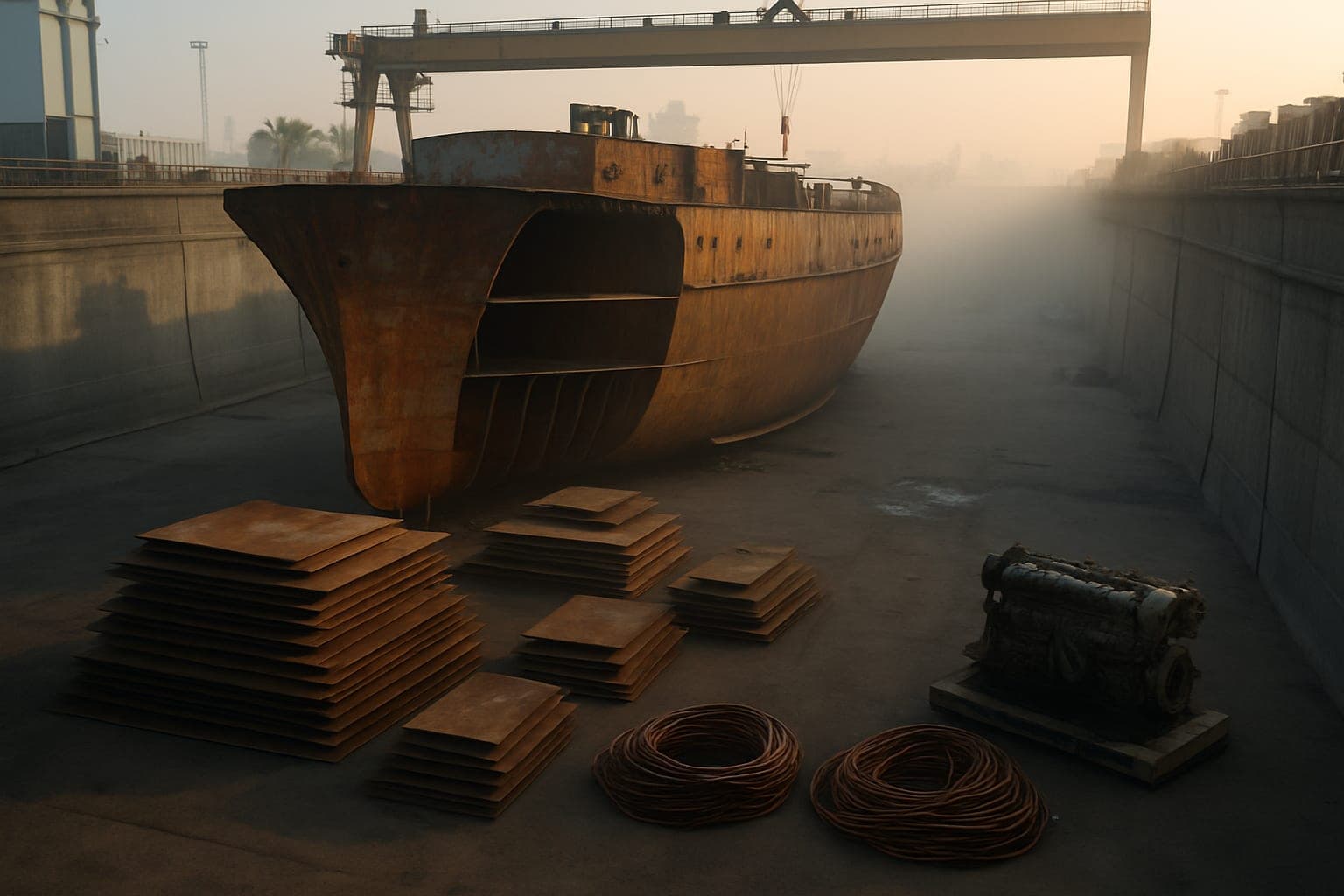
The UAE ship recycling regulation covers UAE-flagged ships, foreign ships recycled in the UAE, and foreign-flagged ships whose recycling decision is taken in UAE waters. State-owned vessels and ships under 500 GT are excluded. Beaching is banned, so cutting happens in dry dock, and the plate, HMS, cable and equipment coming off lands in the domestic scrap market.
What exactly does the UAE ship recycling rule cover?
The Ministry of Energy and Infrastructure unveiled the regulation in December 2023, and it was pushed out through the ports, including Fujairah's Notice to Mariners 344 that same month. Because the circular carried no stated effective date, the law firms advising owners at the time treated it as live immediately for any recycling activity in the UAE. S&P Global Commodity Insights then reported on 25 August 2025 that the rule applies from 26 June, the day the Hong Kong Convention entered into force. Both dates are real. Anyone describing this as a brand new 2025 measure has quietly skipped eighteen months of exposure.
Scope is wider than the flag register. Per that August 2025 S&P reporting, the regulation reaches all UAE-flagged ships, foreign ships recycled in the UAE, and foreign-flagged ships whose decision to recycle is made while the vessel is in UAE waters. Legal notes published when the circular first appeared went further, warning that a vessel heading for a yard which does not meet UAE requirements is in breach if it transits UAE territorial waters en route. Captain Abdulla Al Hayyas, MoEI's Director of Maritime Transport, was the official who presented the framework.
Who falls outside it
Two exclusions matter commercially. State-owned ships, warships included, sit outside the rule, and so do vessels under 500 GT. That leaves a large population of barges, workboats, crew boats and small local craft that will still be dismantled under ordinary industrial and environmental permits rather than the ship recycling regime. Their steel, engines and cable reach exactly the same yards and the same buyers.
The other hard requirement is method. Beaching and landing are prohibited, and work has to take place in a dry dock or equivalent infrastructure with impermeable flooring. That is the most expensive sentence in the document, and it is why capacity, not demand, is the binding constraint.
Why does the Hong Kong Convention date matter for your material?
The Convention was adopted on 15 May 2009. Bangladesh and Liberia acceded in June 2023, which met the entry-into-force conditions and started a 24 month clock, and it entered into force on 26 June 2025 across 24 contracting states, per a Holland & Knight note dated 30 September 2025. If you have read that the Convention took effect in 2023, that is wrong, and the error changes which vessels needed paperwork when.
From 26 June 2025 a ship going for recycling needs an approved Inventory of Hazardous Materials in three parts, a ship-specific recycling plan written by the chosen facility, a Ready for Recycling Certificate, and a yard holding a valid Document of Authorisation for Ship Recycling, according to Lloyd's Register's published guidance on the regime. For the scrap buyer downstream, the IHM is the document worth asking for. It tells you before a single plate is cut where the asbestos lagging, the PCB-bearing cable, the ozone-depleting refrigerant circuits and the tributyltin anti-fouling paint sit on that hull.
We could not confirm from public sources whether the UAE is itself a contracting state, or whether any UAE yard currently holds a DASR issued by MoEI. Ask for the certificate instead of assuming. Do not assume competing destinations are automatically non-compliant either, because Alang in India holds Hong Kong Convention certified capacity.
Where does the material actually go once cutting starts?
Almost all of a vessel's light displacement tonnage is steel. The value density, however, sits in the fractions that are not steel, and those are the ones most often thrown into a mixed pile. We have no sourced tonnage split per LDT and will not manufacture one, so treat the map below as the practical breakdown of a demolition job rather than a dataset.
| Stream | Form as it leaves the dock | UAE buyer | Price reference |
|---|---|---|---|
| Hull and deck plate | Cut plate, sometimes re-rollable if thickness holds | Re-rolling mills, EAF melt shops when oversize or pitted | Top of the domestic ferrous range |
| Frames, girders, structural | HMS 1, sheared to mill spec | EAF melt shops | HMS sheared assessment |
| Ducting, thin plate, light steel | HMS 2 or light blended | Shredders, then mills | Light and HMS blended assessment |
| Mixed shreddable | Shredded to ISRI 210 to 212 | Domestic consumers, minimum 100 tonne lots | Fastmarkets UAE shredded index, AED per tonne |
| Cable and wiring | Insulated cable, stripped bright copper | Non-ferrous processors and exporters | LME Copper Grade A |
| Valves, fittings, propellers | Brass and bronze castings, high unit value | Non-ferrous traders, foundries | LME copper complex |
| Superstructure, accommodation | Aluminium sheet and extrusion | Aluminium recyclers | LME Aluminium |
| Pipework, galley, tanks | 304 and 316 stainless sections | Specialist stainless buyers | Nickel-linked |
| Marine equipment | Engines, gensets, pumps, winches, anchors, chain, navigation | Second-hand marine trade, offshore operators, workshops | Reuse value, far above scrap value |
| Regulated waste | Asbestos, PCB, ODS, sludge, batteries, TBT paint chips | Permitted hazardous waste contractors only | A cost line, not revenue |
The last row is not a trading opportunity and should never be treated as one. Movement of those fractions runs on emirate-level hazardous waste permits and manifests, and a marketplace listing is no substitute for the permit. If you are already documenting industrial loads digitally in Dubai, the same discipline applies here, and our note on digital waste transfer notes explains what auditors now expect to see per load.
Which grades do UAE mills and traders actually pay up for?
First, a correction that costs sellers money every week. The LME does not set the price of ship plate or HMS in this market. The physical reference for deep-sea ferrous scrap is the Turkish HMS 1&2 80:20 CFR import index published by Platts, Fastmarkets and Kallanish, and the LME's cash-settled steel scrap contract settles against that index rather than driving it. Where the LME does bite directly is the non-ferrous side of a demolition job: Copper Grade A for cable, valves and propeller bronze, and Aluminium for superstructure.
Second, the UAE now has its own published ferrous reference. Fastmarkets launched a UAE shredded steel scrap index on 24 April 2025, specified as shredded scrap compliant to ISRI 210 to 212, minimum 100 tonnes, basis delivered consumer UAE, timing within four weeks, quoted in dirhams per tonne, payment cash or letter of credit, published on Tuesdays. A dirham-denominated delivered-UAE print is exactly what a one-off demolition seller needs to stop being lowballed.
Third, the spread between grades is the commercial argument for sorting. The set below comes from Kallanish domestic UAE assessments effective 27 January. We could not establish the year from the snapshot we hold, so read the levels as indicative and refresh them before you price a job. The relationships are same-source and same-date, so the arithmetic between them stands.
| Grade | Assessed level, AED per tonne | What it tells you |
|---|---|---|
| HMS sheared | 1,325 | Sized and clean, top of the domestic range |
| Fabrication scrap | 1,320 | Clean new production offcuts, priced alongside sheared |
| Grade scrap | 1,225 | Standard mill feed |
| Light and HMS blended | 1,050 | Mixed and unprepared, bottom of the range |
Sheared sits roughly AED 275 per tonne above light and HMS blended on that assessment, a premium of about 26 percent for sizing and cleanliness alone. On a demolition job producing a few thousand tonnes of steel, the decision to shear and separate rather than dump everything into one blended pile is worth more than the yard's entire cutting labour bill. Listing the grades separately on the metals marketplace is how you get paid for that work instead of donating it to a trader.
Has the export duty closed the container route out of the UAE?
Kallanish reported that UAE mills cut buying prices by AED 75 per tonne, around USD 20.4, week on week after UAE scrap export duties were announced, with participants expecting UAE-origin material to become less attractive to buyers in Pakistan, Bangladesh and India. Containerised shipments to Pakistan continued at meaningful volume regardless. That is the honest picture: bids dropped, the route narrowed, it did not vanish overnight.
We could not verify the instrument name, number, date, rate or the HS codes and grades covered, and we are not going to guess at a tariff line that determines whether your tonnage clears customs. Confirm it with your broker before you commit a demolition parcel to export. Our earlier piece on how UAE HMS 80:20 behaved as the export route tightened shows how quickly the domestic bid resets when the outbound option closes.
Is UAE yard capacity ready for the tonnage?
MoEI's stated purpose, as reported by S&P Global in August 2025, is to encourage the growth of compliant ship recycling capacity. The NGO Shipbreaking Platform made a similar point from the other direction in December 2023, noting that Bahrain already hosts a dry-dock facility doing this work and that the region needs more dry-dock capacity able to fully contain hazardous materials. Two very different observers, one conclusion. We have no figure for existing compliant UAE capacity in LDT per year, so we are not putting a number on the gap.
The infrastructure class the rule demands does exist in the Emirates. Damen Shipyards Sharjah in Hamriyah Free Zone runs a 284,000 square metre site with a 120 by 26.5 metre shiplift rated at 5,200 tonnes, eight dry berths, an enclosed blasting and painting facility and 1,200 metres of quay with up to 9 metres of water. That is a newbuild and repair yard, not a recycling yard, and the distinction matters. It shows the engineering exists here, not that it has been authorised for demolition.
Do not expect a demolition wave. The same S&P reporting carried an analyst view that demand for ship recycling is at a low point, which is precisely why this is a sensible moment for the UAE to put the framework in place and build yards. Meanwhile Fujairah, Khalid Port in Sharjah and Khor Fakkan are named as the ports vessels use before proceeding to a yard, and the world's largest cash buyer of ships and offshore units for recycling is based in Dubai. The commercial gravity is already here.
How do you clear a demolition job instead of stockpiling it?
The reuse fractions are where value leaks. Engines, gensets, pumps, winches, chain, valves and navigation electronics get swept into a mixed scrap sale because nobody at the yard has a buyer list, and a AED 40,000 genset leaves at HMS 2 pricing. That is a discovery problem, not a pricing problem.
- Pull the IHM before cutting starts and ring-fence every hazardous line item to a permitted contractor. Nothing on that list goes to a marketplace.
- Segregate ferrous at the dock into sheared, plate and light, and weigh each stream separately so you can quote against a published grade.
- Strip cable, brass fittings, bronze and aluminium into separate lots and price them off the relevant LME reference, not off a blended scrap offer.
- Photograph and list running machinery as reusable equipment. A demolition job spans our metals, industrial and electronics categories, so it is a multi-listing exercise, not one scrap sale.
- Publish while the material is still on the ground rather than after three months of storage. KYC-verified buyers through UAE PASS, escrow settlement via MyFatoorah and a 48-hour inspection window mean you can sell to a counterparty you have never met without carrying the credit risk.
- Keep the tonnage records. Audit-ready diversion figures from a demolition job are the cheapest ESG reporting you will ever produce.
For more on how domestic ferrous and non-ferrous pricing is moving across the seven emirates, our market insights archive tracks the grade spreads week by week.
Frequently asked questions
Does the UAE ship recycling rule apply to foreign-flagged vessels?
Yes. According to S&P Global Commodity Insights reporting from 25 August 2025, the regulation covers foreign ships recycled in the UAE and foreign-flagged ships whose decision to recycle is taken while the vessel is in UAE waters, alongside all UAE-flagged ships. Legal notes issued when the MoEI circular appeared in December 2023 also warned that transiting UAE territorial waters on the way to a non-compliant yard puts a vessel in breach.
Which vessels are excluded from the regulation?
State-owned ships, including warships, and ships under 500 GT sit outside the rule, per the same August 2025 reporting. That covers a lot of barges, workboats and small local craft in the Gulf. Their dismantling still runs under ordinary industrial and environmental permits, and the steel, cable and machinery still reach domestic buyers.
Can a ship be beached for scrapping in the UAE?
No. Beaching and landing are banned under the regulation, and recycling must take place in a dry dock or equivalent infrastructure with impermeable flooring. That requirement is the main reason compliant capacity is expensive to build, and why both MoEI and the NGO Shipbreaking Platform have pointed to the need for more dry-dock capacity in the region.
Does the LME set the price of ship plate and HMS in the UAE?
No, and assuming it does will cost you money. The physical reference for deep-sea ferrous scrap is the Turkish HMS 1&2 80:20 CFR import index, and the LME steel scrap contract settles against that index rather than setting it. The LME does directly drive the non-ferrous fractions of a demolition job through Copper Grade A and Aluminium.
Is there a UAE-specific published scrap price I can quote against?
Yes, since 24 April 2025. Fastmarkets launched a UAE shredded steel scrap index specified as ISRI 210 to 212 material, minimum 100 tonnes, delivered consumer UAE, quoted in dirhams per tonne and published on Tuesdays. It gives sellers with one-off demolition tonnage a defensible domestic reference instead of relying on a trader's word.
How much more do mills pay for sorted ship steel?
On a Kallanish domestic UAE assessment effective 27 January, HMS sheared was quoted at AED 1,325 per tonne against AED 1,050 for light and HMS blended, a gap of about AED 275 per tonne or roughly 26 percent. We could not confirm the year of that snapshot, so refresh the levels before pricing, but the relationship between prepared and unprepared material is consistent across cycles.

Comments(0)
Sign in to join the conversation.