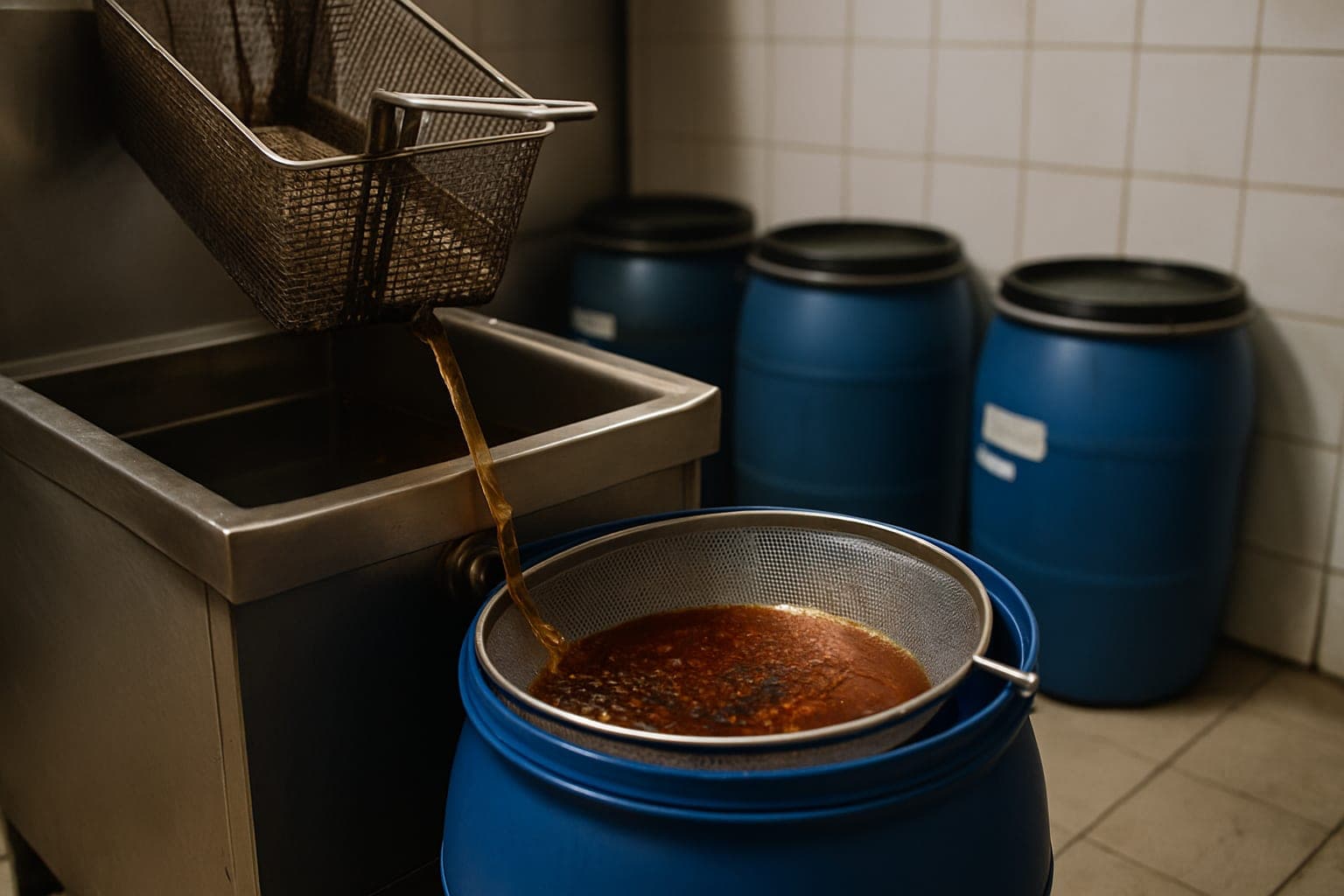
UAE aggregators and biodiesel refiners buy used cooking oil against the same specification as the traded export benchmark: free fatty acid content at 5% maximum and moisture, impurities and unsaponifiables at 2% maximum. Oil that clears both limits, backed by collection paperwork that names its origin, earns the top quote available that week. Off-spec oil is deducted against or refused outright.
What actually sets the used cooking oil price in the UAE?
There is no exchange contract for used cooking oil. The reference most UAE export aggregators work from is the Fastmarkets assessment AG-UCO-0010, "used cooking oil, cif Amsterdam-Rotterdam-Antwerp", published in US dollars per tonne daily at 4pm London time. Its quality basis is specific: FFA 5% max, MIU 2% max, iodine value minimum 70 g iodine/hg, sulphur 50 ppm maximum, minimum cargo 500 tonnes, shipment within 45 days of sale. Fastmarkets moved to that FFA and iodine basis after market feedback, which tells you the trade standardised around 5% rather than the other way round.
Two things follow from the spec. First, the 500-tonne minimum parcel explains why a single hotel in Al Quoz or a catering kitchen in Ras Al Khor does not export directly; you need an aggregator to consolidate before a parcel leaves through Jebel Ali. Second, Fastmarkets also runs a separate line, AG-UCO-0011, for ISCC-certified oil delivered duty paid into Northwest Europe, priced in euros. Certified, traceable oil is a different product with its own price. Paperwork, not chemistry, is what moves a load between those two tiers.
Your local quote is then the benchmark less freight out of the UAE, less the collector's handling and margin, less any quality deduction on FFA, moisture or sediment. Convert at the pegged 3.6725 AED to the dollar and you have the ceiling your oil could theoretically reach. What you actually receive depends on how many bidders know what your monthly volume is.
Why we are not printing an AED per litre figure
We looked for a verifiable AED-per-litre UCO purchase price in the UAE and did not find one we would stand behind. UAE trader listings we reviewed, including Global Rec Source in Sharjah and Green Shadow Used Cooking Oil Trading in Abu Dhabi, publish full specifications and then say price on request. Figures circulating on aggregator content pages are worse than useless; at least one conflates used cooking oil with used lubricating oil, which is a completely different waste stream with different permits. The honest position is that this market is quote-driven and opaque, and that is exactly the argument for running a tender.
For contrast, GlobalProductPrices put retail fresh cooking oil in the UAE at USD 4.49 per litre in April 2025. That is virgin oil at retail, not a waste price, but it frames the question every finance manager eventually asks: if we pay that going in, why is the value going out invisible on our accounts?
Why do FFA and MIU decide the rate?
Free fatty acids are what frying does to a triglyceride over time. Heat, water, salt and suspended food particles all accelerate hydrolysis, so FFA is essentially a record of how long the oil sat hot and how much contamination went into the fryer. Refiners care because high FFA means more pre-treatment before esterification, higher chemical use and lower yield per tonne. Moisture and impurities matter for the same reason, plus water adds weight you get paid for and the buyer then has to remove.
Both UAE exporter listings we checked advertise to FFA 5% max and MIU 2% max, alongside saponification values around 185 to 205 mg KOH/g and iodine values in the 75 to 120 range depending on the seller. That consistency is the point. When two independent traders in two emirates publish the same ceiling as the ARA benchmark, the ceiling is real, and the belief that "oil is oil" costs money. It is the same dynamic we see in colour-sorted glass cullet, where a sorting habit at source decides the tier a load is bought into.
| Load condition | Typical cause in the kitchen | How buyers treat it |
|---|---|---|
| FFA under 3%, MIU under 1% | Daily filtration, oil cooled before decanting, sealed drums, no water ingress | Best available quote, and the load is fit for a certified export parcel |
| FFA 3% to 5%, MIU up to 2% | Normal fryer cycles, weekly filtration, drums kept indoors | On-spec against the ARA benchmark basis, standard contract price |
| FFA above 5% | Oil pushed too many cycles, drums standing in yard heat, salt and batter carryover | Deduction negotiated per load, or rejection at the depot |
| Visible water layer, MIU above 2% | Wash-down water, ice, rain, open-top containers | Weight disputed, load often refused; you may pay to have it removed |
| Mixed with grease trap or FOG waste | One container used for both streams | Not a UCO purchase at all, priced as liquid waste with a disposal cost |
Which storage and filtration habits protect the grade?
Nothing here needs capital spend. It needs a written standard in the kitchen and a chef who enforces it.
- Filter daily through a fine mesh or fryer filter machine and skim crumbs between services. Particulate is both MIU and an FFA accelerant.
- Let oil cool before decanting, then close the drum. Hot oil in an open drum picks up moisture as it cools in a humid loading bay.
- Use one dedicated, lidded, food-grade container per site and label it with the first and last fill date. Never the same container as grease trap sludge.
- Keep water out completely. No ice for cooling, no hosing near open drums, no outdoor storage without a roof. A visible water layer is the fastest way to lose a load.
- Never let mineral oil, dishwasher chemicals, cleaning solvent or fryer-cleaning caustic reach the drum. Sulphur has a 50 ppm ceiling on the benchmark basis and contamination is not reversible.
- Store drums in shade. Drum surface temperatures in a Dubai Industrial City or Musaffah yard in July will keep pushing FFA up after the oil has left the fryer.
Ask your collector for written quality feedback. Neutral Fuels states on its own site that key accounts receive bi-annual oil quality reports, so this is already commercial practice in the UAE rather than a favour. If nobody is reporting FFA back to you, you cannot tell whether a handling change earned anything.
Who buys used cooking oil in the UAE now?
The buyer field is wider than most older articles suggest, and it widened materially in 2025. Dubai Municipality signed a memorandum of understanding with BiOD Technology FZCO, described in the Municipality's 29 July 2025 release as a subsidiary of DUBAL Holding, authorising it to collect used cooking oil and fats, oils and grease from across Dubai and process them into B100 biodiesel. Fahad Al-Awadhi, Director of the Sewerage and Recycled Water Projects Department, and Adel Al Marzooqi, CEO of the Waste and Sewerage Agency, were named on the Municipality side. The stated rationale is as much about protecting sewer infrastructure and cutting wastewater treatment cost as it is about fuel.
Alongside that sit established processors and exporters. Neutral Fuels has operated since 2011 and describes two refineries, one in Dubai and one in Abu Dhabi, with its bio-refinery in Dubai Investments Park. Treat the widely repeated 4 million litre annual capacity figure with caution; it traces to reporting from around 2015 and has been recycled online ever since. Lootah Biofuels has been active in Dubai since at least the middle of the last decade. On the export side, traders in Sharjah and Abu Dhabi buy filtered oil to spec for consolidation. That is at least three or four credible destinations for the same drum, which is the structural reason a standing offer is rarely the best offer.
One caution on permits. Neutral Fuels claims on its website to hold the only Tadweer permit to collect and recycle used cooking oil in Abu Dhabi. That is a vendor claim, not a regulator statement, and you should check the current licensed service provider position with Tadweer Group directly before you treat it as settled. For Sharjah we found no published rule specific to commercial liquid food waste, so ask Sharjah City Municipality in writing rather than assuming Dubai practice transfers.
What chain-of-custody documents does a buyer require?
Certified oil earns a different price because the certification scheme can trace the litre back to a named kitchen. Break the chain anywhere and the load drops to the uncertified tier, or worse, becomes unsaleable into Europe. Build the file as the oil moves, not at audit time.
- A copy of the collector's current permit or licence from the competent authority in the emirate where the oil is generated, with an expiry date you diarise.
- A transfer note or digital manifest for every single collection, showing date, vehicle, driver, litres or kilos, and the receiving facility. Dubai has moved this record onto digital waste transfer notes, so the log exists whether you file it or not.
- A weighbridge ticket or calibrated volume measurement at the receiving depot, not just the driver's estimate on your loading bay.
- A certificate of analysis per delivered parcel covering FFA, MIU, iodine value and sulphur, with the sampling method and lab named in the contract.
- A declaration of origin tying the oil to your trade licence and site, which is what a certification auditor asks for first.
- A reconciliation each quarter of litres collected against litres paid for, and a diversion summary you can drop into your ESG report.
Unpermitted collection is the hole that swallows all of this. Lootah Biofuels' Yousif Saeed Lootah described working with Dubai Municipality on a framework to stop unauthorised collectors from collecting and exporting UCO in comments published by Emirates 24|7 in December 2015 and updated in October 2018. That reporting is old and the enforcement position needs rechecking, but the risk it describes has not changed: oil that leaves your kitchen without a document leaves your carbon claim with it.
How do you tender collection instead of accepting a standing offer?
Most hotels and catering groups inherited their collector. Very few have ever put the volume in front of more than one buyer.
- Measure first. Pull 12 months of collection notes and produce litres per site per month. Neutral Fuels publishes a 200 litre per month threshold for regular scheduled collection, so a single outlet may sit below serviced volume while a group of eight clears it comfortably. Tender as a group.
- Verify the bidders. Confirm permit status with the authority in each emirate you operate in before you read a price. A cheap quote from an unpermitted truck is not a quote.
- Write the spec into the tender. State FFA, MIU, iodine and sulphur limits, who samples, which lab arbitrates a dispute, and how a deduction is calculated. Undefined deductions become the collector's discretion.
- Ask for an index-linked formula, not a flat number. A percentage of a named published assessment on the week of collection, converted at 3.6725, survives market moves in both directions. Flat AED per litre for 24 months always ages badly for one side.
- Price the service, not only the oil. Container supply, collection frequency, spill response, out-of-hours access, and a bi-annual quality report should all be scored.
- Award for 12 months with a quarterly review and an explicit right to audit the documentation pack. Keep one alternate bidder warm.
For one-off parcels, a decommissioned kitchen, an over-ordered stock of frying oil or a batch nobody will collect on schedule, you can put the lot in front of verified buyers on our organic materials marketplace, where counterparties are KYC-verified through UAE PASS, funds sit in escrow via MyFatoorah, and the buyer has a 48-hour inspection window. That inspection window is the mechanism that makes an FFA claim on a listing worth something.
Two last claims to retire. Free collection is not free; it means the collector is keeping the value your kitchen created. And the frequently quoted 84% carbon reduction for UCO biodiesel comes from World Economic Forum reporting in February 2015, before current lifecycle methodologies. Use a current, pathway-specific figure from your buyer's certification, or use tonnes diverted, which nobody can argue with.
Frequently asked questions
What FFA level do used cooking oil buyers in the UAE accept?
The working ceiling is 5% free fatty acids with moisture, impurities and unsaponifiables at 2% maximum. That is the quality basis of the Fastmarkets cif Amsterdam-Rotterdam-Antwerp assessment, and both UAE exporter listings we reviewed, in Sharjah and Abu Dhabi, advertise to the same limits. Loads above those levels are discounted per contract or refused at the depot.
Is there a published AED per litre price for used cooking oil in the UAE?
No credible published figure exists. UAE traders list full specifications and quote price on request, so the market is negotiation-driven and opaque. Price your oil off a dated print of a named published assessment converted at 3.6725 AED to the dollar, plus at least three direct collector quotes taken in the same week.
Who is authorised to collect used cooking oil in Dubai?
Collection is a permitted activity, and the field widened in 2025. Dubai Municipality signed an MoU on 29 July 2025 with BiOD Technology FZCO, a DUBAL Holding subsidiary, authorising collection of used cooking oil and FOG across Dubai for processing into B100 biodiesel. Ask any bidder for its current permit and verify it with the Municipality before signing.
Can we put grease trap waste in the same drum as fryer oil?
No. Grease trap and FOG waste carries high water and solids content, which pushes MIU straight past the 2% limit and turns a saleable commodity into liquid waste you pay to remove. Keep one dedicated lidded food-grade container for fryer oil only, and let the collector handle the trap under a separate line item.
What is the minimum volume needed to get scheduled collection?
Neutral Fuels publishes a threshold of at least 200 litres per month for regular scheduled collection. Single outlets often sit below that and end up on ad hoc pickups with weaker pricing. Aggregating volume across a group of properties is the simplest way to cross the threshold and tender as one account.
Which documents keep a certified price tier available to us?
A permit copy for the collector, a transfer note or digital manifest for every collection, a weighbridge or calibrated volume record at the depot, a certificate of analysis per parcel, and a declaration of origin naming your site and trade licence. Fastmarkets prices ISCC-certified oil separately from uncertified oil, so that file is the difference between two price lines.

Comments(0)
Sign in to join the conversation.