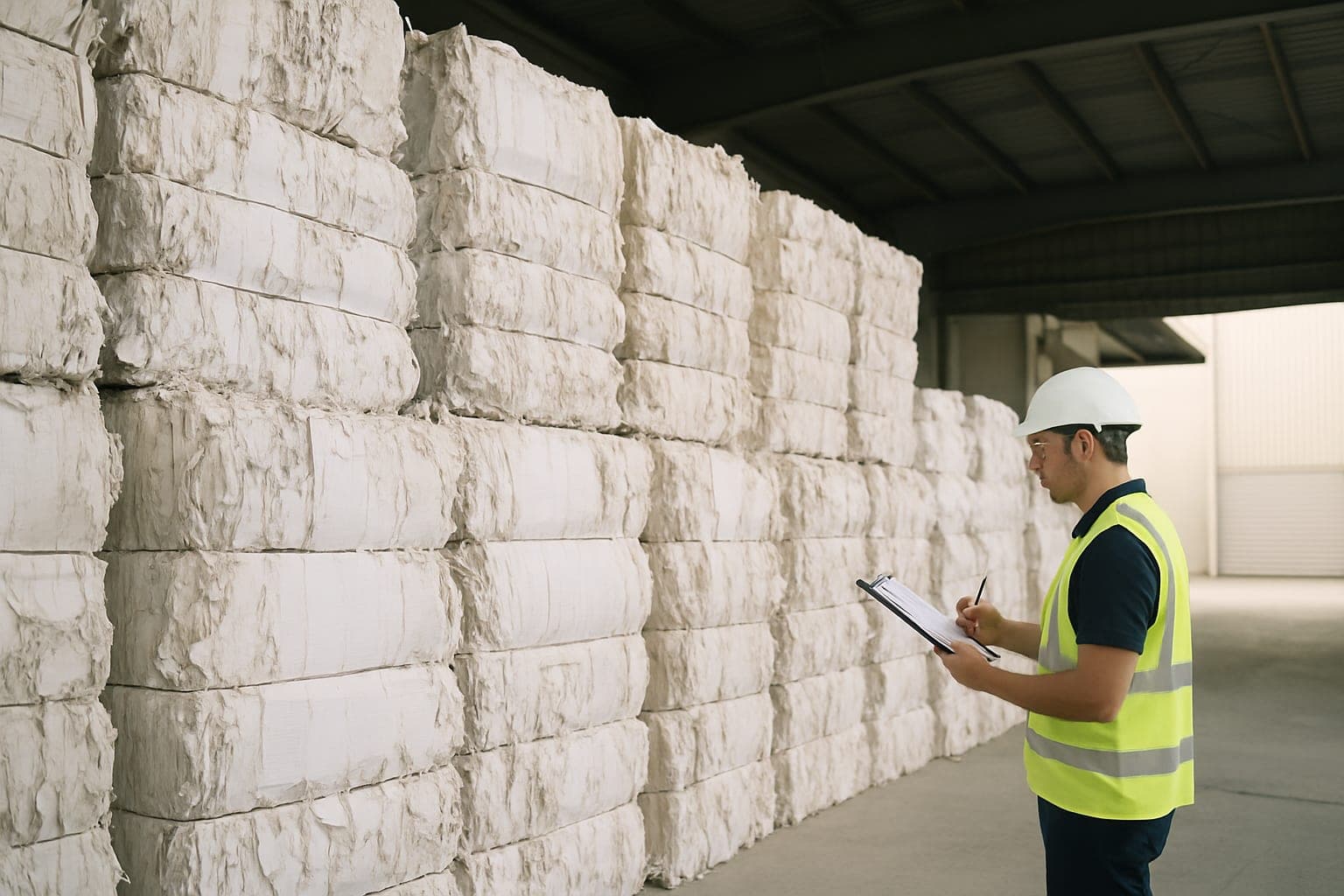
Sorted office paper, the white ledger and continuous-form stock your printers and back offices produce, trades as its own grade and clears well above OCC and mixed paper. To capture that spread you keep it separate at the desk, strip out carbon paper, carbonless sets and window envelopes, bale to your buyer's written specification, and shred only the documents a retention rule actually forces you to destroy.
What is the difference between SOP and mixed office waste?
Sorted office paper, universally called SOP in the trade, is a printing and writing grade. It is the material a deinking mill wants: uncoated white and lightly coloured office stock, computer print-out and continuous-form paper, with the ink removable and the fibre long enough to survive another pass through a paper machine. Mixed office waste is everything the cleaning contractor swept together, including magazines, coated brochures, kraft envelopes, tissue and whatever cardboard was near the bin.
The reference document buyers cite is the ReMA paper stock specifications circular, formerly published under the ISRI name, which defines each grade along with its permitted outthrows and prohibitive materials. Get a current copy from your buyer before you argue about a rejection, because the definitions, not your opinion of the material, decide the settlement. If your buyer will not name the grade they are buying in writing, you are selling mixed paper at a mixed paper price.
Here is where the fibre in a typical UAE office actually sits.
| Stream | Typical UAE source | What disqualifies it | Commercial position |
|---|---|---|---|
| Sorted office paper (SOP) | DIFC and Abu Dhabi Global Market back offices, clinic administration, government service counters | Carbon paper, NCR sets, plastic windows, food residue, thermal receipts | Highest paid fibre grade from an office building |
| Continuous-form / computer print-out | Legacy banking and logistics printers, warehouse pick lists | Tractor-feed edges are usually fine, tape and label backing are not | Often priced with or close to SOP if kept clean and dry |
| Mixed office waste | General office bins, pantry areas, meeting rooms | Nothing much, which is exactly the problem | Lowest value, sometimes a cost to move |
| OCC (old corrugated containers) | Loading bays in JAFZA, Dubai Industrial City, KEZAD | Wax coating, wet strength, polystyrene | Separate market, containerboard mills, not deinking |
Do not blend OCC into an office paper lot because both are "paper". They go to different mills. If corrugated is your bigger volume, price it on its own terms and watch the containerboard side of the market, which we track in our OCC bale price coverage.
Why does the grade premium matter more when mixed paper is weak?
There is no published UAE or GCC index for sorted office paper. Fastmarkets runs PIX Testliner GCC and PIX Fluting GCC, but those track recycled containerboard, the product OCC feeds, not the fine paper and tissue chain that consumes SOP. So the honest position is this: any AED per kilogramme number you see for office paper in this market is a trader's quote on a given day, not an index print. Ask for it in writing and ask for the date.
What international data does show is the size of the gap between a sorted grade and an unsorted one. Recycling Product News reported in January 2025 on a material recovery facility realising roughly US $148 per sorted ton of SOP while paying about US $2 per ton to offload mixed paper, and described sorted office paper as generally clearing above US $100 per ton. That is close to a US $150 per ton swing produced by sorting alone. Treat it as a mechanism, not a UAE rate.
The wider fibre market has been soft. Fastmarkets put the US SOP national average at $233 per short ton in November 2022, a figure still quoted in trade content today and roughly 55 percent above the sub-$150 levels indicated in 2025 sources. Do not let a buyer anchor you to a three-year-old print, in either direction. In 2025, BIR members reported that material recovery facilities and paper recycling plants were struggling to turn a profit because collection and baling costs exceeded selling prices, US mill closures took an estimated 4 million tons of annual capacity offline, and container freight from Europe to Southeast Asia and India fell from around US $500 to US $300 per box by July 2025. India, not China, is now the most consistent export outlet.
Weak low grades strengthen the argument for grading, not the reverse. When mixed paper approaches zero, the entire economics of your paper stream sits in the premium you can prove.
What does it cost you to leave office paper in the mixed bin?
The cost side is documented in the UAE far better than the revenue side. Dubai moved landfill disposal from AED 10 per visit to AED 100 per tonne of non-recyclable waste at the start of 2022, as reported by the World Economic Forum. That schedule sits under Executive Council Resolution No. 58 of 2017 and its amendments, so check the current tariff with Dubai Municipality before you build a business case on the 2022 figure. In Abu Dhabi, the Tadweer Group Services Guide dated July 2025 sets an AED 300 disposal fee that applies where waste goes to a Tadweer Group managed landfill, tied to a Waste Disposal Permit for the waste types listed in its Appendix 1, with contracting through Bolisaty and gate access enabled by a topped-up Tadweer Group Wallet.
There is a second cost that rarely reaches the procurement spreadsheet. Dubai Municipality's Warsan waste-to-energy plant, built at a stated cost of AED 2 billion across 400,000 square metres, processes daily waste equivalent to that generated by three million people. Unsorted office paper in a general stream is combustion feedstock there, not mill feedstock. The fibre is gone, and you paid to send it.
Which contaminants kill an office paper lot?
Prohibitives are not a matter of degree. A small quantity can down-grade or reject a whole bale, because the mill's deinking and screening plant cannot economically remove them. Brief your facilities team on the list, not on the principle.
- Carbon paper and carbonless (NCR) sets. Still circulating in UAE clinics, logistics offices and government-facing paperwork. Both are classic prohibitives.
- Plastic window envelopes and courier document pouches. Windows, tape and adhesive labels are the most common single defect in an office lot. Ministerial Resolution No. 380 of 2022 on single-use products has also pushed some UAE offices toward windowless stock, which helps.
- Thermal receipt paper, laminated sheets and plastic-coated covers. Coated and laminated stock does not repulp.
- Ring binders, spiral bindings, plastic dividers and file spines. Metal and plastic damage equipment.
- Moisture and food residue. A pantry-adjacent bin will contaminate a lot faster than any printer.
- Wet strength papers and adhesive-bound blocks. Sticky notes in volume are a problem, not a rounding error.
The cheapest control is a dedicated white paper bin next to each printer and copier, and a separate confidential bin for anything covered by a retention rule. Cleaning crews consolidate whatever is easiest to consolidate. Design for that.
Does shredding destroy the value of your office paper?
Shredding always costs you something. It shortens fibre, mixes colours, raises bulk and makes contaminants far harder for a buyer to spot, which is why many buyers price shredded material as mixed paper unless they have their own handling for it. Cross-cut and micro-cut output is worse commercially than strip-cut, and it is also the output most compliance teams insist on.
The correct decision is not shred everything or shred nothing. It is to shred the documents where a retention or data protection rule requires destruction, and to route everything else to the SOP stream intact. Personal data is governed federally by Federal Decree-Law No. 45 of 2021, with separate regimes inside the DIFC under Data Protection Law No. 5 of 2020 and in ADGM under its Data Protection Regulations 2021, and banks and clinics carry additional record-retention obligations from their own regulators. Confirm the applicable retention periods with your counsel or data protection officer rather than a waste contractor, because we have seen offices shred years of blank forms and unread internal memos that carried no obligation at all.
Three practical points. Shred at document level, not at bin level. Keep shredded output baled separately from intact SOP so one stream does not drag the other down. And if shredding is unavoidable at volume, ask your buyer for a written price on loose versus baled shred before you commission a machine. The same discipline applies to devices, which we cover in our guide on selling retired IT assets without failing a data audit.
How do you bale and package a saleable lot?
No UAE-wide published bale standard exists for office paper, and anyone who tells you otherwise is quoting their own mill. Bale to the specification your buyer gives you in writing, and get that specification before the first bale, not after the first rejection.
- Separate at source. White ledger and continuous-form in one bin, coloured and mixed office in another, corrugated at the loading bay. Label in English and the languages your cleaning crew actually reads.
- Get the buyer's bale spec in writing. Dimensions, target weight per bale, wire or strap count, maximum moisture, permitted outthrows percentage, and whether they accept mill-size or half-size bales.
- Keep it dry. Store bales under cover and off the slab. Summer humidity in Al Quoz and Musaffah yards adds weight a buyer will discount, and moisture invites rejection.
- Weigh and photograph every bale. Bale count, individual and total weights, and clear photographs of the bale face. This is your evidence if a grade is disputed.
- Batch to a full load. Ask each buyer their minimum monthly volume for a paid collection rate and whether they place an on-site baler. Below that threshold you are buying a collection service, not selling a commodity.
- Keep the paperwork with the lot. Waste transfer documentation, permits and any destruction certificate travel with the material, not in a separate folder six weeks later.
What do UAE rules require from a seller of baled office paper?
Federal Law No. 12 of 2018 on integrated waste management covers every phase from production through sorting, transport, storage, recycling and disposal, with the competent local authority in each emirate responsible in its own area. Its executive regulations, Cabinet Resolution No. 39 of 2021, place responsibility for proper disposal on the waste generator, including the financial cost. Cabinet Resolution No. 116 of 2023 organises the work of establishments engaged in the integrated management of recyclable materials, and if you trade volume you should read its text on uaelegislation.gov.ae rather than a summary.
Dubai tightened this materially. Law No. 18 of 2024 regulating waste management applies to all areas within the emirate, including special development zones and free zones such as the DIFC, which ends the old assumption that a free zone tenant sits outside municipal waste rules. Administrative Resolution No. 253 of 2025 then approved technical guidelines for the evaluation and classification of establishments in waste collection and transport, waste treatment and recycling, and waste trading, administered by the Waste and Sewerage Agency of Dubai Municipality. If you are selling baled fibre regularly, check whether your activity falls under the trading classification and check your buyer's registration too. Documentation trails are also going digital, as we set out in our note on Dubai waste transfer notes.
How do you sell a lot that also needs a certificate of destruction?
The destruction certificate and the grade premium are not in conflict, and they usually come from two different people in the same building. Compliance wants proof that identifiable records were destroyed. Procurement wants the best price for the fibre. Both are satisfied by splitting the material, not the process.
Run confidential documents through witnessed shredding, with the operator issuing a certificate that names the collection date, the site, the container or bin identifiers, the weight destroyed and the method. Route everything non-confidential to the SOP stream whole. Then, when you list the lot, attach the certificate and the weighbridge tickets as part of the listing pack so a buyer can see immediately which portion is intact SOP and which is shred. Buyers pay for certainty, and a documented lot argues its own grade.
One gap worth stating plainly: we could not verify a published UAE deinking mill buying SOP at scale, so unless your buyer names the consuming mill, assume your fibre is heading for export and price accordingly. A Dubai Chamber linked directory lists dozens of waste paper trading companies in Dubai alone, which is a healthy bid pool, but not all of them are selling into the same chain. Ask each one where the material goes. If you want competing offers on a documented lot rather than a single trader's number, list it on our paper marketplace, where counterparties are KYC verified through UAE PASS, payment sits in escrow with MyFatoorah, and the buyer has a 48-hour inspection window that gives your grading claim somewhere to be tested.
Frequently asked questions
How much does office waste paper sell for per kilogramme in the UAE?
There is no published UAE or GCC index for sorted office paper, so every figure you see is a trader quote on a specific date rather than a market print. Local quotes are usually given in fils per kilogramme, while international benchmarks are per ton, so convert before you compare. Ask for the quote in writing, dated, with the grade named and the collection terms stated.
Is shredded paper worth less than intact office paper?
Yes, in almost every case. Shredding shortens fibre, mixes grades and hides contamination, so many buyers price shredded material as mixed paper unless they run a dedicated line for it. Shred only what a retention or data protection rule requires you to destroy, keep shredded output baled separately, and send the rest to the sorted office paper stream intact.
What counts as a prohibitive in a sorted office paper bale?
Carbon paper, carbonless NCR sets, thermal receipts, laminated and plastic-coated sheets, plastic window envelopes, adhesive labels, ring binders and plastic file spines are the recurring offenders in UAE offices. Food residue and moisture from pantry-adjacent bins cause just as many rejections. Ask your buyer for the current ReMA paper stock specification for the grade they are buying, because their definitions govern the settlement.
Do free zone companies in Dubai have to follow municipal waste rules?
Yes. Dubai Law No. 18 of 2024 regulating waste management applies to all areas within the emirate, including special development zones and free zones such as the DIFC. Administrative Resolution No. 253 of 2025 adds technical guidelines classifying establishments in waste collection and transport, treatment and recycling, and waste trading, administered by Dubai Municipality's Waste and Sewerage Agency.
What does it cost to landfill paper instead of selling it?
Dubai moved from AED 10 per visit to AED 100 per tonne of non-recyclable waste at the start of 2022, per the World Economic Forum, and that schedule sits under Executive Council Resolution No. 58 of 2017 as amended, so confirm the current rate with Dubai Municipality. In Abu Dhabi, the Tadweer Group Services Guide of July 2025 sets an AED 300 disposal fee where waste goes to a Tadweer managed landfill, tied to a Waste Disposal Permit.
Can a destruction certificate and a sale of the same paper coexist?
Yes, if you split the material rather than the process. Shred the records covered by a retention obligation and take a certificate naming the date, site, container identifiers, weight and method, then keep non-confidential paper whole for the sorted office paper stream. Attach the certificate and weighbridge tickets to the listing so the buyer can verify what they are bidding on.

Comments(0)
Sign in to join the conversation.