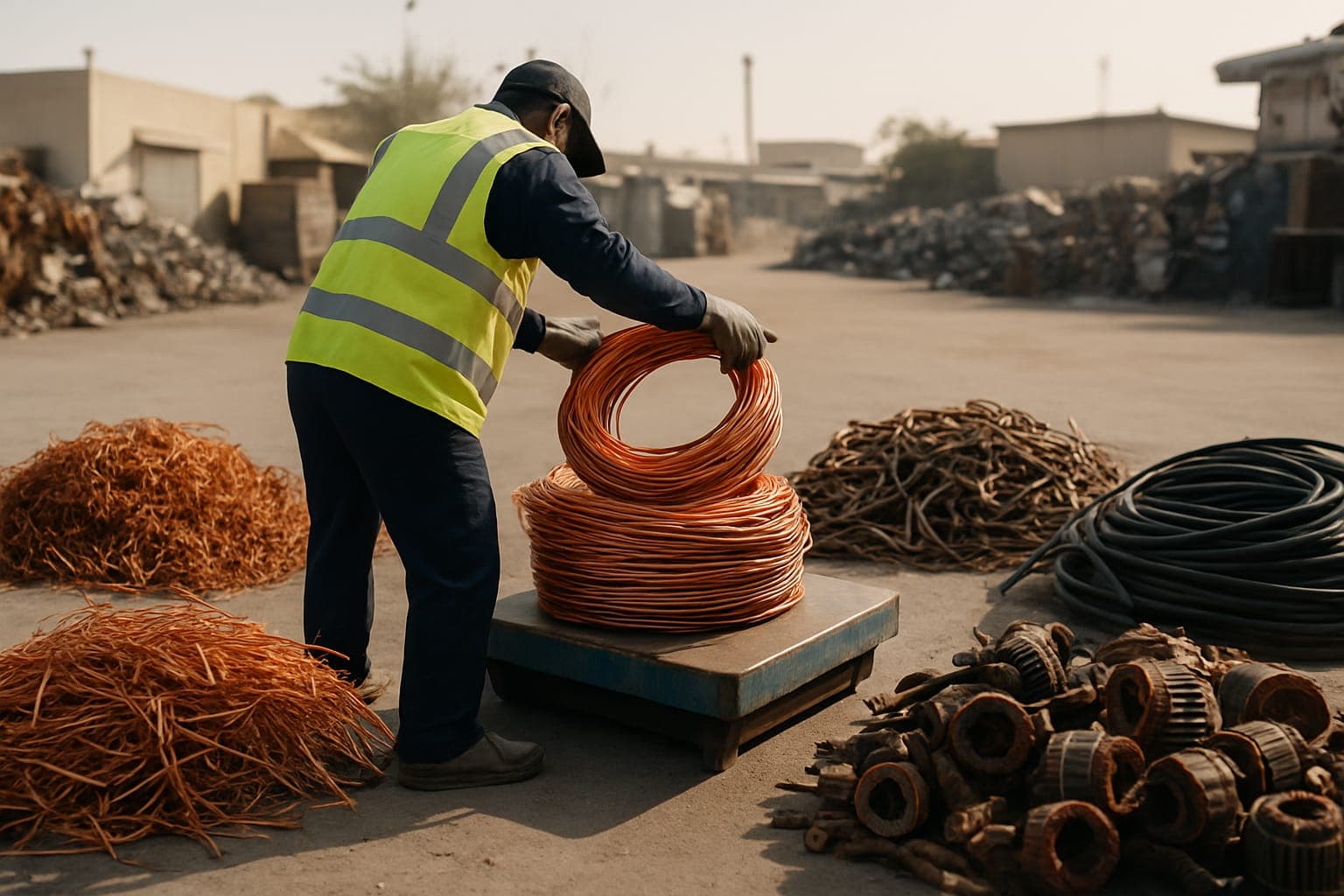
LME copper set an all-time intraday high of $14,875 per tonne on 10 September 2026, worth about AED 54.63 per kg of cathode at the dirham peg. UAE yards were still quoting bare bright at AED 25 to 32 per kg in July 2026, roughly half of contained metal value. A formula deal priced off LME cash settlement, minus a fixed AED per kg deduction, is how that rally reaches your weighbridge ticket instead of the buyer's spread.
Which copper price should you price off, LME or COMEX?
The run started before 2026 did. Goldman Sachs Research logged $11,771/t on 8 December 2025 as a then record and forecast an H1 2026 average of $10,710/t, with a full-year range of $10,000 to $11,000. LME cash then broke $13,000/t for the first time in history on 5 January 2026, up about 16% since the start of December and roughly 50% year on year, according to Benchmark Mineral Intelligence on 7 January.
On 29 January the three-month contract spiked to $14,527.50/t, the largest single-day rise since 2008, nearly touching the LME's 12% daily movement limit before closing at $13,720.50/t. Benchmark reported the move likely originated in China, with Shanghai Futures Exchange prices pushing up aggressively before the LME opened.
January was not the peak. Bloomberg confirmed that on 7 September 2026 the three-month contract traded at $14,533/t, beating the January record, and on 10 September it reached $14,875/t before reversing to about $14,329.50. Mid-September brought a close of $14,014.50/t after a fall of roughly 6% from the record, with an intraday high of $14,833/t on 23 September.
| Date | LME level | AED/kg cathode equivalent |
|---|---|---|
| 31 Dec 2025 | $12,423/t close (Barchart) | 45.62 |
| 5 Jan 2026 | $13,000/t cash, first time ever | 47.74 |
| 29 Jan 2026 | $14,527.50/t spike, $13,720.50/t close | 53.35 / 50.39 |
| 7 Sep 2026 | $14,533/t, record broken | 53.37 |
| 10 Sep 2026 | $14,875/t, all-time high | 54.63 |
| mid-Sep 2026 | $14,014.50/t close | 51.47 |
| 23 Sep 2026 | $14,833/t intraday | 54.47 |
The drivers are supply fear plus structural demand. Reuters columnist Andy Home, quoted by Mining.com on 14 August 2026 on the market's outsized reaction to a Congolese export ban touching under a fifth of that country's output, put it plainly: "The real news here is not Congo's long-standing ambition to move down the value chain, but copper's acute sensitivity to any sign of supply disruption." At Escondida in Chile, the world's largest copper mine, the union rejected a wage offer and a strike vote was set for 28 to 30 September 2026. On the demand side, Goldman Sachs and Trading Economics both point to grid build-out, renewables, EVs and data centres, which is why a UAE data centre refresh cycle now generates copper at the same time as it consumes it.
Do not quote COMEX at a Dubai yard
If you have seen copper described as $6.60 to $6.70 per pound, that is COMEX, not LME. Trading Economics had COMEX at about $6.66/lb on 25 September 2026, which converts to $14,683/t, while LME sat near $14,014.50/t. COMEX set an all-time $6.83/lb on 22 September. That gap of roughly $670/t is a US tariff artifact, with COMEX holding about 69% of global exchange copper stocks. Your material is not going into a COMEX warehouse.
LME states that its Official Price is the global benchmark for copper and is used as indexation in primary and secondary copper contracts, and secondary means scrap. The contract is 25 tonnes, quoted in USD per tonne, code CA, physically settled, with more than 170,000 lots traded on average every day in 2025 across 400 warehouses in 32 locations. One practical detail matters for drafting: physical trade prices off LME cash, exchange traders follow the three-month, and cash official closing prices are published the following day. Your contract has to say what happens on that one-day lag.
How do you turn LME dollars per tonne into AED per kilo?
The dirham is pegged at AED 3.6725 to the dollar, so there is no FX argument to have. Multiply the LME cash price in USD per tonne by 3.6725, then divide by 1,000. At $14,014.50/t that is AED 51.47 per kg of cathode. Every quote you receive should be read as a percentage of that number, not as a standalone figure.
Why does a yard offer AED 25 per kg when cathode is worth AED 51?
Against AED 51.47/kg, the published UAE rate cards look like this. All of these are collector and yard marketing pages, not assessed prices, and each carries the date we found it.
| Material as quoted | AED/kg | Source and date | % of cathode value |
|---|---|---|---|
| Bare bright, clean uncoated 16 gauge and thicker | 25-32 | alkasirscrap, 3 Jul 2026 | 49-62 |
| Copper, full range across grades | 26-47 | raseen, Apr/Aug 2026 | 51-91 |
| Copper cable scrap | 25-40 | greenmetalrecycleuae, 16 Feb 2026 | 49-78 |
| Copper, general | 18-26 | dubaiwaste estimator, 3 Apr 2026 | 35-51 |
| Mixed or insulation-covered wire | 8-14 | dubaiwaste estimator, 3 Apr 2026 | 16-27 |
| Brass | 24-25 | raseen, Apr/Aug 2026 | 47-49 |
Internationally, No.1 bare bright typically transacts at roughly 90% to 96% of exchange copper value. Only the AED 47/kg top of one collector's range, at 91%, sits inside that band, and we could not find a second source quoting AED 47/kg as a discrete stripped-bright number. AED 25/kg against AED 51.47/kg is 49%.
There are three honest explanations and you should test all three before you accuse anyone of anything. The rate card may be stale and never updated through the rally, which is plainly the case for at least some pages, including one from May 2025 still showing scrap copper at AED 14.70 to 23.90/kg. The spread may be real, meaning the buyer keeps the rally. Or the label may describe worse material than you think it does, which is why grade definitions belong in writing.
The discount ladder, as UAE yards describe it
One Dubai yard sets it out in four rungs: bare bright is clean uncoated wire of 16 gauge or thicker with no solder, paint or oxidation; No.1 covers clean tube and heavier bright wire with some oxidation allowed but no coatings, solder or attachments; No.2 carries paint, solder, oxidation or minor attachments and drops 10% to 20% against bare bright; birch and cliff insulated wire is priced on recoverable copper percentage. UAE listings also use Millberry and Berry, so ISRI nomenclature is understood by your counterparties. Use it.
Why do yards quote a fixed daily AED number at all?
Because a fixed number transfers price risk to you and leaves the grade adjustment invisible. Some operators say outright that they track the exchange. One states its valuation structures follow LME spot rates; another says the daily LME copper price is converted from USD per tonne to AED per kg, then adjusted for grade. That is exactly the right mechanism. The fixed quote simply hides the size of the adjustment, and in a market that moved $860/t in three days in September, it also hides which day's price you were paid on.
A third yard's estimator is more candid still: bulk quantities from one tonne up may qualify for preferential pricing, and mixed or unidentified scrap is assessed on site and may receive mixed-grade pricing. That last clause is the penalty. It is also avoidable, and the same logic applies to chiller and HVAC strip-outs where copper tube, aluminium fin and steel casing arrive on one truck.
How do you write a formula deal that captures the rally?
- Grade before you quote. Split the accumulation into three or four lots minimum, photograph each, and weigh each separately.
- Name the reference precisely: LME cash settlement, official price, USD per tonne, copper Grade A.
- Fix the pricing date. Either the delivery date or a declared average, for example the average of official cash settlements across the calendar month of delivery. Add a clause covering the one-day publication lag on LME cash official prices.
- Convert at AED 3.6725 to the dollar and say so in the contract.
- State a recovery percentage per lot and how it is proved, whether by XRF reading, a sample strip and weigh, or an agreed assay.
- Take the buyer's margin as a fixed AED per kg processing deduction, never as a percentage. A percentage deduction grows every time the market rallies, which means the buyer captures the upside you negotiated for.
- Demand a printed weighbridge ticket, a documented tare procedure, and the right to witness weighing.
- Cap moisture and attachment deductions in writing. We found no published UAE convention for these, so treat them as negotiated terms rather than market standard.
Three or four graded lots also mean three or four separate bids. Posting each lot with its own grade description, weight and photographs on the metals marketplace is how you find out whether AED 25/kg or AED 40/kg is the real number for your bright wire, and our 48-hour buyer inspection window gives the counterparty a reason to believe your grade call without discounting for doubt.
Do the export rules change what your copper is worth?
Three separate instruments get merged into one wrong sentence constantly, so keep them apart. First, the UAE lifted its earlier outright ban on ferrous scrap and industrial waste exports in late 2024 and replaced it with export taxes, including AED 400 per tonne on copper waste and scrap under HS 74040000. That is AED 0.40 per kg, about 1.33% of an AED 30/kg bright wire price and 0.78% of a $14,014/t LME base. Small on the headline, large on a thin trading margin.
Second, Decision No. 105 of 2026 from the Ministry of Foreign Trade imposed a temporary export ban on certain industrial wastes and metal scraps covering iron, aluminium and copper, published and implemented on 3 June 2026 for four months, taking effect seven working days after issuance, with copper ingots explicitly exempted to encourage higher value-added exports. Sources differ on the instrument type, with SMM and Recycling International calling it a Ministerial Decision and Mesteel calling it a Cabinet Resolution.
Third, and operative for most sellers, Dubai Customs Notice No. 13/2026 restricted exports of copper under HS 74040000, plus six iron codes and aluminium under HS 76020000, from 10 June 2026 to 8 October 2026. It renews automatically unless a further notice cancels it, so check status on the day you book a shipment rather than assuming expiry. Exemptions for shipments under valid international contracts concluded before the ban, and shipments in the public interest, require Ministry of Foreign Trade approval through its trade information platform. Violations are penalised under the Unified Customs Law.
It is a Dubai notice, not a federal border closure. Analyst Karim Aouini told Hellenic Shipping News that Dubai Customs can issue trade notices independently and that in principle scrap can still leave through Sharjah, Abu Dhabi or Fujairah ports, so with exemptions and rerouting the effect on actual volumes is likely partial. SICO Bank's Anoop M. Fernandes made the same point, noting that much of the trade moves through Jebel Ali Port, which is why the restriction was applied at Dubai level.
Mir Mujtaba, President of the Dubai-based Bureau of Middle East Recycling, told Recycling International on 26 June 2026 that the timing hurt: "This comes just as the Strait of Hormuz is re-opening. Exports were picking up again, and the supply of materials to and from Dubai was restarting." He added that "it looks like the decision to impose a ban has been made under pressure of local smelters" seeking to retain material domestically.
For clean copper the price effect is smaller than the headlines suggest. SMM's assessment is that because the USD 109 per tonne duty had already squeezed direct export arbitrage margins, the ban's marginal impact on the copper scrap market is limited, and the primary impact falls on copper alloys, specifically Honey, Ocean and Gun metal grades. If your accumulation is heavy on brass fittings and motor stators, the export layer matters more to you than it does to a seller of stripped bright wire.
What did the 14 January 2026 VAT reverse charge do to your cash flow?
Cabinet Decision No. 153 of 2025 applies the reverse charge mechanism to local supplies of metal scrap between VAT-registered persons. It was dated 4 November 2025, published in the Official Gazette on 26 November 2025, announced by the Ministry of Finance on 19 December 2025, and took effect on 14 January 2026, sixty days after gazette publication. The legal basis is Federal Decree-Law No. 8 of 2017 on VAT as amended, with Cabinet Resolution No. 52 of 2017.
Mechanically, the VAT-registered recipient who intends to resell, process or manufacture the scrap accounts for the VAT and carries the related tax obligations. The supplier does not charge VAT and is no longer responsible for accounting for it, provided the statutory conditions are met before the date of supply, including a written declaration from the recipient confirming its registration and intended use. Export transactions and dealings with non-registered parties stay under the traditional treatment. The Ministry of Finance framed the change as a measure against fraudulent practices in the metal scrap trading sector.
The cash-flow consequence is the part sellers miss. Before 14 January you invoiced 5%, collected it, held it and remitted later, which was a working-capital float. On a qualifying domestic sale that float is gone. On the AED 360,135 graded sale modelled below, 5% is roughly AED 18,000 that no longer transits your account. It is a timing change, not a cost, but if your cash forecast was quietly leaning on it, reforecast now. One more thing: commentary circulating in January claimed the reverse charge only applies above a 100-tonne threshold. That threshold appears in no Ministry of Finance, Big Four or law firm summary we have read. Treat it as unverified and confirm with your tax adviser before you invoice on that basis.
Who checks the weight, and what can you insist on?
In Dubai, more than you probably ask for. Dubai Municipality's Technical Guidelines on Metal Scrap Processing, Version 5.0 dated 16 October 2024 from the Waste Strategy and Projects Department, require licensed facilities to visually evaluate, weigh and document incoming waste loads and to identify the types of metals received so downstream processing is correct. Identification may be by visual inspection, chemical analysis, or advanced methods such as XRF analysers. The guidelines also require an ANPR system connected to Dubai Municipality and CCTV coverage, and they sit inside the Duty of Care Programme, which requires all transfers of waste to be recorded to track quantities and movements.
So a printed weighbridge ticket, a stated grade determination method and an XRF reading are compliance expectations at a licensed Dubai yard, not favours you are asking for. One operator advertises weighing through approved local weighbridge networks with printed tickets, and free-zone gate-pass coordination for JAFZA, SAIF Zone and KEZAD, which is a real friction point if your material sits inside a free zone. Under the executive regulations to Federal Law No. 12 of 2018 on Integrated Waste Management, the waste generator remains responsible for proper disposal and bears the financial cost, and the same documentation chain that protects you on price protects you on diversion reporting.
What does grading plus formula pricing pay on a 12-tonne load?
Take a 12-tonne cable and motor accumulation from an MEP strip-out. The composition, recovery percentages and processing deductions below are a modelled illustration, not sourced market data. The Scenario B rates are drawn from the published rate cards above. The reference price is $14,014.50/t, or AED 51.47/kg cathode.
| Lot | Tonnes | Assumed Cu recovery | B: fixed rate AED/kg | B: value AED | C: formula net AED/kg | C: value AED |
|---|---|---|---|---|---|---|
| No.1 bare bright / stripped wire | 3.0 | 99% | 30.00 | 90,000 | 46.45 | 139,361 |
| No.2 copper, tube and solder | 2.0 | 96% | 26.00 | 52,000 | 42.41 | 84,819 |
| Birch/cliff insulated cable | 4.5 | 55% | 11.00 | 49,500 | 21.81 | 98,134 |
| Low-grade harness and fine wire | 1.5 | 30% | 6.00 | 9,000 | 9.94 | 14,911 |
| Brass and motor stators | 1.0 | 62% | 24.00 | 24,000 | 22.91 | 22,910 |
| Total | 12.0 | 18.71 blended | 224,500 | 30.01 blended | 360,135 |
Scenario A is the single mixed-grade sale, the outcome the estimator language above describes. At AED 16/kg that pays AED 192,000. Grading alone adds AED 32,500. Grading plus formula pricing, where each lot is paid at LME cash in AED per kg times recovery, less a fixed AED per kg deduction, pays AED 360,135. That is AED 168,135 more than the mixed sale, and AED 135,635 more than grading at fixed yard rates. Blended realisation moves from AED 16.00 to AED 18.71 to AED 30.01 per kg, or 31%, 36% and 58% of contained metal value. Grading is worth something. Grading plus a formula is worth roughly five times as much.
The formula also works both ways. A 5% LME fall to $13,314/t takes the same load to AED 338,428, and a 5% rise to $14,715/t takes it to AED 381,841, a swing of AED 21,707 either side. That is the price of participation.
Should you hold copper scrap or lock the price?
The forward curve stopped rewarding patience in September. The cash to three-month spread hit $434/t in mid-August, a five-year high, and exceeded $550/t backwardation in early September, then flipped to a $67.50/t contango by mid-month. Backwardation pays you to sell now; contango does not. LME warehouse stocks rose 3.59% to 242,900 tonnes in mid-September and are up about 20% since mid-August, while combined LME, COMEX and SHFE stocks stood at 1,065,512 tonnes at end-June 2026, the highest since May 2003 and 43% above end-2025. The Yangshan premium went from $20/t in January to $115/t in late July and $100/t on 14 September.
Nobody's model has been right. Goldman's December 2025 range of $10,000 to $11,000 was overtaken within weeks, and BMI's August 2026 revision to an approaching $13,500/t full-year average, up from $12,700 with strong upside risk, still sat below where the market traded in September. If institutions with dedicated desks missed by that much, a facilities manager timing a cable sale is not going to do better.
Holding cost is not the argument either way. Financed at an illustrative 5.5% a year, AED 360,135 of inventory costs about AED 381 for a week, AED 1,524 for four weeks and AED 3,047 for eight. A single 1% LME move on the same load is AED 3,601, which means eight weeks of financing is worth less than one percent of price movement.
| Hold period | Financing cost AED | % of load value | 1% LME move AED |
|---|---|---|---|
| 1 week | 381 | 0.11% | 3,601 |
| 2 weeks | 762 | 0.21% | 3,601 |
| 4 weeks | 1,524 | 0.42% | 3,601 |
| 8 weeks | 3,047 | 0.85% | 3,601 |
So holding is not a storage problem, it is a directional bet, and it should be described as one in your board paper. Add yard storage, handling and insurance on top, which we could not source for UAE operators and which you should get quoted in writing from your JAFZA or Musaffah yard. The practical rule: if you are not willing to write down a price view and own it, lock the price. If you want participation without a single-day bet, price on a declared monthly average and let the volatility average itself out.
Frequently asked questions
What is the copper scrap price in the UAE today?
UAE rate cards quoted bare bright at AED 25 to 32 per kg in July 2026, with one collector's copper range running to AED 47 per kg, but those pages go stale quickly and some still carry 2025 numbers. Convert the day's LME cash price yourself: USD per tonne times 3.6725, divided by 1,000, gives AED per kg of cathode. At $14,014.50 per tonne that is AED 51.47 per kg, and every quote should be read as a percentage of it.
Should I price copper scrap off LME or COMEX?
LME. The COMEX premium, roughly $670 per tonne in late September 2026, reflects US tariff expectations and the fact that COMEX held about 69% of global exchange copper stocks. LME states its official price is used as indexation in both primary and secondary copper contracts, and secondary means scrap.
Can I still export copper scrap from Dubai?
Dubai Customs Notice No. 13/2026 restricted exports of copper scrap under HS 74040000 from 10 June 2026 to 8 October 2026, and it renews automatically unless a further notice cancels it, so verify status before booking. Exemptions for pre-ban international contracts and public-interest shipments require Ministry of Foreign Trade approval. Copper scrap leaving the UAE also carries the AED 400 per tonne export duty introduced in late 2024.
Who accounts for VAT on a scrap metal sale in the UAE now?
Since 14 January 2026, under Cabinet Decision No. 153 of 2025, the VAT-registered buyer accounts for VAT on local supplies of metal scrap where it intends to resell, process or manufacture the material. The seller does not charge VAT, provided the conditions are met before the date of supply, including a written declaration from the buyer. Exports and sales to non-registered parties keep the previous treatment.
How much does grading a mixed copper load actually add?
On a modelled 12-tonne cable and motor accumulation, a single mixed-grade sale at AED 16 per kg pays AED 192,000, while five graded lots sold at published yard rates pay AED 224,500. Grading those same lots and pricing them off an LME formula pays about AED 360,135, roughly AED 168,000 more than the mixed sale. The composition, recovery rates and deductions in that model are illustrative, not sourced market data.
Is it worth holding copper scrap for a higher price?
Financing is not what stops you. At an illustrative 5.5% a year, eight weeks of holding AED 360,135 of inventory costs about AED 3,047, less than a single 1% move in the LME price on the same load. The relevant signal is the curve: the cash to three-month spread flipped from over $550 per tonne backwardation in early September 2026 to a $67.50 contango by mid-month, so the market stopped paying a premium for immediate metal.

Comments(0)
Sign in to join the conversation.