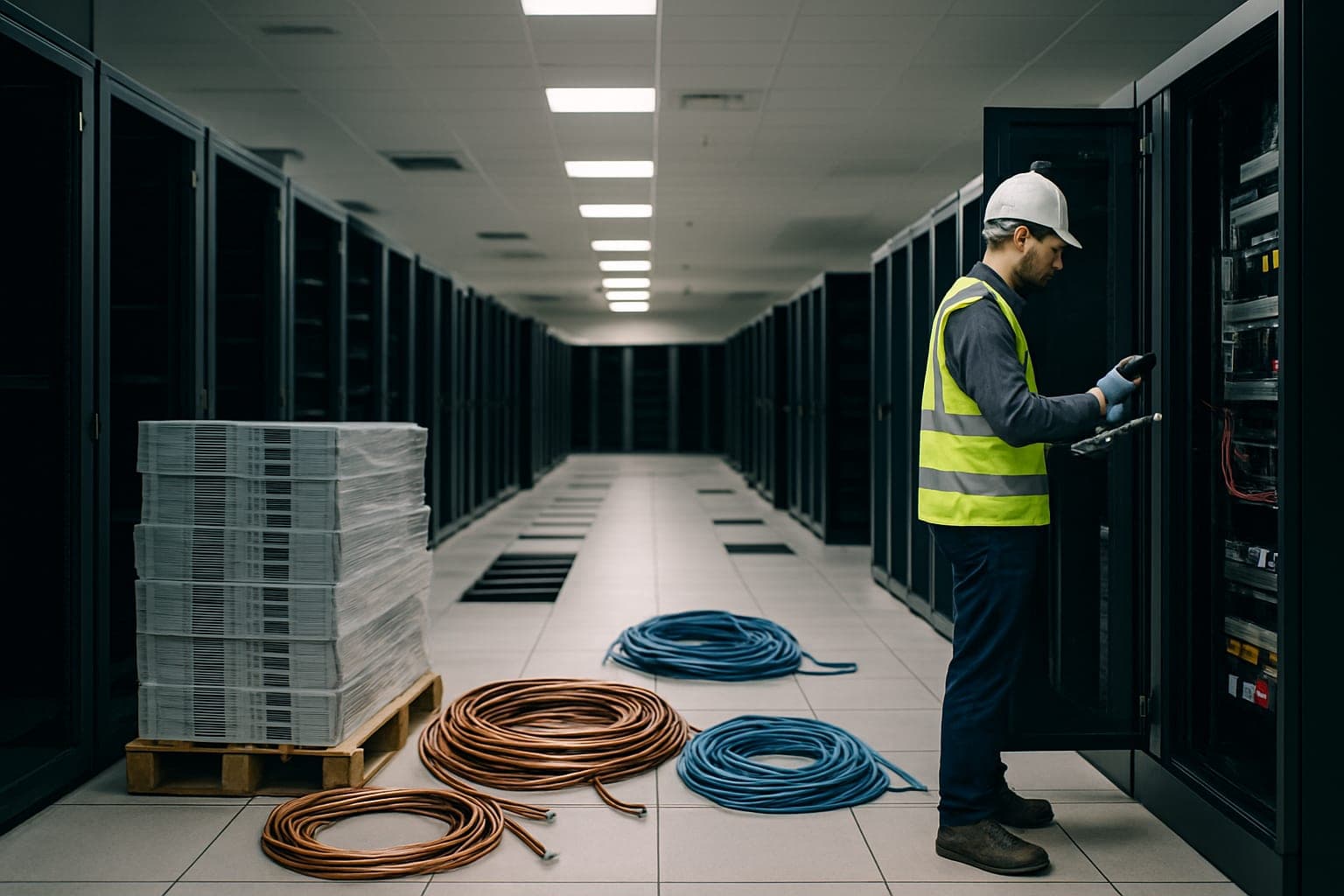
UAE data centre IT load was 358 MW in October 2025, and Emirates NBD Research expects roughly 950 MW by 2028. On a three to five year hardware refresh, that schedules a rolling stream of servers, accelerators, PDUs, UPS strings and structured cabling into the secondary market. Value splits three ways: whole-unit remarketing, component harvesting, then shredding for metal.
Why is UAE decommissioning volume climbing so quickly?
The build-out numbers are the easy part. Emirates NBD Research, in a macro note dated 14 October 2025, put installed UAE capacity at 358 MW and forecast about 950 MW by 2028, a 165% increase, with Khazna Data Centers alone investing USD 1.28bn across five facilities under construction. Microsoft and G42 announced a 200 MW UAE expansion expected online by end of 2026, reported by Data Center Knowledge on 19 February 2026. Data Center Dynamics reported a Dubai joint venture called Volt targeting a 29 MW facility on 27 July 2026. The much-quoted 5 GW Abu Dhabi AI campus, with a first 200 MW cluster said to go live in 2026, appears mainly in secondary write-ups, so treat the headline figure as unconfirmed until the operators publish it themselves.
Now the part that matters to procurement. If you take the 358 MW that was already installed in late 2025 and assume a three to five year refresh, the arithmetic implies annual decommissioning equal to roughly 20% to 33% of installed IT load, every year, before any of the new capacity starts to age. That is a model, not a sourced statistic, and the assumption is doing the work. But it explains why UAE ITAD enquiries have shifted from one-off pallet clearances to scheduled multi-hall programmes with a contract attached.
What is the difference between decommissioning, ITAD and e-waste recycling?
Vendor copy uses the three terms interchangeably and it costs sellers money. Decommissioning is the whole planned retirement process: de-racking, data sanitisation, asset reconciliation, transport, sale or disposal. ITAD is the commercial layer inside it, where assets are tested, graded and resold. E-waste recycling is only the last resort, the point at which an asset stops being equipment and becomes material. Circular IT group made this distinction usefully in a November 2025 explainer. The paperwork differs at each stage, which is why a single "disposal" line in a contract usually means somebody is capturing the resale margin and it is not you.
Who buys decommissioned servers, GPUs, PDUs and cabling in the UAE?
Five buyer types compete for the same rack, and they value it completely differently.
| Buyer type | What they want | How they price | UAE presence |
|---|---|---|---|
| Whole-unit remarketers and ITAD houses | Tested, complete, recent-generation servers, switches, accelerators | Percentage of original purchase price, by generation and configuration | Dubai, Abu Dhabi and Sharjah, including ITAD-branded services offered from Dubai Industrial Park and Dubai-based specialists |
| Component harvesters | DIMMs, NVMe drives, CPUs, GPUs, PSUs, fan trays, rails, optics | Per part, against spot demand for that SKU | Trading floors across Dubai, often serving regional resellers |
| Licensed e-waste processors | Populated boards, mixed e-scrap, chassis, refrigerant-bearing kit | Blended per-tonne rate, sometimes a gate fee on low-value streams | Enviroserve's Recycling Hub in Dubai Industrial Park; Ecyclex with branches in Dubai, Abu Dhabi and Sharjah |
| Non-ferrous yards | Busbar, PDU whips, structured cabling, transformer and motor copper | LME converted to AED per kg, then discounted by grade | Yards across Dubai and the northern emirates |
| Battery smelters | UPS lead-acid strings | Per kg on lead content, licence-dependent | Licensed UAE smelters only |
Enviroserve's Recycling Hub at Dubai Industrial Park is the facility most often cited in this market, at 280,000 sq ft with 100,000 tonnes a year of integrated waste capacity of which 39,000 tonnes a year was e-waste. Be careful with those numbers. They come from the 2019 opening announcements and have been copied verbatim ever since, so they describe design capacity at launch, not current throughput. Ecyclex operates branches in Dubai, Abu Dhabi and Sharjah covering collection, refurbishment and reuse, dismantling, material recovery and secure data destruction, and holds ISO certification for quality, environment and safety.
Lead-acid UPS strings deserve their own line in your tender, not a footnote under "general scrap", because the licensing question sits with the receiving smelter rather than with you. We have written about that chain separately in used lead-acid batteries need a licensed UAE smelter.
How does resale value split between remarketing, harvesting and shredding?
The honest baseline for commodity servers is uncomfortable. A May 2026 US ITAD blog put typical recovery at 5% to 15% of original purchase price for recent gear and 0% to 5% for older equipment. That is a US market figure from an unverified source, so use it as a sanity check rather than a UAE benchmark, and note it says nothing about current-generation AI accelerators, where the secondary market behaves nothing like a five-year-old two-socket server. We are not going to print a used GPU price we cannot source. If a broker quotes you one, ask for three completed transactions with dates.
What you can control is which route each asset takes. A tested, complete, serialised server with a certificate of data destruction sells as equipment. The same server with drives pulled, rails missing and no test report sells as e-scrap. The gap between those two outcomes is documentation and about four hours of bench time, and it is usually larger than any price negotiation you will win at the yard gate.
What is the copper in a decommissioned hall actually worth?
Copper sets the floor under everything metallic in a rack. LME copper hit an all-time high of USD 14,572 per tonne on 29 January 2026, an 11% move in a single day partly attributed to Chinese buying tied to data centre investment expectations. Benchmark Mineral Intelligence noted the following day that no fundamental development justified the spike, and prices fell back on tech-stock weakness and a firmer dollar. By 24 February 2026 the LME close was reported at USD 13,166 per tonne, after dipping below USD 12,500. Copper had already broken USD 12,000 in late December 2025, up around 42% across 2025.
At the fixed peg of AED 3.6725 to the dollar, those translate to roughly AED 53.52, AED 48.35 and AED 44.07 per kg of cathode. Cathode is not scrap. UAE dealer pages quoted clean bare bright copper at AED 25 to 32 per kg in the first half of 2026 and insulated wire at AED 8 to 12 per kg, but these are marketing rate cards, not an exchange or a government index, and one page ran a top figure of AED 47 per kg that computes to about 97% of cathode. No yard pays that. Price your lot the way the better dealers describe their own method: take LME in USD per tonne, convert to AED per kg, then discount by grade.
| Stream from a decommissioned hall | Dealer-quoted band, H1 2026 (unverified) | What moves the number |
|---|---|---|
| Bare bright copper, stripped busbar and whips | AED 25 to 32 per kg | LME reference on the day, lot size, cleanliness |
| #2 copper, painted, soldered, oxidised, minor attachments | 10% to 20% below bare bright | Grade downgrade applied at the gate |
| Insulated cable, unstripped Cat6 and power | AED 8 to 12 per kg | Recovery yield assumption on the buyer's side |
| Ferrous chassis, rails, cabinet steel | From around AED 0.8 per kg | Mill demand, contamination, transport |
Two operational points follow. First, the spread between stripped and unstripped cable is the biggest single decision in a cabling pull-out, and unstripped Cat6 from a full floor is easily a five-figure difference. Second, one hall is a bulk lot. UAE estimator pages note that rates move daily with LME and SHFE and that lots above one tonne can attract preferential pricing, so a decommissioning programme should never be priced off a walk-in rate card. If you want to see how comparable metal grades are being listed and quoted, our electronics listings are the fastest read on current UAE demand.
Does the 14 January 2026 scrap metal reverse charge apply to your sale?
This is the change most internal SOPs have not caught up with. Cabinet Decision No. 153 of 2025 applied the VAT reverse charge mechanism to trading of metal scrap between UAE registrants with effect from 14 January 2026, announced by the Ministry of Finance and grounded in Federal Decree-Law No. 8 of 2017 on VAT and Cabinet Resolution No. 52 of 2017. From that date the buyer, not the supplier, accounts for the VAT. Secondary summaries state that the recipient must supply a valid Tax Registration Number and a written declaration of intent; confirm the exact wording against the Federal Tax Authority's own clarification before you rewrite your invoice template, because that is the sentence your finance team will be audited on.
The stated policy rationale is VAT system integrity, since scrap metal is internationally exposed to missing-trader and carousel fraud, and removing VAT cash flow from the chain is the fix. One scope question remains genuinely open, and we are not going to guess at it: whether "metal scrap" as defined in the decision captures mixed e-scrap, populated circuit boards and whole decommissioned servers, or only ferrous and non-ferrous metal. Get that in writing from the FTA or your tax adviser before your first pallet leaves the loading bay. Alongside this, the UAE's national e-invoicing programme begins its phased rollout from 2026, with thresholds you should verify directly, and the combined effect is simple: an undocumented cash scrap sale is now a visible compliance gap, not just a missing receipt.
What paperwork keeps a resale from undercutting the metal value or the audit trail?
The federal frame is Federal Decree-Law No. 12 of 2018 on Integrated Waste Management with its executive regulations under Cabinet Resolution No. 39, sitting under the UAE Circular Economy Policy 2021 to 2031. Reporting has also been cited that Cabinet Decision No. 18 of 2024 requires entities handling waste, including electronic and hazardous waste, to register waste streams, secure permits before storage, treatment or disposal, and use authorised transport and processing channels; that comes from a market-research summary rather than the gazette, so verify the decision text with MoCCAE. One thing to strike from your internal deck: the 75% by 2025 and 85% by 2035 figures in the UAE Environmental Policy are municipal solid waste treatment targets, not a compliance obligation on your facility's e-waste stream.
Below is the file we would expect a UAE seller to hold. It is assembled from general ITAD practice, so check each line against the permit conditions in your emirate, and against the licence categories set out in Dubai Resolution 253 if you are operating in Dubai.
- Asset register with make, model, serial number and rack position, reconciled before anything leaves the hall.
- Data sanitisation record per asset, naming the standard used and whether the drive was wiped or physically destroyed.
- Certificate of data destruction issued by the party that performed it, matched to serials.
- Functionality test report for every unit you intend to sell as working equipment rather than waste.
- Permits and licence copies for the carrier and the receiving facility, current on the date of movement.
- Transfer note per load, with weighbridge tickets for anything sold by weight.
- Grade breakdown at the gate, showing bare bright, #2, insulated and ferrous separately, with the LME reference used.
- Recycler's certificate of recycling or downstream disposition for the residual fraction.
- Tax invoice compliant with the reverse charge treatment, carrying both TRN numbers and any declaration the FTA requires.
That file is also your ESG evidence. With the UAE Climate Change Law of 2024 and a national carbon credit registry, reuse and avoided-emissions claims are moving closer to registry-grade reporting, which means a claim without serial-level backup is a liability rather than an asset. For more on how UAE buyers are contracting material streams rather than clearing them ad hoc, see our market-insights archive.
Can you export decommissioned IT equipment out of the UAE?
Not casually. The UAE has been a party to the Basel Convention since 1990, and MoCCAE has issued a ministerial decision prohibiting the passage and export of hazardous waste across UAE borders, per the official UAE government platform. The practical dividing line is functionality. A tested, working, documented server leaving as equipment is a different customs and Basel proposition from a pallet of stripped boards leaving as waste, and the difference is proven by your test reports and asset records, not by the wording on a commercial invoice. We could not verify a single published UAE test standard for that distinction, so if export is part of your plan, get the classification confirmed before you book a container. Assets decommissioned inside JAFZA or DAFZA and sold to a mainland recycler carry their own customs treatment, which is worth clearing with your zone authority early.
Frequently asked questions
Who buys decommissioned servers in the UAE?
Five buyer groups compete: whole-unit remarketers and ITAD houses, component harvesters, licensed e-waste processors such as Enviroserve at Dubai Industrial Park and Ecyclex with branches in Dubai, Abu Dhabi and Sharjah, non-ferrous yards for copper and steel, and licensed smelters for UPS lead-acid strings. Each values the same rack differently. Run all five in parallel on your first programme so you can see the spread before you commit.
Do I charge VAT on scrap metal in the UAE in 2026?
For metal scrap traded between UAE registrants, the reverse charge mechanism applies from 14 January 2026 under Cabinet Decision No. 153 of 2025, so the buyer accounts for the VAT rather than the supplier. Secondary summaries also require a valid TRN and a written declaration of intent from the recipient, which you should confirm against the Federal Tax Authority's own clarification. Whether mixed e-scrap and whole servers fall inside the definition of metal scrap is not settled publicly, so get it in writing.
How much is a used server worth compared with scrap?
A May 2026 US ITAD source put typical recovery at 5% to 15% of original purchase price for recent gear and 0% to 5% for older equipment, which is an unverified overseas figure and only a sanity check for the UAE. Current-generation AI accelerators behave completely differently and we have no verified 2026 resale figure for them. The controllable variable is documentation: a tested unit with a certificate of data destruction sells as equipment, the same unit undocumented sells as e-scrap.
Should I strip cable before selling it to a UAE yard?
Dealer rate cards in the first half of 2026 quoted bare bright copper at AED 25 to 32 per kg against insulated wire at AED 8 to 12 per kg, and #2 grade copper takes a further 10% to 20% discount versus bare bright. Those are unverified marketing figures, but the direction is consistent. On a full-floor cabling pull-out the stripped versus unstripped decision is usually the largest single number in the recovery.
Can I export used IT equipment from the UAE?
Only with the classification settled first. The UAE has been a Basel Convention party since 1990 and MoCCAE has issued a decision prohibiting the passage and export of hazardous waste across UAE borders. Tested, working, documented equipment is treated differently from waste e-scrap, and your test reports and asset register are what carry that argument.
How large is the UAE decommissioning opportunity?
Emirates NBD Research put installed UAE data centre capacity at 358 MW in October 2025, rising to roughly 950 MW by 2028. Applying a three to five year refresh to the 358 MW already installed implies annual retirements equal to about 20% to 33% of installed IT load, which is arithmetic based on a stated assumption rather than a published statistic. Treat it as a planning model for sizing contracts, not as a market figure.

Comments(0)
Sign in to join the conversation.