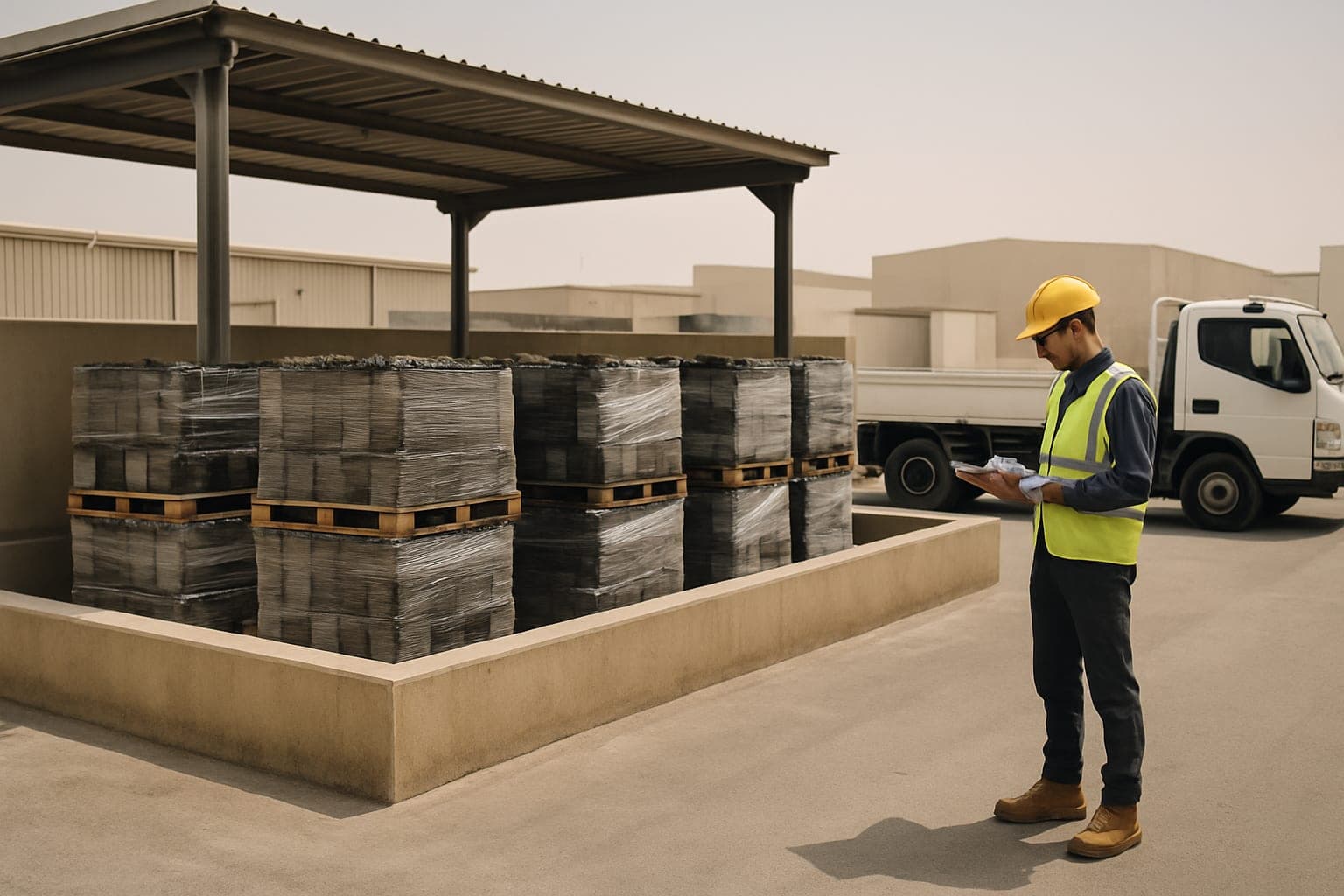
Used lead-acid batteries are hazardous waste, listed under Basel Annex VIII as A1160. In the UAE that means a permitted vehicle, a licensed destination and a signed manifest for every pallet. Under the executive regulations of Federal Law No. 12 of 2018, the generator still bears responsibility and cost for proper disposal, so a trader's cash receipt protects nothing.
Is a used car, forklift or UPS battery really hazardous waste in the UAE?
Yes, and the classification is not a UAE invention. Waste lead-acid batteries, whole or crushed, sit in Basel Annex VIII (List A) under code A1160, with A1020 also applied where the constituent hazard is cited. That code list is quoted verbatim by Australia's Department of Climate Change, Energy, the Environment and Water in guidance updated 19 February 2024, and it is the same list the UAE works from as a Basel party.
Domestically, Federal Law No. 12 of 2018 on Integrated Waste Management covers the whole chain: production, sorting, transport, storage, recycling, treatment and disposal, excluding radioactive waste. That scope is set out in the UNEP LEAP legal database entry for the law, which is undated. The UAE government portal, on a page updated in August 2026, describes hazardous waste requirements as segregation, treatment and reduction under the supervision of the concerned authority.
The part that catches finance and procurement teams is in the executive regulations. When MOCCAE detailed them, as reported by Zawya on 4 July 2021, two principles were spelled out: the waste generator is responsible for the proper disposal of the waste it generates and bears the financial cost, and suppliers must collect products at the end of their life cycle. Read that twice if you run a fleet depot. Selling a pallet does not sell the liability with it. The Cabinet decision number usually quoted for those regulations is not something we have verified in the official gazette, so confirm it before your legal team cites it in a contract. For the wider compliance picture across materials, our regulation coverage tracks the same pattern of generator liability in other streams.
Who is actually allowed to take the pallets off your yard?
In Dubai, not your general waste contractor. Dubai Municipality Technical Guideline No. 11, Transportation and Handling of Hazardous Waste (Version 3), requires a Hazardous Waste Transport permit for the vehicle itself, applied for through the municipality waste portal at waste.dm.gov.ae as a "Request for permit of a Hazardous Waste Transport Vehicle". A separate waste transport permit is issued by the Studies and Permits Section. The vehicle must have RASID tracking installed.
The guideline is specific about the truck that arrives at your gate. It must be placarded on both sides and at the rear with the relevant hazard symbol and wording, readable from at least 30 metres, and carry the carrier's name, address and telephone number. Every transport must be recorded in the waste manifest along with the other records the municipality requires. Waste must move with licensed waste management companies and be delivered to an approved destination. The legal basis cited in the guideline runs back to a Dubai Local Order as amended by Local Order No. (5) of 2003.
There is also a circular written for exactly this material. Dubai Municipality Waste Department Circular No. (3) of 2018, "Transport, Recycling, and Disposal of Used Lead Acid Batteries (ULAB)", is listed on the municipality's waste circulars page, itself dated 3 August 2019. We have confirmed the circular exists but have not verified its clause-by-clause text, so do not take a summary from a vendor's brochure. Download the PDF from the municipality, read it, and keep a dated copy in your compliance file.
What about Abu Dhabi, Sharjah and the free zones?
Federal Law No. 12 of 2018 makes the competent local authority in each emirate responsible for waste management in its area. In practice the licence, the permit and the manifest come from Dubai Municipality, from Tadweer and EAD in Abu Dhabi, from the Sharjah authorities, or from your free zone's own environment function. We could not verify the current Abu Dhabi or Sharjah hazardous waste manifest requirements for this piece, and we will not guess at them. If your depot is in Musaffah, KEZAD or Al Sajaa, put the question to the authority in writing and file the reply.
What should the paper trail contain before a pallet leaves?
| Document | Held or issued by | What it proves to an auditor |
|---|---|---|
| Trade licence with a matching hazardous waste activity | Carrier and receiving facility | The counterparty is licensed for this specific work, not general scrap |
| Hazardous Waste Transport vehicle permit | Dubai Municipality, via waste.dm.gov.ae | The truck at your gate is permitted to carry the load |
| Waste transport permit | DM Studies and Permits Section | The movement itself is authorised, separately from the vehicle |
| RASID tracking and correct placarding | Carrier | The consignment can be traced and is visibly identified at 30 metres |
| Waste manifest per movement | Generator, carrier and receiver sign | Waste type, quantity, generator, collector and disposal destination |
| Environmental permit of the destination | Smelter or treatment facility | The pallets reached a licensed processor, not an intermediate yard |
| Weighbridge tickets in and out | Carrier and receiver | Tonnage reconciles between your gate and the destination |
| MOCCAE export permit, notification and movement documents | MOCCAE, for export only | Basel prior informed consent was obtained before shipment |
One practical test: ask for the receiving facility's environmental permit with its expiry date, not just a licence number in an email signature. Buyers on our platform go through UAE PASS KYC before they can transact, which removes the first layer of uncertainty about who you are dealing with, and you can see current metals listings and buyers before you commit a load.
Can you export ULAB instead of using a local smelter?
You can apply to, but it is a Basel process, not a booking. MOCCAE's service card for the export of hazardous waste, on a page dated 18 August 2025, lists six requirements: a valid trade licence with an activity in the same field, a valid environmental permit, a contract between exporter and importer, insurance, a Movement Document and a Notification Document. The process runs electronically, form to e-payment to document check to permit.
Notification means the importing country's authority has to be told and has to consent before the container moves. That takes weeks, not days, and it is the reason "export is the fast way to clear volume" is one of the most expensive misconceptions in this trade. Note also that the Basel technical guidelines for the environmentally sound management of waste lead-acid batteries were adopted by COP-6 decision BC-6/22 in December 2002. They remain the reference document, but they are 24 years old, so check basel.int for any newer text before you build a procedure around them.
Is there a licensed ULAB smelter inside the UAE?
Two plants were announced in Dubai Industrial City, and both announcements are now old enough that you must verify status yourself. Dubatt Battery Recycling, a joint venture of Regency Group for Corporate Management LLC and Seashore Group, broke ground on 21 March 2022: a 70,000 sq ft building on 154,000 sq ft of land, an AED 110 million investment, a 10 tonne per hour battery breaker, a 4 cubic metre smelter and four refinery kettles supplied by FIB SPA of Italy's SERI Group, with a stated target of full operation in January 2023. Sharaf Group announced a 250,000 sq ft plant in the same district in August 2021, 6 tonnes per hour of processing with a 3 tonne per hour smelter, built by Engitec Technologies of Italy, targeting Q1 2023 with a team of 25.
Those are announcements and design figures, not confirmed commissionings, and we could not verify either plant's 2026 operating status or licence. Treat any capacity claim built on those 2021 and 2022 press releases as four to five years out of date. Ask the facility for its current permit, its accepted feed specification and its manifest procedure, in writing.
The volume picture is just as thin. Sharaf Group's August 2021 announcement, reported by Gulf Business on 17 August 2021, put its plant at roughly 21,000 tonnes a year and described that as 85 per cent of Dubai's ULAB, implying about 24,700 tonnes a year in the emirate. A study commissioned by Dubatt, quoted by its director in March 2022, put UAE battery scrap generation near 6,000 tonnes a month. Both are company estimates, not regulator statistics, and no official MOCCAE, Dubai Municipality or Tadweer tonnage figure for ULAB was available when we compiled this in August 2026.
What is a pallet of ULAB actually worth?
Start from refined lead, because every local offer is derived from it. LME lead opened 2025 at US$1,921.44 per tonne on 2 January, hit US$2,090.48 on 18 March and fell to US$1,829.75 on 9 April, figures published by Investing News Network on 14 January 2026 citing the LME. At the pegged rate of AED 3.6725 to the dollar, that range is roughly AED 6,720 to AED 7,677 per tonne, or AED 6.72 to 7.68 per kg. Physical lead deals are priced as LME cash plus a premium, while the number traders quote is usually the 3-month contract, a distinction set out in a ZAMAK price explainer dated 25 March 2026.
We could not obtain a verified, dated AED per kg UAE buying price for whole scrap batteries, and we will not print one we cannot stand behind. As arithmetic only: acid, plastic and non-recoverable content plus smelting cost usually leave whole ULAB clearing well below refined value, and a 35 to 65 per cent band against AED 7.16 per kg would imply roughly AED 2.50 to 4.65 per kg. That is an illustration of the mechanism, not a quote. Get two written offers from named licensed processors, dated, with the acid and moisture deduction stated. The same discipline that lifts recovery on other metal streams applies here, as we set out for copper cable preparation.
Price the cost side too: transport permit fees, gate or treatment fees per tonne, acid-resistant pallets and IBCs. We could not verify current fee schedules, so request them from Dubai Municipality's waste portal and from the receiving facility rather than budgeting from last year's invoice. Producer take-back obligations are moving in the same direction across other regulated streams, which is the argument we made about e-waste costs landing on importers.
How should batteries be stored before collection?
Keep them whole and upright with the electrolyte contained. Basel environmentally sound management practice is to move batteries intact and to neutralise or treat electrolyte at a licensed facility, because on-site draining is what puts acid into yard drains and soil. We have flagged this as consistent with Basel practice but not verified against the UAE text, so confirm it in Circular No. (3) of 2018 before you write it into an SOP.
- Store on acid-resistant pallets inside a bunded, shaded area away from drains and combustibles.
- Keep terminals covered and never stack batteries so terminals can short against a casing above.
- Segregate cracked or leaking units into sealed acid-resistant containers immediately.
- Keep a neutralising spill kit and eyewash at the storage point, with a trained responder on shift.
- Log every unit in and out by count and weight, so the manifest reconciles with your asset register.
- Verify carrier permits and vehicle placarding at the gate, and photograph both before loading.
- Sign the manifest only when quantities on it match your weighbridge ticket.
- File the receiver's signed copy, the destination permit and the weighbridge tickets together, by movement.
Frequently asked questions
Are used lead-acid batteries classified as hazardous waste in the UAE?
Yes. Waste lead-acid batteries, whole or crushed, carry Basel code A1160 under Annex VIII (List A), and hazardous waste in the UAE falls under Federal Law No. 12 of 2018 on Integrated Waste Management, which covers transport, storage, treatment and disposal. That means permitted vehicles, licensed destinations and a manifest for every movement, not an ordinary scrap collection.
Can a general scrap trader legally collect ULAB from my depot in Dubai?
Not unless that trader holds hazardous waste authorisation. Dubai Municipality Technical Guideline No. 11 requires a Hazardous Waste Transport permit for the vehicle, applied for through waste.dm.gov.ae, a separate waste transport permit from the Studies and Permits Section, RASID tracking and hazard placarding readable from 30 metres. Ask for all of it at the gate before you load.
Does selling the batteries transfer my liability to the buyer?
No. When MOCCAE detailed the executive regulations of Federal Law No. 12 of 2018, reported on 4 July 2021, it confirmed that the waste generator is responsible for proper disposal of the waste it generates and bears the financial cost. A signed manifest showing a licensed carrier and a licensed destination is the evidence that the transfer was lawful. A cash receipt is not.
What documents does MOCCAE require to export used lead-acid batteries?
According to the MOCCAE service card for export of hazardous waste, on a page dated 18 August 2025, you need a valid trade licence with an activity in the same field, a valid environmental permit, a contract between exporter and importer, insurance, a Movement Document and a Notification Document. The permit is issued under the Basel Convention, so the importing country must consent before shipment.
What is the current UAE price per kg for scrap batteries?
We could not verify a dated UAE buying price when compiling this in August 2026, so treat any single number you see online with caution. What you can anchor on is refined lead: LME lead traded between US$1,829.75 and US$2,090.48 per tonne during 2025, about AED 6.72 to 7.68 per kg at the AED 3.6725 peg. Ask two licensed processors for written, dated offers with deductions stated.
Should we drain the acid before handing batteries over?
Basel environmentally sound management practice is to keep batteries whole and upright and to have electrolyte neutralised or treated at the licensed facility, because on-site draining creates soil and drain contamination. We have not verified this against the specific UAE text, so confirm the requirement in Dubai Municipality Circular No. (3) of 2018 on ULAB before writing it into your procedure.

Comments(0)
Sign in to join the conversation.