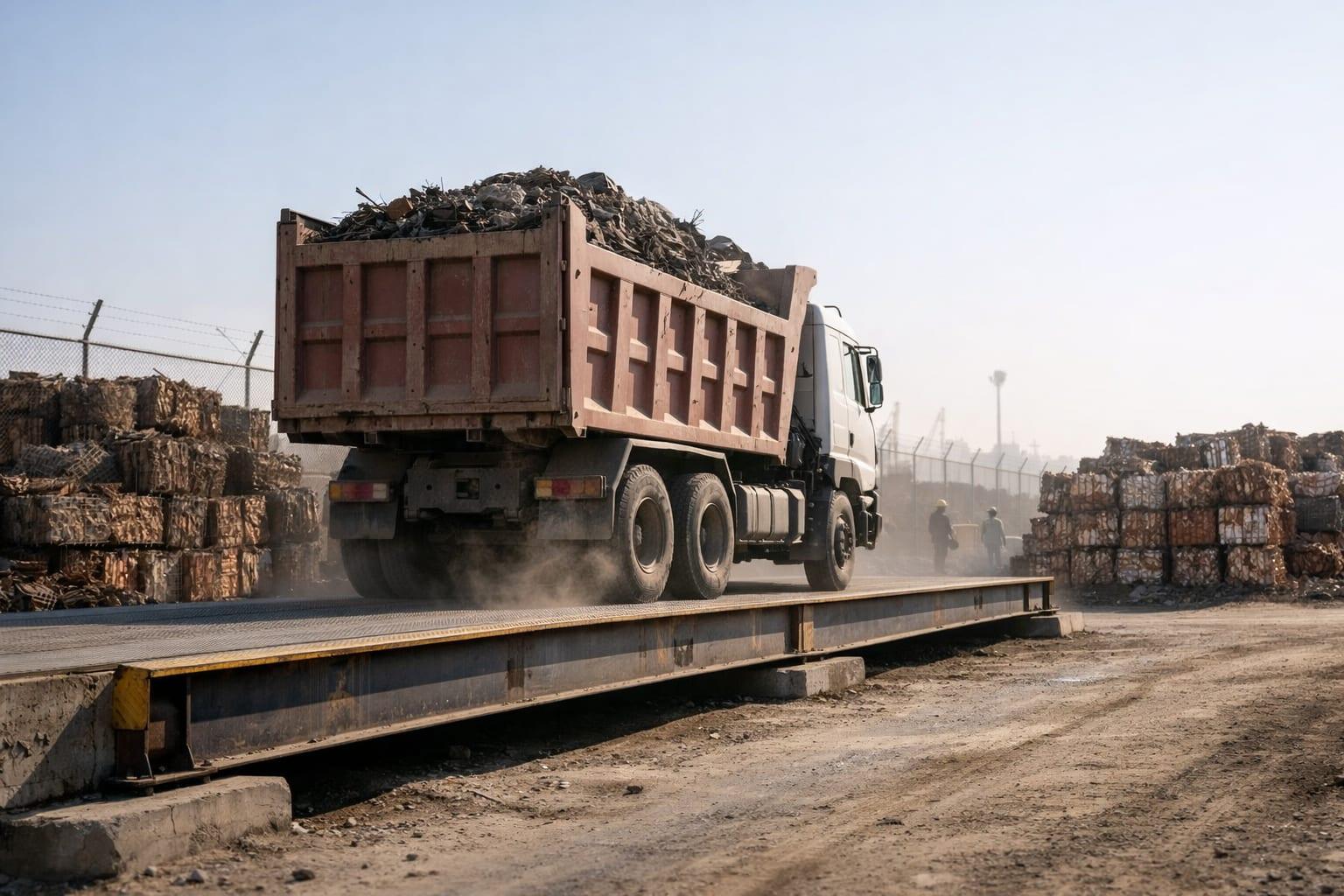
A free zone licence does not give you 0% corporate tax. It gives you the chance to qualify. A Qualifying Free Zone Person pays 0% only on Qualifying Income and 9% on everything else, tested every single tax period. For most scrap yards the whole thing turns on one question: does your mainland buyer resell or process the material, or consume it?
Do free zone companies pay corporate tax on scrap sold to the mainland?
Federal Decree-Law No. 47 of 2022 brought corporate tax in for financial years beginning on or after 1 June 2023. A Qualifying Free Zone Person, a QFZP, pays 0% on Qualifying Income and 9% on taxable income that is not Qualifying Income. A mainland company, or a free zone company that fails the test, pays 0% on the first AED 375,000 of taxable income and 9% above it. That AED 375,000 band sits in the general rate article, and the common professional reading is that it does not shelter a QFZP's non-qualifying income, which is taxed at 9% from the first dirham. Have your tax agent confirm that point against Article 3 before you budget on it.
Article 3 of Cabinet Decision No. 55 of 2023 sets out three buckets of Qualifying Income: transactions with other Free Zone Persons, other than Excluded Activities; transactions with a Non-Free Zone Person, but only for Qualifying Activities that are not Excluded Activities; and any other income, provided the de minimis test is met. Read the second bucket slowly. Selling to the mainland is not fatal by itself. It qualifies only when the activity is on the Qualifying Activities list.
Is mixed scrap a "qualifying commodity" under Ministerial Decision 265 of 2023?
Ministerial Decision No. 265 of 2023, issued 27 October 2023, replaced Ministerial Decision No. 139 of 2023. Plenty of advisory pages still quote the old one. Under MD 265, Qualifying Commodities are "metals, minerals, energy and agriculture commodities that are traded on a Recognised Commodities Exchange Market in raw form", and Article 2(3)(c) scopes the activity as physical trading plus associated derivative trading used to hedge the risk in that trading. A Recognised Commodities Exchange Market is one licensed and regulated by the competent authority in the UAE, or an exchange of equal standing outside it.
The FTA's Free Zone Persons guide, as summarised by PwC Middle East in 2024, says the commodity needs to be in a form that is traded on such an exchange. Raw form refers to a natural, unprocessed state, and minimal processing such as cleaning, sorting, grading or minor refining does not destroy it. The HSN code is an indicator, not a conclusive test. That is where most yards come unstuck. LME contracts are for refined primary metal, Grade A copper cathode at a minimum 99.9935% purity, and your material is not deliverable against them.
| Material | How it is actually priced | Qualifying commodity claim |
|---|---|---|
| Copper cathode, Grade A | LME cash settlement, USD 13,610 per tonne on 13 November 2026 (Westmetall, official LME data) | Strong |
| No. 1 heavy copper (birch) | Published trader bands at LME 3M minus USD 500 to 700 per tonne, indicative and undated | Weak, discounted secondary grade |
| No. 2 mixed copper (cliff) | LME 3M minus USD 600 to 800 per tonne, indicative | Weak |
| HMS 1&2 (80:20) | CFR Turkey assessments, monthly average USD 397 per tonne in October 2026 per GMK Center, down USD 4 on September | Contested, cash-settled index not primary metal |
| Zorba, baled plastics | Negotiated against aluminium or polymer references with yield assumptions | Very weak |
There is a genuine grey area here and we will not pretend otherwise. One UAE legal commentary from late 2023 argues the Minister never required the commodity to be sold on an exchange, only to be of a type traded there, and advisers point to the cash-settled LME Steel Scrap CFR Turkey contract. The FTA's published reading is narrower. If your pricing formula references a named exchange quotation and quotation date, keep that paper, because it is the only evidence that makes the argument runnable. Our note on index-linked scrap contracts covers how to write that linkage into the contract itself.
Does "distribution from a Designated Zone" cover a scrap yard?
This is the fallback almost every yard ends up on, and it carries three traps. First, the activity must be undertaken in or from a Designated Zone, not any free zone. Under Cabinet Decision No. 59 of 2017, effective 1 January 2018, only around 20 of roughly 45 UAE free zones were designated. Jebel Ali North and South, Hamriyah, Ajman Free Zone and Fujairah Free Zone are all on that original list, as are the free zone areas in Al Quoz and Al Qusais, Khalifa Port, RAK Maritime City and Umm Al Quwain. The Cabinet can amend the list, so check the current version before you rely on your address.
Second, the customer must resell the goods, or process or alter them for sale or resale. Distribution to an end user who uses or consumes the material does not qualify. In scrap the line is usually clear once you look: a re-roller, a secondary smelter, a foundry or a plastics compounder is a processor, while a contractor buying rebar offcuts for a site or a factory consuming your copper in its own maintenance is an end user. The FTA expects KYC checks and written undertakings confirming the buyer is a reseller, not an assumption.
Third, goods entering the UAE must be imported through the Designated Zone. Material cleared on a mainland customs entry and later trucked into the zone can fail that condition even when the sale is made from the zone. High sea sales and third-port shipments, where the goods never enter the UAE, have been clarified as meeting the distribution conditions.
What is the de minimis threshold and what does breaching it cost?
The de minimis allowance is the lower of AED 5 million or 5% of total revenue in the tax period. Not the higher. Above roughly AED 100 million of revenue the flat AED 5 million caps you; below it, the 5% figure caps you. Non-Qualifying Revenue means revenue from Excluded Activities, or from activities that are not Qualifying Activities where the counterparty is a Non-Free Zone Person.
Breach it and you do not pay 9% on the excess for one year. You lose QFZP status for the current tax period and the following four, and all income is taxed at 9% throughout. Small Business Relief is not a backstop either: it cannot be claimed in the same period as QFZP status, and it is available only for tax periods ending on or before 31 December 2026.
Worked example: a Jebel Ali yard with AED 60m turnover
JAFZA licence, calendar FY2026, revenue AED 60,000,000. Seventy per cent, AED 42,000,000, goes to mainland buyers who consume the material. The remaining AED 18,000,000 goes to free zone buyers and overseas re-processors. The rules are verified; the margins below are illustrative modelling, not assessed figures.
- De minimis cap: lower of AED 5,000,000 or 5% of AED 60,000,000, so AED 3,000,000.
- Non-Qualifying Revenue: the AED 42,000,000 of end-user sales.
- Breach: 14 times the cap.
- Consequence: QFZP status lost for FY2026, FY2027, FY2028, FY2029 and FY2030, with 9% on all income.
| Net margin | Taxable income | Tax at 9% above AED 375,000 | Five-year exposure at the same profit |
|---|---|---|---|
| 2% | AED 1,200,000 | AED 74,250 | AED 371,250 |
| 4% | AED 2,400,000 | AED 182,250 | AED 911,250 |
| 6% | AED 3,600,000 | AED 290,250 | AED 1,451,250 |
Now run the counterfactual. Same yard, same AED 42 million of mainland sales, but every buyer is a re-roller, secondary smelter or compounder, the trade licences and signed reseller undertakings are on file, and the material was imported through JAFZA. That revenue is Qualifying Income and the tax is zero. The difference between AED 1.45 million over five years and nothing is not the business model, it is the customer file. If you need buyers who are clearly processors rather than end users, that classification should be visible before you invoice, which is one reason we hold verified counterparty records on metals listings.
The near miss is worth modelling too. If only AED 2.4 million, 4% of revenue, goes to end users, you sit under the AED 3 million cap and the income is treated as Qualifying. Grow turnover or lose one reseller account and that AED 2.4 million becomes AED 3.2 million. The cap moves with revenue, and growing past the line without rerunning the sum is the classic failure.
What does FTA Decision No. 6 of 2026 add?
This is the piece most of the trade has not seen. FTA Decision No. 6 of 2026 was issued on 2 June 2026 and published on 14 July 2026, and it applies to tax periods beginning on or after 1 January 2026, which is the year you are filing for. It was issued in continuation of Clause 3 of Article 2 of Ministerial Decision No. 84 of 2025. Any QFZP claiming the Designated Zone distribution activity must obtain an annual Agreed-Upon Procedures report from an independent UAE-licensed auditor, prepared under ISRS 4400 using a margin-of-error sampling methodology.
Six prescribed procedures sit behind two evidence tests: that the customer resells or processes the goods, proven by valid trade or commercial licences, and that goods entering the UAE did so through a legally recognised Designated Zone. If the report is not submitted, the conditions for the distribution activity are treated as not met. Importer-of-record, drop-shipment and third-party customs arrangements, all common in this trade, need factual review rather than a tick. We could not confirm the submission deadline from secondary summaries, so ask your auditor to read the decision text directly.
What substance and audited accounts will an FTA review test?
Cabinet Decision No. 55 of 2023 requires a QFZP to undertake its core income-generating activities in the free zone, and where activities are outsourced, to have adequate supervision of them. For a yard that means the leased plot, the weighbridge, the shear or baler, the grading and segregation function, the buy and sell decisions, and staff on zone visas. A licence in Hamriyah with the actual tipping, sorting and weighing happening on a mainland plot in Sharjah Industrial Area has both a substance problem and a likely domestic permanent establishment problem.
Ministerial Decision No. 84 of 2025 made audited financial statements mandatory for every QFZP at any revenue level, for tax periods starting on or after 1 January 2025, alongside the AED 50 million revenue threshold that applies to other taxable persons. Sources differ on whether it was issued on 25 March or published 14 April 2025, so cite the Ministry of Finance text. Tax groups follow FTA Decision No. 7 of 2025 for aggregated statements. Transfer pricing under Articles 34 and 55 applies in full, which matters if your free zone entity sells to a related mainland yard at a price the owner sets by feel.
When is the FY2026 return due?
Nine months from the end of the tax period, with payment due on the same date. There is no separate later payment window and no routine extension. Filing runs through EmaraTax, and registration is mandatory for every free zone taxable person regardless of revenue, because a 0% rate is not zero filing.
| Financial year end | Return and payment due |
|---|---|
| 31 December 2025 | 30 September 2026, already passed |
| 31 March 2026 | 31 December 2026 |
| 30 June 2026 | 31 March 2027 |
| 30 September 2026 | 30 June 2027 |
| 31 December 2026 | 30 September 2027 |
How is the scrap VAT reverse charge different from corporate tax?
Completely different obligation, different file, different return. Cabinet Decision No. 153 of 2025 was announced by the Ministry of Finance on 19 December 2025 and took effect on 14 January 2026. It applies the reverse charge mechanism to specified domestic supplies of metal scrap between VAT-registered businesses, defined as ferrous or non-ferrous metal waste that has commercial value and remains useable after processing. The supplier stops charging the 5%, and the registered buyer self-accounts for output and input tax in its own return.
It applies only where the scrap is supplied for resale or for processing into materials used to manufacture new products, and only where both parties are VAT-registered in the UAE. It does not apply to zero-rated supplies, so exports keep their existing treatment. Both parties must complete procedural requirements before the date of supply, in practice written declarations exchanged in advance. The Ministry framed the measure as a crackdown on fraudulent practices in metal scrap trading. Reverse charge moves who accounts for the VAT. It does not make scrap VAT free, and it says nothing about whether your income is Qualifying Income.
Customs is a third obligation again. Moving goods out of a Designated Zone into the mainland is an import and needs a declaration, with import VAT and any duty, filed through Mirsal 2 in Dubai. Under FTA Decision No. 6 of 2026 that paperwork is no longer just logistics, it is the evidence your auditor samples, which is a reason to tighten the process set out in our guide to the customs bill of entry on free zone scrap sales.
What should be on file before 30 September 2027?
- Customer classification: trade or commercial licence with activity codes for every mainland buyer, a signed reseller or processor undertaking, and a customer master flag that splits reseller from end user in the sales ledger monthly rather than in a panic in March.
- Designated Zone and import route: bills of entry showing goods entered through the zone, importer-of-record documentation where a third party clears, the zone lease and gate passes.
- Exchange-price linkage: contracts and invoices showing the pricing formula, the named exchange quotation and the quotation date, ISRI or equivalent grade specifications, assay certificates, HS codes and any hedging records.
- Substance: plot lease, weighbridge calibration certificates and tickets, shear and baler asset register, staff list with zone visas, board minutes taken in the zone, outsourcing agreements with evidence of supervision.
- Transfer pricing: local and master file as applicable, intercompany agreements, benchmarking for related-party scrap sales.
- Compliance artefacts: audited financial statements, the ISRS 4400 report where you claim distribution, corporate tax registration and EmaraTax confirmation, plus the VAT reverse charge declarations kept in a separate file.
None of this is tax advice. The qualifying commodities question in particular is contested, and a yard betting several hundred thousand dirhams on the wide reading needs a written opinion from a registered UAE tax agent, not a forum post. More of our coverage sits under regulation.
Frequently asked questions
Does a free zone licence mean my scrap company pays 0% corporate tax?
No. Free zone status alone gives no tax benefit, and the 50-year guarantees in zone legislation do not override federal corporate tax. You get 0% only on Qualifying Income, and only if you pass the Qualifying Free Zone Person conditions in Cabinet Decision No. 55 of 2023, which are tested every tax period.
Is copper birch or cliff a qualifying commodity?
Probably not on the FTA's published reading. Ministerial Decision No. 265 of 2023 requires metals to be traded on a recognised commodities exchange in raw form, and LME contracts cover refined primary metal such as Grade A cathode at 99.9935% purity. Birch and cliff trade at published discounts of USD 500 to 800 per tonne to the LME three-month price, which is a reference, not an exchange listing.
What happens if I sell more than 5% of revenue to mainland end users?
The de minimis allowance is the lower of AED 5 million or 5% of total revenue, so a yard with AED 60 million turnover is capped at AED 3 million. Breaching it costs you QFZP status for the current tax period plus the next four, with 9% applied to all income, not only the excess.
Does my free zone scrap company need audited financial statements?
Yes. Ministerial Decision No. 84 of 2025 removed the revenue threshold for Qualifying Free Zone Persons, so audited statements are required at any revenue level for tax periods starting on or after 1 January 2025. Most free zones also impose their own audit requirement at licence renewal, with different deadlines and approved auditor lists.
Is the metal scrap VAT reverse charge a form of tax relief?
No. Cabinet Decision No. 153 of 2025, effective 14 January 2026, simply moves the 5% VAT accounting from the supplier to the VAT-registered buyer on domestic metal scrap supplies. It does not exempt scrap, it does not apply to zero-rated exports, and it has no bearing on whether your income is Qualifying Income for corporate tax.
When is my FY2026 corporate tax return due?
Nine months after your tax period ends, with payment due on the same date. A calendar-year company closing on 31 December 2026 files and pays by 30 September 2027 through EmaraTax. Registration is mandatory regardless of revenue, so a 0% rate still carries a filing obligation.


Comments(0)
Sign in to join the conversation.