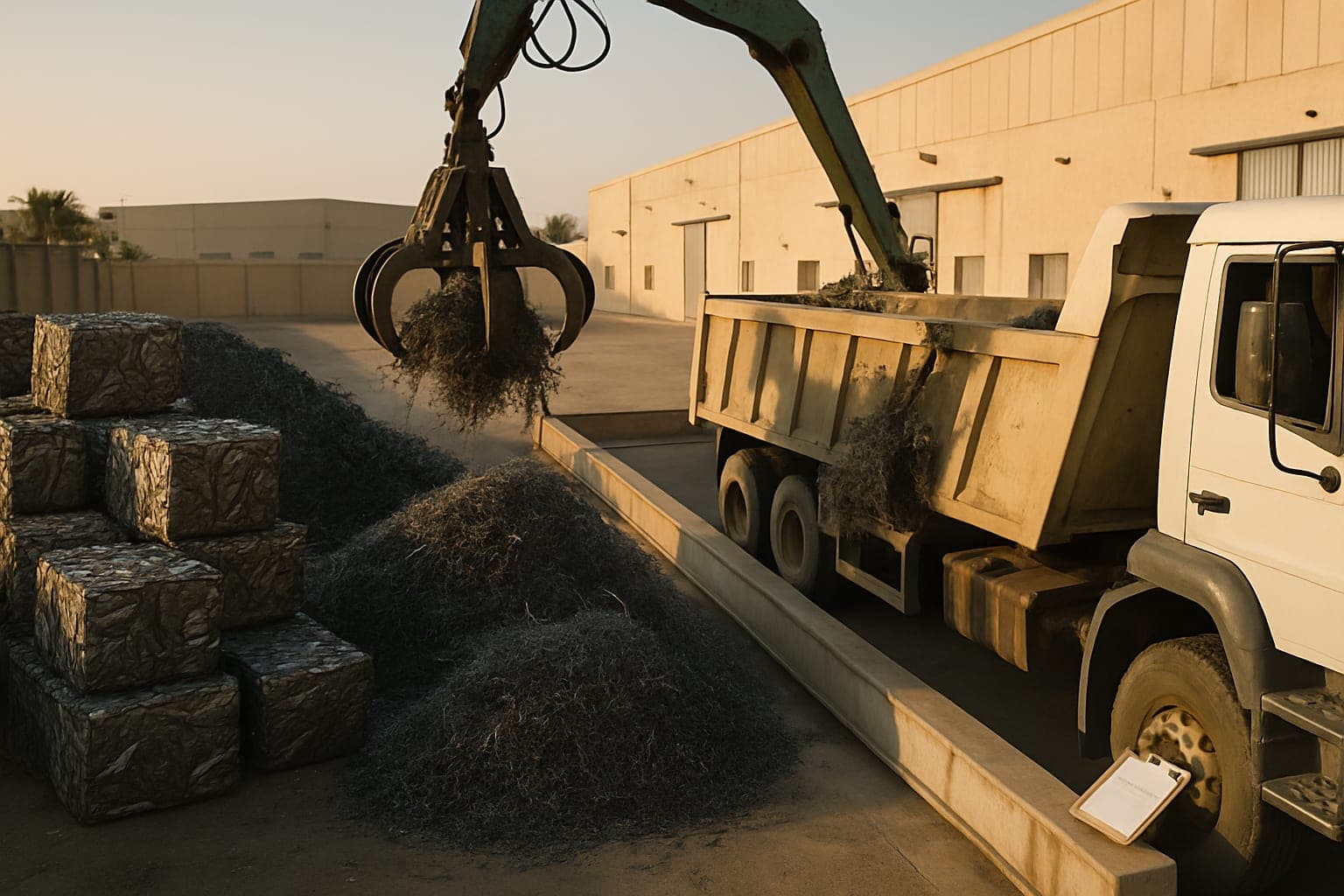
A free zone plot sits outside UAE customs territory, so selling scrap to a mainland recycler is an import. It needs a customs declaration on Mirsal 2 or your emirate's portal, a customs value backed by weighbridge tickets, duty settled at the point of transfer, and a gate pass your hauler carries. Miss one and the load stops.
Is scrap metal export from the UAE still banned?
Ministerial Decision No. 105 of 2026 imposed a four month ban on exports of certain industrial wastes and metal scrap, aimed at iron, aluminium and copper. The decision came from the Ministry of Foreign Trade, not the Ministry of Economy that issued the 2020 ferrous ban, and that distinction matters the moment you quote authority in a dispute. Reported effective dates differ. SMM put federal implementation at 3 June 2026, while Dubai Customs Notice No. 13/2026 ran from 10 June 2026 to 8 October 2026, which is consistent with a federal decision taking effect seven working days after issue and the emirate implementing it on its own clock.
Here is the part most traders have missed. Both BIR, on 25 June 2026, and Recycling International, on 27 June 2026, reported that Notice 13/2026 renews automatically unless a further notice cancels it. As of 19 October 2026, eleven days after the stated window closed, we have seen no cancellation. Treat the restriction as live until your broker shows you written confirmation from Dubai Customs, and date-stamp that confirmation in the file.
The notice lists specific codes: ferrous 72041000, 72042100, 72042900, 72043000, 72044100 and 72044900; copper waste and scrap 74040000; aluminium waste and scrap 76020000. Violations are penalised under the Unified Customs Law. Two details carry real money. Copper ingots are explicitly outside the ban, so the form your copper stream takes, not just the metal, decides whether it can move. And HS 720450, remelting scrap ingots, appears in the 2023 export duty schedule but in none of the reported listings of the 2026 ban codes, so confirm its status against the gazetted text before you book a vessel.
Shipments under contracts signed before the ban can be exempted, as can public interest cases. That route exists. It is paperwork, not a phone call.
The export duty is not a flat AED 400 per tonne
Cabinet Resolution No. 131 of 2023 set the export fees on industrial waste, and the rates differ by material. Quoting AED 400 across the board, as plenty of brokers still do, overstates an aluminium export cost by four times.
| Material | HS codes | Export duty |
|---|---|---|
| Scrap iron and steel | 720410, 720421, 720429, 720430, 720441, 720449, 720450 | AED 400 per tonne |
| Copper waste and scrap | 74040000 | AED 400 per tonne |
| Waste electrical and electronic equipment | 85491100, 85491200, 85491300 | AED 300 per tonne |
| Aluminium waste and scrap | 76020000 | AED 100 per tonne |
Understand the sequence as well as the rates. The duty and the ban are alternating instruments, not companions. Ferrous exports were banned from 15 May 2020 and extended to 19 December 2023, the ban was then lifted and replaced by the duty schedule from January 2024, and prohibition returned in June 2026. While a code sits under a ban you cannot pay AED 400 and ship it. The duty governs codes outside the ban and the periods between bans. If your aluminium leaves the country as a semi rather than as scrap, the carbon arithmetic changes the calculation too, which we covered in our note on CBAM and scrap-fed aluminium.
Why does selling to a mainland buyer count as an import?
Dubai Customs' own guidance is unambiguous. A free zone company selling goods into the local market must process the appropriate customs declaration, and the licence holder must hold a Customs Business Code before it can file anything at all. Goods needing approval from a restricted authority must have those approvals attached to the clearance. Customs value is defined as the value of the goods for the purpose of imposing import duties, which is the sentence your finance team should read twice.
Duty liability crystallises at the point of mainland transfer, not when the material first entered the zone. That is why a plant that brought in raw coil under suspension can still owe duty on the offcuts it sells to a yard in Ras Al Khor or Al Sajaa. Mainland buyers are not hard to find, and you can see what is moving on our industrial listings before you price a lot.
On the declaration type, be careful. Logistics and consultancy sources describe the same movement differently, some calling it an FZ transit out declaration through Mirsal 2, others an import to local market from a free zone. Those are not the same declaration code. Confirm the exact type on Dubai Trade, or with Abu Dhabi Customs for KEZAD and Sharjah Customs for Hamriyah, before your broker files. The phrase bill of entry is still used right across the trade, and the Free Zone Customs Centre issues a free zone bill of entry on the inbound leg, but what your driver actually needs at the barrier is a declaration number that matches the cargo on the trailer.
Customs value comes off the weighbridge, not the cash drawer
Scrap is the one category where declared value and settlement value drift apart, because yards still settle on a final weight taken at their own bridge days later. Build the file the other way round. Weigh loaded and tare on a calibrated bridge, keep both tickets, invoice against the ticketed net weight, and let the declaration carry that figure. Where a buyer disputes weight or grade after arrival, a documented inspection window gives you a cleaner route than a credit note written three weeks after the truck left.
Who pays the duty under EXW and DDP?
This is where free zone finance teams lose money, usually by writing EXW into a contract and assuming the obligation ends at the plot gate. It does not. Under EXW the mainland buyer becomes the importer, so the buyer needs its own Customs Business Code and a broker who can file, while your zone still has to issue the exit approval regardless of who pays. Under DDP you carry the duty, the VAT position and every hour of delay at the gate.
| Term and named place | Who files | Who pays duty | Most common failure |
|---|---|---|---|
| EXW, seller's plot | Mainland buyer | Buyer | Buyer holds no Customs Business Code, truck waits at the barrier |
| FCA or FOB, Jebel Ali | Seller for the zone leg | Depends on route taken | Export route chosen before the ban status was confirmed |
| DDP, buyer's yard | Seller | Seller | Lot priced with no duty line in the build-up |
Whatever term you use, put the incoterm, the named place and the party responsible for the customs declaration into the same clause. Three words of clarity prevent a two day argument at a gate.
How does the scrap reverse charge interact with designated zones?
Cabinet Decision No. 153 of 2025 moved VAT accounting on qualifying domestic scrap metal supplies from the supplier to the recipient where both parties are registered. The Ministry of Finance issued it on 4 November 2025, it was published in the Official Gazette on 26 November 2025, and it took effect 60 days later on 14 January 2026. Two conditions decide whether it applies at all: the recipient must give a valid Tax Registration Number and a written declaration of intent to resell or process the scrap. Without both, standard 5 per cent rules apply and the supplier accounts for the tax.
Now the complication nobody has resolved cleanly in public. The reverse charge is drafted for domestic supplies between registrants, while a movement out of a VAT designated zone into the mainland is treated as an import and runs on import VAT mechanics. We have not seen published FTA guidance that squarely addresses a scrap sale out of a designated zone, and much of the consultancy material in circulation blurs the two. Get the position in writing from your tax adviser, referencing your specific zone, and keep that advice on file with the deal.
One check comes before any of that. Designated zone status attaches to a specific fenced area, not to the brand name of a free zone, so confirm your plot rather than assuming the whole zone qualifies. The entire VAT analysis changes if it does not. This is worth particular care for office-based licences in zones such as DMCC, where fenced warehousing is only part of the picture.
When is it cheaper to clear to the mainland than ship out of Jebel Ali?
When a code is banned, the question answers itself. When it is not, run four numbers: the duty at the Cabinet Resolution 131 rate, ocean freight against the current bid from the destination market, the mainland mill bid net of transport, and the cost of time. Domestic mills reprice fast on policy. Kallanish reported in late January 2024 that UAE mills cut scrap purchase prices by AED 75 per tonne, around USD 20.40, within days of the export duty being announced. That figure is more than two years old and should be read as evidence of how quickly mill bids move, not as a current market level.
Non-ferrous sellers should price off the exchange rather than off last month's invoice, because UAE yard bids on copper and aluminium track LME cash settlement closely and the spread to the mainland mill is where the decision actually sits, as we set out in our copper price piece.
There is a deadline worth checking this week. Dubai Customs Notice No. 17/2026, reported on 10 October 2026, extended duty suspension periods by 60 days to a total of 180 days for goods imported for re-export, under temporary admission or in transit, covering suspended statuses expiring between 27 February 2026 and 31 October 2026. If you are holding material under suspension and redirecting it to the mainland, 31 October 2026 is a hard edge in that relief. Check your status dates now, not in November.
What does the free zone authority need before the truck leaves the plot?
Customs is one layer. The zone authority is a second, and the emirate's waste regulator can be a third. Most zones require an exit approval or gate pass tied to the declaration, and several maintain an approved hauler list, which means the recycler's truck and driver have to be on it before the barrier lifts. Your customs authority follows the emirate: Dubai Customs for JAFZA and DMCC, Abu Dhabi Customs for KEZAD, Sharjah Customs with the zone authority for Hamriyah.
Then ask whether your material is being treated as goods or as waste. Clean metal offcuts normally move as goods on a customs declaration. Anything carrying oil, coolant, battery content or process residue can trigger a waste transfer permit and a licensed transporter requirement from Dubai Municipality, Tadweer in Abu Dhabi or the Sharjah authorities, on top of the customs file. Confirm the classification with your zone's environment officer before the load is built, not after. Where the stream is genuinely hazardous and the buyer is offshore, the Basel permit route applies and the timeline runs far longer than any customs clearance.
The document pack, in order
- Free zone licence and Customs Business Code for whichever party is filing.
- Commercial invoice showing material description, HS code and the value you will declare.
- Packing list by lot, with container or trailer numbers.
- Calibrated weighbridge tickets, gross and tare, matching the invoice net weight.
- Customs declaration on Mirsal 2 or the relevant emirate portal, with the declaration number printed for the driver.
- Duty payment receipt where duty is due, or the suspension reference where it is not.
- Zone exit approval or gate pass, plus the entry record on the mainland side.
- Approved hauler documentation: trade licence, vehicle permit, driver identification.
- Waste transfer manifest or municipality permit where the material is classified as waste.
- Buyer's TRN and written declaration of intent to resell or process, where you are relying on the reverse charge.
Three errors that strand containers
Booking the vessel before confirming the code
A container of 72044100 turnings loaded against a stale reading of the ban status sits at port while a broker tries to establish whether Notice 13/2026 rolled over. Demurrage accrues from the day free time expires, and nobody refunds it. Confirm the code and the notice in writing on the day you book, not on the day you load.
Declaring scrap yard cash value instead of weighbridge value
If the declared customs value cannot be reconciled to a ticketed weight and a matching invoice, expect inspection and query. The fix is procedural and costs nothing: weigh, ticket, invoice, declare, in that order, with the same net figure on all four documents.
Writing EXW and assuming the buyer can file
Plenty of mainland yards buying from free zones have never held a Customs Business Code. The truck arrives, the barrier stays down, and both sides discover the gap at the gate with a driver on the clock. Ask for the buyer's customs code number at quotation stage and record it against the deal, alongside the TRN you will need for the VAT treatment.
Frequently asked questions
Is scrap metal export from the UAE banned right now?
Ministerial Decision No. 105 of 2026 imposed a four month ban on iron, aluminium and copper scrap exports, implemented in Dubai by Customs Notice No. 13/2026 from 10 June to 8 October 2026. BIR and Recycling International both reported that the notice renews automatically unless cancelled by a further notice. As of 19 October 2026 we have seen no cancellation, so confirm the current status in writing with Dubai Customs before booking any vessel.
What customs declaration do I file to sell free zone scrap to a mainland buyer?
A free zone to mainland sale is an import, so it needs a customs declaration filed on Mirsal 2 through Dubai Trade, or through Abu Dhabi Customs or Sharjah Customs for zones in those emirates. Published sources disagree on whether the correct type is an FZ transit out or an import to local market declaration, so confirm the code on the portal before your broker files. The filing party must hold a Customs Business Code.
Does the scrap metal reverse charge apply to a sale out of a designated zone?
Cabinet Decision No. 153 of 2025 applies the reverse charge to qualifying domestic scrap metal supplies between VAT registered parties from 14 January 2026, provided the buyer gives a valid TRN and a written declaration of intent to resell or process. A movement out of a VAT designated zone into the mainland is treated as an import, which runs on different mechanics. We have not seen published FTA guidance resolving the overlap, so get written advice naming your specific zone.
Who pays the customs duty, the free zone seller or the mainland buyer?
It follows the incoterm and the named place. Under EXW at the plot the mainland buyer is the importer and pays the duty, but that buyer needs its own Customs Business Code and a broker who can file. Under DDP the seller pays duty and any VAT due, which has to be priced into the lot before you quote.
How much is the UAE export duty on scrap?
Cabinet Resolution No. 131 of 2023 sets AED 400 per tonne on scrap iron and on copper waste and scrap, AED 300 per tonne on waste electrical and electronic equipment, and AED 100 per tonne on aluminium waste. The rates are not uniform. While a code sits under an export ban the duty is irrelevant, because the shipment cannot leave at any price.


Comments(0)
Sign in to join the conversation.