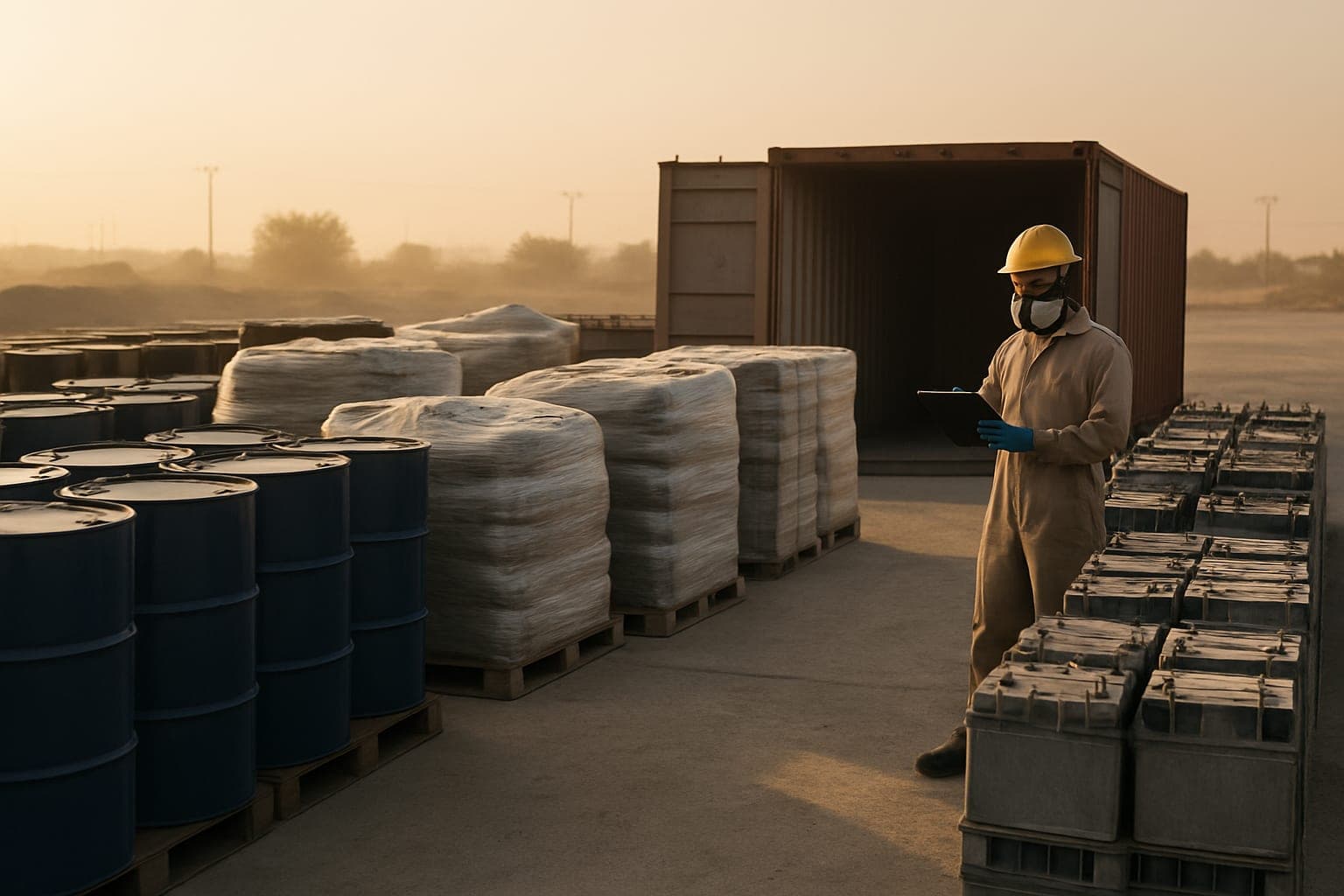
Spent catalyst, used batteries, contaminated solvent, oily sludge, furnace dust and regulated e-waste all leave the UAE under a MoCCAE export permit issued inside the Basel Convention. The application fee is AED 500 and the permit needs written consent from the importing state and from every transit state before the box moves. Ship without it and the container comes back at your cost.
Which of your streams actually needs the permit?
Federal Law No. 12 of 2018 on Integrated Waste Management, issued 18 December 2018, covers waste from production, separation, collection, transport, storage, reuse, recycling, treatment and disposal inside the State, and it says expressly that this includes the free zones. Nuclear and radioactive material sits outside it. Cabinet Resolution No. 39 of 2021 carries the executive detail. Underneath both sits Cabinet Decree No. 37 of 2001, which requires a licence from the competent authority simply to handle or deal in hazardous material, hazardous waste or medical waste, and requires every installation treating hazardous waste to be licensed.
Classification runs in a fixed order, and the order matters because an inspector will follow the same path.
- Confirm the material is a waste under the federal definition and your emirate's definition, not a by-product you can still sell as a product.
- Check Basel Annex I for a Y number. Y6 covers wastes from the production, formulation and use of organic solvents. Y8 covers waste mineral oils unfit for their original use. Y9 covers oil and water, hydrocarbon and water mixtures and emulsions. Metal constituents carry their own entries, including Y21 hexavalent chromium, Y22 copper compounds, Y23 zinc compounds, Y24 arsenic, Y26 cadmium and Y27 antimony.
- Check Annex VIII, List A. A1010 covers metal and alloy wastes of antimony, arsenic, beryllium, cadmium, lead, mercury, selenium, tellurium and thallium. A1020 covers wastes carrying those elements as constituents or contaminants, excluding metal waste in massive form. A1181 covers hazardous electronic waste.
- Check Annex IX, List B. B1010 and B1020 cover clean uncontaminated metal scrap. B1130 covers cleaned spent precious metal bearing catalysts.
- Apply the Annex III hazard characteristics. A List A entry does not stop you demonstrating that the material shows no Annex III characteristic, and a List B entry does not stop a regulator demonstrating that it does.
- Cross check the emirate list. Abu Dhabi pre-classifies certain wastes under EAD Waste Classification Policy EAD-EQ-PR-P-01, and once EAD has classified a waste, no other party in the emirate may reclassify it. Dubai leaves the hazardous and non-hazardous split to a resolution of the Director General under Law No. 18 of 2024.
One warning on codes. The Basel annexes were consolidated again with effect from 1 January 2025, and spent hydroprocessing catalyst, used lead acid batteries, halogenated solvent and furnace dust each sit in more than one plausible entry depending on oil content, moisture, free liquids and whether the metal is in massive form. Pull the current annex text for the specific entry and let the assay decide. Do not quote a code from a two year old consultant report.
What changed for electronics on 1 January 2025?
The e-waste amendments adopted by consensus at COP-15 in June 2022 took effect on 1 January 2025. Annex II gained entry Y49 covering all e-waste, its components and wastes from e-waste processing not listed in Annex VIII. Annex VIII entry A1180 was replaced by A1181. Annex IX entries B1110 for e-wastes and B4030 for single use cameras were deleted outright. The practical result, as the US EPA put it, is that non-hazardous e-waste and scrap is controlled under the Convention for the first time. Hazardous and non-hazardous both need prior informed consent now.
So the old trading assumption that a sorted, de-polluted board or a pallet of stripped servers moves on a commercial invoice alone is simply out of date. Equipment exported for genuine reuse is normally treated as used equipment rather than e-waste, and consent does not apply, unless the importing or exporting country treats such equipment as waste under its own law. We have not found a published UAE national position on that point, which is exactly why refurbished IT consignments get reclassified at the destination port.
There is a second constraint that catches exporters off guard. Cabinet Resolution No. 116 of 2023, dated 20 November 2023, and the UAE Policy for Integrated Management of Recyclable Materials name used tyres, electronic waste, plastic waste, used cooking oils and aluminium dross as materials to be sent to recycling factories inside the country. That is a policy steer toward domestic processing sitting on top of the Basel consent chain pointing outward. If your stream is on that list, build the domestic case first. Our note on Dubai's waste oil permit list shows how tightly the buyer side of one of those streams is already controlled.
What does the MoCCAE export permit application require?
The ministry's hazardous waste export service lists six documents: a valid trade licence with the activity in the same field, a valid environmental permit, the contract between exporter and importer, insurance, the Movement Document and the Notification Document. The fee shown on the service page in the version we reviewed was AED 500. Check the live page before you budget, because fees and service descriptions on government portals change without notice.
Two of those documents are routinely confused. The Notification Document goes first, before anything sails, and it is what triggers the consent chain. Under Basel Annex V A it must carry the projected shipment dates and period, the proposed itinerary including point of entry and exit, the means of transport, insurance information, and the designation and physical description of the waste including its Y number and UN number, its composition, and the special handling and emergency provisions. The Movement Document travels with the consignment and is signed at each handover. One is a request. The other is a chain of custody record.
The ministry's own conditions are explicit on three points. The state of import and every transit state must be a party to the Basel Convention. Consent must be obtained from the state of import for that specific import, provided the state of import has not prohibited the entry of hazardous waste. And the ministry must be notified of receipt of the shipment in the country of import and of the disposal method specified in the export notification form. Your file does not close when the vessel sails. It closes when the destination facility confirms what it did with the material.
How long does prior informed consent realistically take?
Plan around the consent chain, not around a published turnaround. The version of the MoCCAE service page we reviewed displayed an empty service completion duration field, so we are not going to print a number of working days that we cannot source. The honest answer is that your lead time is set by the slowest competent authority in the chain, and each transit state is an independent dependency that can sit on the file.
Two practical consequences follow. First, route selection is a regulatory decision, not just a freight decision, because every additional transit state is another consent you have to collect. Second, never book the container or build a stockpile with a storage deadline against a notification that has not come back approved. Material sitting in a drum store under a valid emirate permit costs you very little. The same material sitting in a box at port on demurrage while a transit authority reviews a file costs you daily, and those charges are the single biggest avoidable loss in this trade.
On the Ban Amendment, which readers often misread: it was adopted at COP3 on 22 September 1995 and entered into force on 5 December 2019, and it obliges Parties listed in Annex VII, meaning OECD members, the EU and Liechtenstein, to ban hazardous waste exports to countries outside Annex VII. It does not directly block UAE exports. The live obligation for a UAE exporter is the general duty on all Parties to respect the import and export bans of other Parties, which is exactly what the MoCCAE condition on prohibited imports codifies. Confirm the current Basel party status and Ban Amendment status of your destination against the Secretariat's own list rather than a trade summary.
Which emirate licence must already be in place?
MoCCAE will not consider you without a valid trade licence in the matching activity and a valid environmental permit, and those come from the emirate. In Abu Dhabi there is a second permit in front of the federal one, and most published guidance still gets it wrong.
| Authority | Instrument | What it controls for an exporter |
|---|---|---|
| Dubai Municipality, Waste and Sewerage Agency | Law No. 18 of 2024, with an implementing Administrative Resolution reported as No. 34 of 2026 effective around 10 March 2026 | Waste management activity permits. The law's definition of waste management expressly includes import and export, and a Waste Carrier must be authorised. Reported to apply inside free zones and special development zones including DIFC. Penalties reported up to AED 500,000, doubled for a repeat within one year. It replaced Local Order No. 115 of 1997. |
| Environment Agency Abu Dhabi | Abu Dhabi Law No. 21 of 2005 and the EAD Executive Regulation for Integrated Waste Management | Since 2024, EAD issues licences and permits for waste transportation, trade and treatment, and issues permits for waste export operations outside the emirate. EAD also fits GPS devices to waste vehicles and tracks hazardous movements. Tadweer Group retains operational permits such as landfill access, food disposal and NOI for large projects. |
| Sharjah and the northern emirates | EPAA and emirate municipalities | We have not verified the current hazardous waste permit set for Sharjah, Ras Al Khaimah, Ajman, Fujairah or Umm Al Quwain. Confirm directly with the emirate authority rather than assuming Dubai or Abu Dhabi procedure carries across. |
| MoCCAE, all seven emirates | Federal Law No. 12 of 2018, Cabinet Resolution No. 39 of 2021, Cabinet Decree No. 37 of 2001 | The export permit itself, plus the underlying requirement for a licence to handle hazardous waste at all and for every treating installation to be licensed. |
An ICAD or KEZAD generator therefore needs an EAD permit to move the material out of the emirate and a MoCCAE permit to move it out of the country, in that order, and both must be alive on the shipment date. Free zone status changes nothing. The same discipline that keeps a project's disposal evidence clean applies here, as we set out in our piece on Abu Dhabi demolition NOCs and waste records.
Does the metal value justify exporting at all?
Price formation is the first thing to understand before you model anything. Lead, nickel and cobalt price off the LME, so a used lead acid battery or a nickel bearing residue is quoted against a visible exchange reference and a payable percentage after assay. Molybdenum and vanadium are not exchange traded, so a spent CoMo or NiMo hydroprocessing catalyst parcel is quoted off a published assessment from an agency such as Fastmarkets, Argus or Platts, again as a payable percentage of contained metal after assay. We are not printing a per tonne number in this article, because those assessments move weekly and a figure we print today misleads you next month. Get a dated written quote tied to a named assessment and a stated pricing period.
What you can model precisely is the cost line. The AED 500 permit fee is noise. Freight, hazardous surcharges, insurance, drumming and overpack, sampling and umpire assay, and the demurrage exposure while consent is pending are not. Run the comparison against a licensed UAE treatment route on total landed cost per tonne, not on headline metal value.
Export usually loses on three kinds of material: streams on the domestic recycling list in the 2023 policy, streams where the hazard class is high and the payable metal content is low, such as contaminated solvent, oily sludge and most furnace dusts, and small parcels where the fixed cost of a notification and a consent cycle swamps the recovery. Domestic capacity is real, though published figures are dated. Tadweer's Eco Park sits around 70 km from Abu Dhabi city on Hamim Road across 27 plots and 1.8 million square metres, with medical and hazardous treatment plants operated by Al Ahlia Waste Treatment and Cleanco Waste Treatment at a reported capital cost of AED 100 million, figures published around December 2020. Tadweer reported processing roughly 108,000 tonnes of medical and hazardous waste in 2021. Urbaser was awarded a greenfield material recovery facility for Abu Dhabi in 2026 rated at 400,000 tonnes a year, split evenly between municipal and commercial and industrial waste, operational in 2028, with Tadweer Group chief executive Etienne Petit targeting 80 percent diversion from landfill by 2031.
One more live variable. Trade press reported a temporary UAE ban on exporting selected iron, copper and aluminium scrap running from 10 June to 8 October 2026, with the possibility of extension, and the source itself could not confirm the associated duty rates against a primary customs document. Check the current Dubai Customs and Ministry of Economy notices before you quote a metal export. Export windows for secondary material close faster than contracts do, which is the same lesson UAE exporters learned when Asian buyers shut the door on plastic scrap.
What protects you if consent is refused mid-shipment?
Basel Articles 8 and 9 are the spine here. Article 8 deals with the duty to re-import where a transboundary movement cannot be completed in accordance with the contract, and Article 9 deals with illegal traffic and take-back. We are deliberately not quoting day counts from memory, so read the current convention text before you draft, but understand the direction: the risk points back at the exporting side, and that means you.
Put the risk where it belongs in the contract with the overseas recycler.
- A condition precedent that nothing is released from the yard until written consent from the import state and every transit state is in the file, with the consent references recorded.
- The destination facility named by licence number, with a right to audit and a bar on onward transfer without your written approval.
- A rejection and return clause that allocates return freight, demurrage, port storage, re-drumming and domestic re-treatment cost if consent is refused, withdrawn or the facility's permit lapses mid-voyage.
- Sampling at the destination facility with your right to attend, a named umpire laboratory, and a deadline for quality claims.
- Payment against documents that include the signed Movement Document and the destination facility's receipt, not against the bill of lading alone.
- A certificate of final recovery or disposal returned within a fixed number of days, because the ministry requires you to report receipt and the disposal method used.
For domestic trades the same protections exist in a simpler form. On our platform the counterparty is KYC verified through UAE PASS, funds sit in escrow through MyFatoorah, and the buyer has a 48 hour inspection window, which removes most of the payment risk that an export letter of credit is trying to solve. You can see live industrial material on the industrial category before you commit a parcel to a six week consent cycle.
What records will an inspection ask for?
Article 61 of Federal Law No. 24 of 1999 obliges the owner of an establishment to keep a registry of hazardous wastes, the methods of disposal used and the parties contracted to receive them, and Article 60 covers control measures for transport and disposal. CWM Technical Guideline CWM.TG/10 on inspection management ties those articles to penalties, though that guidance is old and may now be read alongside the EAD Executive Regulation.
On retention, published summaries of Article 8 of Dubai Law No. 18 of 2024 put the generator's register at two years for non-hazardous waste and five years for hazardous waste, available to Dubai Municipality on request. Verify that against the primary text on the Dubai legislation portal before you set your own policy, and if you operate across emirates, hold everything for five years as a single standard. In Abu Dhabi, policy EAD-EQ-PR-P-04 requires commercial and industrial generators to use registered Environmental Service Providers and establishes emirate-wide recording of transfer from one holder to another from the point of generation to the final point.
Keep one file per consignment and keep it complete: the Notification Document and every consent reply, the Movement Document signed at each handover, the contract with the importer, the insurance certificate, copies of your trade licence and environmental permit valid on the shipment date, the emirate transport permit and the carrier's authorisation, weighbridge tickets, sampling and assay certificates, the destination facility's licence, and the certificate of recovery or disposal with your notification to the ministry. If any one of those is missing, the gap is usually the destination evidence, and that is the first thing an inspector asks for. More material on UAE waste rules sits in our regulation section.
Frequently asked questions
What does a MoCCAE hazardous waste export permit cost?
The ministry's hazardous waste export service listed an application fee of AED 500 in the version of the page we reviewed. Confirm the current figure on the live service page before budgeting. Either way the fee is trivial next to freight, insurance and the demurrage you will pay if you book a container before every consent is in hand.
Can I still export e-waste from the UAE without prior informed consent?
No. Since 1 January 2025 all e-waste is subject to prior informed consent, hazardous and non-hazardous alike, after Annex IX entries B1110 and B4030 were deleted and Y49 and A1181 were added. Separately, Cabinet Resolution No. 116 of 2023 and the UAE Policy for Integrated Management of Recyclable Materials direct electronic waste to recycling factories inside the country.
Who licenses hazardous waste transport in Abu Dhabi, EAD or Tadweer?
Since 2024 the Environment Agency Abu Dhabi issues licences and permits for waste transportation, trade and treatment, and issues permits for waste export operations outside the emirate. Tadweer Group retains operational permits such as landfill access, food disposal permits and no objection certificates for large development projects. Most older guidance still names Tadweer as the licensing body and is out of date.
How long must a UAE generator keep hazardous waste records?
Published summaries of Dubai Law No. 18 of 2024 put the generator's register at five years for hazardous waste and two years for non-hazardous waste, produced to Dubai Municipality on request. Federal Law No. 24 of 1999 requires the registry itself without fixing a period in that article. A five year retention across all emirates is the safe operating standard.
What happens if the importing country refuses the shipment after it sails?
Basel Articles 8 and 9 place the duty to re-import or take back on the exporting side when a movement cannot be completed as contracted or turns out to be illegal traffic. In commercial terms that means return freight, accumulated demurrage and domestic treatment cost land on you unless your contract with the recycler says otherwise. Allocate those costs in writing before the container moves.
Do free zone companies need the same permits?
Yes. Federal Law No. 12 of 2018 applies to waste management inside the State including the free zones, and Dubai Law No. 18 of 2024 is reported to apply within special development zones and free zones including DIFC. A generator in JAFZA, KEZAD or Hamriyah is fully in scope and needs the same emirate permits before MoCCAE will process an export notification.

Comments(0)
Sign in to join the conversation.