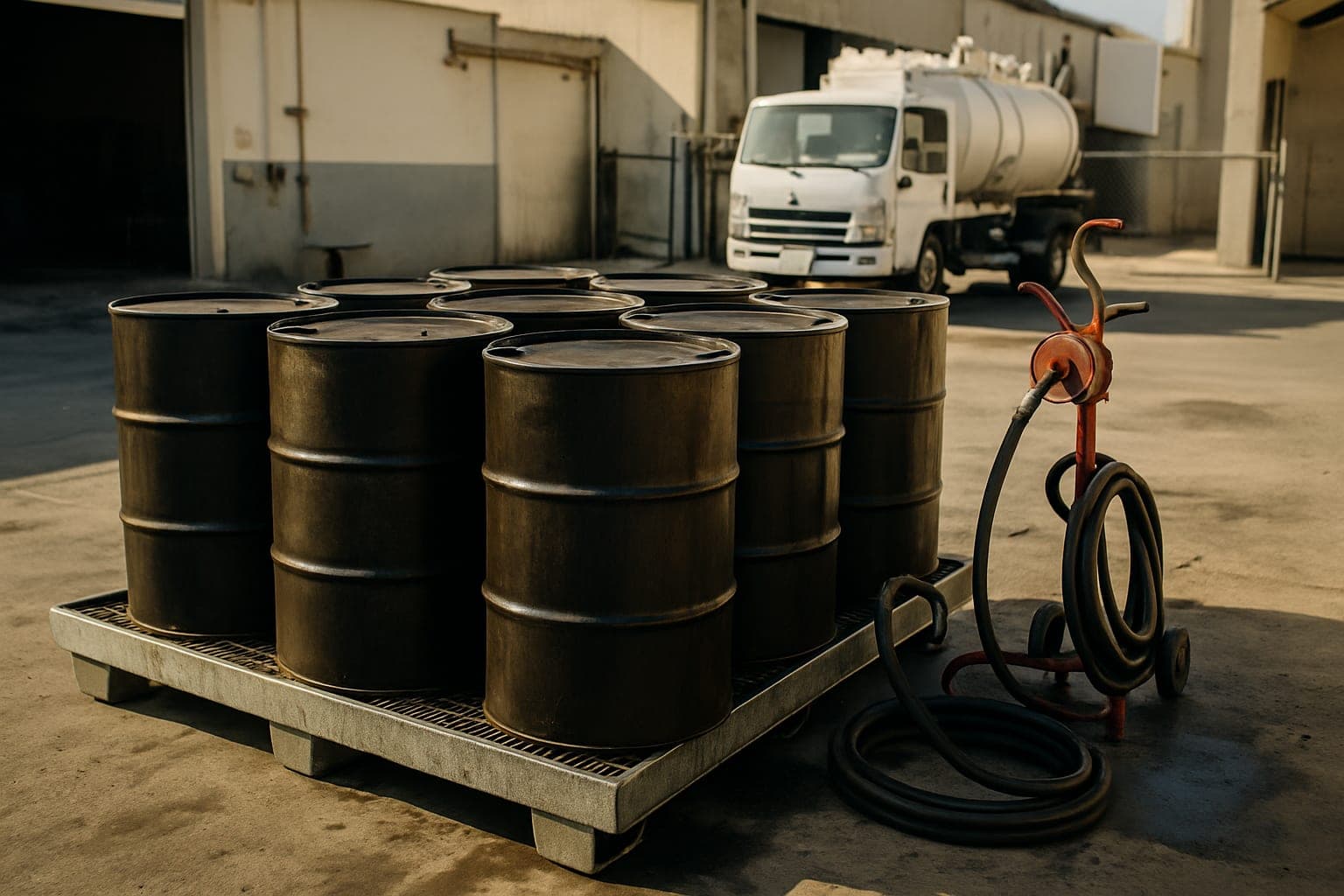
Dubai Municipality publishes a list of companies permitted to collect and transport waste oil for recycling, plus a separate list of approved processing premises. Hand drums to a collector on neither list and the liability stays with you as the generator, under Cabinet Resolution 39/2021 and Dubai Law No. 18 of 2024. Check both lists before you sign.
Who is permitted to collect waste oil in Dubai, and which list do you check?
Dubai Municipality's waste department information bulletin page carries three downloadable lists that matter to anyone producing used lubricating oil. The first is the List of Approved Hazardous Waste Transporters. The second is titled Companies Permitted to collect & Transport Waste oil in the Emirate of Dubai for the purpose of Recycling. The third is Hazardous and Non Hazardous Waste Processing and Recycling Premises in the Emirate of Dubai.
Most generators check one list and stop. That is the mistake. A collector can sit on the permitted transport list and still tip your drums at a site that never appears on the processing premises list, and you have no way of proving otherwise unless the destination is named in your paperwork. Check who lifts the oil, then check where it lands.
We are not publishing a count of permitted collectors. The bulletin page does not stamp a visible revision date, the version we reviewed indexed to 11 August 2022 while the sibling circulars page indexed as recently as 13 July 2026, and a number that ages badly is worse than no number at all. Download the PDF yourself, save it with the download date in the filename, and re-pull it every quarter.
Ask for the classification grade as well
Administrative Resolution No. (253) of 2025 issued technical guidelines for the evaluation and classification of establishments engaged in waste related activities in Dubai. It names the competent body as the Waste and Sewerage Agency of Dubai Municipality, not a generic waste department, and that is the desk you now write to. If your collector holds a classification under that resolution, ask for the certificate in writing. The grading bands are not set out in a form we could verify from published material, so collect the document rather than the claim.
Does a free zone trade licence cover your waste oil contractor?
No, and this is where most published advice is eighteen months out of date. Law No. (18) of 2024 Regulating Waste Management in the Emirate of Dubai was issued on 4 September 2024, published on 10 October 2024 and came into force 30 days after publication, around 9 November 2024. The text on the Dubai Legal Portal applies the law to all areas within the Emirate, including Special Development Zones and Free Zones such as the Dubai International Financial Centre, and to public and private entities alike.
That kills the old argument. A contractor licensed in JAFZA, Dubai Industrial City or a TECOM zone sits inside the same waste regime as a workshop in Al Quoz Industrial 3 or a plant in Ras Al Khor. Article 30 of the same law abrogated the older local orders, including Local Order No. 7 of 2002 on waste disposal sites, while keeping regulations, decisions and guides issued under them alive to the extent they do not conflict, pending replacement. That transitional clause is why you will find both old and new documents circulating online, and why the bulletin lists still stand.
One point is genuinely unsettled. Environmental permitting inside several Dubai free zones has historically run through Trakhees-EHS for JAFZA, Dubai World Central and the Palm, and through the DDA for TECOM zones. How those permits now sit against the Law 18/2024 requirement is not spelled out in any published guidance we could verify. Put the question to the Waste and Sewerage Agency in writing and keep the reply in the contract file. If a contractor tells you verbally that the free zone covers it, that is not evidence.
What happens if the collector turns out not to be on the list?
Cabinet Resolution No. (39) of 2021, the executive regulations of Federal Law No. (12) of 2018 on Integrated Waste Management, runs to 13 articles and two annexes. Article 2 sets the responsibilities of the waste producer and supplier, Article 5 covers hazardous waste management and Article 6 covers transport between the emirates. The principle the Ministry set out when it announced the details on 4 July 2021 is the one to memorise: the generator is responsible for proper disposal of the waste it generates and bears the financial cost. Federal Law 12/2018 names waste oil as a category in its own right, so there is no argument that used lube sits outside the regime.
Dubai's enforcement menu under Law 18/2024 goes well past a fine. In addition to the penalty under Article 20, the Municipality may suspend the violating establishment for up to three months or close it permanently, revoke licences or permits, impound non-compliant vehicles until compliance is achieved, deport the driver of a non-compliant vehicle from the UAE, and disconnect water and electricity to the building or establishment for up to three months. For a facilities manager running a dealership workshop or a district cooling plant, three months without power is not a line item you can absorb.
We are deliberately not quoting a dirham fine. The range repeated across UAE blogs, AED 500 to AED 50,000 across 23 violations, comes from a Dubai Municipality release dated 4 August 2021 describing Executive Council Resolution No. (58) of 2017. It predates both Law 18/2024 and Administrative Resolution No. (34) of 2026, the implementing bylaw, so treat it as superseded until you have read the current schedule. We track this kind of change in our regulation coverage.
Can you move used oil drums from Dubai to Sharjah?
Not without written permission. The UAE Government portal states that moving hazardous waste by sea, land or air within the country without written permission from the Ministry of Climate Change and Environment is banned, in line with the Basel Convention. Read that carefully: within the country. A Sharjah-registered collector lifting drums from your Umm Ramool yard to a processor in Al Sajaa is inside that rule, not outside it.
For consignments leaving the UAE, MoCCAE runs a digital service for the export of hazardous waste, with the service page dated 18 August 2025. Its published requirements are a valid trade licence with the activity in the same field, a valid environmental permit, a contract between exporter and importer, insurance, a Movement Document and a Notification Document. The process runs electronically from form to payment to document check to permit issue. The fee and the turnaround time are not stated on the indexed page, so ask early and build the wait into your storage plan. Basel's prior informed consent procedure begins with notification and passes through four stages before a shipment moves.
Used oils fall inside Basel's hazardous listings. The precise entry depends on the stream and its contaminants, so have your consultant match your material against the Annex text rather than copying a code off a supplier's quotation.
What paperwork proves the oil left your site legally?
A waste transfer note at every lift, counter-signed by the driver. It should carry the date, the volume, a plain description of the waste, the generator and origin site, the named destination facility, the vehicle registration and the driver's name. Add a recycling or destruction certificate from the processor, which serious collectors already issue because their clients need it for reporting. That certificate is what an auditor asks for, not the invoice.
Retention is the one question we cannot answer for you with a source. Three years is the period commonly cited in the market and it is a sensible working standard, but we could not verify a three-year retention obligation in a published Dubai instrument. Check your own permit conditions, Administrative Resolution No. (34) of 2026 and Article 5 of Cabinet Resolution 39/2021, and if the answer is not explicit, ask the Waste and Sewerage Agency and file the written reply with the records. While you are in the bulletin, note Circular No. (1) of 2024 on the maintenance of hygiene standards for waste transport vehicles and bins, which is the standard the tanker at your gate has to meet.
If you report ESG data, this paperwork is the raw material. Diverted tonnage without a transfer note and a processor certificate is an assertion rather than evidence, and the bar rises as Scope 3 waste emissions enter UAE climate law reporting.
What is a litre of clean used lube oil actually worth?
There is no exchange benchmark. Unlike copper or aluminium scrap, used lubricating oil is not traded on the LME or anywhere else, so there is no daily settlement, no forward curve and no public reference price you can hold a collector to. That single fact explains why two companies on the same Dubai Municipality list will quote you differently for identical drums.
What sets the band is fuel value at the floor and base oil value at the ceiling. Contaminated or off-spec oil gets burned or blended, so its floor tracks high sulphur fuel oil, and the regional marker is 380 CST HSFO at Fujairah, published by Platts and by Ship & Bunker. Clean oil that can be re-refined tracks Group I and Group II base oil, published by Argus Base Oils and by ICIS Base Oils Asia-Pacific. Both sit downstream of ICE Brent. None of those four references is free to access, which is exactly why your position improves the moment you put three quotes side by side.
The table below is arithmetic, not a price forecast. It assumes a density of 0.88 kg per litre, our working assumption for used lube oil in a typical range of 0.86 to 0.90, not a published figure.
| AED per litre | AED per tonne | Per 205 L drum | Per 1,000 L IBC |
|---|---|---|---|
| 0.20 | 227 | 41 | 200 |
| 0.30 | 341 | 62 | 300 |
| 0.50 | 568 | 102 | 500 |
| 0.75 | 852 | 154 | 750 |
| 1.00 | 1,136 | 205 | 1,000 |
| 1.25 | 1,420 | 256 | 1,250 |
Run your own volume through it before you get excited. A machine shop generating 3,000 to 5,000 litres a month from machining, hydraulic and compressor maintenance, a figure that appears in supplier material as an illustrative scenario rather than as market data, earns somewhere between AED 750 and AED 5,000 a month across that band. That is real money. It is not transformational. The return on doing this properly is the avoided liability, the audit trail and the reporting evidence, and the rebate is the tip on top.
Two observations on the buy side, neither of which we have checked against the permitted list, so verify before you engage anyone. Kinetic UAE states on its own site that it pays per litre for recovered waste oil. Kleen Lube, a Dubai producer, markets a recycled base oil under the name MRL-300 and a Process Lube Oil grade on a page dated 11 December 2024, without publishing prices. Remember also that used cooking oil and used lube oil are separate markets with separate collectors and separate outlets, so do not let a UCO quotation anchor your lube negotiation.
Why buyers care so much about water content
An assessment of used motor oil recycling opportunities in the UAE, published in the Journal of King Saud University Engineering Sciences with a Springer record dated 17 September 2018, found that one gallon of used motor oil yields about 2.5 quarts of base lubricant, roughly 62 percent recovery, against 42 gallons of crude to produce the same quantity. The same study found the recycled motor oil then produced in the UAE required more stringent quality control to match virgin characteristics. The paper is old. The economics it describes still explain why re-refiners write tight acceptance specifications and charge back hard on contamination.
No credible public figure exists for how much used lubricating oil Dubai or the UAE generates in a year. The federal dataset on the quantity of collected hazardous waste by emirate, source and method of treatment is the honest route to one, and we will publish a number when we can source it rather than estimate it.
What keeps a load in the paying grade?
Four contaminants move oil from the re-refinery grade down to fuel grade or to a gate fee: water, engine coolant, solvent and brake fluid. Degreaser will do it too. Once glycol or chlorinated solvent is in the tank, the whole tank is downgraded, so the cost of one careless decant is not the litre, it is the batch.
The practices that hold grade are unglamorous. Bunded containment sized to at least 110 percent of the largest container. Sealed drums or IBCs exchanged at each visit rather than decanted on site. Separate, clearly marked containers for coolant and brake fluid, stored physically away from the oil. Labels showing waste type, accumulation start date and generator name. It is the same discipline that keeps other industrial streams saleable on our marketplace: segregate at the point of generation, or pay for it at the weighbridge.
Ask every bidder for a written acceptance specification with numbers on it: maximum water percentage, maximum halogens, minimum flash point and the PCB screening limit. Those thresholds come from the buyer's process rather than from Dubai Municipality, which is why they differ between collectors and why you need them on paper before the first lift.
How do you structure a 12-month collection contract?
- Term and volume band. Twelve months with a stated monthly range rather than a fixed volume, and a review trigger if you move outside it.
- Rebate tiers tied to a named reference. Fuel grade indexed to 380 CST HSFO at Fujairah, re-refinery grade indexed to a named Group I or Group II base oil assessment, with the reset frequency written down. A flat AED per litre for twelve months simply rewards whichever side guessed the market right.
- Written acceptance specification. Numeric thresholds plus the charge-back schedule at 5, 10 and 20 percent water, agreed before signature rather than after the first rejected load.
- Sampling rights. You take a split sample at loading, both parties retain it for 30 days, disputes go to a named independent laboratory and the losing party pays the fee.
- Permit annex. Dated copies of the collector's entry on the waste oil list, the hazardous transporter list where it applies, the trade licence with a matching activity, and the destination facility's entry on the processing premises list.
- Named destination. The processing site is named in the contract and cannot be substituted without your written consent.
- Notification duty. The collector informs you within five working days of any lapse, suspension or revocation, and you may terminate immediately on delisting.
- Movement permissions. Written MoCCAE permission on file where a load crosses an emirate boundary or leaves the country, with Movement and Notification Documents for exports.
- Documentation flow. Transfer note at every lift, monthly reconciliation against your own meter or drum count, annual recycling certificate for reporting.
- Indemnity and insurance. The collector indemnifies you for downstream handling and carries insurance covering the load in transit.
The one-page pre-collection compliance check
Print this and keep the completed copy with the contract. The middle column is what an inspector or an auditor would accept, the right column is where the requirement comes from.
| Check | What good looks like | Basis |
|---|---|---|
| Collector permitted for waste oil | PDF downloaded, date recorded, entry highlighted | DM waste department bulletin |
| Hazardous transporter listing | Entry on the List of Approved Hazardous Waste Transporters | DM waste department bulletin |
| Destination premises listed | Named site appears on the processing and recycling premises list | DM waste department bulletin |
| Free zone contractor | Dubai Municipality position confirmed in writing, not just a free zone licence | Law No. 18 of 2024, applies to free zones including DIFC |
| Classification grade | Certificate obtained from the collector | Administrative Resolution No. 253 of 2025 |
| Inter-emirate movement | Written MoCCAE permission on file before the lift | UAE Government portal guidance, Basel Convention |
| Vehicle condition | Tanker meets hygiene standards, turned away at the gate if not | DM Circular No. (1) of 2024 |
| Transfer note | Signed at every lift, destination named on the note | Cabinet Resolution 39/2021, generator responsibility |
| Storage | Bund at 110 percent of the largest container, oil segregated from coolant and brake fluid | Buyer acceptance specifications |
| Records | Retained for the period in your permit conditions, three years commonly cited | Confirm with the Waste and Sewerage Agency |
One last point on verification. We KYC counterparties through UAE PASS before they trade with us, and that tells you a company is real and who stands behind it. It is not a waste permit check, and we do not pretend otherwise. The same logic runs through every regulated stream, which is why used lead-acid batteries need a licensed UAE smelter rather than whoever offers the best price at the gate. Open the Municipality bulletin yourself, and date the copy you file.
Frequently asked questions
Who is licensed to collect waste oil in Dubai?
Dubai Municipality publishes a list titled Companies Permitted to collect and Transport Waste oil in the Emirate of Dubai for the purpose of Recycling on its waste department bulletin page, alongside a List of Approved Hazardous Waste Transporters. A collector must appear there before you hand over drums. Check the separate list of hazardous and non hazardous processing and recycling premises too, because a permitted transporter can still deliver to an unpermitted site.
Do I need a Dubai Municipality waste permit if my site is in a free zone?
Law No. 18 of 2024 applies to all areas within the Emirate of Dubai, including special development zones and free zones such as DIFC, and to public and private entities. A free zone trade licence on its own does not answer the waste permit question for your contractor. How Trakhees-EHS and DDA permits interact with the 2024 law is not clear in published guidance, so ask the Waste and Sewerage Agency in writing and keep the reply.
Can I move used oil drums from Dubai to Sharjah?
Only with written permission from the Ministry of Climate Change and Environment. The UAE Government portal states that moving hazardous waste by sea, land or air within the country without that written permission is banned, in line with the Basel Convention. The rule catches movements between emirates, not just exports, so a Sharjah collector lifting from a Dubai yard needs the permission on file.
How much do UAE buyers pay per litre for used engine oil?
There is no exchange benchmark for used lubricating oil, so there is no published UAE price to quote. Offers sit between a floor set by fuel value, tracking 380 CST HSFO at Fujairah, and a ceiling set by Group I and Group II base oil assessments from Argus or ICIS. Run three dated written quotes from listed collectors and ask each one for its charge-back schedule at 5, 10 and 20 percent water.
How long must I keep waste transfer notes?
Three years is the period commonly cited in the UAE market, but we could not verify a three-year obligation in a published Dubai instrument. Check your permit conditions, Administrative Resolution No. 34 of 2026 and Article 5 of Cabinet Resolution 39/2021. If the answer is not explicit, ask the Waste and Sewerage Agency and file the written reply with the records.
What happens if my waste contractor is not licensed?
Under Dubai Law No. 18 of 2024, and in addition to fines, the Municipality may suspend an establishment for up to three months or close it permanently, revoke licences and permits, impound vehicles, deport a non-compliant driver and disconnect water and electricity for up to three months. Cabinet Resolution 39/2021 places the duty and the cost of proper disposal on the generator. That exposure sits with you, not only with the contractor.

Comments(0)
Sign in to join the conversation.