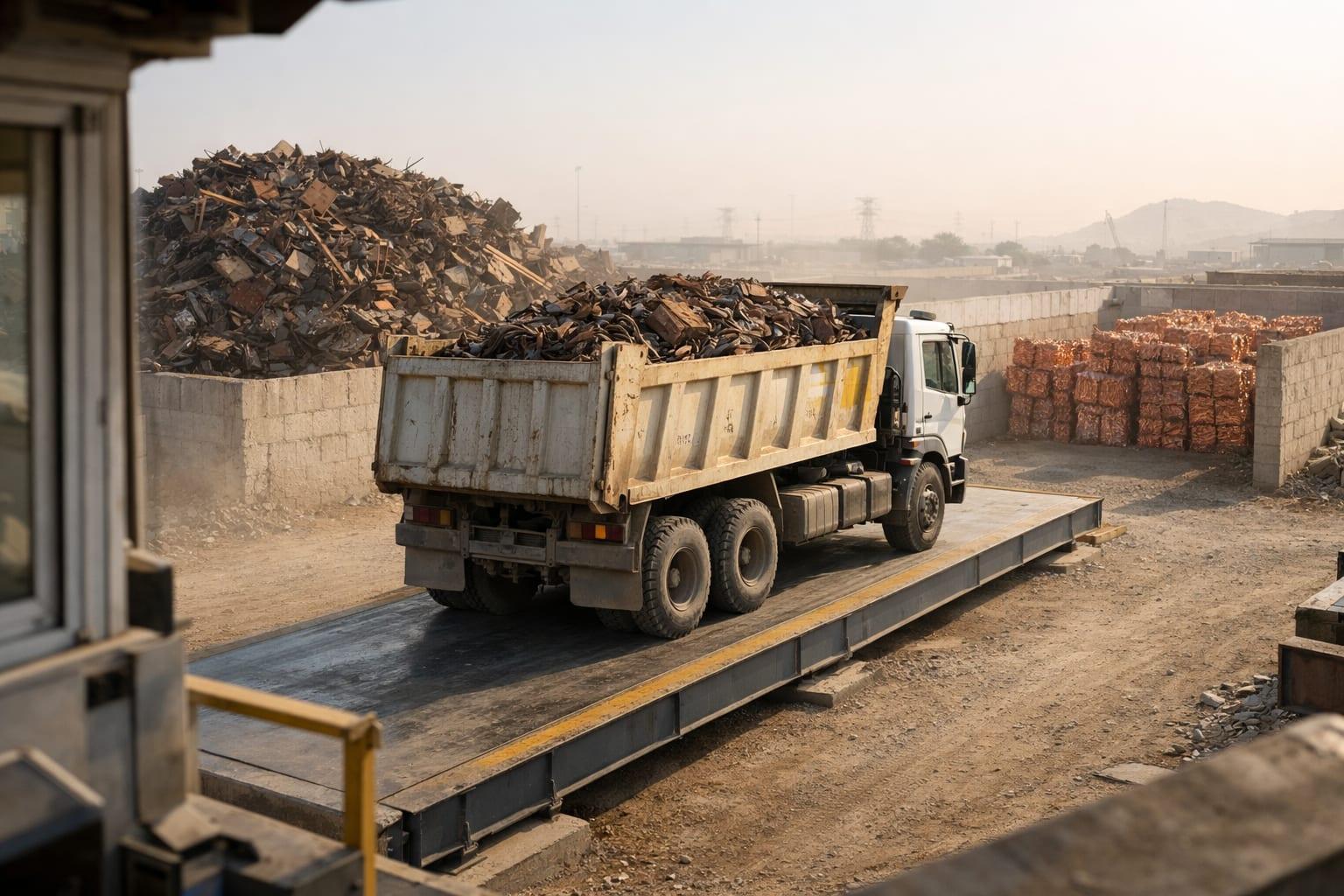
Price your 2027 scrap contract off a named index, not a handshake number. BigMint assessed UAE HMS 80:20 processed at AED 1,021 per tonne for the week ended 5 November 2026. Pair that index with a 90 per cent floor, a 115 per cent cap and re-weigh rights, and you keep downside cover without giving the buyer every upswing.
What does index-linked actually mean in a UAE scrap contract?
It means the price is a formula with six named parts: the publisher, the exact grade, the delivery basis, the publication day, the lag between publication and application, and the percentage applied to the published number. A clause that says price to be based on the prevailing market index is not a pricing clause. It is an invitation to argue in month seven.
Delivery basis is where UAE sellers lose money without noticing. BigMint's weekly UAE assessment is quoted DAP Abu Dhabi, so the AED 1,021 per tonne printed for the week ended 5 November 2026 already carries freight into Abu Dhabi. If your arisings sit in Al Quoz, Sharjah's Al Sajaa or a fabrication shop in Ajman, either you deliver to that basis or you agree a stated freight adjustment in dirhams per tonne. Leave it vague and the buyer applies his own number.
Name the exchange as well. The LME steel scrap contract is cash settled in 10 tonne lots, quoted in US dollars per tonne, listed monthly out to 15 months, and settles against the monthly average of the Platts TSI HMS 1/2 80:20 CFR Turkey assessment. That is a Turkish import price, not a UAE domestic one, and the basis between the two moves. On copper the exchanges have visibly parted company: LME three month copper was quoted at USD 14,095 per tonne on 4 November 2026, while a COMEX converted price on 7 November 2026 worked out at USD 13,706.54 per tonne. Close to USD 400 a tonne sits in that choice alone.
Fix the conversion rate in the document. The dirham is pegged at 3.6725 to the US dollar and BigMint's own conversions imply 3.672. Writing converted at the prevailing rate on the date of invoice adds a negotiation to every invoice for no benefit at all.
Which index or formula fits each material?
| Grade | Reference to write into the contract | Last verified level | Note |
|---|---|---|---|
| HMS 80:20 processed | BigMint UAE weekly, DAP Abu Dhabi | AED 1,021/t, week ended 5 Nov 2026 | Up AED 10 week on week from AED 1,011/t |
| Shredded | Same publisher, shredded line, or HMS plus a stated premium | AED 1,140 to 1,180/t DAP, trader indications, same week | Premium over HMS of AED 100 to 140/t |
| PNS, plate and structural | HMS assessment plus a stated premium | About AED 1,080/t on a 500 to 1,000 t lot, late Sep 2026 | Thin and lot size dependent |
| Bare bright copper | LME copper cash or three month, percentage | AED 46.46/kg quoted 26 Oct 2026 | About 90 per cent of LME at the time |
| General copper scrap | LME copper, percentage | AED 43.46/kg, 26 Oct 2026 | About 84 per cent of LME |
| Brass | LME copper with a stated discount, or a named brass reference | AED 26.84/kg, 26 Oct 2026 | Never bundle with copper lines |
| Clean 6063 extrusion | LME aluminium, percentage | LME aluminium about USD 3,135/t on 5 Nov 2026, or AED 11.51/kg | Trade level 70 to 82 per cent implies AED 8.06 to 9.44/kg |
| Insulated wire and radiator | Separate priced lines | AED 21.00/kg and AED 25.00/kg, 26 Oct 2026 | Recovery rate drives the percentage |
The aluminium row is the clearest warning in that table. UAE collector sites were still advertising clean 6063 at AED 4.50 to 5.50 per kilo in mid 2026, which is 39 to 48 per cent of LME, while US yard boards in October 2026 paid 70 to 82 per cent for the same grade. Those dirham figures are walk-in yard rates, not traded B2B prices. Drop one into a 12 month contract as the market price and a 60 tonne a year extrusion arising gives up roughly AED 188,000.
Copper tells the same story. The AED 18 to 26 per kilo range still circulating on UAE scrap pages belongs to a copper era that ended well before LME copper set an intraday record of USD 14,527.50 per tonne on 29 January 2026 and a record close of USD 14,298 on 25 August. If you want the detail behind that run, we covered it in how UAE copper scrap prices track the record LME run.
What percentage of index should you be signing?
The percentage is where processing cost, freight, lot size and credit risk are priced. On a 200 tonne a year ferrous arising at AED 1,021 per tonne, gross value is AED 204,200 and every single percentage point is AED 2,042.
| Percentage of index | Net AED/t | Annual revenue, 200 t | Given up against 100 per cent |
|---|---|---|---|
| 100% | 1,021.00 | 204,200 | 0 |
| 97% | 990.37 | 198,074 | 6,126 |
| 95% | 969.95 | 193,990 | 10,210 |
| 92% | 939.32 | 187,864 | 16,336 |
| 90% | 918.90 | 183,780 | 20,420 |
| 85% | 867.85 | 173,570 | 30,630 |
| 80% | 816.80 | 163,360 | 40,840 |
There is no universal right number. A sorted, cut to size, single grade parcel delivered into a buyer's yard in Musaffah should price far closer to 100 per cent than mixed uncut arisings collected from a site in Dubai Industrial City. What matters is that the number is written down rather than implied.
Fixed or indexed, what would the last 12 months have paid?
Honest answer first. Ferrous has been falling. BigMint had UAE HMS 80:20 processed at AED 1,245 per tonne in early December 2024 and at AED 1,021 for the week ended 5 November 2026, a drop of about 18 per cent. Over that path a seller on a fixed price beat a seller on 95 per cent of index. Anyone telling you index-linking always pays more has not run the arithmetic.
We are not going to publish a fabricated monthly series to make the point land. The verified recent run is narrow: AED 1,030 per tonne around 25 September 2026, AED 1,011 for the week ended 29 October, AED 1,021 for the week ended 5 November. A 1.9 per cent band. The useful output is the breakeven percentage you have to beat in each kind of market.
| Scenario | Average index AED/t | Indexed at 95% | Fixed at AED 1,021 | Difference | Breakeven percentage |
|---|---|---|---|---|---|
| A. Falling 18%, the actual Dec 2024 to Nov 2026 path | 929 | 176,531 | 204,200 | -27,669 | 109.9% |
| B. Flat within 2%, the Sep to Nov 2026 regime | 1,021 | 193,990 | 204,200 | -10,210 | 100.0% |
| C. Rising 15% on a restock | 1,098 | 208,539 | 204,200 | +4,339 | 93.0% |
Read that as a risk question, not a profit forecast. Fixed wins when the market falls, index wins when it rises, and nobody sitting at the table in January knows which 2027 will be. Downstream sentiment is not encouraging: imported rebar sat at workable offers of USD 765 to 775 per tonne CPT Jebel Ali in the week ended 5 November 2026, Chinese billet was offered around USD 590 to 600 against GCC billet at USD 650 to 660, and traders are warning that new regional rolling capacity deepens the oversupply. What index-linking actually buys you is that your price cannot go stale while the mill's price moves, and that you can show an auditor how the number was derived. The upside comes from the collar below, not from the index itself.
How do you stop deductions eating the percentage you negotiated?
A seller who pushes the headline from 92 to 95 per cent, then signs an uncapped moisture clause, has given it all back and more.
| Line | Deduction | Tonnes | Value AED |
|---|---|---|---|
| Gross declared | 200.00 | 204,200 | |
| Moisture | -2.0% | -4.00 | -4,084 |
| Non-conforming and attachments | -3.0% | -6.00 | -6,126 |
| Weighbridge variance | -0.5% | -1.00 | -1,021 |
| Net payable | -5.5% | 189.00 | 192,969 |
Cap each line as a maximum percentage of consignment weight, require photographic evidence and a written deduction note before payment is released, and set a window, 48 hours from tipping works, after which no deduction can be raised at all. One percentage point on the moisture cap is AED 2,042 a year on this arising, exactly the same as one point on the headline price.
Watch grade substitution too. Shredded was indicated AED 100 to 140 per tonne above HMS processed in the week ended 5 November 2026, between 9.8 and 13.7 per cent. A contract that despatches shredded and pays the HMS index line transfers that whole spread to the buyer, quietly, every month of the year.
Weighbridge and re-weigh rights
Require a calibrated weighbridge with a current certificate, a copy of every ticket within 24 hours, and the right to re-weigh at a third-party bridge if variance exceeds a stated tolerance. Half a per cent on a loaded truck is reasonable. Agree in advance who pays when the re-weigh confirms the original figure, because an unpriced right is one nobody ever exercises. Our 48 hour inspection window exists for this moment: a defined period in which either side raises a weight or quality claim with evidence, rather than a phone call three weeks after the metal has been melted.
Floor, cap or collar?
This is the clause that settles the fixed versus index argument. A collar keeps the formula and bolts a floor and a ceiling onto it.
| Index move | Index AED/t | Collared AED/t | Against naked index, 200 t | Against fixed, 200 t |
|---|---|---|---|---|
| -25% | 766 | 919 | +30,630 | -20,420 |
| -15% | 868 | 919 | +10,210 | -20,420 |
| -5% | 970 | 970 | 0 | -10,210 |
| +5% | 1,072 | 1,072 | 0 | +10,210 |
| +15% | 1,174 | 1,174 | 0 | +30,630 |
| +25% | 1,276 | 1,174 | -20,420 | +30,630 |
A 90 per cent floor at AED 919 and a 115 per cent cap at AED 1,174 is worth up to AED 30,630 a year if the market drops 15 per cent or more, and costs you nothing until the index rises past 15 per cent. Buyers resist floors. They resist less when the cap is genuine and the volume commitment is firm. If the floor is refused outright, ask for a reopener instead: either party may call a renegotiation if the index moves more than a stated percentage from the signing level, with a 30 day window and a right to walk if no agreement follows.
Which publication day, and how much lag?
Pick one publication, one day and one lag, then write all three into the clause. For ferrous we prefer the arithmetic average of the weekly assessments published in the preceding calendar month, applied to everything despatched in the following month. It is easy to audit, hard to game, and it stops a buyer timing collections around a dip.
Be honest about the size of the prize today. Week on week moves in the UAE ferrous assessment ran at AED 9 to 10 per tonne from September to November 2026, roughly 1 per cent, or AED 1,800 to 2,000 a year on 200 tonnes. Small. In a fast market it is the clause you will wish you had written, and it costs nothing to include now.
Add a fallback. If the named assessment is discontinued, suspended for more than two consecutive weeks, or changes methodology materially, the contract should name a substitute source and give the parties 15 days to agree a replacement, with termination as the backstop.
What else the sale leg has to say
- A volume commitment with a tolerance band, say 200 tonnes a year plus or minus 15 per cent, and a stated consequence if you fall short or overshoot.
- Exclusivity, if you grant it, priced. A right of first refusal at the indexed price with a 48 hour matching window is usually enough.
- Title and risk transferring at the weighbridge, with a clear statement of when your liability for the material ends.
- Payment terms counted in days from the weighbridge ticket, not from invoice acceptance, with interest for late payment. Escrow removes the argument: funds are held and released on confirmed delivery and inspection.
- VAT. The UAE applies 5 per cent. Whether your supply falls under a domestic reverse charge rather than normal output tax changes who accounts for the tax, so confirm the treatment in writing with your adviser and state the agreed position in the contract.
- A permit warranty. The buyer warrants it holds valid waste transport and recycling permits in every emirate where it operates, and provides copies on request and on each renewal.
- Export responsibility. If the buyer re-exports through Jebel Ali, say who files the customs paperwork and who carries the cost of a hold, a point we set out in our guide to free zone scrap sales and the bill of entry.
- Data. Monthly tonnage by grade, receiving facility and recovery route, in a format you can drop straight into an ESG report.
- Index discontinuation and force majeure, drafted as above.
- Termination for convenience on 60 or 90 days notice, independent of any service agreement.
What if the company that collects your waste also buys it?
Plenty of UAE service providers do both, lifting the skip and taking the metal. That is fine until the two prices are bundled, because one monthly figure lets the provider recover a collection discount out of the scrap price and you will never see where it went. Separate the documents: price the service in the service agreement, price the material in the sale agreement, and make sure the sale leg can be terminated without touching collections.
The buy side of that relationship is a different exercise with different levers, and we have written it up separately in retendering a UAE waste contract to turn cost into rebate. Run both in January and you negotiate the gate fee and the metal price with the same information in front of you.
Why a 200 tonne arising gets a yard price
Tradeable parcels in this market are 500 to 1,000 tonnes. BigMint reported a PNS lot in that range at around AED 1,080 per tonne in late September 2026. A 200 tonne annual arising is a quarter to a third of one parcel spread over 12 months, which is why it meets the yard bid rather than the mill bid, and why yard rate cards rather than index formulas dominate the search results you are reading.
Aggregation is the structural fix. On our metals marketplace, sellers list graded parcels that buyers bid for against a named reference, every counterparty is KYC-verified through UAE PASS before transacting, and payment sits in escrow through MyFatoorah until the inspection window closes. The ticket trail that produces is the same evidence your sustainability team needs at year end.
Frequently asked questions
What is HMS 80:20 and why does every UAE ferrous contract quote it?
HMS stands for heavy melting scrap, and 80:20 means a blend of 80 per cent HMS 1 and 20 per cent HMS 2 by weight. It is the default reference grade for obsolete ferrous scrap in the Gulf, which is why assessments such as BigMint's UAE weekly, published at AED 1,021 per tonne for the week ended 5 November 2026, quote it. If you sell a different grade, price it as a stated premium or discount to that line rather than letting the buyer decide after the truck is tipped.
How is scrap price calculated in the UAE?
Either as a fixed rate per kilogram or tonne, or as a percentage of a named published assessment or exchange price, then adjusted for delivery basis and deductions. Ferrous normally references a UAE domestic assessment quoted DAP Abu Dhabi, while copper and aluminium reference the LME, with the percentage reflecting grade cleanliness and recovery. A sound clause states the publisher, the grade, the publication day, the lag, the percentage and the AED to USD conversion rate of 3.6725.
What percentage of LME do UAE buyers pay for copper and aluminium scrap?
Trade level bare bright copper was quoted at AED 46.46 per kilo on 26 October 2026, about 90 per cent of LME at the time, with general copper scrap at AED 43.46, about 84 per cent. Clean 6063 extrusion normally trades at 70 to 82 per cent of LME aluminium, which on 5 November 2026 implies roughly AED 8.06 to 9.44 per kilo. Rate cards advertising AED 4.50 to 5.50 per kilo are walk-in yard prices, not B2B benchmarks.
Is a fixed-price scrap contract always worse than an indexed one?
No. UAE HMS 80:20 processed fell from about AED 1,245 per tonne in early December 2024 to AED 1,021 for the week ended 5 November 2026, roughly 18 per cent, and a fixed price would have beaten 95 per cent of index across that path. Indexing buys transparency and protection against a stale number, not guaranteed upside. A collar, meaning a floor plus a cap, is the clause that gives you genuine downside cover.
Is VAT charged on scrap metal sales in the UAE?
The UAE applies VAT at 5 per cent, and the contract should state the agreed treatment and which party accounts for the tax. Whether a domestic reverse charge applies to your particular supply of scrap between registered businesses is something to confirm in writing with your tax adviser or the Federal Tax Authority before signing. Do not leave it to be discovered on the first invoice.
My buyer deducted weight for moisture and contamination. What should the contract have said?
Every deduction line should be capped as a maximum percentage of consignment weight, supported by photographic evidence and a written deduction note, and raised inside a fixed window such as 48 hours from tipping. You should also hold a right to re-weigh at a third-party calibrated weighbridge where variance exceeds an agreed tolerance, with costs falling on whichever party is proved wrong. On a 200 tonne arising at AED 1,021 per tonne, one percentage point of uncapped deduction is AED 2,042 a year.


Comments(0)
Sign in to join the conversation.