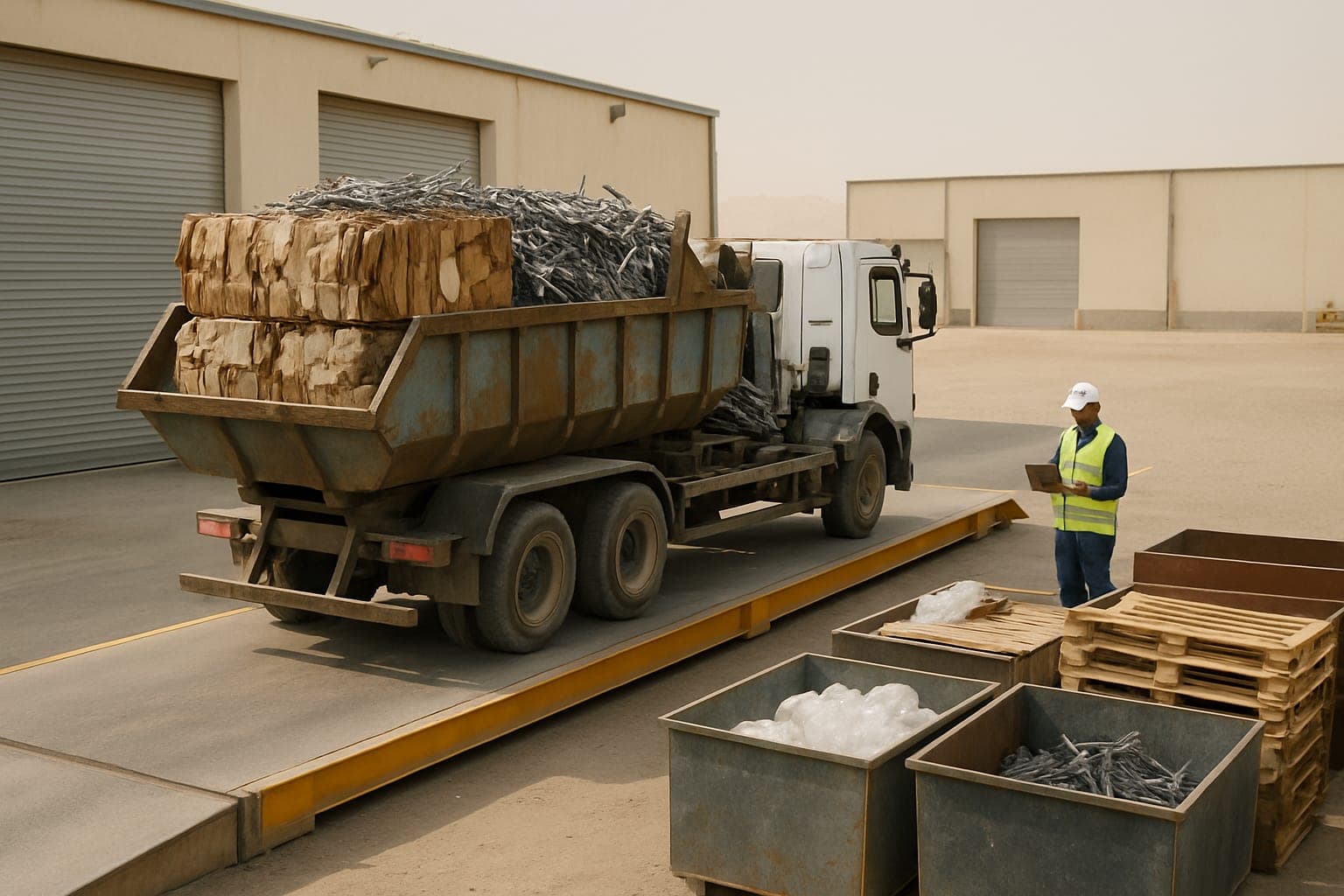
Most UAE sites buy disposal at a flat monthly fee that hides a published municipal rate. In Dubai that rate is law: AED 100 per tonne to landfill municipal waste, AED 30 per tonne for recyclable free of organics, set by Executive Council Resolution No. 58 of 2017. Unbundle it, retender per tonne, sell the commodity streams separately.
What does a tonne of waste actually cost in Dubai?
The gate fee is the one number in your waste cost that is published, fixed and checkable in ten minutes. Executive Council Resolution No. (58) of 2017, Approving the Fees and Fines for Waste Disposal in the Emirate of Dubai, was issued on 18 October 2017 and came into force roughly six months after gazetting. Its rates stepped up over three years and plateaued from 2020 onwards. Those 2020 rates are still the ones your contractor pays at the gate.
| Waste type | Treatment route | 2018 | 2019 | 2020 onwards |
|---|---|---|---|---|
| Municipal waste | Landfilling | AED 80/t | AED 90/t | AED 100/t |
| Organic waste | Waste treatment plants | AED 30/t | AED 40/t | AED 50/t |
| Recyclables mixed with organic waste | Waste sorting stations | AED 30/t | AED 40/t | AED 50/t |
| Recyclables free from organic waste | Waste sorting stations | AED 20/t | AED 25/t | AED 30/t |
| Agricultural waste | Treatment and composting | AED 10/t | AED 10/t | AED 10/t |
| Construction and demolition waste | Landfilling | AED 10/t | AED 15/t | AED 20/t |
Read line four against line three. Clean recyclable costs AED 30 per tonne at a sorting station. The same material with food waste in it costs AED 50 per tonne. That is a 67 per cent contamination premium written into legislation, not negotiated with a hauler, and it is the published anchor for every contamination clause you will write later in this process.
Two details get missed. Article (1)(b) of the same Resolution rounds any part of a tonne up to a full tonne for fee calculation, so a year of half empty skips is quietly billed as full ones. And inert construction and demolition material is the cheapest stream in the emirate at AED 20 per tonne to landfill, with the treatment plant route cheaper still, which means your C&D savings come from haulage and volume rather than from the gate. If your site is in demolition or fit out, the 50 per cent diversion requirement tied to building completion matters more to your programme than the tipping line ever will.
The fees people quote at you are often the wrong schedule
Resolution 58 of 2017 carries a second schedule for disposal of unwanted materials, which prices destruction of condemned goods: AED 200 per tonne for paper, tapes and CDs, for leather, rubber, sponge and fabric waste, for food unfit for consumption and for waste furniture and bulky items; AED 300 per tonne for electrical and electronic equipment, personal hygiene products and carcases. That is a destruction tariff for specific consignments, not your weekly commercial collection rate. Anyone quoting AED 300 per tonne as the standard e-waste disposal price has read the wrong table.
Hazardous waste is priced by treatment method, not by the word hazardous. Schedule (3) runs from AED 20 per tonne for disposal of difficult liquid and semi liquid waste, through AED 200 per tonne for solid difficult waste and evaporation of industrial liquid waste, AED 400 per tonne for contaminated empty drums, AED 500 per tonne for chemical treatment and closed incineration, up to AED 1,000 per tonne for physical stabilisation. A contractor who gives you one blended hazardous rate is averaging across a fiftyfold spread. Name the treatment route in the tender pack and the number stops being a guess.
Why does every contractor website quote a different number?
Because almost none of them are quoting the law. One UAE waste contractor site states Dubai Municipality 2026 gate fees start at AED 100 per tonne for general and organic waste and rise to AED 550 per tonne for hazardous. Another page on the same domain states AED 50 to 90 per tonne for general solid waste, AED 30 to 80 per tonne for construction debris and AED 200 to 600 plus per tonne for hazardous. Both cannot be right. Neither matches Resolution 58 of 2017.
The regulator said as much when the tariff was published. Abdul Majeed Abdul Aziz Al Saifaie, then director of Dubai Municipality's Waste Management Department, told the press around the 2017 and 2018 reform that some building managers were being charged AED 300 per tonne by disposal companies, and framed the published schedule as a transparency measure. Before the reform, Dubai charged a AED 10 gate fee per truck trip, so there was no per tonne reference at all. The gap between the published gate fee and your invoice is where the money leaks, and the department head said so on the record.
Dubai Municipality indicated in late 2022, via Khaleej Times, that it was reviewing all waste fees under a twenty year integrated master plan, with the possibility of separate rates for segregated and non segregated waste. Check the Dubai Legislation Portal for any resolution issued after 58 of 2017 before you build a model on these rates. If a newer schedule exists, it supersedes the table above.
How do Abu Dhabi and Sharjah price it differently?
Abu Dhabi has historically charged per tonne with an annual cap and enforced collection through trade licence renewal, a structurally different mechanism from Dubai's gate fee. The published figure, AED 225 per tonne capped at AED 50,000 a year on commercial, industrial and professional waste producers, dates from the Centre of Waste Management's Nadafa programme in 2011. That is fifteen years old and predates the 2022 transfer of Tadweer to ADQ and its rebrand to Tadweer Group. Do not plan a Mussafah, ICAD or KEZAD budget on it. Confirm the live tariff with Tadweer in writing before you issue a tender.
One current signal is worth reading. In the EWEC and Tadweer waste to energy tender for the plant planned at the Al Dhafra landfill, a Marubeni, Hitachi Zosen Inova and Japan Overseas Infrastructure Investment Corporation team bid a levelised waste treatment cost of AED 175 per tonne, while a Suez and Pal Cooling Holding team bid AED 391 per tonne, with the power tariff fixed at 11.215 fils per kWh (MEED, bids received 14 April, bidders revealed 4 May). The plant is sized at around 900,000 tonnes a year. That bracket, AED 175 to 391 per tonne for guaranteed thermal capacity over a twenty year horizon, tells you which direction residual disposal pricing is heading.
Sharjah's commercial tipping rate at the Al Saja'a landfill off the Sharjah to Dhaid road was reported at AED 50 per tonne by Gulf News around 2011, before Bee'ah introduced two stream collection and a revised tipping fee structure in 2012. Bee'ah was established by the emirate as a public private partnership in 2007, and Sharjah announced a full landfill diversion plan in October 2011. The Sajja waste to energy plant is rated at 400,000 tonnes a year for 80 MW. Treat the AED 50 figure as history and ask Bee'ah for the current schedule.
Does any of this apply inside a free zone?
Yes, and the statute says so by name. Law No. (18) of 2024 Regulating Waste Management in the Emirate of Dubai states in Article (3) that it applies to all areas within the emirate including Special Development Zones and Free Zones, naming the Dubai International Financial Centre. Article (9)(a) prohibits any person from conducting a waste management related activity without the relevant permit from Dubai Municipality. Penalties under the Law reach AED 500,000, with repetition of the same violation inside a year able to double the fine subject to the same ceiling.
Permit scope is where most tenders fail. Resolution 58 of 2017 prices a permit at AED 1,000 per activity, with separate lines for metal scrap trade, plastic scrap trade, paper scrap trade, glass scrap trade, textiles and fabrics scrap trade, used tyre waste trade, C&D collection and transportation, and general waste collection, removal and transportation. Administrative Resolution No. (34) of 2026, the implementing bylaw in force from around 10 March 2026, defines waste related activities to include trading in waste, and assigns permitting to Dubai Municipality's Waste and Sewerage Agency. A hauler permitted to collect and transport is not thereby permitted to trade your metal. Ask for the permit per activity line, and remember it costs the contractor AED 1,000 to hold each one, so there is no cost excuse. The same discipline applies to specialist streams, as the published list of approved waste oil collectors shows.
Who carries the record keeping liability, you or your hauler?
You do. Article (8) of Law 18 of 2024 requires the waste producer to maintain a register and keep it for at least two years for non hazardous waste and five years for hazardous waste, available to Dubai Municipality on request. Article (2) of Administrative Resolution 34 of 2026 specifies what goes in it: type of hazardous and non hazardous waste, daily quantity, a description of the production, segregation, sorting and recycling operations, carrier details, and the approved disposal sites used.
Read that as a dataset rather than a compliance chore and it is a diversion report, already mandated. A monthly hauler invoice does not discharge it, because an invoice does not tell you which approved site received which tonne. Requiring per movement digital transfer note evidence in the format Dubai Municipality currently mandates is therefore not a nice to have in your tender pack, it is how you meet a duty that already sits on your licence. That same record becomes the audit trail when Scope 3 waste emissions enter UAE climate law reporting.
How do you run the retender in eight steps?
- Weigh for four weeks, by stream. Not estimated volumes, not skip counts. Put a scale at the compactor and record every movement by material, weight, date and destination. Four weeks catches a monthly production cycle at most factories and a full weekend pattern at malls and hotels.
- Split the baseline into disposal and commodity. Old corrugated cardboard, ferrous and non ferrous metal, clean LDPE film and serviceable pallets are inventory. Everything else is disposal. Most sites find a third or more of their tonnage on the inventory side once they count it properly.
- Verify permits before shortlisting. Trade licence from DET or the free zone authority is one layer. The Dubai Municipality permit, per activity, is a second and separate layer. Reject any bidder who sends a trade licence when you asked for a permit.
- Price per tonne, never per skip. Require three separate lines: gate fee as an auditable pass through, haulage and labour, and margin. A per skip rate hides the part tonne round up in Article (1)(b) and makes benchmarking impossible across sites.
- Index rebate streams to a named published reference. State the index, the contract, the settlement date and the lag. Aluminium and copper price off LME cash settlement as a stated percentage of grade. UAE ferrous moves with the Turkish deep sea import scrap assessment, not with LME. Cardboard tracks regional delivered Asia OCC assessments or the local mill gate. A rebate quoted as a flat dirham figure for twelve months is a bet the contractor has already won.
- Keep weighbridge tickets and a re weigh right. Calibrated bridge, a ticket per movement copied to you, your right to witness weighing and to re weigh at a third party bridge with the cost falling on whoever is proved wrong.
- Cap contamination and moisture deductions. Set a maximum deduction percentage, a defined sampling method, mandatory photographic evidence at the point of rejection, and a right to dispute. The statutory AED 30 against AED 50 per tonne differential is your benchmark for what contamination is actually worth.
- Ban evergreen renewal. Fixed term, stated notice period, and no clause that transfers title in your material to the contractor on termination. This single paragraph is why most UAE waste contracts have never been tested in the market.
What should the scoring matrix weight?
| Criterion | Weight | Evidence required |
|---|---|---|
| Permit scope, per activity | 20% | DM permit line for every activity the contract touches, including each scrap trade stream |
| Per tonne price transparency | 20% | Gate fee, haulage and margin as three separate lines, no blended per skip rate |
| Weighbridge and re weigh rights | 15% | Calibration certificate, ticket per movement, witness and re weigh clause accepted |
| Named disposal sites per stream | 15% | DM approved facility named for each material, matching Admin Res. 34 of 2026 Article (2) |
| Contamination and moisture cap | 10% | Stated maximum percentage, sampling method, photographic evidence protocol |
| Digital transfer note evidence | 10% | Per movement record copied to you with type, quantity, generator, carrier and destination |
| Hazardous treatment route specificity | 5% | Treatment method named per stream, priced against Schedule (3) rather than blended |
| Exit and renewal terms | 5% | No auto renewal, stated notice, no transfer of material title on termination |
What does a 150 tonne per month site actually save?
Here is the arithmetic for a site presenting 150 tonnes a month as undifferentiated municipal waste, using Resolution 58 of 2017 rates only. These are gate fees. Haulage, skip rental, container hire and contractor margin sit on top and are the part you tender.
Unsegregated: 150 tonnes at AED 100 per tonne is AED 15,000 a month, AED 180,000 a year in gate fees alone.
| Stream after segregation | Tonnes/month | Route | Rate | Gate cost/month |
|---|---|---|---|---|
| Residual municipal | 90 | Landfill | AED 100/t | AED 9,000 |
| Recyclable, free of organics | 40 | Sorting station | AED 30/t | AED 1,200 |
| Organic | 15 | Treatment plant | AED 50/t | AED 750 |
| Inert C&D | 5 | Landfill | AED 20/t | AED 100 |
| Total | 150 | AED 11,050 |
That is AED 3,950 a month, AED 47,400 a year, a 26 per cent cut in gate fee spend before a single kilogram of material is sold. Now price the failure mode. If those same 40 tonnes of recyclable arrive with food waste in them they are charged at AED 50 per tonne rather than AED 30, which is AED 800 a month and AED 9,600 a year lost to a lid left open in a Al Quoz loading bay. Substitute your own four week baseline into the table and the model is yours.
The revenue line we will not invent for you
Material revenue sits entirely on top of that AED 47,400 and it is the larger half on most industrial sites. We are not printing a dirham per kilogram figure here, because any number we publish today is wrong by the time you tender, and because grade, moisture, bale density, load size and collection point move the price more than the headline commodity does. Put the formula in your model, not a constant: tonnes per stream, multiplied by a percentage of a named index on a named settlement date. Then go and get live bids for the actual material.
When should material sales leave your hauler?
At the moment you can prove the stream is clean, consistent and weighable. Surrendering clean recyclable to a sorting station still costs AED 30 per tonne under Dubai's schedule, so recycling is not free, it is simply cheaper disposal. Material only turns revenue positive when it is sold as a commodity to a buyer who needs that grade. One incumbent hauler sets one rebate, reviewed when it suits them. A competitive field of buyers prices moisture, grade and load size far more finely, which is exactly what the statutory AED 30 against AED 50 differential already proves the system does.
That is the handover point. Disposal stays with the winning contractor on a per tonne, permit verified, weighbridge backed contract. Commodity streams move to a multi buyer channel where counterparties are KYC verified through UAE PASS, payment is held in escrow through MyFatoorah until release, and the buyer has a 48 hour inspection window that turns a post hoc deduction into a defined, evidenced, time boxed event. For factories and logistics sites in Al Quoz, Ras Al Khor, Dubai Industrial City, JAFZA, Mussafah or KEZAD, that is usually where the second half of the saving lives. Start by listing what your baseline told you is inventory on the industrial materials marketplace and see what the bids say.
Frequently asked questions
Is the Dubai Municipality gate fee negotiable?
No. The rates in Executive Council Resolution No. (58) of 2017 are set by legislation, with municipal waste to landfill at AED 100 per tonne from 2020 onwards. What is negotiable is everything above the gate: collection frequency, haulage, container rental, administration and margin. Require your bidders to show the gate fee as an auditable pass through line so you can see the rest.
Do I need a permit to sell my own scrap in Dubai?
Article (9)(a) of Law No. 18 of 2024 prohibits conducting any waste management related activity without a Dubai Municipality permit, and Administrative Resolution No. 34 of 2026 defines those activities to include trading in waste. In practice the permit burden falls on the party trading and transporting, which is why you should verify your buyer holds the specific scrap trade line for your material. Each activity line costs AED 1,000 under Resolution 58 of 2017, so there is no reason for a serious counterparty not to hold it.
My waste contract auto renews next month. Can I still retender?
Check the notice period rather than the renewal date, because most evergreen clauses require written notice 60 or 90 days ahead. If you have missed it, serve notice for the following cycle and run the four week weighed baseline now so the tender pack is ready. You can also move commodity streams out immediately if the contract does not transfer title in your material to the hauler, which many do not.
How long should the weighed baseline run?
Four weeks is the minimum that captures a full production or occupancy cycle, including weekends and a month end. Weigh by stream and by movement, not by skip count, and record the destination for each load. Shorter samples systematically understate the recyclable fraction because the biggest cardboard and metal movements are irregular.
Do Dubai waste rules apply inside free zones?
Yes. Article (3) of Law No. (18) of 2024 states the law applies to all areas within the emirate including Special Development Zones and Free Zones, and names the Dubai International Financial Centre specifically. Your free zone authority may add its own approved contractor list and facilities management rules on top, so request that list as well, but it does not displace the emirate regime.
What price should I index a metals rebate to?
Aluminium and copper rebates should reference LME cash settlement for the stated contract, quoted as a percentage of settlement for the specific grade, with the settlement date and lag written into the clause. UAE ferrous scrap tracks the Turkish deep sea import assessment rather than LME, because Gulf material flows to Turkish and Asian mills. Never accept a flat dirham rebate fixed for twelve months.

Comments(0)
Sign in to join the conversation.