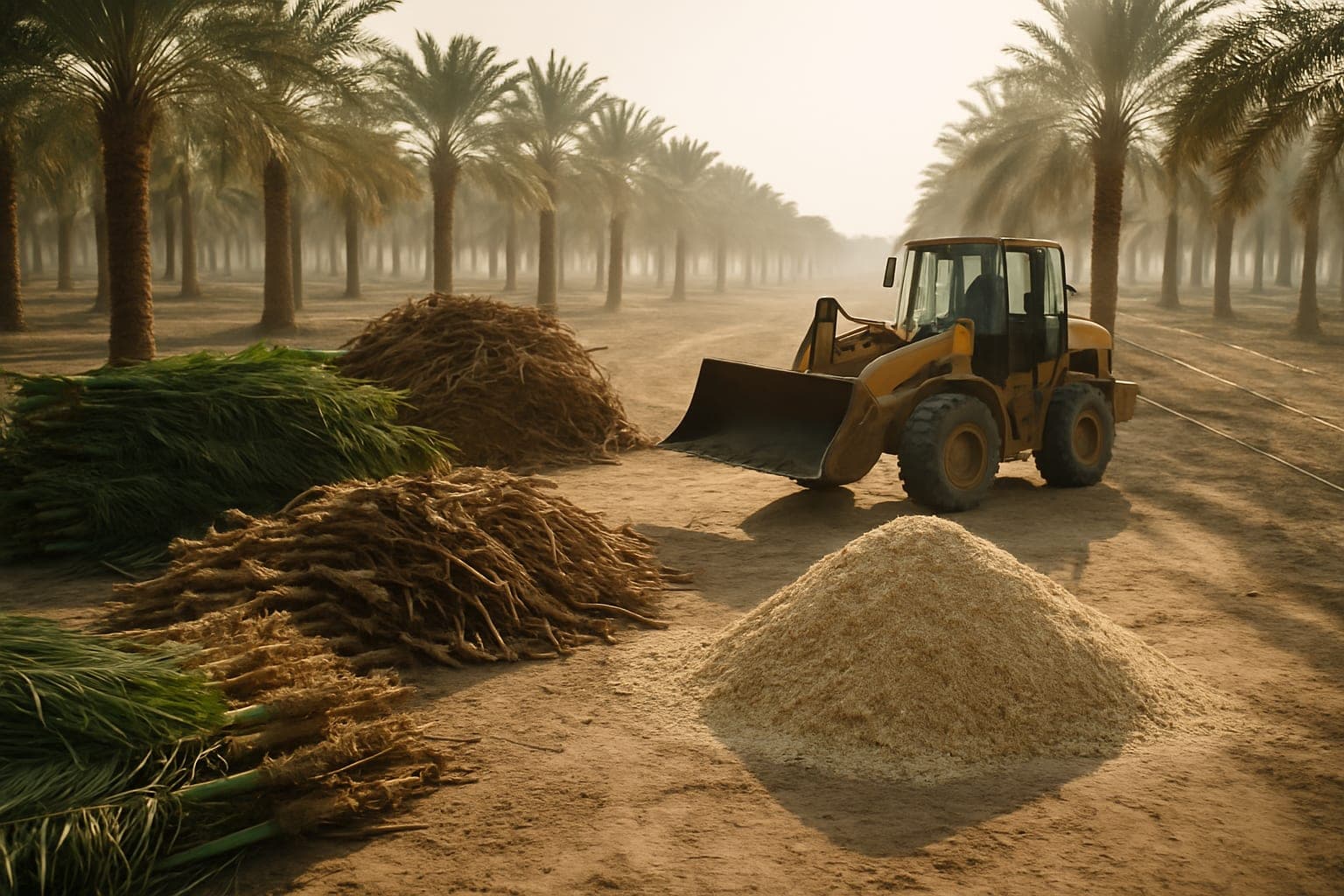
Date palm waste buyers in the UAE now include DesertBoard's engineered panel plant at KEZAD, which has been pressing Palm Strand Board since December 2021, and Tadweer's Liwa Compost Plant in Al Dhafra, which takes agricultural waste from farms across the region. Offtake exists. The bottleneck is aggregating enough dry, graded frond in one place to justify a truck.
Who actually buys pruned frond, trunk and pressings today?
Four outlets are real, and they are not equally mature. The panel route is the most industrial: DesertBoard operates at Khalifa Economic Zones Abu Dhabi and was described by Khaleej Times in May 2025 as the world's first industrial-scale facility making engineered wood boards from pruned palm fronds. If you are reading older coverage, note two traps. The zone appears as KIZAD in 2021 reporting and is now KEZAD, and the company appears in pre-2022 articles as Talah Board or Al Talah Board.
The composting route is government-run and regionally anchored. Tadweer's Liwa Compost Plant recycles agricultural and animal waste from farms and ranches in Al Dhafra into organic fertiliser that goes back to municipal projects, farms and palm oases in the same region. It first opened in 1998 and reopened in 2021 after roughly a year of refurbishment, with a stated capacity of 20,000 tonnes of compost annually. That capacity figure is from 2021 and should be checked before you build a plan around it.
The biomass fuel and animal bedding routes are the least documented. Shredded frond is a plausible bedding and fuel material, and Dubai's Warsan compost operation has produced refuse-derived fuel alongside compost. We found no published UAE demand data for palm-based bedding at all. If someone quotes you a bedding tonnage market, ask where the number came from.
How much frond is actually generated, and is the 500,000 tonne figure real?
You will see "the UAE generates more than 500,000 tonnes of palm waste annually" in Gulf News in 2018, Construction Week in July 2021 and Woodworking Network in December 2021. In every case it traces back to statements by Talah Board, later DesertBoard. It is an industry estimate, not a government census.
A CGIAR and ICARDA feasibility study on recycling date palm waste as organic fertiliser, drawing on FAOSTAT, puts UAE palm-grove waste at 121,974 tonnes per year. That is a fourfold gap against the industry number, most likely a scope difference: frond only versus all palm biomass, or dry weight versus fresh. Both figures are in circulation. Neither is settled.
The tree count is more current. Research reporting in April 2026 put the UAE at 45 million date palms, ahead of Saudi Arabia at 32 million, Iraq at 22 million and Egypt at 15 million, with roughly 20 kg of lignocellulose biomass waste per tree per year across seeds, leaves, fronds and surface fibres. That supersedes the widely repeated 2021 pairing of 40 million trees at 15 kg each, which understates the resource by about half.
For scale at estate level, the ICARDA work at Al Kuwaitet research station in Al Ain recorded roughly 127 tonnes of total by-products, of which about 59 tonnes were date palm and 17 tonnes citrus. Abu Dhabi has 25,563 farms according to ADAFSA figures published in October 2024, spread across the Al Ain, Al Dhafra and Abu Dhabi regions. One farm rarely fills a contract. Fifteen farms in one district might.
What moisture and chip specification will a buyer demand?
Here is the honest position: we could not find a single published UAE buyer specification for palm frond, covering moisture percentage, chip or strand dimension, ash content, silica limits or contamination tolerance. Anyone publishing a confident spec table for this material is guessing. So treat the spec as a conversation you open, not a standard you meet in advance.
Ask the receiving plant these questions in writing before you cut anything:
- What maximum moisture content do you accept at the weighbridge, and do you test on arrival or on a composite sample?
- Do you want whole frond, chipped material or strands, and at what nominal length and thickness?
- Is leaf base, midrib, leaflet and trunk material accepted in the same load, or must they be separated?
- What is your tolerance for sand, soil, wire, plastic twine and irrigation drip line in the load?
- Do you accept material from farms treated recently with pesticides, and do you require a declaration?
- Who owns the shredding cost, and does chipping on farm raise or lower your gate price?
The last question matters more than it looks. Chipping on farm cuts transport cost because you move density instead of air, but chipped material dries and degrades differently to whole frond, and a composting buyer and a panel buyer will not want the same particle. Peer-reviewed work is a warning here. A 2015 BioResources study on OSB from date palm fronds found most samples had relatively lower bending properties, and that water-washing the raw strands actually reduced panel values further. A 2023 Saudi study presented at ByPalma in Riyadh reported particleboard from palm frond waste that outperformed commercial samples and showed low thermal conductivity. Both can be true. Date palm fibre is a natural fibre whose properties vary with soil, tree condition, climate, disease and extraction method, so performance is process and cultivar dependent.
What is a tonne of palm frond worth delivered?
No verifiable AED per tonne price for delivered palm frond biomass, compost feedstock or bedding exists in UAE public sources. There is no exchange benchmark either. Wood pellet indices such as ENplus track temperate softwood with different calorific value, ash and silica behaviour, and reading them across to palm frond is not valid.
So price the avoided cost instead. For most agricultural estates the first money is not the sale, it is what you stop paying to dispose. Published fee data is old and inconsistent, which is itself useful to know before you sign anything.
| Figure | Source and vintage | How to treat it |
|---|---|---|
| Agricultural waste disposal fee held at AED 10 per tonne, Dubai | Trade press, undated page describing a fee introduced around 2017 to 2018 | Directional only. Verify against the current Dubai Municipality schedule |
| Recyclables to Dubai sorting stations: AED 30 to 50 per tonne if mixed with organic waste, AED 20 to 30 per tonne if free of organic | Same source, same vintage | The principle still holds: organic contamination roughly doubles the gate fee |
| Abu Dhabi commercial waste fee AED 225 per tonne in year one, doubling in year two without a 20 per cent volume cut | MEED, circa 2010 | Historic. Do not budget from it |
| Dubai general waste AED 80 per tonne rising to AED 100 by 2020 | Reported January 2021 | Superseded |
| UAE imported about 1.25 million cubic metres of wooden board in 2015 at AED 1.6 billion | Talah Board CEO quoted in Gulf News, September 2018 | The import substitution case, but the underlying data is a decade old |
The practical move is to get the current tariff table from the Tadweer Group Services Guide published in July 2025, and the current Dubai Municipality schedule, then calculate your existing disposal spend per hectare. That number is your floor. Anything a processor pays above zero is upside, and in early-stage markets a free collection with guaranteed uplift is often the best available deal. You can see what organic material is currently trading on our organic listings before you set an asking price.
When does supply peak, and can you plan around it?
Every tree is pruned annually, so the resource is genuinely recurring rather than one-off. We could not source the timing of UAE pruning and harvest peaks from any published record, and we are not going to name months we cannot support. What you can do is instrument your own yard for one full cycle: weigh every load out, log the date, and record moisture at the point of collection. After twelve months you have a supply curve no processor can argue with, and that curve is what turns a spot sale into an offtake conversation.
Seasonality cuts both ways. A processor sized for continuous feed cannot absorb your entire annual arisings in six weeks, which means either you store, they store, or the district staggers pruning. Storage is not free and wet stacked frond composts itself. That is a design problem worth solving before harvest, not during it.
How do estates aggregate enough volume to attract industrial offtake?
Single-farm tonnage almost never clears the threshold. Aggregation does. The sequence that works:
- Measure one full year of arisings by weight, not by trailer loads or guesswork.
- Agree a common grade with neighbouring estates in the same district, ideally with one chipping contractor serving all of them.
- Nominate one weighbridge and one loading yard so buyers deal with one address.
- Put the combined annual tonnage, moisture range and seasonal profile in front of a processor as a single document.
- Sell the first loads on spot terms and use the receiving facility's weight records to build a documented delivery history.
- Convert that history into a term arrangement with agreed rejection criteria and a stated inspection right.
This is the same aggregation logic that turned manufacturing residues into contracted supply under industrial programmes, a pattern we covered in our piece on factory offcuts becoming contracted feedstock. Agricultural material is harder because the sellers are more numerous and smaller, which is precisely why a shared listing and a KYC-verified counterparty on the other side reduce the friction.
What compliance applies before the first truck moves?
Federal Law No. 12 of 2018 on Integrated Waste Management governs, and Cabinet Resolution No. 39 of 2021 provides the executive regulations. Two articles matter directly. Article 6 sets rules and conditions for transporting waste between the emirates, which is exactly what you are doing when frond leaves an Al Ain farm for a processor in another emirate. Article 7 covers reuse of by-products, and it is the enabling provision for frond valorisation.
In Abu Dhabi, movement runs through Tadweer's system. The Tadweer Group Services Guide of July 2025 sets out that waste producers must hold a valid commercial licence and the relevant authority approvals, register waste type, quantity and disposal method, select a receiving facility and pay fees, while service providers assign manifests to vehicles on the Bolisaty platform, update them to collected, and deliver to the facility, which records the received weight and retains an explicit right to reject the load. Tadweer also publishes a standard operating procedure for transporting waste outside the Emirate of Abu Dhabi. Read it before you promise a delivery date.
That reject right is worth pausing on. It is the Abu Dhabi analogue of the 48-hour inspection window we apply on our marketplace, and it means the load you thought you sold can come back to you at the gate. Grade honestly at origin.
Two open compliance questions
First, phytosanitary controls. We could not confirm whether ADAFSA or MOCCAE restrict movement of pruned frond and trunk material from red palm weevil infested or quarantined areas. Given ADAFSA runs an Integrated Date Palm Management Programme with engineers visiting farms directly, this is the first call to make and the highest compliance risk in the whole chain. Do not assume either way.
Second, compost standards. Tadweer's Liwa output is described as meeting MOCCAE requirements, but we could not retrieve the standard number or its limits. If you intend to sell a frond-derived soil conditioner rather than raw feedstock, you need to know which standard you are certifying against. Buyers of finished organic product will ask, in the same way new organic offtakers in Abu Dhabi ask for consistent feedstock characterisation before contracting.
One last framing correction. Coverage as recent as April 2026 still claims farmers have no option but to burn or landfill palm waste. That has not been accurate since December 2021, when the first board came off the line at KEZAD, and a full-scale residential mock-up built entirely from Palm Strand Board was completed at Dubai Creek Harbour by mid-2025. DesertBoard states its process sequesters roughly 401 kg of CO2e per cubic metre of board and that the product is zero-formaldehyde. That is a company claim and we found no third-party lifecycle verification of it. The offtake is real. The missing piece is you, organised.
Frequently asked questions
Who buys date palm frond waste in the UAE?
The clearest industrial buyer is DesertBoard at KEZAD in Abu Dhabi, which has been manufacturing Palm Strand Board from pruned fronds since December 2021. Tadweer's Liwa Compost Plant in Al Dhafra takes agricultural waste from farms and ranches in the region and converts it into organic fertiliser. Biomass fuel and animal bedding buyers exist but are far less documented in public sources.
How much does date palm waste sell for per tonne in the UAE?
No verifiable AED per tonne price for delivered palm frond exists in UAE public sources, and there is no exchange benchmark for this material. Wood pellet indices track temperate softwood and do not read across. Price your position from avoided disposal cost first, then negotiate any uplift on top of that floor.
Does the UAE really produce 500,000 tonnes of palm waste a year?
That figure has been repeated since 2018 but traces back to company statements from Talah Board, later DesertBoard, rather than a government census. A CGIAR and ICARDA study using FAOSTAT data gives 121,974 tonnes for the UAE, a fourfold difference that probably reflects a scope or moisture basis difference. Treat 500,000 tonnes as an industry estimate.
What moisture content do palm frond buyers require?
We could not find a published UAE buyer specification for moisture, chip size, ash or contamination limits for palm frond. Ask the receiving plant in writing what it tests at the weighbridge, what particle geometry it wants, and how it treats sand, twine and drip line in the load. Get the answer before you invest in a shredder.
Do I need a permit to move palm waste between emirates?
Cabinet Resolution No. 39 of 2021, the executive regulations to Federal Law No. 12 of 2018, sets rules and conditions for transporting waste between the emirates, and Tadweer publishes a standard operating procedure for moving waste outside Abu Dhabi. In Abu Dhabi the load also needs a manifest on the Bolisaty platform. Separately, confirm with ADAFSA whether red palm weevil controls restrict movement from your area, because we could not verify that point.

Comments(0)
Sign in to join the conversation.