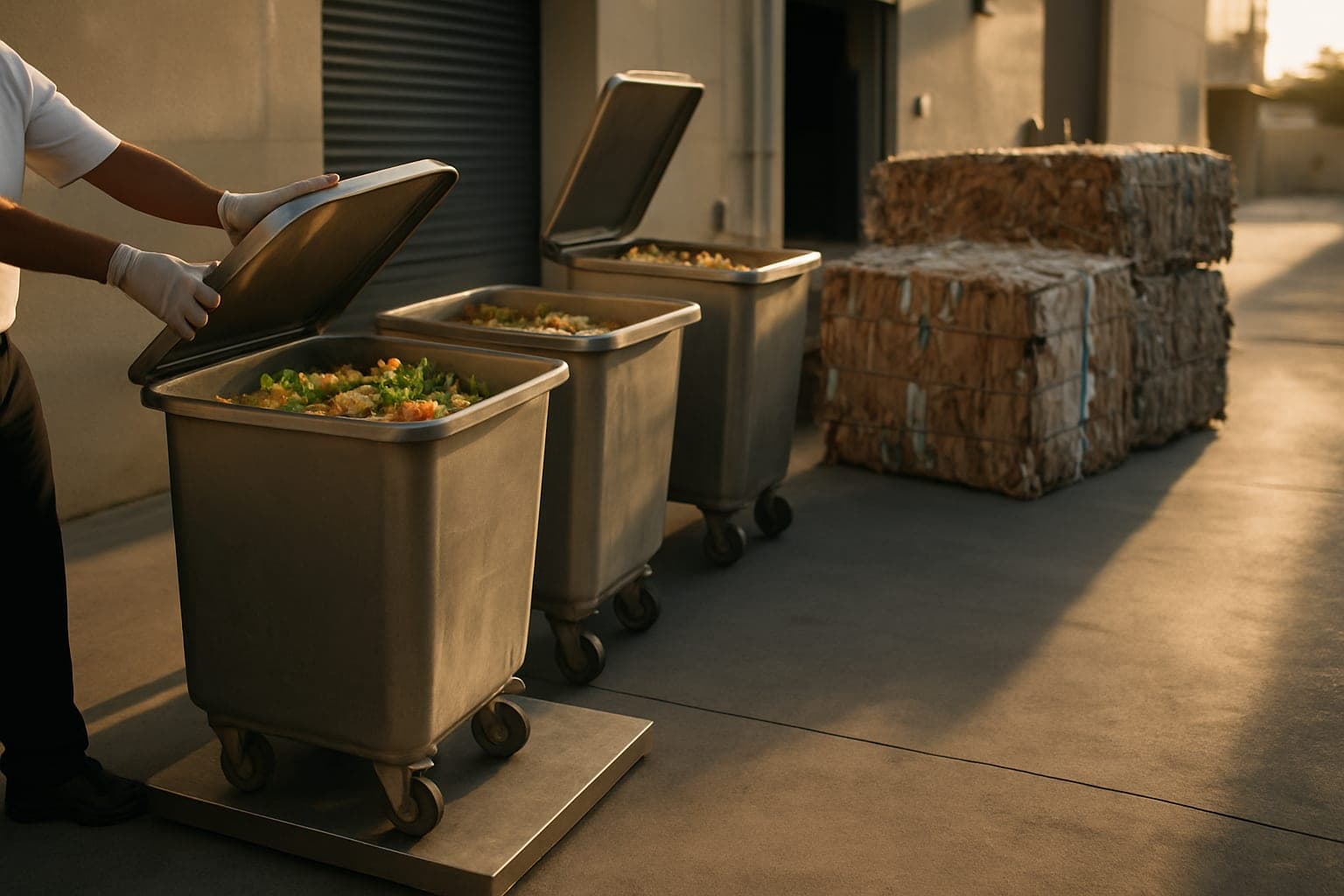
Masdar and Tadweer Group signed a joint development agreement on 20 November 2025 for Abu Dhabi's first commercial-scale waste-to-sustainable-aviation-fuel plant, sized at roughly 500,000 tonnes a year of biomass and urban solid waste. There is no site, no final investment decision and no published feedstock price. The practical move for generators now is a weighed, permit-traceable segregation record.
What did Masdar and Tadweer actually sign, and what is still missing?
The agreement is a joint development agreement, signed after the two parties completed a feasibility study that they said demonstrated viability. Masdar's newsroom put the design intake at approximately 500,000 tonnes per year of biomass and urban solid waste, converted through a hybrid route. Mohamed Jameel Al Ramahi signed for Masdar, Ali Al Dhaheri for Tadweer Group. Tadweer frames the project as support for its target of diverting 80% of waste from landfill by 2030.
What was not disclosed matters just as much if you are planning supply. No location inside the emirate. No final investment decision, no capex, no SAF output in litres, no commercial operation date and, critically, no feedstock offtake terms of any kind. A JDA is a commitment to develop together. It is not a contract to buy your waste.
One point of confusion is worth clearing early. In January 2023, Masdar, ADNOC, bp, Tadweer and Etihad Airways announced a joint feasibility study on producing SAF, renewable diesel and naphtha in the UAE from municipal solid waste and renewable hydrogen. Five parties, a study, nearly three years earlier. The November 2025 JDA names Masdar and Tadweer only. Treat them as two separate things, because the scope and the signatories differ.
Why does the technology choice decide which waste the plant wants?
The disclosed pathway is hybrid: gasification of waste into syngas, plus renewable-powered electrolysis producing green hydrogen, then chemical conversion into jet fuel. That is not HEFA. HEFA plants run on used cooking oil, tallow and similar lipids, and they sit in a separate supply market with separate collectors, separate quality tests and separate pricing, as anyone already selling fryer oil in the UAE will recognise from the free fatty acid grading used by UCO buyers.
Gasifiers are fussy in a specific direction. They want feed that is dry, high in calorific value, low in chlorine, low in ash and consistent in particle size. Raw wet food waste, generally in the 70 to 80 percent moisture range as an industry rule of thumb rather than a measured figure for this project, is a poor direct gasifier feed. The realistic feed for a plant of this design is refuse derived fuel and dry biomass, produced through mechanical sorting and a drying step, not kitchen waste delivered in a wheelie bin.
The counter-intuitive part for hotels and food factories
Here is the implication most coverage skipped. If the plant buys the dry residual fraction, then the most valuable thing a hotel, caterer or food factory can do for it is take the wet organics out of the residual stream. Removing food waste raises the calorific value of what remains and cuts moisture, chlorine and ash load. You matter to this project twice: once as a supplier of clean organics to composters and digesters, and once as the reason the residual fraction can meet a gasifier specification at all.
What feedstock specification should you expect to be asked for?
Nothing has been published. What follows is our reading of what a gasification offtaker at 500,000 tonnes a year would plausibly write into a supply contract, based on how thermal conversion contracts work elsewhere. Every parameter here is measurable at a weighbridge or in a lab, which is exactly why it ends up in a contract.
- Moisture ceiling, expressed as a percentage on delivery, with deductions above it.
- Net calorific value floor, the number that decides whether a load is fuel or a disposal problem.
- Chlorine and sulphur limits, which is where PVC, salted food residues and certain packaging films cause rejections.
- Ash and inerts limit, meaning glass, grit, sand and stones.
- Particle size after shredding, usually a maximum with a tolerance band.
- Rejection and deduction clauses for contamination, load by load.
- Consignment-level traceability for lifecycle carbon accounting. SAF sold into international aviation is accounted under CORSIA, which the UAE participates in, and that pushes documentation obligations back down the chain to the generator.
Who competes for your organics, and will that firm up gate terms?
Split the stream in your head before you split it in the loading bay. Composters and anaerobic digesters want the wet fraction. Thermal routes, meaning any waste to energy facility and potentially this SAF plant, want the dry residual. Two buyer sets, two products, one back of house.
Whether a second large thermal offtaker firms up gate terms for generators is a hypothesis to test with your contractor, not an established fact. The best available evidence on thermal pricing in the emirate is the bid spread on Abu Dhabi's first waste to energy project, where MEED reported a levelised waste treatment cost of AED 175 per tonne from the Marubeni, Hitachi Zosen Inova and JOIN consortium against AED 391 per tonne from Suez and Pal Cooling, with the power tariff fixed at 11.215 fils per kWh and bids received on 14 April. We could not confirm the publication date of that report, so read it as a directional signal rather than a current quote. The signal is that thermal treatment pricing here is wide and contested.
| Route | Fraction it wants | What decides the price | Published Abu Dhabi rate |
|---|---|---|---|
| Composting | Wet organics, low plastic | Plastic and glass contamination, carbon to nitrogen balance | None found |
| Anaerobic digestion | Wet organics with high biogas yield | Packaging, grit, cleaning chemical inhibitors | None found |
| Waste to energy | Dry residual and RDF | Calorific value, moisture, chlorine, ash | AED 175 to AED 391 per tonne levelised treatment cost across two bids (MEED, date unconfirmed) |
| Waste to SAF (Masdar and Tadweer) | Biomass and urban solid waste, realistically RDF and dry biomass | Inferred: moisture, NCV, chlorine, ash, traceability | None. JDA only, 20 November 2025 |
| Landfill | Anything permitted | Nothing | No current published rate. The AED 225 per tonne figure in circulation comes from 2011 and 2013 tariff phases and a 2017 FAQ page |
For a cross-emirate reference point, Dubai's tipping economics are more transparent than Abu Dhabi's, and we have worked through how a per tonne landfill charge changes the arithmetic on food waste diversion in our note on Dubai's AED 100 tipping fee. Apply it as direction, not as an Abu Dhabi rate.
What do Abu Dhabi rules already require from you?
Start with the correction that trips up half the vendor pitches in the market. Tadweer Group is no longer the regulator. On 29 May 2024, waste licensing and permitting, waste vehicle tracking, the tariff system, the Sector Regulatory Authority function and inspection of waste traders, transporters and collectors transferred to the Environment Agency Abu Dhabi. Tadweer Group retains the operational and commercial side. If a proposal quotes Tadweer as the licensing authority, it is working from an old page.
Operationally, you work through Bolisaty. Waste types are classified in the system and mapped to a Waste Disposal Permit or a Movement and Disposal Permit. Generators contract authorised Waste Providers through Bolisaty, follow Tadweer EHS standards, and top up a Tadweer Group Wallet to obtain gate access at Tadweer facilities, per the Tadweer Group Services Guide dated July 2025. Those permit records and wallet transactions are third-party evidence of what you produced and where it went, which is precisely the kind of record an offtaker's technical adviser asks for.
Federally, Federal Law No. 12 of 2018 on integrated waste management sets the frame, and Cabinet Resolution No. 39 of 2021 carries the executive regulations. Two articles matter here. Article 3 covers containers for separating municipal solid waste. Article 6 sets the rules and conditions for transporting waste between emirates, which becomes live the moment anyone tries to aggregate feedstock from Dubai or Sharjah into an Abu Dhabi plant.
One older requirement is worth verifying before you budget against it. Abu Dhabi has required four and five star hotels, malls with food courts and food-serving healthcare facilities to submit a technical and economic evaluation for on-site organic waste equipment such as a composter, digester or macerator. That was reported through Tadweer some years ago and we could not confirm its current legal basis, so check the status with EAD before you buy a machine.
What should you do in the next twelve months?
Nobody underwrites a 500,000 tonne a year intake on optimism. They underwrite it on audited tonnage histories from named generators. Here is the sequence that puts you in that group.
- Weigh three streams separately. Wet organics, dry recyclables, residual. Daily, per site, with the scale ticket retained.
- Clean the permit trail in Bolisaty. Make sure your WDP or MDP classifications match what is physically in the bin, because mismatches are what break an audit.
- Fix contamination at the source. Back of house segregation beats any downstream sorting line, and it is the cheapest quality control you will ever buy.
- Test the residual once a quarter. Moisture, net calorific value, chlorine and ash on a representative sample. If a thermal offtake conversation starts, you already have the numbers.
- Re-tender wet and residual separately. A single blended per tonne charge hides which fraction is costing you money.
- Keep 12 to 24 months of history. Contracts for a project of this size get locked well before commissioning, and the supply record you cannot produce is the one that disqualifies you.
- List surplus organic streams where buyers can see them. Composters, digesters and animal feed processors are active now, and you can post volumes on our organic materials marketplace while the SAF offtake is still years out.
The honest summary of the pricing question is that Abu Dhabi has not published a gate fee for source-segregated organics, and the AED 225 per tonne number still repeated in the market is more than eight years old and predates the EAD transfer. We keep tracking published rates and tender outcomes across the seven emirates in market insights.
Frequently asked questions
Will the Masdar and Tadweer SAF plant buy food waste from Abu Dhabi hotels?
Nothing published says so. The stated feed is biomass and urban solid waste, and the disclosed gasification route favours dry refuse derived fuel over wet kitchen waste. The likelier role for hotels is indirect, by removing wet organics so the residual fraction meets a gasifier specification.
What is the gate fee for organic waste in Abu Dhabi?
No current organics-specific rate is published. The AED 225 per tonne figure still circulating comes from tariff phases in 2011 and 2013 and a Tadweer FAQ page dated 2017, and tariff setting moved to the Environment Agency Abu Dhabi on 29 May 2024. Ask EAD or your permitted waste provider for the rate that applies to your permit class.
Is food waste segregation mandatory for Abu Dhabi restaurants and hotels?
Cabinet Resolution No. 39 of 2021, the executive regulations of Federal Law No. 12 of 2018, addresses containers for separating municipal solid waste under Article 3. Abu Dhabi has also required certain four and five star hotels, malls with food courts and food-serving healthcare facilities to evaluate on-site organics equipment. That last requirement was reported some years ago, so confirm its current status with EAD.
How big is the plant and when will it start?
Around 500,000 tonnes a year of biomass and urban solid waste, per Masdar's announcement of 20 November 2025. No commercial operation date, site, capex or final investment decision has been published. Any start date you see quoted elsewhere did not come from the two parties.
Does the UAE have a 1% SAF mandate from 2031?
No. The General Policy for Sustainable Aviation Fuel, developed by the Ministry of Energy and Infrastructure with the General Civil Aviation Authority and detailed on 13 December 2023, sets a voluntary target of 1% locally produced SAF in fuel supplied to national airlines at UAE airports by 2031. Officials have separately cited an ambition of 700 million litres a year of local capacity by 2030.
Does this project create new demand for used cooking oil?
Not directly. UCO feeds HEFA plants, while the Masdar and Tadweer project uses gasification plus green hydrogen from electrolysis. UCO collection and pricing in the UAE remain a separate market with their own buyers and their own free fatty acid tests.

Comments(0)
Sign in to join the conversation.