Naseej is the UAE's national textile circularity initiative, launched in June 2026 under Presidential directive and run by the National Projects Office, the Ministry of Economy and Tourism, Emirates Foundation and Tadweer Group. The 220,000 tonnes is the estimated volume the country discards each year, not a recycling target. Pilots cover retail take-back, residential collection and circular uniforms.
What exactly is Naseej, and who is behind it?
Naseej, the National Initiative for Textile Circularity, was launched on the directives of President Sheikh Mohamed bin Zayed Al Nahyan in the first week of June 2026. It was formed through a partnership between the National Projects Office, the Ministry of Economy and Tourism, Emirates Foundation and Tadweer Group, and it describes itself as a unified national platform coordinating policy, industry action, research and public engagement across the textile value chain.
Read the sponsor list carefully, because it tells you what kind of programme this is. The lead ministry is Economy and Tourism, not the environment ministry. MOCCAE was present at the COP28 textile circularity panel in Dubai in 2023, which Naseej traces its origins to, but it does not appear among the founding partners announced in 2026. That means the near-term pressure on your business is commercial and reputational rather than a penalty regime. Minister of Economy and Tourism Abdulla bin Touq has framed the campaign as an opportunity to give the UAE a significant financial boost, and Sheikha Mariam bint Mohamed, Deputy Chairwoman of the Presidential Court for National Projects, said Naseej reaffirms the country's commitment to sustainability as a shared national responsibility.
The public face came first. "The Fabric of Possibility" ran from 5 to 7 June 2026 at Yas Mall in Abu Dhabi, handing out reusable bags made from upcycled kandura fabric so residents could return unwanted clothing. The business face arrived a month later, on 8 July 2026, when 14 memoranda of understanding were signed at Emirates Foundation headquarters in Abu Dhabi in the presence of the minister, taking the ecosystem past 35 partner organisations.
Is the 220,000 tonnes a target or the size of the problem?
It is the size of the problem, and it is an estimate. State news agency WAM and every major UAE outlet that covered the launch describe roughly 220,000 tonnes of textile waste as generated in the country each year, against consumption of around 500 million textile items annually. Naseej puts about 88 per cent of discarded textiles in landfill. No source we have seen publishes the methodology behind the 220,000 tonne figure, and no source states a tonnage that Naseej has committed to recycling. Treat it as the addressable pool, not a quota.
The number that does behave like a target sits with Tadweer. Its chief executive, Etienne Petit, has said the group works to "a simple criterion: 80 per cent diversion from landfill by 2031", stated in the context of Abu Dhabi's waste strategy, alongside reported plans to close 11 landfill sites within three years. Whether those closures are Abu Dhabi-only or national was not resolved in the launch coverage, so do not build a disposal plan on the assumption that your current tipping site will still be open in 2029. Ask your waste contractor which site your skips actually go to, and what the replacement is.
What counts as sortable feedstock, and what kills the value?
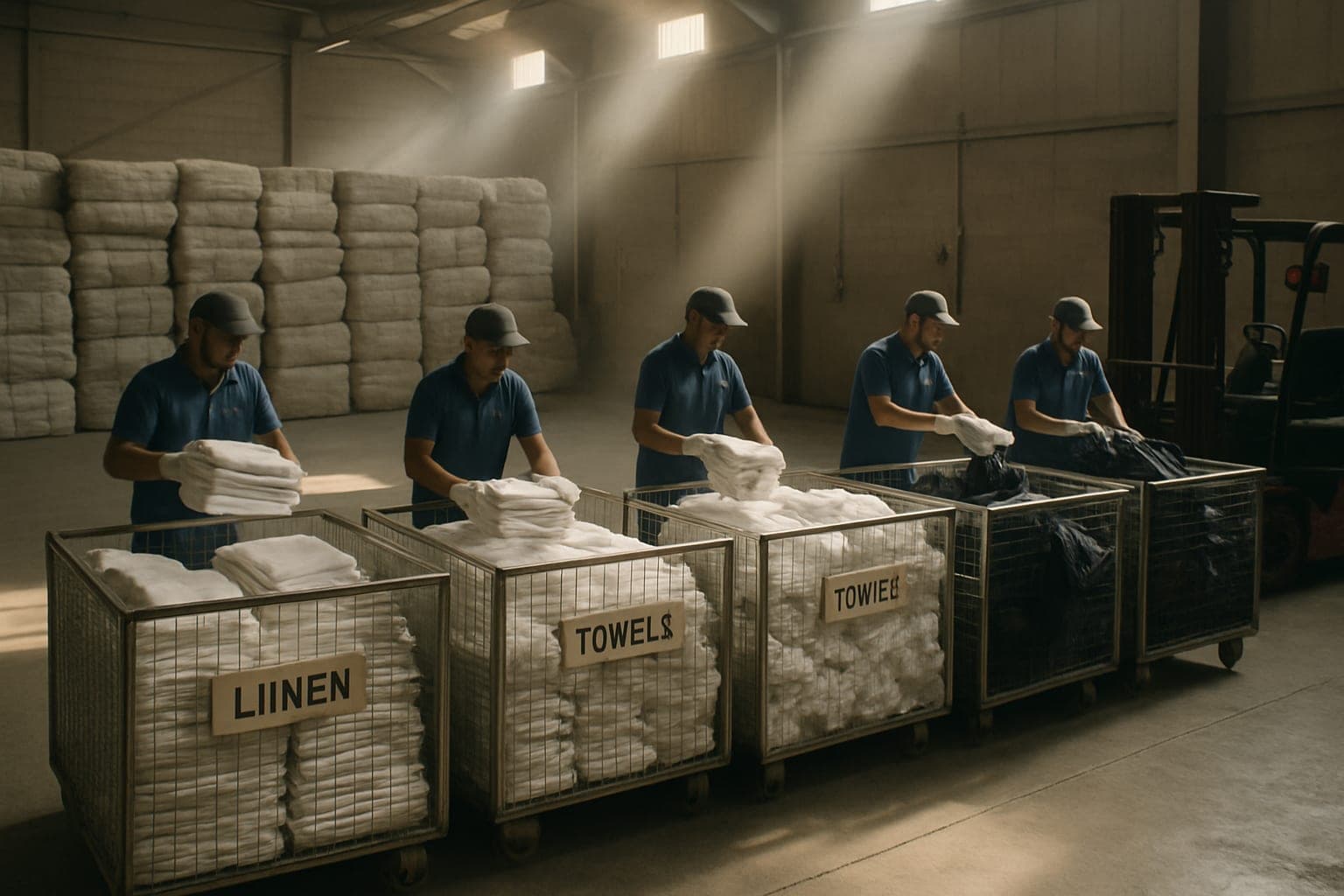
The single most operationally useful thing said at launch came from Petit: material separation at source is critical, because textiles mixed with food or cardboard become contaminated and unrecyclable. That is a back-of-house problem, not a technology problem. A hotel in Deira that puts stained banquet linen into the same skip as kitchen waste has not created a low-grade feedstock, it has created landfill. A laundry in Al Quoz that keeps condemned sheeting in a dedicated cage, dry and under cover, has created something a sorter will quote on.
The stream itself breaks into four parts that were named explicitly in UAE coverage of the launch: factory offcuts, used clothing, damaged material and unused inventory. All four currently end up in landfill in most cases. Each behaves differently commercially.
How the four streams behave in practice
| Stream | Typical UAE generator | What destroys the value | Most likely Naseej-era route |
|---|---|---|---|
| Factory offcuts and cutting-room waste | Garment and technical textile plants in Sharjah industrial areas, Dubai Industrial City, KEZAD | Mixed fibre compositions in one bag, dust, oil from machinery | Fibre recovery, if composition is documented per batch |
| Hotel and hospital linen, towels, scrubs | Hospitality groups, commercial laundries, healthcare operators | Food residue, bio-contamination, mixing with general waste | Wiper and rag conversion, or fibre recovery for single-composition cotton |
| Branded uniforms | Retail, fuel forecourts, delivery fleets, facilities management | Logo and brand-protection rules that force incineration if no compliant processor is contracted | Circular uniform programmes with documented de-branding |
| Unsold and unused inventory | Retailers, distributors, e-commerce returns operations | Nothing physically, this is the cleanest material in the chain | Reuse and resale, the highest value route available |
Notice the asymmetry. Unsold inventory is the cleanest and most valuable material in the country and it is also the material most companies are least willing to release, because of brand control. Linen is the highest volume and the easiest to segregate. Uniforms are the smallest volume and the most contractually complicated. If you are choosing where to start this quarter, start with linen.
Who actually buys UAE textile waste right now?
The July 2026 partnership wave named ADNOC Distribution, Aldar, PureHealth, M42, Landmark Group, LuLu Group, Deliveroo, Talabat, Re-Up, Rebound, Miniwiz, Fabricaid, Thrift for Good and Kiswa. Grouped by function, and this is our reading rather than an official classification, the corporate uniform generators are ADNOC Distribution, PureHealth, M42, Deliveroo, Talabat and Aldar. Retail take-back points sit with LuLu Group and Landmark Group. Collection, sorting, processing and resale sit with Re-Up, Rebound, Miniwiz, Fabricaid, Kiswa and Thrift for Good. We have not verified the individual capacity, location or accepted-material specification of any of those processors, so confirm directly before you commit a stream to one of them.
Pricing is the honest gap in this market. Textiles have no exchange benchmark, nothing equivalent to the LME reference that sets a floor under metals, and the relevant international reference points are private used-clothing export indices and mill demand for recycled cotton and polyester. UAE recyclate pricing for fabric is broker-quoted and largely unpublished. That is exactly why a documented, photographed, weight-verified listing changes the conversation: when there is no index, the counterparty prices the risk instead of the material. You can see live textile enquiries on the textiles category of our marketplace, and the pattern is consistent, the sellers who specify composition, weight and contamination status get quoted first.
Sharjah is worth a mention here. Fabric sorting lines have operated in the emirate for well over a decade, which means capacity for hand sorting is not being built from zero. What is new is a national coordinating body that can point corporate volume at it.
What does the Ellen MacArthur Foundation mandate signal for policy?
In August 2026, two months after launch, the Ellen MacArthur Foundation was engaged to work with the UAE on developing and delivering a national textiles circularity policy framework under Naseej, including identifying policy instruments that can support circular outcomes for the sector. The Foundation says it will draw on its experience of EU textile policy work.
Translate that for a procurement audience. Extended producer responsibility style obligations on textiles are being scoped in the UAE right now. They are not law, nothing retrieved announces a mandate, and anyone telling you textile EPR is already in force is wrong. What the mandate does give you is a window, and the UAE has form here: fleet operators found out what a quota feels like when tyre recycling rules put disposal proof on their side of the ledger. Fabric is a plausible next candidate.
One more line from the EMF announcement deserves attention. Jocelyn Bleriot, the Foundation's Policy and Institutions Executive Lead, noted that the UAE occupies an important place in global textile flows, notably as a re-export hub. That matters commercially. Sorting capacity built here does not only serve the estimated 220,000 domestic tonnes, it serves transit volume, which is why capacity decisions taken in 2027 will be made on a bigger number than the domestic estimate suggests.
How will take-back volumes be reported?
Naseej is a coordinating platform, so reporting will follow the operators rather than a single national register, at least in this pilot phase. What that means in practice is that your diversion claim will only be as strong as the paperwork your collector gives you. For any textile stream leaving your site, insist on four things: a weighbridge or calibrated-scale weight, the receiving facility's name and licence, the processing route the material entered, and the date. If your collector cannot supply the receiving facility name, you have a transfer note, not a diversion record.
Branded uniforms need a fifth item. Ask in writing how the logo is removed or destroyed and whether you receive a certificate for it. We have not verified that any UAE regulation requires such a certificate, but brand-protection teams almost always do, and that requirement is the reason a lot of perfectly recyclable polycotton gets destroyed instead. Settle it before the contract, not after the first collection.
How do you get in front of this now?
- Weigh what you actually generate for one month. Not an estimate from your waste invoice. Segregate fabric into the four streams above and record kilograms per week per site.
- Fix the contamination first. A dedicated, covered, dry cage away from the kitchen line does more for your material value than any technology upgrade. Petit's point about food and cardboard contamination is the whole ballgame.
- Document composition. Percentage cotton, polyester or blend, per stream. Fibre-to-fibre buyers cannot quote without it, and blends are the most common reason a sample gets rejected.
- Approach the pilot cohort directly. The circular uniform channel has named corporate generators but no dominant B2B intermediary, which is the clearest gap in the current partner map.
- Contract before the policy framework lands. Sorter and processor terms signed in a voluntary market are usually better than terms signed the quarter after an obligation is published.
- List surplus and offcuts rather than tipping them. Manufacturers on the industrial side have already learned this with trim waste, as we covered in our piece on turning factory offcuts into contracted feedstock.
On our side, the mechanics that make textile trades work are the boring ones: UAE PASS verified counterparties so you know who is collecting, escrow through MyFatoorah so payment does not depend on trust, a 48-hour inspection window so a contamination dispute has a process, and export-ready diversion records for your ESG file. More on the policy side sits in our sustainability coverage.
Shaima Sibtain, founder of Luved, put the behaviour problem well at the launch: "It's friction, not apathy." She was talking about consumers. It applies just as precisely to a hotel where the skip is thirty metres from the loading bay and the sorter is thirty kilometres away.
Frequently asked questions
Is 220,000 tonnes a Naseej recycling target?
No. It is the estimated volume of textile waste the UAE generates each year, cited by WAM and UAE media at the June 2026 launch, and roughly 88 per cent of it goes to landfill. No source we have seen states a tonnage Naseej has committed to recycling. Treat 220,000 tonnes as the addressable pool.
What textile waste from a hotel or laundry can actually be recycled?
Dry, segregated linen, towels, scrubs and condemned sheeting all have a route, either as wiper and rag stock or as fibre recovery where the composition is single-fibre cotton. Tadweer's chief executive has said textiles mixed with food or cardboard become contaminated and unrecyclable. The deciding factor is the cage you store it in, not the fabric itself.
Who buys used uniforms in bulk in the UAE?
The Naseej partner list published on 8 July 2026 includes collectors and processors such as Re-Up, Rebound, Miniwiz, Fabricaid, Kiswa and Thrift for Good, alongside uniform-heavy generators including ADNOC Distribution, PureHealth, M42, Deliveroo and Talabat. We have not verified each processor's capacity or accepted specifications, so confirm directly and settle logo destruction terms in writing first.
Is textile extended producer responsibility now law in the UAE?
No. In August 2026 the Ellen MacArthur Foundation was engaged to help develop a national textiles circularity policy framework and identify policy instruments, which means obligations are being scoped rather than enforced. Nothing published announces a textile EPR mandate. That gap is the window for voluntary contracting.
What paperwork do I need for a credible ESG diversion claim on fabric?
Four items per consignment: a verified weight, the receiving facility's name and licence number, the processing route the material entered, and the date. For branded garments, add written confirmation of how logos are removed or destroyed. A transfer note with no named receiving facility is not a diversion record.

Comments(0)
Sign in to join the conversation.