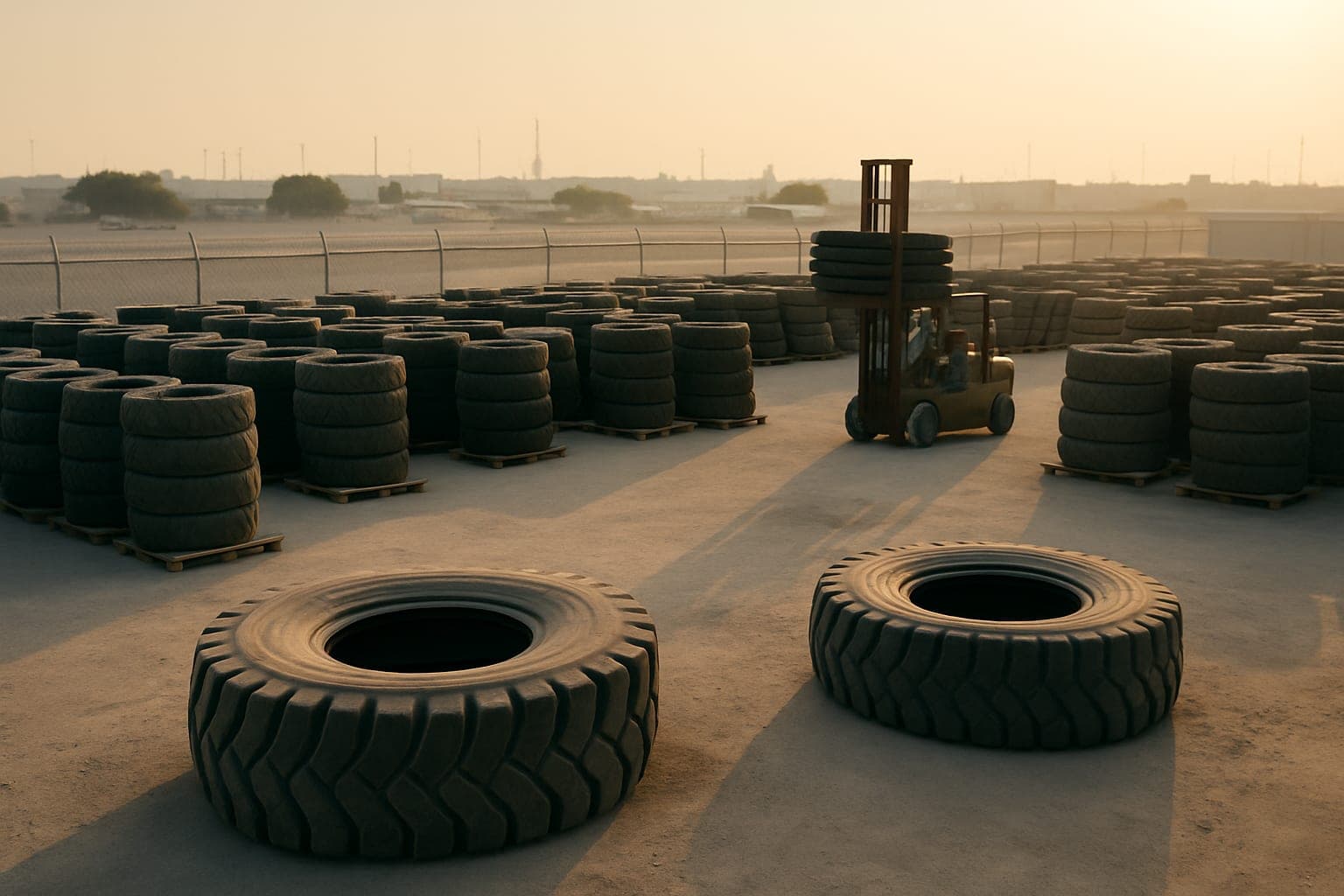
Used tyres are named in the UAE Policy for Integrated Management of Recyclable Materials as a stream that must reach licensed recycling factories inside the country, alongside e-waste, plastics, used cooking oil and aluminium dross. Under Cabinet Resolution No. 39 of 2021, the producer of the waste carries the disposal duty. Your file, not your hauler's word, is the defence.
What does UAE law actually require when you retire a casing?
The frame is Federal Law No. 12 of 2018 on Integrated Waste Management, issued on 18 December 2018. It gives the Ministry power to compel the reuse of certain waste types, to require recycling where a material is suitable for it, and to build a national waste database that local competent authorities feed on a regular basis. That database point matters more than it looks. Once an emirate authority is reporting tonnages upward, it needs a paper trail from generators to close the loop.
The detail sits in Cabinet Resolution No. 39 of 2021, the Executive Regulations of that law: thirteen articles and two annexes. Article 2 sets out the responsibilities of the waste producer and the supplier to ensure proper disposal. Article 5 covers hazardous waste, Article 6 governs the transport of waste between the emirates, Article 7 deals with reuse of by-products, and Article 10 sets administrative penalties. If you operate a depot in Dubai Investments Park and your casings end up at a plant in Sharjah or Al Ain, Articles 2 and 6 both apply to the same load.
Above that sits the recyclable materials policy, which governs the licensing of facilities that manage, collect, recycle and export recyclable materials, and which names used tyres on the list. We should be straight about one limit: as of August 2026 we could not retrieve the resolution number and approval date of that policy from a primary government text, and nothing we have read in it sets a tyre-specific recovery percentage. The same policy list is what drives the equipment take-back debate we covered in our piece on UAE WEEE rules and electronics importers.
Where the 75 per cent figure really comes from
You will see the claim that the UAE mandates recycling of 75 per cent of used tyres by 2025. We chased it. Every trail we followed ends at market research vendor pages rather than at a ministry or cabinet text. The figure that is genuinely traceable is Abu Dhabi's aim to divert 75 per cent of its waste from landfill across all streams, reported by The National in July 2021 as a Tadweer target. Tyres fall under that ambition. They are not carved out with their own quota that anyone can cite. Plan against the direction of travel, which is real, and do not build a compliance case on a number whose target year has already passed.
Who carries the liability if the casings end up in a stockpile?
You do, until you can show otherwise. Article 2 of the Executive Regulations places the duty on the producer to ensure proper disposal, and that duty does not transfer to a man with a flatbed who quotes AED 15 per casing and disappears toward the desert road. In Dubai, Law No. 18 of 2024 Regulating Waste Management in the Emirate of Dubai makes it an offence to bring waste into or remove waste from Dubai Municipality disposal sites without a permit from the Municipality, and tasks DM with pulling volume off the landfilling route.
Abu Dhabi is more explicit about the signature. The Environment Agency Abu Dhabi Standard Operating Procedure for the Transportation of Wastes outside the Emirate of Abu Dhabi carries a generator certification clause. The generator certifies that the waste contains no radioactive material, that the information given is complete and correct, and that the material is classified, packaged, marked and labelled properly for transport. That SOP references Tadweer's SOP for licensing hazardous waste service providers, number CWM.SOP.PR/01. When you sign it, you have made a statement of fact that an inspector can test against what actually left your yard.
One correction worth making because so many operator guides get it wrong. Tadweer is the Abu Dhabi authority. It does not license your tyre movement in Dubai. Dubai runs on Dubai Municipality under Law 18 of 2024, and Sharjah on its own municipal and environmental authorities with BEEAH as the operating contractor. Sending a Dubai depot manager to a Tadweer portal wastes a week.
What belongs in the file for every load that leaves your yard?
There is no published federal waste transfer note template that we could locate, and no stated retention period for tyre movements specifically. That is an argument for building your own pack and keeping it as long as you keep tax records, not an argument for keeping nothing. Eight items, per movement:
- The receiving facility's licence number, issuing authority and expiry date, captured as a copy on file, not as a claim in an email.
- The transporter's waste transport permit for the emirate of origin and, if the load crosses a border, for the destination emirate.
- A dated transfer note showing origin site, destination facility, vehicle plate and driver name.
- Weighbridge tickets, gross and tare, from either the origin or the receiving plant.
- A count by category: passenger, light truck, TBR truck casings, and OTR by rim size.
- A signed acceptance note from the receiving facility, quoting its licence number.
- A recovery or processing certificate where the plant issues one. Some do, some only issue receipts. Ask before the first load, not after the audit.
- Two photographs of the loaded vehicle at your gate, timestamped.
Items one and six are the pair that actually protect you. A weighbridge ticket proves mass left. Only a licensed facility's acceptance note proves where it landed.
Which processors take whole casings, and which want shreds?
Intake form decides your handling cost, so confirm it before you commit a year of arisings. The picture below is drawn from published reporting, and every capacity figure in it is five to seven years old. Treat it as a starting call list, not a spec sheet.
| Route | Location | Intake form | Reported capacity and date | What to request |
|---|---|---|---|---|
| Tadweer facility with Tarheel Collecting Wastes LLC | Abu Dhabi | Whole casings, collected and cleaned before processing | 70,000 t/yr expanded toward 100,000, Gulf News, 18 Nov 2020. The same article's headline says tyres and its body says tonnes, so verify the unit | Licence copy and signed acceptance note |
| Gulf Rubber Factory | Al Ain | Line begins with cutting and shredding, feeding crumb rubber production | Up to 24,000 tonnes per year, three lines on 37,000 sq m, The National, 1 Jul 2021 | Output record, plus export documents if material leaves the UAE |
| BEEAH tyre recycling facility | Al Saja'a, Sharjah | Whole casings into a cryogenic process producing crumb and tiles | 30,000 t/yr or up to 8 million tyres at launch, Gulf News, Jul 2019. About 3 million tyres per year reported in 2021 | Weighbridge ticket and dated receipt |
| Cement kiln, tyre derived fuel | Plants not publicly named in the sources we checked | Shredded chips only | Burnt at 1,000 to 1,200 degrees C, The National, Jul 2021 | Written confirmation the kiln is permitted to burn TDF |
| Dubai | No licensed tyre processor identified in public sources as of Aug 2026 | Not applicable | Not applicable | DM permit for any movement into or out of a DM disposal site |
The volume record is similarly thin. Abu Dhabi processed roughly 17,000 tonnes of tyres between the start of 2020 and the end of the third quarter that year according to Gulf News, and The National reported about 7,000 tonnes, or 420,000 tyres, over an eight month period in 2021. We found no national arisings figure and no emirate diversion rate for tyres published in 2024, 2025 or 2026. If your sustainability report cites a UAE tyre recovery rate, check what year it is really describing.
What do you do with OTR and quarry casings?
This is where the file usually breaks. We could not confirm from any public source that a UAE facility accepts 25 inch and larger earthmover casings whole, which is precisely why stockpiles build at aggregate sites and remote works compounds. A 3.5 tonne haul truck tyre will not go through a shredder built for TBR truck casings, and nobody wants to mobilise a mobile shear for eleven units.
Three things fix it, in order. Get written intake confirmation, by rim size and unit weight, before the fleet reaches end of life rather than after. Budget size reduction as a line item in the tyre purchase, since ring cutting or on-site shearing is the real cost and it does not vanish because you ignore it. Then split the outputs: the bead and belt wire recovered from a casing is ferrous scrap with a buyer, and if you are already selling steel, the invoicing rules in our note on the scrap metal VAT reverse charge apply to that fraction too.
Does any of this pay, or is it purely a cost line?
Be honest with your finance team. For most fleets, scrap casings are a negative value stream. You pay to move them, and the value sits with whoever processes them. There is no exchange contract for tyre derived material, so nothing behaves like an LME reference. Three things set the range instead, and this is our reading of the market rather than a sourced figure: natural and synthetic rubber futures, which cap what crumb rubber can substitute for; ferrous scrap indices, for the steel recovered from the casing; and coal and petcoke pricing, which decides what a cement kiln will pay for TDF rather than take it for a gate fee.
We could not verify a single credible AED per tonne price for UAE casings, shred or crumb as of August 2026. The listing boards that show up in search carry placeholder numbers that no trader here would honour. Ask each plant for a signed, dated quotation per tonne delivered, valid for a stated period, and compare it against your disposal alternative rather than against a number you read online. On the disposal side, Dubai's fees run under Executive Council Resolution No. 58 of 2017, and the per tonne figures circulating on auto generated sites should be checked with the Municipality before they enter a budget, as we argued in our analysis of Dubai's tipping fee and diversion economics.
How do you set this up in the next 30 days?
- Count what you hold. Walk the yard, count casings by type and rim size, and photograph any stockpile older than three months.
- Write to the competent authority in your emirate, Dubai Municipality, Tadweer or the Sharjah authority, asking in writing how waste tyres are classified there and what permit your transporter needs.
- Shortlist two licensed processors, one whole casing intake and one shred intake, and get licence copies from both.
- Issue a one page transfer note template to every depot and make the driver's signature a gate condition.
- List anything with residual value, casings suitable for retreading, recovered wire or crumb, in the other materials category so buyers with a licence come to you rather than the other way round.
Do that and the next inspection becomes a file request instead of an argument. More rulings and filings for UAE generators sit in our regulation coverage.
Frequently asked questions
Are waste tyres classified as hazardous waste in the UAE?
We found no single definitive federal classification, and treatment appears to vary by emirate, which matters because the classification drives both the gate fee tier and the documentation burden. Cabinet Resolution No. 39 of 2021 handles hazardous waste separately under Article 5. Ask your emirate authority for the classification in writing and keep the reply on file.
Can I store used tyres on site until I have a full truckload?
Storage is usually permitted only within the conditions of your trade or environmental licence, and fire risk is the reason authorities take an interest. We could not locate a published federal limit on quantity or duration. Keep the pile small, keep it away from fuel and buildings, and get written confirmation of any allowed volume from your emirate authority.
Which document proves I handed casings to a licensed recycler?
A signed acceptance note from the receiving facility that quotes its own licence number, paired with a dated weighbridge ticket and your transfer note showing vehicle plate and destination. A collection invoice on its own proves you paid somebody. It does not prove where the tyres landed.
Does Tadweer regulate tyre disposal in Dubai?
No. Tadweer is the Abu Dhabi waste authority. Waste management in Dubai runs under Law No. 18 of 2024 and Dubai Municipality, which also issues the permits required to move waste into or out of its disposal sites. Sharjah operates through its own authorities with BEEAH as operator.
Is there really a 75 per cent tyre recycling quota in the UAE?
Not one we can source to a government text. The traceable 75 per cent figure is Abu Dhabi's goal to divert 75 per cent of all waste from landfill, reported in July 2021 as a Tadweer target, and tyres sit inside that. The widely repeated claim of a tyre specific mandate traces back to market research pages rather than legislation.
What can I actually sell from a scrapped truck tyre?
The steel bead and belt wire recovered during processing has a ferrous scrap buyer, and crumb rubber has value if a processor produces it. Casings still fit for retreading are worth more than scrap and should be separated before collection. For most fleets the stream is still net cost, so the win is in reducing that cost and holding proof of compliance.

Comments(0)
Sign in to join the conversation.