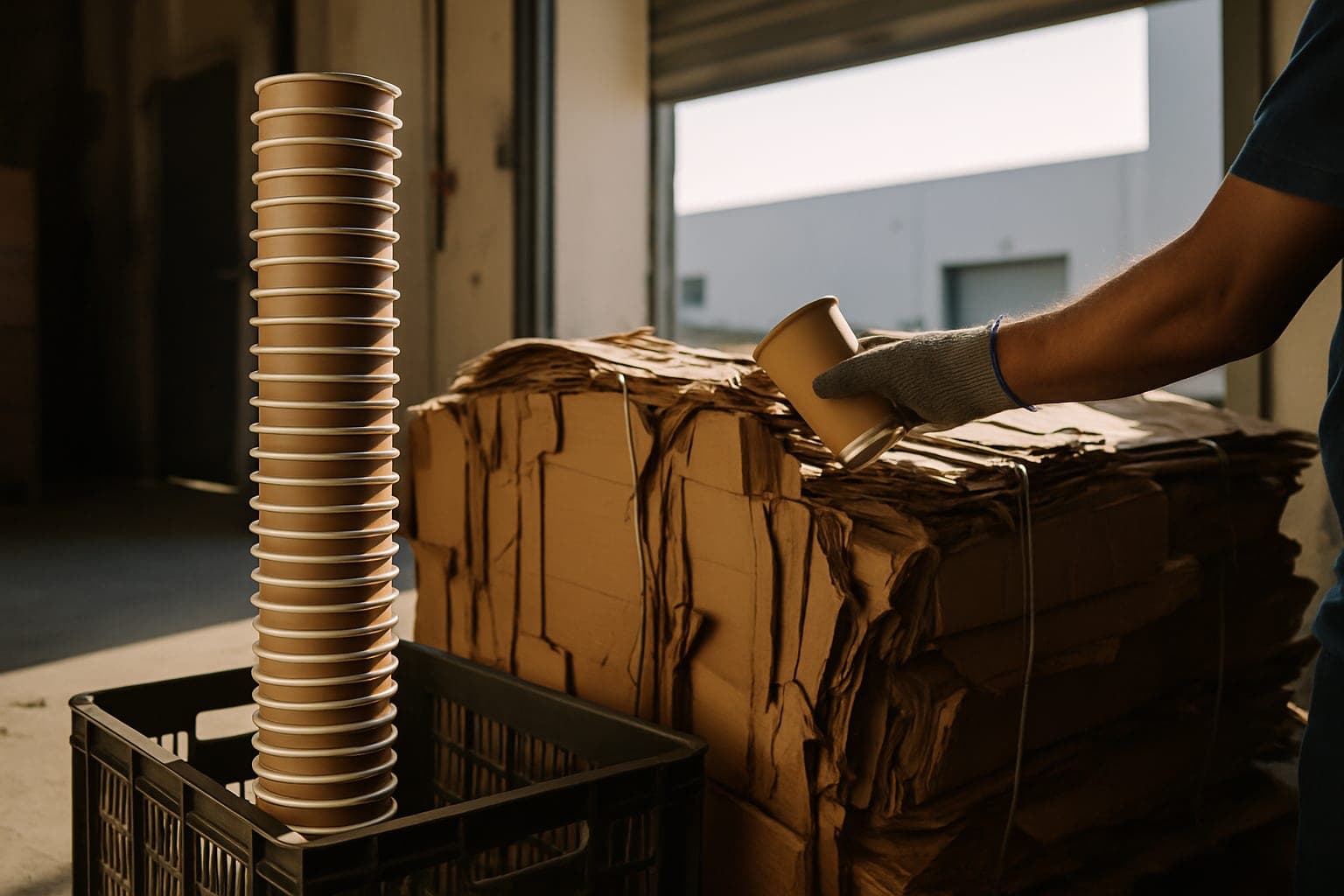
A polyethylene-lined paper cup is legal under the 1 January 2026 rules and still close to worthless in the UAE fibre trade. The lining does not defibre in a standard pulper, so lined cups act as a prohibitive material in OCC and SOP bales. Segregate them at front of house, or the whole load gets downgraded or rejected.
Are paper cups banned in the UAE in 2026?
Not as a product. The ban is about material. Ministerial Decision No. 380 of 2022, issued by the Ministry of Climate Change and Environment, is the legal basis for the federal single-use products regime, and from 1 January 2026 it prohibits the import, manufacture and trade of beverage cups and their lids, cutlery including chopsticks, plates, straws, stirrers and food containers where those items are made from conventional plastic. Bags under 50 microns are banned nationwide from the same date regardless of material. MOCCAE's Alya Al Harmoodi framed the move around circular economy goals and the protection of marine and terrestrial environments, in comments reported in December 2025.
Dubai runs its own phased instrument, Executive Council Resolution No. (124) of 2023, and the dates do not match the federal ones. Articles that give a single national date for everything are simply wrong, and procurement teams working across emirates get caught by that.
| Date | Jurisdiction | What changed |
|---|---|---|
| 1 June 2022 | Abu Dhabi | Plastic bag ban, two years ahead of the federal move |
| 1 January 2024 | Federal, and Dubai phase 1 | Single-use plastic bags |
| 1 January 2025 | Dubai phase 3 | Styrofoam cups, plates and food containers, plastic straws, cotton swabs, table covers, stirrers |
| 1 January 2026 | Federal, and Dubai final phase | Plastic beverage cups and lids, plates, cutlery including chopsticks, plus bags under 50 microns nationwide |
Here is the gap that matters commercially. The published rules target the material of the cup body. A paper cup with a thin polyethylene lining is not a plastic beverage cup, so on the face of the regulation it is a compliant substitute, and nothing in the summaries of Decision 380/2022 or Resolution 124/2023 requires that substitute to be recyclable inside the UAE. Whether MOCCAE or Dubai Municipality set any cap on coating weight, or require a recyclability or compostability certificate for lined fibre, is not something we have been able to confirm. Dubai Municipality issued an awareness guide in December 2025 to help affected businesses identify approved alternative materials. If you buy foodservice packaging in Dubai, get that guide and read the alternatives list yourself rather than taking a supplier's word for it.
Why does one lined cup ruin an OCC or SOP bale?
Recovered fibre is sold against a grade, and a grade is a promise about what is not in the bale. UAE exporters routinely offer OCC 11 in 98/2, 95/5, 90/10 and 80/20 splits, with stated outthrows of 5 per cent on the 95/5 and 10 per cent on the 90/10, according to supplier listings we reviewed on trade directories that carry no publication date. Sourcing guidance circulating for Dubai OCC in early 2026 asks buyers to require contamination under 2 per cent and moisture under 12 per cent. Treat that as indicative marketplace guidance, not a published index, but it is the right order of magnitude for what a mill buyer will argue about.
A poly-coated cup is not an outthrow in the way a bit of dust or a paper clip is. In a standard hydrapulper the fibre releases and the polymer does not. The lining survives as film fragments, tacky particles and screen rejects, it shows up as defects in the finished testliner or tissue, and it costs the mill money in cleaning and downtime. That is why the trade already prices the problem: at least one UAE fibre trader lists poly cup trims with one side poly as a separate traded grade, sitting apart from sorted white ledger, printers' off-cut and pure white cutting. The market has done your segregation logic for you. It sorts lined stock out of OCC and SOP because those two grades cannot carry it.
Residual beverage makes it worse. Half a centimetre of cold latte in the bottom of a stacked cup column pushes bale moisture up, and moisture is the second thing a buyer weighs you down on after contamination. If you already run a clean office paper stream, the pantry cup is usually the exact point where it fails, which is the same failure mode we described in baling office paper to SOP grade.
Can any UAE mill pulp coated stock?
We are not going to assert that no facility in the country can do it, because we have not been able to confirm the answer either way, and that honest gap is more useful to you than a confident guess. What we can tell you is that the specialist route is genuinely narrow elsewhere. A UK trade briefing from February 2018 noted that PE-lined paper hot cups are recyclable only through correct handling at a small number of dedicated facilities. That source is more than seven years old and describes another market, so use it as a technical principle, not as a UAE data point. The practical step is short: ask your mill or baler in writing, before you switch cups, whether they will pulp poly-coated fibre and what grade they will pay it as.
Is PLA the compliant answer or just a different problem?
Polylactic acid products are explicitly excluded from the 2026 ban and are recognised by MOCCAE as a viable alternative. Read that carefully. It is a compliance judgement, not a recyclability judgement. PLA-lined cups do not go down a conventional paper recycling route, and they need industrial composting to break down at all. Older non-UAE material, updated in March 2021 in a US context, describes commercially composted PLA-lined cups breaking down in under 60 days. That is a laboratory-adjacent claim about a facility type, not a statement about Dubai or Musaffah.
So ask the harder question. How many industrial composting facilities in the UAE will actually accept PLA foodservice items, at what gate fee, and with what pre-acceptance conditions? We could not verify a count, and until you can, a PLA cup in your operation is a compliant cup with an unproven end market. Worse, PLA behaves as a contaminant in two streams at once. It fouls fibre, and in a rigid plastics bale it is not PET even though it looks like it, which is why sorters and buyers penalise it.
Where do lined cups in the UAE actually end up?
In mixed waste. From there the realistic destinations are landfill or energy recovery, and the balance between those two is shifting as thermal capacity comes online, which changes the economics for every lightweight, film-contaminated fraction. We covered that shift for plastic film in Warsan Phase 2, and lined fibre sits in the same category of material: technically combustible, commercially unattractive to recyclers, easy to lose.
The point for a procurement manager is that this is a cost line, not an environmental abstraction. Every kilogram you move out of a saleable fibre grade and into mixed waste is a kilogram you pay a gate fee on instead of invoicing for. Ask Tadweer in Abu Dhabi, Bee'ah in Sharjah and your Dubai contractor for their current accepted-materials list and tariff, dated, in writing. Verbal assurances at the loading bay are not an audit trail.
Which formats keep value in the UAE fibre stream?
- Reusable ceramic and stainless for dine-in. No cup waste stream at all, and the only format where the disposal question disappears rather than moving.
- Uncoated moulded fibre trays and clamshells with no film, wax or foil layer.
- Uncoated kraft bags and corrugated carriers which drop straight into your back-of-house OCC bale.
- Aqueous or dispersion-coated cups but only where a named local mill has confirmed in writing that it will pulp them. Absent that confirmation, treat them exactly as you treat PE.
- Aluminium-laminated and wax-coated fibre: assume no fibre buyer wants it, and keep it out of every bale you sell.
| Stream you create | Grade it sells as | Cup rule |
|---|---|---|
| Back-of-house corrugated, dry | OCC 11, 95/5 or 90/10 | Zero lined fibre, zero food-soiled or wet board |
| Office and admin paper | SOP or white ledger | Zero lined fibre. The pantry bin is the usual breach |
| Front-of-house lined fibre | Poly-coated cup trim, or residual | Segregate at source or it lands in mixed waste |
How do you write a packaging and fibre spec that stays sellable?
- Define poly-coated, PLA-coated, wax-coated and aluminium-laminated fibre as prohibitive materials in your fibre offtake contract, not as outthrows. The wording difference decides who pays for a rejected load.
- Require your packaging supplier to declare the lining polymer and the coating weight on the spec sheet, per SKU, before you approve the item.
- Require any compostable or recyclable claim to name the certification standard and the specific UAE facility that will accept the item.
- Set a maximum bale moisture and write it into the collection agreement rather than leaving it to the weighbridge argument.
- Make your buyer state in writing which grade your bales will be sold as, so a downgrade becomes a conversation you can audit.
- Put a lidded, liquid-tolerant cup bin at every front-of-house station, physically separate from the OCC cage and the office paper bin.
- Re-tender the clean fibre annually. There are dozens of waste paper trading companies operating out of Dubai alone, clustered around Al Quoz, Al Qusais and the Jebel Ali corridor, and OCC is one of the most commonly traded grades in the country.
On pricing, we will not print an AED per tonne figure for OCC 11 or SOP that we cannot attribute to a dated index or a live quote. Fibre has no LME equivalent, so the reference points are published recovered paper indices and whatever your local baler will commit to this week. Ask three balers for a dated written quote against your actual grade, and post the material on the paper category to see what verified buyers bid.
Frequently asked questions
Are paper cups banned in the UAE from January 2026?
No. The federal rules under Ministerial Decision No. 380 of 2022, and Dubai's final phase under Executive Council Resolution No. (124) of 2023, ban beverage cups and lids made from conventional plastic from 1 January 2026. A paper cup with a polyethylene lining is not covered by that wording, so it is a compliant substitute. Compliant does not mean recyclable in the UAE.
Can I put paper cups in my cardboard or office paper bin?
No, if you want the bale to sell. Poly-coated fibre does not break down in a standard pulper and behaves as a prohibitive material in OCC and SOP, not as a tolerated outthrow. Residual liquid in stacked cups also raises bale moisture, which is the second penalty a buyer applies after contamination.
Is a PLA-lined cup better than a PE-lined cup?
For compliance, yes, since MOCCAE explicitly excluded polylactic acid products from the 2026 ban and recognises them as a viable alternative. For end-of-life, not automatically. PLA needs industrial composting, it is not recyclable through conventional paper routes, and it acts as a contaminant in both fibre and rigid plastic bales, so confirm a named UAE facility will accept it before you switch.
Does any UAE mill recycle poly-coated cups?
We have not been able to confirm a UAE facility that separates polyethylene from fibre at commercial scale, and we will not claim there is none. Ask your mill or baler directly, in writing, whether they will pulp coated stock and what grade they will pay for it. Note that some UAE traders already list poly cup trim as a separate low-value grade, which tells you how the market treats it.
What should F&B procurement change first?
Separate the cup from the corrugated. A lidded cup bin at every front-of-house station, plus a contract clause naming coated fibre as prohibitive, protects the two streams that actually earn revenue. After that, push reusables for dine-in and unlined moulded fibre for takeaway, since both remove the problem rather than relocating it.

Comments(0)
Sign in to join the conversation.