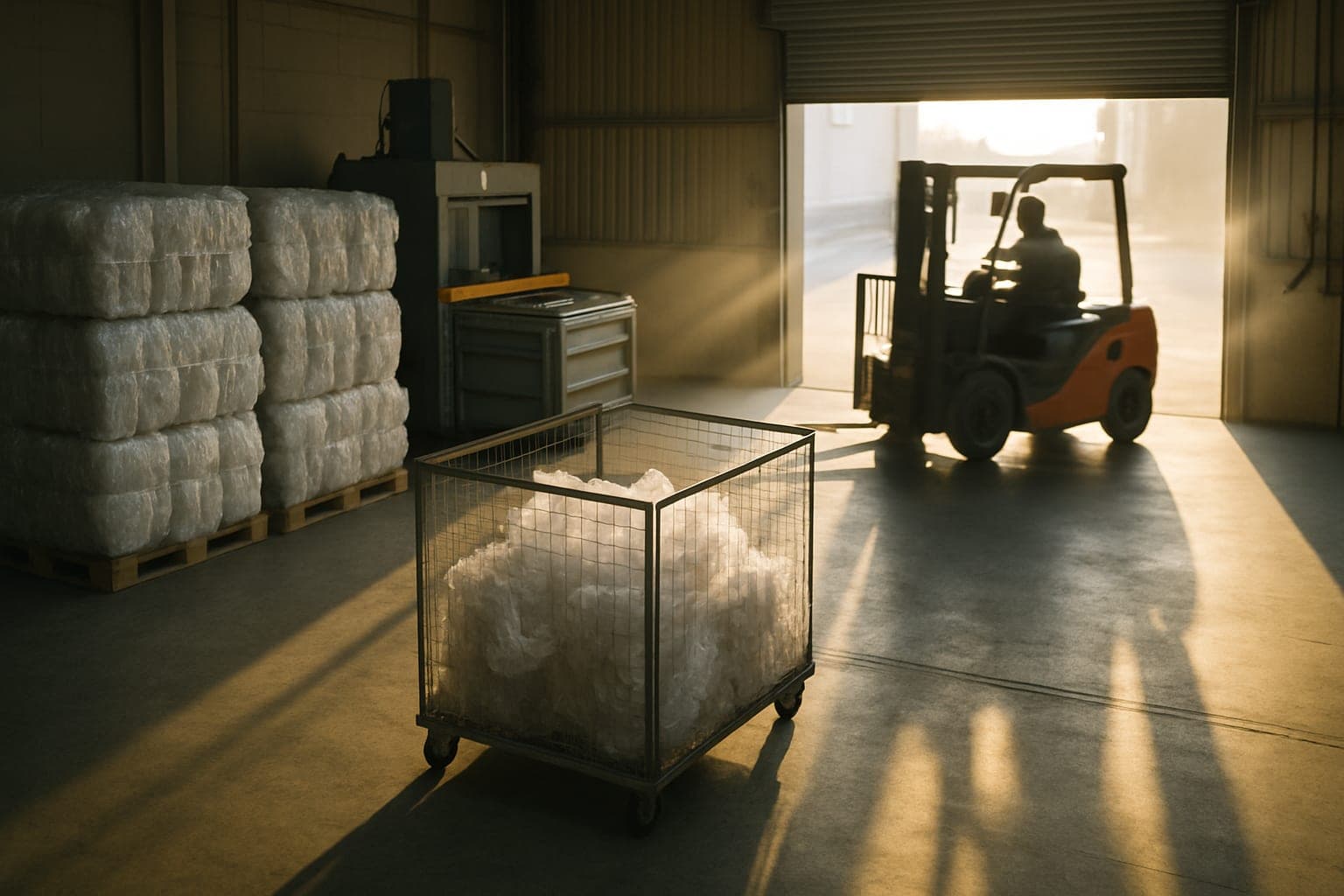
Dubai's Warsan Waste-to-Energy Centre processes up to 6,000 tonnes of solid waste a day, roughly half the emirate's output, and a second phase was announced in February 2026. Clean LLDPE pallet wrap sitting in a mixed compactor is burned as fuel, not reprocessed. US benchmark data puts clean industrial film at USD 176 to 772 per tonne. A separate film stream captures that; a compactor does not.
What is actually changing at Warsan?
Following its 92nd meeting, reported on 15 and 16 February 2026, the Dubai Supreme Council of Energy said the emirate will launch the second phase of expansion at the Warsan waste-to-energy project later this year. The existing plant is rated at 2 million tonnes per annum and was procured by Dubai Municipality under a public-private partnership. Since operations began, more than 4.5 million tonnes of waste have been processed, with 62 percent diverted from landfill, in line with Dubai's goal of eliminating landfill sites by 2041.
Phase 1 cost AED 4 billion, was inaugurated in July 2023 and reached full commercial operation in September 2024. It is run by Warsan Waste Management Company, with a consortium behind it that includes BESIX of Belgium, Hitachi Zosen Inova of Japan, ITOCHU, Dubai Holding, DUBAL Holding and Tech Group. Gulf News, citing Emarat Al Youm in November 2025, put daily capacity at up to 6,000 tonnes against Dubai's generation of around 13,000 tonnes a day. Syndicated coverage also describes output as "up to 220 MWh" powering about 135,000 homes, a line that mixes power and energy units, so treat it as reported rather than verified.
By our arithmetic, 6,000 tonnes a day across 365 days is 2.19 million tonnes, consistent with the nameplate, and Dubai at 13,000 tonnes a day is roughly 4.75 million tonnes a year. Phase 1 therefore absorbs about 46 percent of what the emirate generates. The tonnage uplift from Phase 2 has not been published. What has been published is the closure list: Warsan, Jebel Ali and Hatta landfills are already shut, with Al Qusais and Al Bayadiyah due to close by 2027.
Diversion is not the same as recycling
The 62 percent figure is landfill diversion. For a thermal plant, energy recovery counts inside that number. A bale of clear stretch film sent to Warsan is officially diverted and physically destroyed at the same time. If your sustainability report treats diversion and material recovery as one line, you are reporting a combustion tonne as though it re-entered the supply chain, and any assurance provider who reads the plant's own description will catch it.
How much film does your site actually generate?
Most warehouse managers underestimate this because they count purchase orders for wrap, not the film that arrives on inbound pallets. A UAE stretch film supplier page, undated, gives a working benchmark of 200 to 350 grams of film per pallet for hand wrapping depending on load weight and operator technique, 120 to 180 grams for machine wrapping, and up to 50 percent reduction with pre-stretch film. Treat that as a supplier benchmark, not an audited figure, then weigh a week of your own film for a real number.
Using 250 grams per pallet and 260 working days, our illustrative arithmetic looks like this.
| Pallets wrapped per day | Outbound film per year (our calculation) | Typical site profile |
|---|---|---|
| 100 | ≈6.5 tonnes | Single distribution warehouse, Al Quoz or Ras Al Khor |
| 300 | ≈19.5 tonnes | Mid-size 3PL bay, Dubai Industrial City |
| 1,000 | ≈65 tonnes | Regional DC or multi-tenant JAFZA facility |
Those figures cover outbound wrap only. For retail back-of-house and 3PL operations, inbound film stripped off received goods is usually the larger stream, and it is the one that goes straight into the general waste compactor because nobody owns it. Add both before you decide a film stream is too small to bother with.
What is clean film worth, and what destroys that value?
There is no exchange price for film. Traders back the bale price out of the recycled pellet price. ChemAnalyst reported the R-LLDPE price index in China averaging about USD 757.67 per tonne for the quarter ending December 2025, up 2.62 percent quarter on quarter on steady packaging demand, and softening marginally in December. That converts to roughly AED 2,783 per tonne at 3.6725, our conversion. It is a Chinese pellet index, not a UAE bale bid, but it sets the ceiling any reprocessor works back from.
On the bale side, Carlin Waste Recycling reported on 16 June 2026, citing ICIS and RecyclingMarkets.net, that LDPE scrap in the United States is worth between USD 0.08 and USD 0.35 per pound for clean industrial film and packaging, with baled, colour-consistent, low-contamination loads earning the stronger offers. That is USD 176 to 772 per tonne, or about AED 648 to 2,834 per tonne on our conversion. The fourfold spread is the whole argument. It is not market luck, it is contamination and consistency.
The specification that decides where you land in that band is well established. Grade A film is 95 percent or more clear, clean, dry LDPE or LLDPE stretch wrap, free of coloured plastic, excessive paper labels, rigid strapping and moisture, per a December 2025 spec published by US operator Waste Optima. Coloured film is recyclable but must be kept separate, because mixing colour into a clear load devalues the entire bale. The same grading discipline decides whether office paper clears as sorted grade or gets rejected, and we have set out that process in our guide to baling office paper to SOP grade.
| Grade | Specification | Commercial outcome |
|---|---|---|
| A, clear film | 95%+ clear, dry LLDPE/LDPE stretch wrap, no colour, labels, tape cores or strapping | Top of the price band, recyclers compete for it |
| B, coloured film | Clean but pigmented or printed shrink and pallet hoods, kept separate | Sells at a discount, still a paid load |
| Mixed film | Clear and coloured combined, some labels and dust | Bottom of the band, often collection cost only |
| Wet or compacted film | Film through a general waste compactor, food residue, moisture, fines | No reprocessor bid, becomes calorific value at Warsan |
You will find UAE film scrap listed on open B2B directories at FOB asks around USD 900 to USD 1,220 per tonne. Those are undated seller asking prices for export-graded material, not transacted UAE bale prices, and we will not print them as market rates. The honest position is that a Grade A clear film bale in Dubai is priced against the pellet index minus washing, pelletising and freight, and the only way to know your number is to put a graded sample in front of three buyers.
How do the disposal and recovery routes compare?
The cost side in Dubai is the weakest published area, and we would rather say so than invent precision. The governing instrument is Executive Council Resolution No. 58 of 2017 approving fees and fines for waste disposal in the Emirate of Dubai, which rounds part tonnes up to a full tonne and caps repeat-violation fines at AED 100,000. The per-tonne schedules sit in that Resolution and should be pulled from the official source before you build a budget. Commercial broker guides published in 2026 quote indicative rates in the AED 50 to AED 100 per tonne range for general solid waste, and label them as indicative themselves.
Two myths are still circulating in procurement decks. The first is the AED 10 per truckload gate fee, which belonged to a regime replaced years ago after cheap tipping pulled waste in from outside the emirate. The second is that everything costs AED 100 a tonne, when rates are material-specific by design, which is exactly why a segregated stream prices differently from a mixed one. We looked at how that per-tonne logic changes the maths on organics in our piece on Dubai's tipping fee and food waste diversion.
Set the three routes side by side and the decision is usually obvious before you finish the tipping fee research.
| Route | Cash effect | ESG evidence | Material outcome |
|---|---|---|---|
| Film in general waste compactor | Pay haulage plus per-tonne disposal fee | Counts as diverted if it reaches Warsan, but as energy recovery | Destroyed, permanently out of the pellet chain |
| Mixed or wet film to a recycler | Often free collection at best, sometimes rejected at the gate | Weak, load may be rerouted to disposal without notice | Partial recovery, high reject rate |
| Grade A clear film, baled | Paid per tonne, plus avoided disposal fee on the same tonnes | Buyer, weighbridge ticket and destination on record | Washed, pelletised, back into film or moulding |
What does Dubai Law No. 18 of 2024 change for you?
Law No. 18 of 2024 regulating waste management in the Emirate of Dubai repealed Local Order No. 115 of 1997 and Local Order No. 7 of 2002, so any consultant still quoting those is working from void text. Implementation runs through bylaws, resolutions and technical manuals issued by the Director General, and a new regulator sits above it, the Dubai Environment and Climate Change Authority, established by Law No. 11 of 2024. Administrative Resolution No. 253 of 2025 approved technical guidelines classifying establishments engaged in waste activities into collection and transportation, trading, and treatment and recycling. If you plan to aggregate film across tenants or sites and sell it, check which classification your activity falls into.
Article 13 of the bylaw creates a framework for mandatory minimum recycled content in specified projects and activities, with the actual percentages to be set later. Nothing is quantified yet. Read it as a demand signal written into law: recycled film pellet buyers in the UAE are going to be looking for verified local feedstock, and every tonne of clean film burned this year is feedstock that will not exist when those percentages land. Federally, Cabinet Resolution No. 39 of 2021, the executive regulations of Federal Law No. 12 of 2018 on integrated waste management, already places responsibility for proper disposal and its financial cost on the waste generator.
How do you build a film stream a recycler will bid on?
- Weigh a full week of film, inbound and outbound separately, before you talk to anyone. Annualise it using your real operating days, not 365.
- Put clear-film cages at the wrap station and at the goods-in dock. Film that walks more than ten metres to a bin ends up in the nearest compactor.
- Separate coloured shrink, pallet hoods and printed bags into a second cage on day one. Retro-sorting a contaminated bale never pays.
- Ban tape cores, strapping, labels and cardboard corner boards from the film cage in the SOP, and brief the night shift, which is where most contamination enters.
- Keep it dry. One wet load through a shared compactor area is enough for a reprocessor to downgrade the whole shipment.
- Bale it. Loose film is air, and freight is charged on volume long before it is charged on weight, which is the same economics that governs foam and is covered in our note on densifying EPS before recyclers will quote.
- Aggregate to a full vehicle. Sub-truckload film attracts the worst prices anywhere in the world, so pool across tenants in a multi-occupier JAFZA or Dubai Industrial City facility if your own volume is thin.
- Publish the graded lot with weights, photos and a bale count, take bids from more than one buyer, and keep the weighbridge ticket and destination for your ESG file. Our plastics listings are where UAE film buyers look first.
What we cannot price for you yet
Three things are genuinely unpublished as of August 2026. Whether Dubai Municipality applies a differential gate fee to high-calorific, high-plastic commercial loads is not on the public record. The current per-tonne schedules under Resolution 58 of 2017, and whether a segregated-recyclable discount survives under Law 18 of 2024, need to come from the official Dubai legislation portal rather than a broker blog. And no UAE film reprocessor publishes a standing AED per tonne bid for Grade A clear film, which means your price discovery is a phone call, not a lookup. Everything else in this article is sourced and dated.
Frequently asked questions
Does sending film to Warsan count as recycling in an ESG report?
No. Warsan's reported 62 percent figure, published by the Dubai Supreme Council of Energy in February 2026, is landfill diversion, and thermal energy recovery sits inside that number. If you report combustion tonnes as material recovery, an assurance reviewer will separate them. Keep energy recovery and material recycling as two distinct lines.
What is Grade A clear film and why does it matter so much?
Grade A is 95 percent or more clear, clean, dry LDPE or LLDPE stretch wrap with no coloured plastic, excessive labels, strapping or moisture, per a December 2025 specification from US operator Waste Optima. Clean industrial film in the US benchmarked at USD 0.08 to USD 0.35 per pound in June 2026 according to Carlin Waste Recycling citing ICIS. That fourfold spread is decided by grade, not by market timing.
How many tonnes of film does a Dubai warehouse produce in a year?
Using a UAE supplier benchmark of 250 grams per pallet and 260 working days, a site wrapping 100 pallets a day generates about 6.5 tonnes of outbound film a year, and 1,000 pallets a day gives roughly 65 tonnes, by our calculation. That excludes inbound wrap stripped off received goods, which is usually the bigger stream at 3PL and retail sites. Weigh a week of your own film before budgeting.
Is a baler worth it for a mid-size warehouse?
It depends on volume and on whether you can fill a vehicle. Loose film is mostly air, freight prices on volume before weight, and sub-truckload loads attract the weakest offers in every market. If you are under about 20 tonnes a year, look at pooling baled film with neighbouring tenants in the same JAFZA or Dubai Industrial City facility before buying equipment.
What does Dubai Law No. 18 of 2024 mean for a company selling film bales?
It repealed Local Orders 115 of 1997 and 7 of 2002 and moved implementation to bylaws and technical manuals from Dubai Municipality, with the Dubai Environment and Climate Change Authority established by Law No. 11 of 2024. Administrative Resolution No. 253 of 2025 classifies waste activities into collection and transportation, trading, and treatment and recycling. If you aggregate and sell material from other sites, confirm which classification applies to you.

Comments(0)
Sign in to join the conversation.