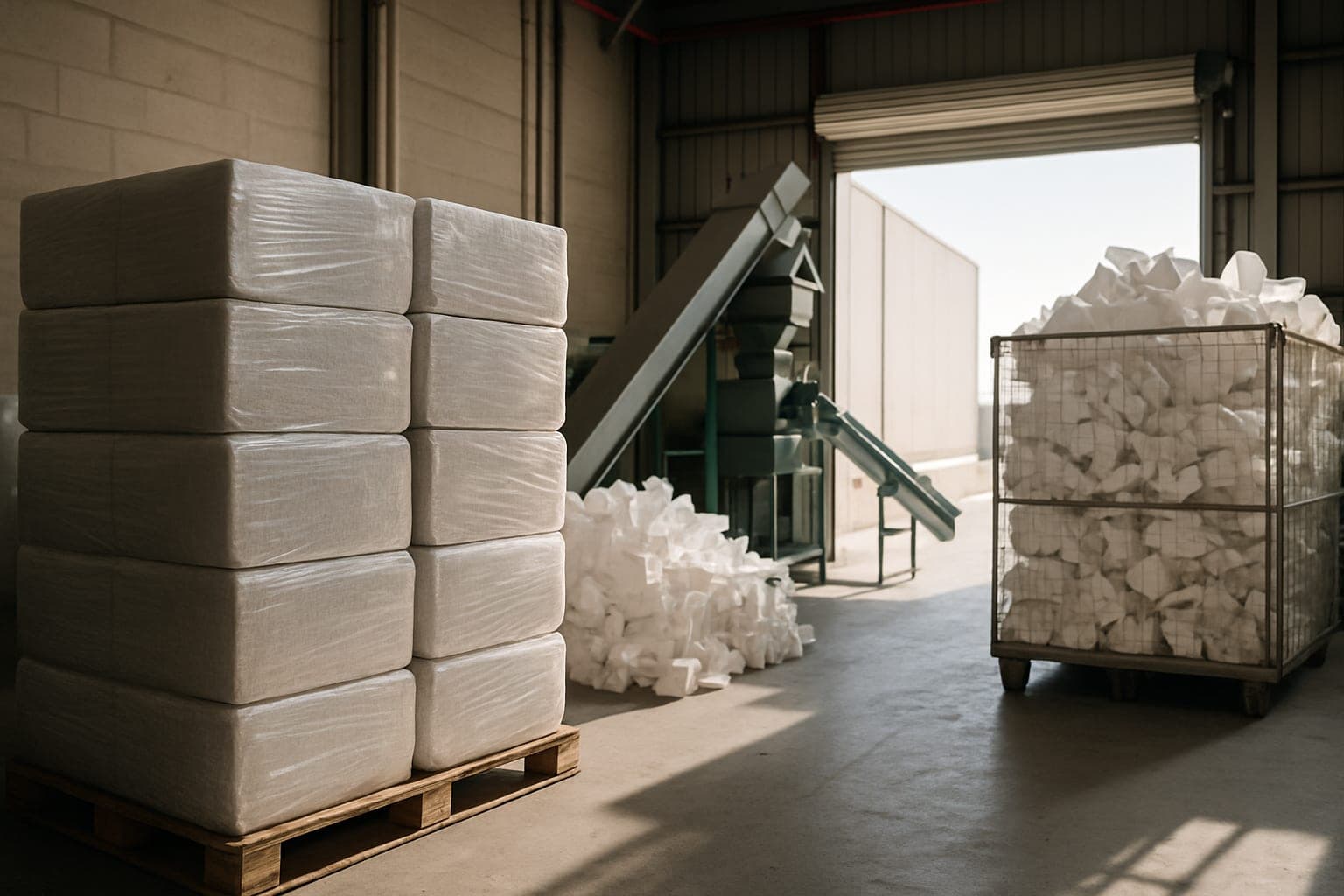
Loose expanded polystyrene is roughly 97 to 98 percent air, so a full trailer carries only 300 to 600 kg and the freight bill swallows any material value. UAE buyers quote on densified EPS instead, either cold-compacted blocks or hot-melt ingot, clean and white, with contamination near one percent, offered in pallet or container lots. Densify first, then list.
Why do UAE recyclers refuse loose EPS foam?
The polymer is not the problem. EPS is a thermoplastic and fully recyclable back into polystyrene pellets, sheet and moulded product. The problem is that you are shipping air. Equipment supplier Energycle puts loose EPS at 15 to 30 kg per cubic metre, which means a full truckload weighs only 300 to 600 kg while occupying the entire trailer. Set that against solid polystyrene at around 1,050 kg per cubic metre and the void fraction works out at 97 to 98 percent.
The same source estimates that moving un-densified EPS costs USD 150 to 400 per tonne in combined disposal and transport fees, which converts to roughly AED 550 to 1,470 per tonne at the pegged rate of AED 3.6725 to the dollar. That conversion is our arithmetic, not a quoted UAE tariff. Either way, the number is bigger than what any recycler will pay for the foam itself, so the honest answer to "who buys polystyrene waste in Dubai" is: nobody, while it is loose.
Run the pallet maths yourself. A standard 1.2 by 1.0 metre pallet stacked 1.5 metres high is 1.8 cubic metres. At 20 kg per cubic metre that pallet holds about 36 kg of foam. Densified to an effective 400 kg per cubic metre, the same footprint carries around 720 kg. Extended to a 40 foot container of about 67 cubic metres, you are comparing roughly 1,340 kg of loose EPS against 16 to 20 tonnes of ingot. Those are our calculations using the density figures above, but they explain every rejection email you have received.
Is Styrofoam banned in the UAE, and does the ban end the trade?
This is where warehouse and retail teams most often get bad advice. The bans target single-use consumer items, not protective transit packaging. Abu Dhabi's Environment Agency ban took effect on 1 June 2024 and covers expanded polystyrene cups, lids, plates and beverage containers, plus food receptacles for immediate or takeaway consumption. It explicitly exempts items not designed for single use, including coolers and large storage boxes, as well as medical-use products, according to the Abu Dhabi Media Office announcement of 21 May 2024 and reporting by FoodNavigator on 27 May 2024. Packaging Gateway reported 97 percent retailer compliance with the foam ban as of 24 December 2024.
Dubai Municipality phased its own restrictions: single-use plastic bags from 1 January 2024, all single-use bags from 1 June 2024, polystyrene cups, plates and food containers along with straws, stirrers and cotton swabs from 1 January 2025, and a final phase from 1 January 2026 covering plastic plates, beverage cups and lids, cutlery and chopsticks. Federally, Ministerial Decision No. 380 of 2022 governs single-use plastics, and MOCCAE confirmed in mid December 2025 that its second phase started on 1 January 2026, extending prohibitions on import, manufacture and trade of a wider list of consumer items and banning bags under 50 microns regardless of material.
So the foodservice stream is being removed by law, and that is exactly why the industrial stream matters more. Electronics and appliance inserts, cold-chain fish and pharma boxes, and EPS insulation board offcuts are unaffected. If you are holding stock of items that fall under the phase-out, that is a separate commercial problem covered in our guide to selling banned single-use plastic stock before it becomes waste. The recycling question here is about packaging arisings, and those keep coming.
Where does the tonnage sit? In distribution warehouses and 3PL sheds in Dubai Industrial City, Al Quoz and JAFZA, in electronics and white-goods importers around Musaffah and KEZAD, and in cold stores near Ras Al Khor. We have not verified any published EPS aggregation point in those areas, so treat them as where your material is generated, not as where a gate is waiting to take it.
What does densified EPS actually sell for?
Start with a correction that matters. There is no LME contract for polystyrene or any plastic, so anyone quoting you an "LME polystyrene price" is improvising. Recycled PS values track virgin polystyrene and styrene monomer contract pricing, published by services such as ICIS, Intratec and IMARC, plus local freight and the buyer's own yield loss.
We could not verify a single published AED buying price from a named UAE recycler for either loose EPS or densified ingot. Every AED figure below is our conversion of an international reference at the pegged rate, and should be used to frame a negotiation rather than to set one.
| Form | Typical density | Mass per 40 ft container (our calc) | Reference value |
|---|---|---|---|
| Loose EPS, uncompacted | 15 to 30 kg/m³ (Energycle) | about 1,340 kg | Negative. USD 150 to 400/t in disposal and transport (Energycle) |
| Cold-compacted block | Commonly cited 250 to 450 kg/m³ unverified | 16 to 20 t | USD 200 to 400/t, about AED 0.73 to 1.47/kg |
| Hot-melt ingot, white, under 1% contamination | Commonly cited 550 to 700+ kg/m³ unverified | Container weight-limited | USD 800/t FOB Singapore in one undated trader listing, indicative only |
| Recycled PS pellets | Bulk pellet | Weight-limited | USD 500 to 900/t, about AED 1.84 to 3.31/kg (Energycle) |
| Virgin EPS, for reference | n/a | n/a | USD 1,650/t Europe, September 2025 (Intratec); USD 1,474/t USA, December 2025 (IMARC) |
Two things jump out of that table. The spread between compacted block and pelletised output is where the processing margin lives, which is why densifiers are sold to generators and pelletisers stay with recyclers. And the gap between recycled and virgin PS is wide enough that a clean, consistently specified ingot has a real buyer, provided the buyer can move it in full loads.
How much EPS do you need before densification pays?
Energycle's guidance is that hot-melt densification suits operations handling 500 kg or more of EPS per day, and that a pelletising line is only justified above about 1,000 kg per day on a consistent basis. For context on throughput, GREENMAX lists its MARS M-C100 hot-melt unit at 100 kg per hour, so 500 kg a day is roughly a five hour run rather than a full shift. GREENMAX has also claimed volume reduction ratios of 50:1 or 90:1, though that market note dates from December 2022 and should be checked against current spec sheets.
Below that threshold, buying a machine is the wrong move. Three routes work better:
- Manufacturer take-back. STYRO, an EPS and XPS manufacturer marketing across Dubai, Sharjah and Abu Dhabi, states on its site, dated 27 December 2024, that it operates recycling facilities serving EPS end users, construction sites and other XPS manufacturers. That is the most credible named take-back route we found.
- Plastic scrap collectors that list EPS. AZ Scrap advertises plastic scrap recycling across Sharjah, Dubai and Abu Dhabi and names expanded polystyrene alongside film and engineering plastics, on a page dated 2026.
- Shared densification. If you sit in a multi-tenant industrial park, one densifier serving four or five warehouses reaches 500 kg a day when none of you would individually. Agree the split on weight of ingot produced, not on volume delivered.
Be honest with your finance team about what is not yet knowable. We could not retrieve a published capex figure in AED for a warehouse-scale densifier, nor a verified Dubai Municipality or Tadweer gate fee per tonne for foam. Both belong in your model, so get them in writing from the supplier and the municipality before you sign. Cost avoidance is usually the larger half of the business case, the same pattern we see in crushed concrete versus tipping fees.
What contamination gets an EPS ingot rejected?
Styrene UAE notes in a 2026 blog post that industrial EPS recycling in the country generally involves shredding and densifying before reuse, and that contamination from concrete and food residue is the barrier. That matches the specs traders publish. One undated regional ingot offer we found calls for white, clean material with under 1 percent contamination, which is a tight tolerance once you count tape.
Reject criteria to write into your own SOP
- Adhesive tape, printed labels and shrink film left on the foam. Strip before feeding, not after.
- Cement or gypsum dust on insulation board offcuts from fit-out sites.
- Food and fish residue on cold-chain boxes. Wash and dry fully, because moisture wrecks hot-melt output density.
- Mixed XPS, EPE and PU offcuts thrown into the same cage. They melt differently and downgrade the ingot.
- Coloured or heavily printed foam mixed with white. Keep white separate, the same colour discipline that lifts value in colour-sorted glass cullet.
How do you list a polystyrene lot buyers will quote on?
- State the form and the density. "Hot-melt ingot" or "cold-compacted block" plus kg per cubic metre. Ask your machine supplier to confirm the figure and put it on the listing.
- Give weight, not volume. Kilograms per pallet and total tonnes available, with a monthly run rate if the stream is recurring.
- Declare contamination honestly. Percentage by weight, and what the contaminant is. A stated 3 percent tape figure sells. A hidden one triggers a rejection.
- Photograph the stack, not a single ingot. Buyers price the load, and they want to see pallet count and consistency of colour.
- Name loading conditions. Emirate, bay access, forklift on site, hours, and whether the buyer needs their own straps.
- Publish before you accumulate the full container. Lead times are long enough that a buyer will often reserve against a build-up.
On our side, the counterparty is KYC-verified through UAE PASS, payment sits in escrow with MyFatoorah until the buyer completes a 48-hour inspection, and the transaction generates audit-ready ESG records for your diversion reporting. You can see live plastics listings on the marketplace to compare how other sellers specify their lots. Sellers pay a promotion package to publish. Browsing costs nothing.
One last point for procurement teams. Extended producer responsibility rules will keep pushing packaging costs back up the chain, which changes who pays for foam and when, as we set out in our note on packaging EPR rules in 2026. Densification kit bought this year is likely to be defending against a bigger cost next year.
Frequently asked questions
Why do UAE recyclers refuse loose EPS foam?
Loose EPS runs at 15 to 30 kg per cubic metre according to equipment supplier Energycle, so a full trailer carries only 300 to 600 kg. The same source puts the cost of moving un-densified foam at USD 150 to 400 per tonne in disposal and transport, which is more than the material is worth. Recyclers decline because the freight economics fail, not because polystyrene cannot be recycled.
Is EPS packaging banned in the UAE in 2026?
Single-use consumer foam is banned, industrial protective packaging is not. Abu Dhabi's ban from 1 June 2024 covers EPS cups, lids, plates and takeaway food containers but exempts items not designed for single use such as coolers and large storage boxes, plus medical products. Dubai Municipality banned polystyrene cups, plates and food containers from 1 January 2025, and electronics inserts, cold-chain boxes and insulation board remain legal to use and to trade.
What is densified EPS worth per kg?
We could not verify a published AED price from a named UAE recycler, so use international references as a starting point. Energycle quotes compressed EPS blocks at USD 200 to 400 per tonne and recycled PS pellets at USD 500 to 900 per tonne, roughly AED 0.73 to 1.47 and AED 1.84 to 3.31 per kg at the pegged rate. Ignore anyone quoting an LME price, because no LME contract exists for plastics.
How much EPS do I need before a densifier makes sense?
Energycle's guidance is that hot-melt densification suits sites handling 500 kg or more per day, while a pelletising line needs consistent volumes above 1,000 kg per day. GREENMAX lists a 100 kg per hour hot-melt unit, so 500 kg a day is about a five hour run. Below that threshold, use manufacturer take-back, a plastic scrap collector that accepts EPS, or share one machine across several warehouses in the same industrial park.
What contamination will get an EPS ingot rejected?
Styrene UAE identifies concrete and food residue as the main disqualifiers in local industrial EPS recycling. Tape, printed labels, shrink film, moisture and mixed XPS, EPE or PU offcuts all downgrade or reject a lot, and one regional ingot spec we found demands white material with under 1 percent contamination. Declare your actual contamination percentage on the listing rather than letting the buyer discover it during inspection.
Comments(0)
Sign in to join the conversation.