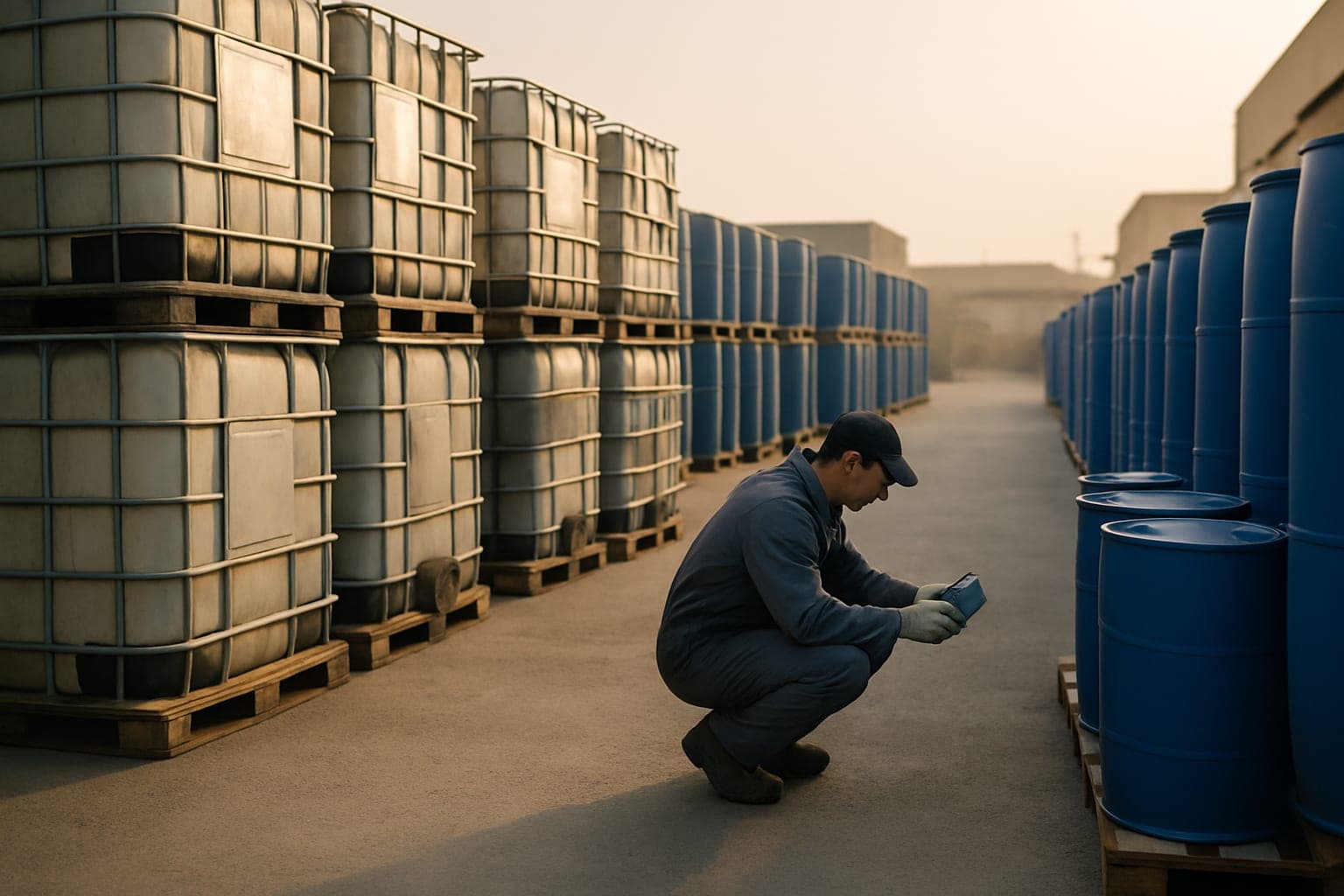
A clean container sells as a container, priced per unit against the cost of buying new. Regrind buyers price the same object per kilo, and there are only around 9 kg of HDPE in a 200-litre drum and roughly 18 kg in an IBC inner bottle. That gap is the entire opportunity. Residue, a legible UN mark and proof of prior contents decide whether you can reach it.
Why does a used container sell for more than the plastic inside it?
Because the two markets use different units. A reuse buyer is comparing your container to the price of a new one, so the reference point is replacement cost. Alfa Plastic L.L.C lists a new 1,000-litre IBC at AED 1,500 on a UAE exporter directory, though that listing carries no date and directory prices are indicative at best. Used and washed IBCs are almost always sold quote-only, which tells you the sellers expect to negotiate per unit rather than publish a number.
Regrind works the other way. A washer or granulator buys mass, sorts by colour and melt flow, and pays a rate per kilogram. Once you strip a container down to flake you have destroyed the only attribute that carried a premium, which was its ability to hold a liquid again legally.
Here is the arithmetic. We could not verify a current published UAE HDPE regrind assessment as of writing, so the columns below are a sensitivity illustration, not market quotes. Fill in your own confirmed bid and the conclusion does not change.
| Item | Approx. HDPE mass | Scrap value at AED 1.50/kg | At AED 2.50/kg | At AED 3.50/kg |
|---|---|---|---|---|
| 200 L HDPE drum | 9 kg | AED 13.50 | AED 22.50 | AED 31.50 |
| 1,000 L IBC inner bottle | 18 kg | AED 27.00 | AED 45.00 | AED 63.00 |
So a drum only has to fetch a two-digit resale price for reuse to win, and an IBC only has to clear a small fraction of new-build cost. This is the same logic that keeps wooden pallets out of the chipper, and we have written about how pallet buyers in Jebel Ali beat wood waste disposal costs on exactly that basis.
What is the difference between a washed IBC and a remanufactured one?
Three different products get called the same thing in daily conversation, and the price spread between them is wide.
- Washed or rinsed. The bottle is cleaned inside, the cage and pallet are checked, nothing is replaced and no packaging certification is issued.
- Rebottled. The steel cage and pallet are reused with a brand new inner receptacle fitted.
- Remanufactured or reconditioned to UN standard. The unit is rebuilt, tested and re-marked so it can legally carry dangerous goods again.
The UAE market we could verify sits firmly in the first category. SpillCo's product page dated 25 July 2025 markets a used and washed 1,000-litre IBC with an explicit statement that it is not UN-certified, and restricts its use to water, detergents, wastewater and agriculture. Crateco Pack LLC advertises IBC refurbishment in the UAE and positions its output for non-potable water, with export sales into Oman and Qatar.
We could not find a UAE operator that we can confirm performs full remanufacture with UN re-marking. That is a finding, not a gap to gloss over. If you are being offered a premium on the assumption that your drums or totes will re-enter dangerous goods service locally, ask the buyer to show you the certification they hold before you price on it.
Does the UN mark survive reconditioning?
The mark is the asset. On a composite IBC it is moulded or plated onto the unit and carries the design type, the packing group, the test pressure and the date and place of manufacture. Paint over it, grind it off, or crush the plate during a bad forklift move and you have converted a certified package into a water tank.
The five-year clock nobody accounts for
Under the UN model regulations for dangerous goods transport, a composite IBC with a plastics inner receptacle has a service life limited to five years from the date the inner receptacle was manufactured, unless a shorter period applies to the substance being carried. A container can therefore be spotless, pressure-tight and completely finished as certified packaging. That date is stamped on the bottle, not the cage, and it is the first thing a serious reuse buyer looks for.
We are not quoting a UAE circular number here because we could not verify one during research. Confirm the current requirement with the authority in your emirate and with the terms of your own dangerous goods transport permit before you make representations to a buyer.
Which residues kill reuse value outright?
Reconditioners refuse work they cannot clean or cannot legally accept, and refusal usually happens on arrival at their yard, after you have paid for transport. The usual disqualifiers:
- Products that cure or set, including isocyanates, polyester resins and two-part adhesives. A skinned bottle is regrind at best.
- Agrochemicals and pesticides, which most reconditioners will not touch regardless of rinse quality.
- Oxidisers and anything that reacts with residue from a previous load.
- Strong dyes and pigments that stain the wall and make the next fill unsellable.
- Unknown prior contents. If you cannot name what was in it, the answer is no.
Food-ingredient sites in Dubai Industrial City and KEZAD hit a different wall. A tote that held glucose syrup or edible oil is easy to clean, but food-contact reuse brings a separate approval chain, and most washed-only units are sold away from food service entirely.
How do you document prior contents so a reconditioner can accept them?
- Pull the safety data sheet for the last product held in each container and keep it with the batch, not in a shared drive nobody can find on inspection day.
- Photograph the UN mark and the inner receptacle manufacture date before the unit leaves your yard. Photograph the cage and pallet condition too.
- Record cleaning status honestly: untouched, triple-rinsed, hot-washed or caustic-washed, plus who did it and when.
- Leave original product labels attached unless the buyer asks for removal. Never paint over the certification mark to hide branding.
- Segregate by prior-content family. Mixed pallets of lubricant, solvent and food-grade totes get priced at the worst item on the pallet.
- State the dangerous goods class plainly, or state clearly that the contents were non-hazardous.
- Move the load on a permitted carrier with the paperwork the emirate requires. In Dubai that trail is now electronic, and we covered what changed when waste transfer notes went digital.
Which route fits which container?
| Condition | Best route | Priced how | Proof required |
|---|---|---|---|
| IBC, legible UN mark, bottle under five years, non-hazardous prior content | Reconditioning for reuse | Per unit | SDS, mark photo, bottle date, wash record |
| IBC, bottle over five years, sound cage | Rebottling, or non-DG service such as water and wastewater | Per unit, lower | Cage and pallet condition, prior content |
| IBC, split or stained bottle, good cage | Cage to steel scrap, bottle to regrind | Cage per kg steel, bottle per kg HDPE | Prior content declaration |
| 200 L HDPE drum, clean, closed head, mark intact | Reuse or reconditioning | Per unit | SDS, mark photo |
| Drum with cured or unknown residue | Granulation after treatment | Per kg, discounted | Prior content declaration, treatment record |
Note which line pays in steel. The galvanised cage is the component that tracks metal markets, and local scrap steel pricing has been unusually firm, as our note on UAE HMS 80:20 near AED 1,000 sets out. There is no exchange contract for HDPE at all, and the polymer benchmarks traders quote come from subscription assessments such as ICIS and Argus or Platts, which is why you will rarely see a public per-kilo number you can rely on.
Where are the buyers, and who is selling into them?
Used drum and IBC trading in the UAE clusters heavily in Ajman New Industrial Area, which shows up repeatedly in supplier directories as the base for washing, refurbishment and resale. Generation runs the other way, concentrated where the filling happens: lubricant blenders and chemical distributors in Jebel Ali and JAFZA, Hamriyah's chemical and coatings tenants, Musaffah and KEZAD in Abu Dhabi, plus paint and coatings operations around Al Quoz and Ras Al Khor.
Logistics decides the margin on small parcels. Empty IBCs are volume, not weight, so a curtain-sider fills up long before it is loaded out, and a run of 20 units from Hamriyah to Ajman can eat the whole premium if you pay for the truck alone. Batch by month, not by week, and get the buyer to collect where you can.
How do you stop reusable stock being priced as regrind?
Run both bids at once. Ask reconditioners for a per-unit price and granulators for a per-kilo price on the same batch, then compare on total AED per pallet, not per kilo, because the units are not comparable. Publish the container details rather than a vague plastics description: UN code, inner bottle manufacture date, prior contents with SDS attached, cleaning status, and a plain yes or no on whether the UN mark is still valid.
That is how we set up plastics listings on the marketplace. Counterparties are KYC-verified through UAE PASS, payment sits in escrow with MyFatoorah until release, and the buyer gets a 48-hour inspection window, which matters more on containers than on baled film because a single unrecorded residue can void a whole load. You can see what is trading now in plastics listings.
One assumption to drop before you model any of this: that doing nothing is free. Tipping fee regimes across the emirates have moved, and holding 300 unsold totes on a leased yard has a cost per square metre that runs whether they sell or not.
Frequently asked questions
Is a reconditioned IBC really worth more than the HDPE inside it?
Almost always, because reuse is priced per unit against the cost of a new container while regrind is priced per kilogram of polymer. A 1,000-litre IBC inner bottle holds roughly 18 kg of HDPE, and one UAE directory listing put a new IBC at AED 1,500 with no date attached. Clearing even a modest per-unit resale price beats the scrap value of that plastic.
Can a used IBC in the UAE be sold back into dangerous goods service?
Only if the UN mark is intact and still valid and the composite inner receptacle is within its service life. Every UAE supplier we could verify sells washed used IBCs for non-hazardous duty only, with SpillCo's July 2025 page stating plainly that its washed unit is not UN-certified. Ask any buyer promising a dangerous goods premium to show the certification they hold.
What documents does a reconditioner need before accepting my containers?
The safety data sheet for the last product held, photographs of the UN mark and the inner receptacle manufacture date, a cleaning statement covering method and date, and a clear declaration of dangerous goods class or non-hazardous status. Containers with unknown prior contents are normally rejected outright. Keep the pack with the batch so it survives an inspection.
Do agrochemical or isocyanate containers have any reuse value?
Rarely. Most reconditioners refuse agrochemical and pesticide packaging regardless of rinse quality, and isocyanates or polyester resins skin the inner wall in a way washing cannot reverse. Those units usually go to granulation at a discount, and the steel cage is often worth more than the bottle.
What happens to the steel cage and pallet if the bottle fails?
The galvanised cage and any steel pallet go to scrap and are priced against local ferrous grades, which have been firm through recent quarters. The bottle goes to regrind. Separating the two before you sell usually beats accepting a single mixed price for the complete unit.
Why do you not publish an AED per kilo HDPE regrind price here?
Because we could not verify a current published UAE assessment at the time of writing, and we do not print numbers we cannot source. HDPE has no exchange contract, and the reference prices traders quote come from subscription services such as ICIS and Argus or Platts. Use your own confirmed bid in the arithmetic above.

Comments(0)
Sign in to join the conversation.