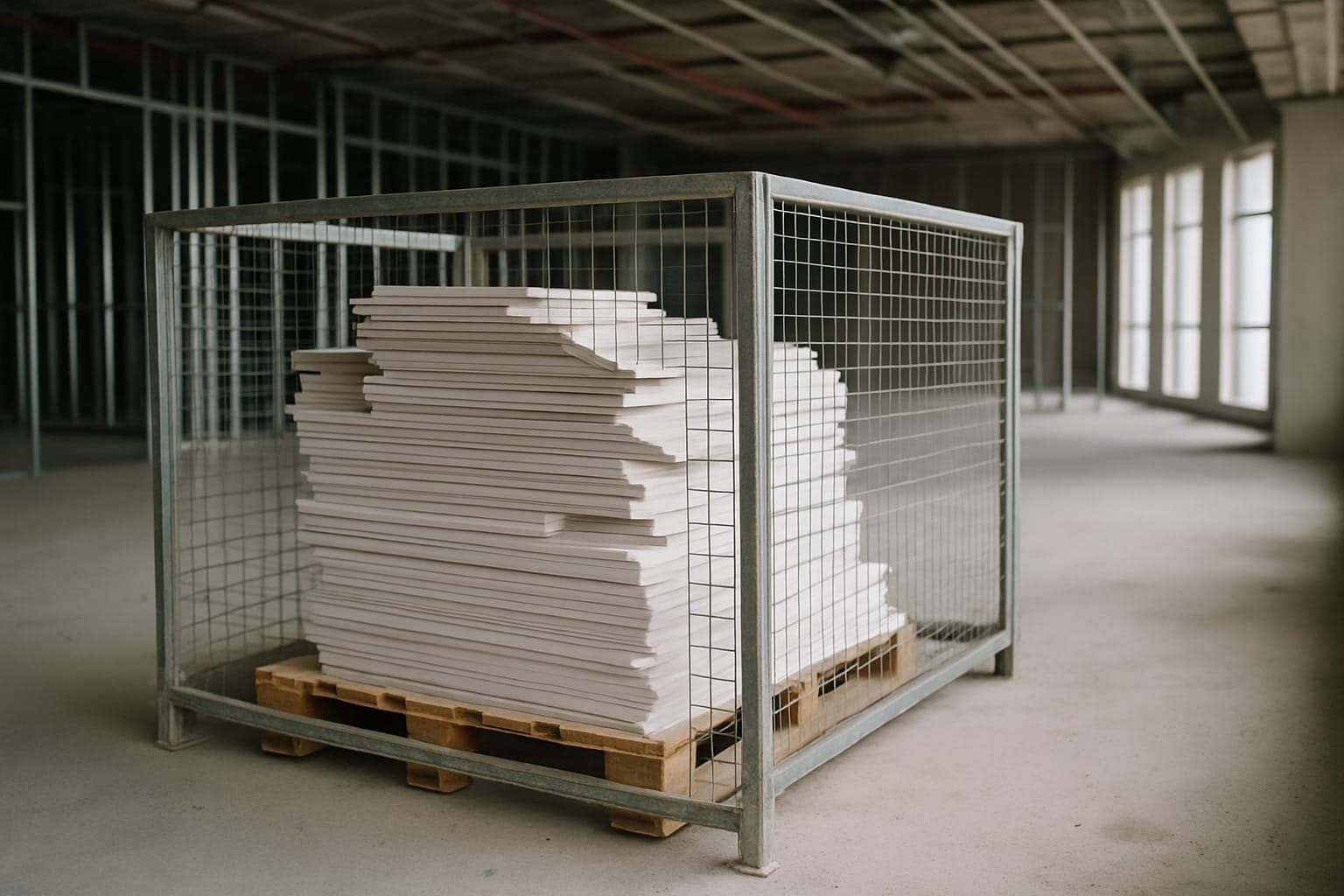
Cage plasterboard offcuts in a dedicated container from the first day of boarding out, keep them dry and free of joint compound, leave the paper facing on, and confirm a receiving facility in writing before demobilisation. Dubai market classification treats gypsum as sulphate-bearing waste, not inert, so letting it drift into a mixed skip costs you money and paperwork.
Why does gypsum board get treated differently from concrete and blockwork?
Gypsum is not inert. In the classification used across the Dubai C&D market, plasterboard sits in its own sulphate-bearing category, separate from inert waste such as concrete and masonry, separate from non-inert non-hazardous waste such as timber, packaging and glass, and separate from hazardous waste such as asbestos and contaminated soil. The reason is chemical rather than administrative. Under anaerobic landfill conditions gypsum breaks down and generates hydrogen sulphide, and the sulphate load can degrade the clay liners used to stop leachate migrating (FEECO International, page dated 30 May 2025).
That single fact reframes the whole job. Segregating gypsum is not a nice-to-have recovery play, it is the reason the stream is called out separately in the first place.
There is also a timing point worth knowing before you plan cages. International figures on gypsum board waste composition put new construction scrap at 64 percent of the total, demolition at 14 percent and renovation at 10 percent (FEECO International, 30 May 2025). That data is US-derived, not UAE, so treat the exact split as indicative. The direction still holds on any Dubai fit-out floor: the cleanest, driest, most saleable gypsum you will ever handle comes off the boarding-out phase, not off a strip-out.
What do federal and Dubai rules actually require on site?
Federal Law No. 12 of 2018 on Integrated Waste Management, issued 18 December 2018, names construction and demolition waste as one of seven governed streams and defines separation of waste as separation at the primary source for the purpose of reuse. The law also gives the Ministry power to oblige an entity to reuse certain waste it generates where reuse causes less environmental damage than disposal. The Executive Regulations, approved by Cabinet and announced by MOCCAE on 4 July 2021, set the principle that decides most disputes on site: the generator is responsible for proper disposal of the waste it generates and bears the financial cost.
In Dubai, the current primary instrument is Law No. (18) of 2024 on the Regulation of Waste Management, published in Official Gazette Issue No. 683. Articles 30 and 31 abrogate Local Order No. 7 of 2002 and Local Order No. 115 of 1997. The nuance that catches people out is that regulations, decisions and guides issued under those repealed orders stay in force where they do not conflict with Law 18/2024, pending replacement. So if your consultant is still quoting Local Order 7 of 2002 as live law, correct them, but do not assume the instruments beneath it have gone.
Two of those surviving instruments matter here. Dubai Municipality Technical Guidelines No. 7 on mandatory waste segregation, issued 13 September 2015, states plainly that the main factor in efficient source segregation is reducing contamination, because that improves the quality of the recycled product and makes streams easier and less costly for facilities to process. Executive Council Resolution No. (58) of 2017 remains the fee instrument behind every AED per tonne figure quoted in this market. Both are old, 2015 and 2017 respectively, and you should treat their numbers as a floor for enquiry rather than a current-year tariff sheet.
Transport, notes and the green building layer
Collection and transport of C&D waste in Dubai are regulated through municipal circulars, with Circular 6/2015 and Circular 12-10-1/2023 named in contractor guidance as requiring the activity to appear on the trade licence and requiring on-site segregation with dedicated sorting areas before transport. That reference comes from a demolition contractor's published guidance dated January 2026 rather than from the circular text, so ask your licensed hauler for the primary document before you write it into a method statement.
Every regulated commercial collection should also generate a waste transfer note through Dubai Municipality's digital system, filed within 24 hours of collection and recording waste type, quantity, generator, licensed contractor and receiving facility. Paper notes have been phased out for most commercial streams. Public reporting on the exact platform name is inconsistent, because the same name appears attached to a separate DM product registration system, so confirm the system with your contractor rather than a blog. What is not in doubt is where the duty sits. The obligation to ensure a valid note exists rests with the generator, which on a fit-out means you, not the skip company.
Above all of that sits Al Sa'fat. Silver Sa'fa is mandatory for new buildings and is required for building permit issuance, with Administrative Resolution No. (154) of 2020 governing exemptions. Green building requirements are reported to include diverting at least 50 percent of C&D waste from landfill, and the Dubai Waste Management Master Plan 2030 targets 75 percent diversion. One widely circulated claim goes further, that projects above AED 100 million must document 75 to 85 percent diversion with the completion certificate at risk. We could not verify that against a Dubai Municipality primary source. If your project is anywhere near that value, ask DM directly instead of budgeting against a rumour.
What is a tonne of clean gypsum actually worth?
Start by killing an assumption. Gypsum has no exchange benchmark, no LME contract, no published index. Recycled gypsum is priced against the delivered cost of virgin material into a buyer's plant, whether that is natural mined rock or imported synthetic FGD gypsum. So if anyone quotes you a confident market rate per tonne for plasterboard offcuts in the UAE, ask where the number comes from.
The money in this stream is on the disposal side, and it is real. The table below sets out the routing costs reported in the Dubai market, all of which trace back to Executive Council Resolution No. 58 of 2017 as relayed through commercial waste operators during 2025 and 2026. We have not verified them against the resolution text, and the schedule is eight years old.
| Route | Reported rate | What sends a load here |
|---|---|---|
| Segregated C&D to an approved treatment plant | AED 2 per tonne | Clean, single-stream, correctly declared |
| Pure C&D to landfill (concrete, asphalt, sand) | AED 20 per tonne | Inert only, no packaging, no canteen waste |
| Load reclassified as municipal or general waste | AED 100 per tonne | General or office waste found in a C&D skip |
| Hazardous or special waste | AED 550 per tonne | Asbestos, contaminated material, mis-declaration |
| Collection and haulage, charged on top | AED 150 to 400 per tonne | Applies regardless of gate rate |
Run the arithmetic on a single 12 tonne load. At AED 2 per tonne that is AED 24 at the gate. Reclassified at AED 100 per tonne it is AED 1,200. Waste operators describe inspectors reclassifying an entire load when general waste turns up in a C&D skip, which is a broker's account rather than a published municipal rule, but the fee gap alone explains why site teams who take segregation seriously report lower disposal spend. The same reclassification logic drives cost in other streams, which we covered in Dubai's AED 100 tipping fee and food waste diversion.
Penalty figures circulating for missing or invalid transfer notes range from AED 5,000 to 15,000 per load in one source and AED 5,000 to 50,000 per violation in another. The two disagree, so do not average them and do not quote either as settled.
What will a buyer accept, and what kills a load?
Be honest with yourself before you call anyone. We could not find a published UAE acceptance specification for gypsum offcuts, and we could not confirm that any UAE facility currently runs plasterboard recycling at commercial scale. The standard process described internationally is straightforward, separate the paper facing from the core, grind the core to powder, then blend recycled powder with fresh gypsum for new board, soil amendment or other products. Whether a plant near you will take your pallets is a different question. So your first call is an acceptance call, not a price call.
These are the terms to agree in writing before the first cage fills.
- Moisture. This is the most common reason a load dies. Board that has been rained on, stacked on a wet slab, or parked under a condensate drip goes soft, gains weight the buyer pays for, and can grow mould before collection. Keep offcuts inside the building line, on pallets or dunnage, covered.
- Paper facing. Grinding lines are generally built to strip facing, so standard paper-faced board usually goes as it is. Foil-backed, vinyl-faced and glass-mat products are different articles. Separate them and declare them.
- Fasteners. Drywall screws at low levels are normally pulled by magnets and screens. Track, channel, angle bead and bracket offcuts are not gypsum. They belong in your metals cage where they carry their own value.
- Chemistry. Cement-based tile backer board and gypsum-fibre board are not plasterboard. Mixing them contaminates the core.
- Everything else. Joint compound buckets, silicone tubes, sanding dust, plastic sheeting, cable clippings and cigarette ends. This is where fit-out loads die, and it happens in the last two weeks.
When do you cage the offcuts during a fit-out?
- At mobilisation, before the first board is lifted, name gypsum as its own stream in the project waste management plan and allocate a cage per floor or per zone.
- Site the cage inside the building envelope, off the slab, away from wet trades and away from any condensate line. A cage in the open yard in July is a cage of rejected material.
- Treat boarding out and first fix as your harvest window. Offcuts then are large, dry and uncontaminated. Once taping, jointing and skimming start, contamination rises fast.
- Brief the drywall subcontractor's chargehand directly, not just the main contractor's HSE file. The person cutting board decides where the offcut lands.
- Log tonnage or cage counts by floor as you go, and keep the transfer notes. Guidance in the market suggests holding them three years for handover and audit purposes.
- Book collection while trades are still on site. A gypsum cage left after demobilisation becomes a mixed skip within a day.
- Get acceptance confirmed in writing after inspection, then file it with your Al Sa'fat diversion evidence.
Write the gypsum stream into the drywall subcontract scope with a named cage location and a nominated receiver. If it lives only in the main contractor's waste plan, it will not survive the last fortnight of programme pressure.
How do you line up a receiver before demobilisation?
Post the material six to eight weeks before demob, not in the final week. Buyers of construction streams plan transport against their own intake schedule, and a listing that appears after the trades have left is a distress sale. Give the tonnage, board type and thickness, facing type, moisture history, emirate and exact location, access and loading equipment on site, and the collection window in dates. Photographs of the actual cage do more than any description. You can post construction material on our construction listings and let verified buyers come to you rather than working a phone list.
On AlKhiidma every counterparty is KYC-verified through UAE PASS, payment moves through escrow with MyFatoorah, and the buyer gets a 48-hour inspection window after delivery, which matters on a stream where moisture disputes are the norm. The transaction record then carries into audit-ready ESG reporting, which is the same evidence pack your sustainability consultant needs at handover. Contractors running several C&D streams at once often list gypsum alongside their harder assets, in the way we described for reclaimed asphalt millings.
If the honest answer comes back that no processor within range will take plasterboard this quarter, you have still won. Segregated, correctly declared non-inert C&D routes at its own rate and does not drag the rest of your load into a reclassification. And you walk into handover with a paper trail instead of an argument.
Frequently asked questions
Is gypsum board classified as hazardous waste in the UAE?
No. In the classification used across the Dubai C&D market, plasterboard falls into a sulphate-bearing category that sits separately from inert waste, from non-inert non-hazardous waste and from hazardous waste such as asbestos. It is not hazardous, but it is not inert either, which is why it should not be tipped into a concrete and masonry skip.
How much does construction waste disposal cost per tonne in Dubai?
Figures reported by Dubai waste operators put segregated C&D to an approved treatment plant at around AED 2 per tonne, pure inert C&D to landfill at about AED 20 per tonne, and municipal or general waste at about AED 100 per tonne, with collection charged separately at AED 150 to 400 per tonne. All of these trace back to Executive Council Resolution No. 58 of 2017, an eight-year-old schedule relayed through commercial intermediaries. Confirm the current tariff with your licensed contractor before you budget.
Who buys gypsum board offcuts in the UAE?
There is no published buyer list for plasterboard scrap in the UAE, and we could not confirm that a local facility runs gypsum recycling at commercial scale today. The realistic route is to approach board manufacturers and Dubai Municipality licensed C&D processors with an acceptance question first and a price question second, and to post the material publicly so buyers who do take it can find you. Ask for written acceptance criteria before you start filling cages.
Does wet plasterboard get rejected?
Usually, yes. Water makes the core soft and the paper facing unusable, adds weight the buyer pays for without gaining material, and can start mould growth before collection. Store offcuts inside the building envelope, raised off the slab on pallets and covered, and keep them clear of air conditioning condensate lines.
Do drywall screws have to be removed before collection?
Screws at normal fixing density are generally tolerated because processing lines use magnets and screens to pull ferrous metal out of the ground core. Metal track, channel, angle bead and bracket offcuts are a different matter and should go into your metals cage, where they earn their own value. Agree the tolerance in writing with the receiver rather than assuming it.
If the skip company mis-declares a load, who is liable?
You are. The Executive Regulations of Federal Law No. 12 of 2018, approved by Cabinet in July 2021, place responsibility for proper disposal and its financial cost on the waste generator, and the duty to ensure a valid waste transfer note exists sits with the generator as well. A licensed contractor reduces your risk but does not transfer the liability.

Comments(0)
Sign in to join the conversation.