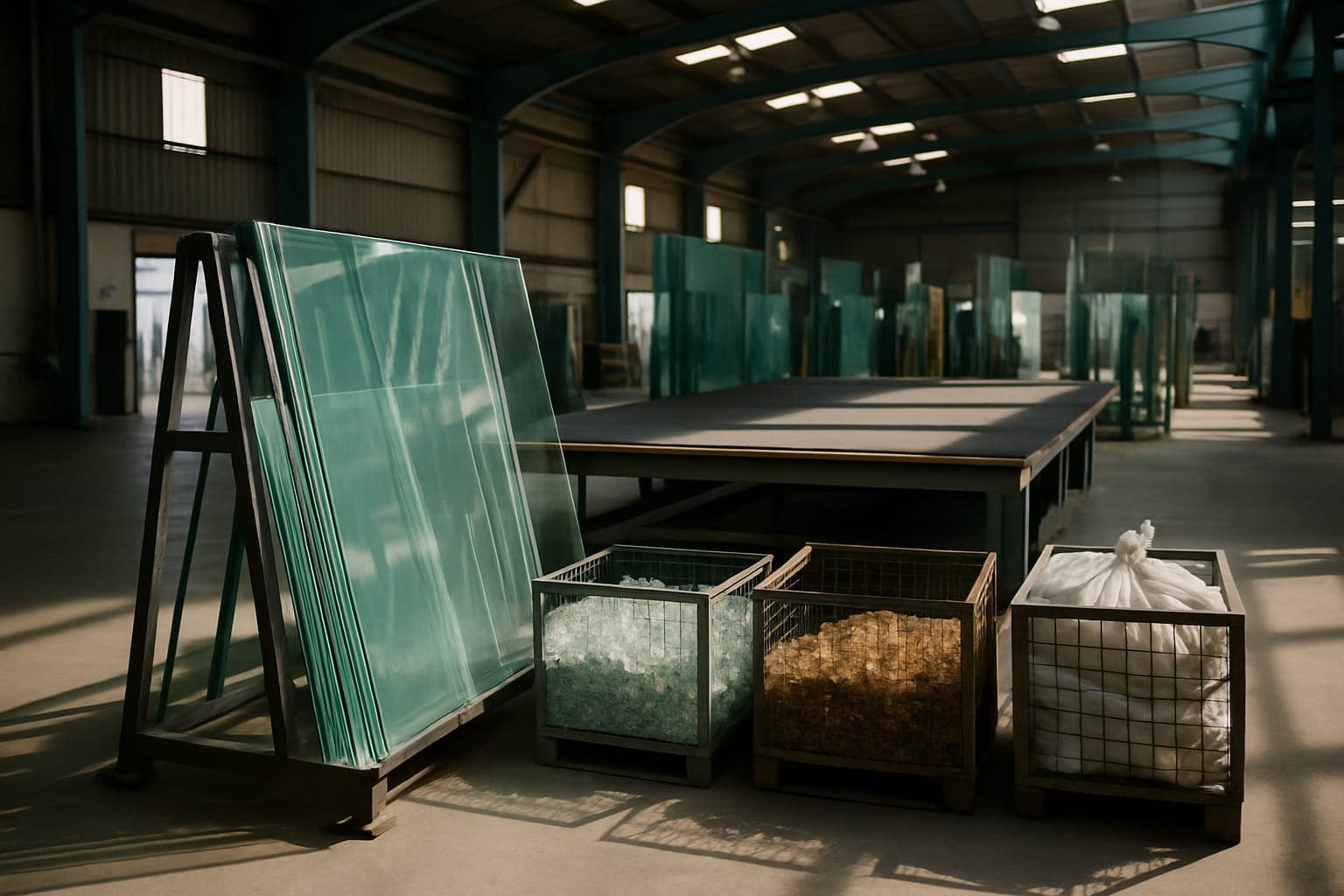
Clean, colour-separated float offcut sells. Mixed glazing waste does not. The split is made at the cutting table: laminated PVB, sealed units with spacer and sealant, mirrored, wired, fritted and borosilicate panels go to a separate container, and ferrous or stainless fragments never touch the clean bin. One careless bin downgrades a whole tipper load.
Why does a clean-looking load of glass still fail at the furnace gate?
Flat glass buyers sort incoming material into three categories, and the one your plant generates is the only one where the outcome sits in your hands. A June 2024 paper in the Challenging Glass Conference proceedingsRecycle Glass: A Contribution to the Circularity of Flat Glass, sets them out: internal cullet from the float line itself, which carries no quality risk and returns straight to production; pre-consumer cullet from glass processing, meaning breakage, geometrical losses and quality rejects at fabricators like yours; and post-consumer cullet from renovation and demolition, where the paper records that recycling into flat glass furnaces has been low or non-existent for years.
Your offcut is category two. It leaves the cutting table with a known composition and no site dirt, which is the only reason a furnace will look at it. Let it commingle with demolition glazing, banding and a few laminated rejects and it becomes category three in the buyer's eyes, with category three economics.
The tolerances are tighter than most operations managers expect. Contamination limits in furnace-grade flat cullet are counted in grams per tonne, not percent. A single ceramic insulator cap, a handful of PVB-bearing fragments or a dropped stainless fixing can be enough to down-grade or reject a 25-tonne load, because the defect they cause shows up in the finished ribbon hundreds of metres later. Metal is policed twice over. Ordinary ferrous appears as a stone, while nickel-bearing stainless carries the risk of nickel sulphide inclusions, which can survive the melt and cause spontaneous breakage in a tempered panel years after installation. That is why a serious buyer asks about your fixings and your banding before it asks about your tonnage.
What has to stay out of the clean flat cullet bin?
The clearest published segregation list we could find is the UK Green Building Council's how-to guide Building glass into the circular economy, from September 2018. It is eight years old and written for another market, so check it against your buyer's current written spec, but the exclusion logic is still what Gulf furnaces apply. The guide puts all clean offcuts of standard flat glass in a clear cullet bin and routes sealed units, mirrored, tinted, laminated, wired and printed glass elsewhere, and it warns specifically that borosilicate float must never enter flat glass cullet.
| Material | Why a flat furnace refuses it | Where it belongs |
|---|---|---|
| Laminated glass (PVB interlayer) | Organic interlayer contaminates the melt; separation needs a delamination line | Separate labelled stream, priced as disposal until a buyer confirms otherwise |
| Insulating glass units | Spacer bar, desiccant, primary and secondary sealant in one panel | Dismantle, or send as mixed glass |
| Mirrored glass | Silver and copper backing plus paint | Mixed cullet |
| Wired glass | Embedded ferrous mesh | Mixed, never the clean bin |
| Ceramic-fritted or printed glass | Ceramic pigment does not melt with the batch and reads as a stone | Separate crate |
| Tinted float | Not a contaminant, but it changes batch colour | Its own crate, sold separately |
| Low-iron float | Not a contaminant, but it loses its premium in a clear bin | Its own crate |
| Coated low-E and solar control | Buyer-specific; some furnaces take soft coat, some reject all coatings | Declare it and get an answer in writing before loading |
| Borosilicate float | Different melting chemistry entirely | Keep out of flat cullet |
| Ferrous and stainless fixings, banding, ceramics, stones, porcelain | Stones and inclusions; nickel-bearing stainless is the worst case | Nowhere near the clean bay |
Three lines deserve spelling out. Tinted and low-iron are value you lose by burying them in a clear bin, so give each a container from the first cut. Coatings are the genuinely buyer-specific item, and the only safe move is to declare them. Sealed units are the trap, because one unit puts spacer, desiccant and two sealants into the bin at once.
How is flat cullet different from container cullet, and why does that matter here?
Container cullet is colour-sorted flint, amber and green for bottle and jar furnaces. Flat cullet is float composition, chemically different, melted on different lines under a different spec, with alumina content among the limits that matter. Treating the two as one commodity is the most expensive technical error in this market.
It matters in the UAE for a specific reason. The only identifiable dedicated glass recycler in the public record, Random Global FZCO in Dubai, described its output in a 2020 industry directory listing as crushed cullet free of impurities, separated by colour, ready to be re-melted by manufacturers making new bottles and jars. That listing is six years old and its first-and-only claim is company marketing, but the orientation is the signal: the glass recycling capacity findable in this market was built around the container stream. A facade fabricator with clear float offcut is not selling into a ready-made buyer pool. Ask any container recycler two questions before you quote a price: can your furnace take float at all, and at what percentage of batch.
What is clean flat cullet worth per tonne in the UAE?
There is no published AED per tonne price for flat glass cullet in the UAE. As of October 2026 we could not verify one from a processor, a trade publication or a government schedule, and we are not going to invent a figure to fill the gap. There is also no exchange benchmark for cullet anywhere, unlike aluminium or copper, so anyone quoting you an index is quoting an aggregator.
Price forms as a netback. A furnace pays up to the value of what your cullet displaces, which is batch raw material (silica sand, soda ash, limestone) plus the melting energy saved, minus freight to its gate. Soda ash is the swing input. Because broken glass is heavy and worth little per cubic metre, freight takes an unusually large share of the gross, and that one fact explains why collection radius and minimum tonnage dominate every conversation you will have with a buyer.
Ignore the two price sources you will find first. ScrapMonster's US glass index, price-dated 19 August 2026, runs from USD 0.10 a pound for bottles to USD 0.48 a pound for CRV glass, and CRV is a California container-deposit subsidy rather than a commodity price, so converting it to AED produces a number wrong by roughly an order of magnitude. Indian listings on TradeIndia at INR 20 to 25 a kilo with a five-tonne minimum are seller asks in a different market with different logistics. Neither tells you anything about Musaffah or Al Quoz.
Three written quotes against a written spec, measured against your avoided disposal cost, will. Posting a specified and photographed load to a verified buyer pool is faster than cold-calling furnaces, and you can scan current glass listings and buyers on the marketplace before you commit to a sort regime. If you want hard volume data rather than anecdote, the customs line to pull is HS 7001.00, cullet and other waste and scrap of glass, from the Federal Competitiveness and Statistics Centre or UN Comtrade.
What does landfilling the same glass cost you?
This is the one number in the chain that is fully documented. Executive Council Resolution No. 58 of 2017, approving the fees and fines for waste disposal in the Emirate of Dubai, sets Schedule 1 gate fees per tonne, and Dubai Municipality's Administrative Resolution No. 253 of 2025 still cites it in its recitals, which is good evidence it had not been replaced as of 2025.
| Waste type | Treatment route | 2018 | 2019 | From 2020 onwards |
|---|---|---|---|---|
| Municipal waste | Landfilling | AED 80 | AED 90 | AED 100 |
| Organic waste | Waste treatment plants | AED 30 | AED 40 | AED 50 |
| Construction and demolition waste | Landfilling | AED 10 | AED 15 | AED 20 |
| C&D waste: concrete, asphalt, waste wood | Waste treatment plants | AED 2 | Not shown in the published extract | Not shown in the published extract |
Read the fourth line carefully, because it is where glazing contractors lose money. The AED 2 treatment-plant rate names concrete, asphalt and waste wood. Glass is not on that list. On our reading, a skip of mixed glazing offcut prices at the C&D landfilling line at best and at the municipal line if the gate judges it mixed or contaminated, a five-fold swing between AED 20 and AED 100 a tonne decided by classification alone. Confirm the code that applies to your load with the Dubai Municipality Waste and Sewerage Agency before you budget on it.
Gate fees are not your all-in cost. Collection, haulage and skip hire sit on top, and contractor prices circulating in the Dubai market in August 2026 were quoted indicatively at roughly AED 100 to 250 a tonne for general waste and AED 150 to 400 for construction waste, figures the source itself described as indicative rather than tariffed. Two claims to stop repeating: the historic AED 10 gate fee, long superseded, and the line that construction waste costs AED 2 a tonne in Dubai, which applies only to three named materials routed to a treatment plant.
Which rules decide who can legally take your cullet?
Federal Law No. 12 of 2018 on Integrated Waste Management, issued on 18 December 2018, names construction and demolition waste in its definition of waste and provides that the competent authority manages it according to standards of separation at source. It also gives MOCCAE power, in coordination with the competent authority, to oblige an entity to reuse or recycle certain waste types, a power not currently exercised on flat glass as far as we can establish. Cabinet Resolution No. 39 of 2021 carries the executive regulations. Because each emirate's local authority is responsible in its own area, there is no single national cullet rule to point at.
Dubai's current governing statute is Law No. 18 of 2024 on the Regulation of Waste Management, listed first on Dubai Municipality's Waste and Sewerage Agency legislation page. The instrument that decides who may receive your cullet is Administrative Resolution No. 253 of 2025, the technical guidelines for evaluating and classifying establishments engaged in waste-related activities. Secondary sources assert that Law 18/2024 brings a segregation mandate with penalties and mandatory digital waste transfer notes. We have not confirmed that against the law text, so read it before you build a compliance process on the claim.
Abu Dhabi changed regulator two years ago. On 29 May 2024 it was announced that the Environment Agency Abu Dhabi had assumed waste-sector licensing, permitting, vehicle tracking, the tariff system, the Sector Regulatory Authority function and inspection and compliance from Tadweer, which remains an operator rather than the regulator. A large share of published UAE waste content still has this backwards. For material leaving a demolition or retrofit site in the capital, our guide to how Abu Dhabi demolition NOCs hinge on C&D waste records covers the paperwork. In Sharjah, BEEAH's Waste Management Complex at Al Sajaa houses 12 recycling facilities including a commercial and industrial line using robotics and AI to identify and separate waste types, although we found no Sharjah rule written specifically for flat glass.
Who in the UAE and the Gulf actually takes it?
The float producers are the obvious first call and the hardest to pin down. Emirates Float Glass sits at ICAD 2 in Musaffah, Abu Dhabi, established by Dubai Investments on a 320,000 square metre plot at a reported AED 692 million with a design capacity of 600 tonnes a day of clear molten glass. Guardian operates a float plant in Ras Al Khaimah, reported at USD 150 million. Every public figure for both dates from somewhere between 2006 and 2014, so treat capacity, ownership and above all third-party cullet intake policy as unknown until you have spoken to them directly.
Ask every candidate buyer the same five questions: do you take third-party flat cullet, against what written spec, at what percentage of batch, what is your minimum load, and who bears the cost when a load is rejected at your gate. The last one is where sellers get hurt. A 25-tonne load turned away for a handful of PVB fragments leaves you with no payment and a return-freight bill on a material worth less than the truck that carried it. Escrow through MyFatoorah and a 48-hour buyer inspection window exist for exactly that scenario, so the buyer checks before funds release and nobody argues about a tipper that has already been emptied.
Be careful with recycler names. Green Land Recycling lists glass waste recycling at Saih Shuaib on Al Fayah Truck Road in Dubai on a page dated October 2024, while a similarly named Greenland Recycling LLC at Dubai Investments Park 2 appeared in a 2021 Gulf News listing with an intake of personal care products, electronics and optical media, and no glass at all. They may well be two different companies. Verifying a counterparty's identity and licence through UAE PASS before you load is not administrative housekeeping in this material, it is the difference between a sale and a disposal you paid for twice.
How do you move a material this heavy and this cheap?
Whole panels and large offcuts travel on A-frames and stillages. Broken cullet travels in steel crates or bins. Keep clear, tinted and low-iron apart from the first cut, because re-sorting commingled cullet costs more than the material is worth and no buyer will do it for you. A glass crate fills out on weight long before it fills out on volume, which is why the commercial unit in this trade is a full bulk tipper or container payload rather than a skip lift.
On minimum tonnage, the only UAE-specific figure in the public record is a trade listing for broken glass cullet quoting a 27-tonne minimum order against a supply ability of 5,000 tonnes a month. It is undated and unverified, so treat it as directional. Plan on aggregating across weeks, lines or sites to reach a load, and give the buyer your accumulation rate so collection is scheduled rather than improvised.
We could not verify a UAE figure for offcut rate per tempering line, skip hire rates by emirate, or the bulk density of broken flat cullet, and estimates dressed as data help nobody. Measure your own instead. Weigh the glass skip weekly for a month and split the weight by stream. You will end up with a better number than anything currently published, plus the baseline a diversion claim needs.
How do you set up the cutting hall so the load passes?
- Baseline for four weeks. Weigh the glass containers, split the weight by stream and record the mix. You cannot price a stream you have never measured.
- Put four containers at the cutting table: clear float, tinted, low-iron and reject. Position them so the shortest walk is to the right bin.
- Make the reject container the default for anything laminated, sealed, mirrored, wired, fritted or borosilicate, and label it in Arabic and English so a new operator cannot guess wrong.
- Ban metal and ceramics from the clean side. No banding offcuts, no fixings, no insulator caps, no crockery, no broom sweepings. Sweep the clean bay separately and bin the sweepings elsewhere.
- Cover the clean crates. Sand and site dust are contamination too, and in Al Quoz or Musaffah they arrive free of charge.
- Get the buyer's written spec before the first load, including the exclusion list, the position on fines and moisture, and the rejection terms.
- Send a pre-qualification sample with photographs and a weight before you book a truck.
- Transact with inspection and escrow, and keep the transfer record. Verified counterparties, a 48-hour inspection window and audit-ready documentation turn a one-off sale into a repeatable outbound lane.
How do you write cullet into a glazing subcontract before the first panel is cut?
If the subcontract is silent on arisings, title defaults to whoever removes them. The hauler then captures any residual value while still charging for the lift, which is the quiet reason so many fabricators are convinced their offcut is worthless. Fix it in the contract, not in a site meeting after the skip has arrived.
Five clauses do the work. Title to arisings, naming which party owns clean flat cullet and which owns the laminated and sealed-unit reject stream. A segregation obligation with the bins specified, so the cost of a mixed bin lands on the party that mixed it. Allocation of rejection and return-freight risk at the buyer's gate. Custody of diversion evidence, because the party holding the weighbridge tickets and transfer records is the party that can claim the tonnage. And a proceeds clause stating whether net income flows to the subcontractor, the main contractor or the employer, since an unpriced stream is an unclaimed one. Have a UAE construction lawyer or your QS review the wording, because this is the section most likely to be quoted back at you.
The evidence clause earns its place on any project with a completion-linked diversion target, where glass leaving site as documented recovered material counts and glass leaving as mixed waste does not. Our explainer on Dubai's 50% C&D diversion rule sets out what that evidence needs to look like.
One lever sits upstream of all of it. If your waste contract was priced on the assumption that everything leaving the fabrication hall is waste, the rebate on a segregated glass stream belongs in the next tender, and retendering that contract is usually where the arithmetic finally changes.
Frequently asked questions
Is there a published price for flat glass cullet in the UAE?
No. As of October 2026 we could not verify an AED per tonne figure from any processor, trade publication or government schedule, and there is no exchange benchmark for cullet anywhere in the world. Price forms as a netback from the furnace gate: the batch raw material and melting energy your cullet displaces, minus freight. Get three written quotes against a written spec and compare them to your avoided disposal cost.
Can laminated glass with a PVB interlayer be sold as cullet?
Not into a clean flat cullet load. The PVB interlayer is an organic contaminant that a float furnace will reject, and separating it requires a delamination line. Keep laminated panels in a separate labelled container and budget their removal as disposal unless a buyer confirms in writing that it accepts them.
What is the minimum load a UAE cullet buyer will collect?
Plan on a full bulk tipper or container payload rather than a skip lift, because freight is a large share of the value in a material this heavy. The only UAE figure in the public record is an undated trade listing quoting a 27-tonne minimum order, so treat it as directional. Aggregate across weeks or sites and tell the buyer your accumulation rate so collection can be scheduled.
How much does it cost to landfill glass in Dubai?
Executive Council Resolution No. 58 of 2017 sets construction and demolition waste at AED 20 a tonne for landfilling from 2020 onwards and municipal waste at AED 100. The AED 2 treatment-plant rate names only concrete, asphalt and waste wood, so glass does not qualify for it. Collection, haulage and skip hire sit on top of the gate fee.
Who owns the offcut on a glazing subcontract?
Whoever the contract says, and where it is silent, title effectively passes to whoever removes the material. In practice that means the hauler captures the value while still charging for the lift. Write title to arisings, segregation duties, rejection risk, custody of diversion records and proceeds into the subcontract before the first panel is cut.

Comments(0)
Sign in to join the conversation.