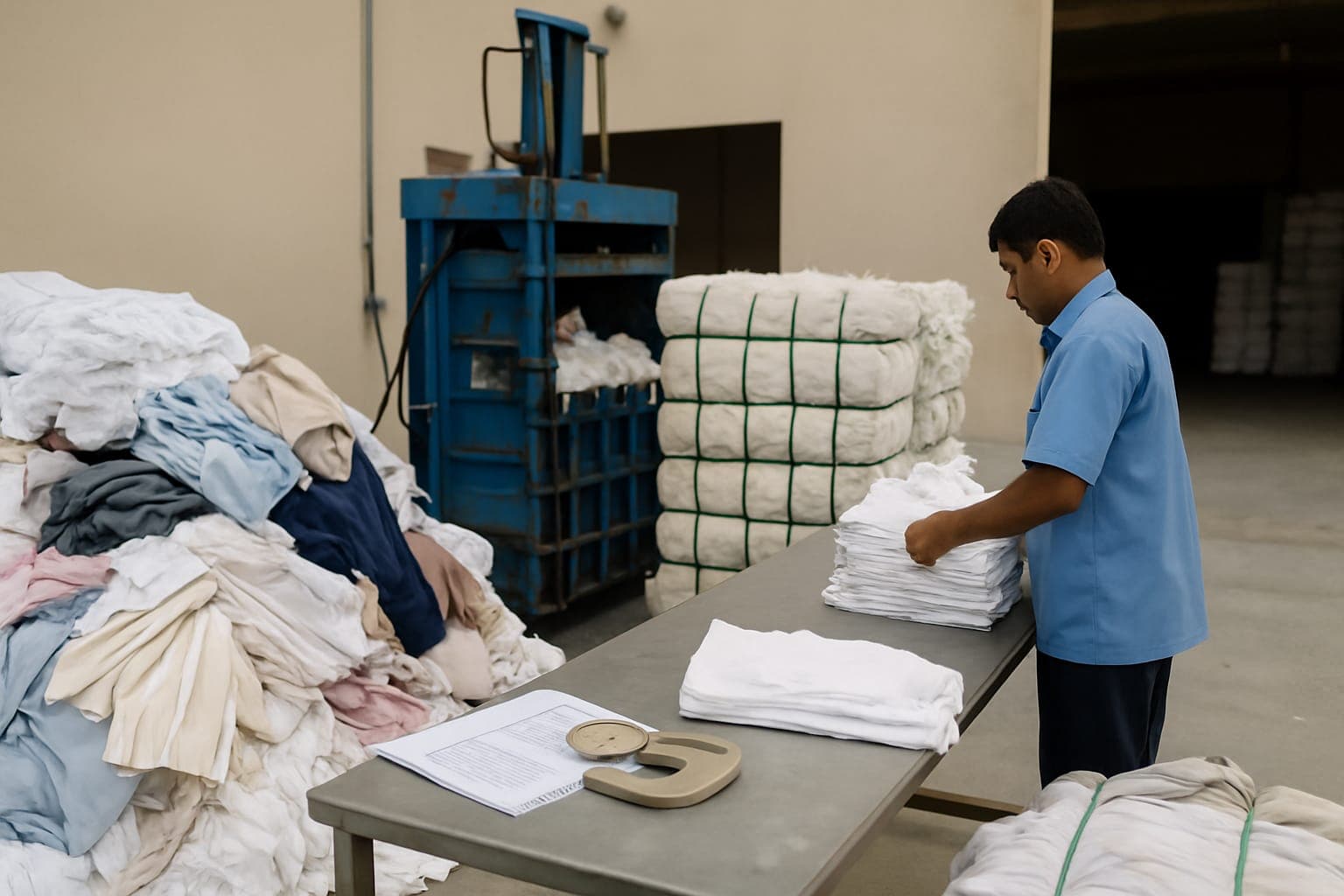
Strip logos first, then sort into three streams and sell by grade. Unbranded white cotton sheeting and cotton-rich terry towelling has a real buyer base in Sharjah's rag and wiper trade. Branded uniforms need documented debranding or witnessed destruction first. For most hotels the money sits in avoided disposal cost and an auditable diversion record, not the per-kilo cheque.
Who actually buys used hotel linen and uniforms in the UAE?
Sharjah is where the buyers sit. SOEX Processing Middle East FZE has been sorting in the emirate since 2016 and its corporate pages describe roughly 500 employees processing up to 140 tonnes of new and used textiles and footwear per day across a 30,000 square metre plant, inspecting material against up to 400 criteria. Those figures carry no date on the SOEX site, so treat them as indicative and confirm current intake before you plan around them.
In SAIF Zone, SK Export FZC grades European-sorted second-hand clothing, shoes and stocklots into more than 180 lines and packs bales of 35 kg to 100 kg to buyer specification, per its site as of 10 March 2026. Older coverage of the Sharjah cluster is still quoted freely: The National profiled Hands Industries in July 2021 at 60 tonnes a day with about half re-exported as wearable clothing. That is five-year-old reporting. Do not build a 2026 sales assumption on it.
For linen specifically, the wiper converters are the most direct buyers. Wiper World markets cut and uncut cotton wiping rags and explicitly names hotel laundry bedsheets and towels among its input materials. Al Ras Textiles Establishment, trading as ARASTCO, lists bed sheet rags cut from reclaimed bedsheet material alongside coloured towel rags, on pages dated January and February 2024. Able Recycling in Dubai accepts linens, curtains and upholstery as a service stream.
On the fibre side, Landmark Circulife opened at Dubai World Central in December 2024 with an initial capacity of 2,000 tonnes of textile waste per year. Set that against national textile waste generation of 220,000 tonnes annually, a figure carried by WAM in June 2026, and domestic fibre recovery is handling under one percent of the stream. Sharjah has been the region's sorting hub for two decades. Dubai has the newer fibre-to-fibre plant. Both statements are true, and the press framing of a regional first belongs only to the second one.
How much per kilo can you expect for used bed sheets and towels?
There is no exchange, no published gate price and no government tariff for post-consumer textiles in the UAE. Every number in this trade is a private quote between a property and a grader. The AED 2 per kg figure that circulates in local recycling content came from Kiswa's consumer doorstep buy-back reported by Khaleej Times in January 2022. It was a household collection incentive, it is four and a half years old, and it is not a commercial baled price for hotel linen.
The macro backdrop is soft, not booming. Observatory of Economic Complexity data puts the global used-clothing trade at USD 4.96 billion in 2024, down 6.79 percent from 2023, and places the UAE among the three largest national trade deficits in used clothing at minus USD 179 million. The UAE is a net importer that brings in European-sorted stock to grade and re-export. Your stripped linen competes with that imported, already-graded feedstock, which caps what a Sharjah buyer will offer.
Three things move the price and none of them is your negotiating skill: ICE Cotton No. 2 futures, which set the cost of the virgin cotton that reclaimed wiper stock undercuts, polyester staple fibre pricing, which tracks crude and caps recycled polyester value, and East and West African import demand, which sets the reuse-grade ceiling. Linen and towelling are an absorbency play, not a fibre-value play. White cotton and cotton-rich terry has a market. Polycotton uniforms mostly do not, and that gap is the single most important commercial fact on your side of the table.
So price it the way you would price any thin-margin secondary material. Get three written, dated quotes from named buyers, state clearly whether the price is collected from your loading bay or delivered to their gate, and confirm who pays haulage. On small tonnages the collection cost usually decides whether you net anything at all, exactly as it does with wood. The same arithmetic that turns pallets from a cost line into a revenue line applies here, and we walked through it in our guide to pallet buyers in Jebel Ali.
How do you grade a decommissioned linen room?
Sort at the point of stripping, not at the loading bay. Once white sheeting is mixed with coloured towelling and polycotton tunics, you have created a mixed bale, and a mixed bale is priced at the value of its worst component.
| Stream | Typical material | Route | Buyer type | Commercial reality |
|---|---|---|---|---|
| Reuse grade | Unbranded sheets, duvet covers and towels with no stains, tears or thinning | Sorted and baled for export as second-hand goods | Sharjah graders in SAIF Zone, Hamriyah and Sharjah Industrial Area | Best price of the three, but the export ceiling fell with the 6.79 percent global contraction in 2024 |
| Wiper grade | White cotton sheeting and cotton-rich terry with stains or light damage, still absorbent | Cut into industrial wiping rags | UAE wiper converters that name hotel bedsheets and towels as inputs | The most reliable domestic outlet for hotel linen, priced on absorbency and colour, not on brand |
| Fibre or energy recovery | Polycotton uniforms, polyester blends, rubber-backed mats, heavily soiled stock | Shredding to secondary fibre, or waste to energy | Fibre recovery plants, licensed waste operators | Usually at or below zero net of haulage. Budget this as a disposal cost, not a sale |
Keep three physical piles and label them at source: white flat, coloured terry, and blends. Housekeeping already handles linen by category during a par-stock change, so the marginal labour is small if you brief the team before the refurbishment week rather than after it.
What do you do with uniforms that carry a logo?
Treat branded uniforms as a security item, not a textile. A logoed tunic, a housekeeping dress or an airline crew jacket appearing on a resale rack is a brand incident and, in most operator agreements, a contract breach. Donation is not the safe default answer here that people assume it is.
Specify the method in writing before the material leaves your building. The realistic options are logo excision, where the embroidered or printed panel is cut out and the shell is downgraded to rag, overdyeing to obliterate the mark, shredding against a certificate of destruction, or witnessed destruction with your own security or brand representative present. UAE market practice varies between operators and we have not seen a single published standard for it, so put your requirement in the contract and require evidence rather than assuming your buyer's default.
Ask for four things on every uniform batch: a weight ticket in and out, dated photographs of the defaced or shredded material, a signed certificate of destruction naming the batch, and a clause prohibiting resale as wearable garments anywhere in the world. If a buyer will not sign that, they are not a uniform buyer. They are a resale trader, and you have just learned something useful.
How should the material be baled, and what should you exclude?
Agree bale weight before the first pickup. The one verified UAE reference point is SK Export's 35 kg to 100 kg range packed to buyer specification, and most graders will tell you which end of that band suits their line. Consistency matters more than the number itself, because a buyer paying on a per-kilo rate wants to weigh predictable bales rather than reconcile loose bags.
- Brief housekeeping and the laundry contractor two weeks before the refurbishment date, with the three-stream split written on the store room wall.
- Launder everything before it leaves. Wet or damp linen grows mould in a bale within days and will be rejected on inspection.
- Remove hangers, name badges, pins, plastic clips and metal fastenings. These damage cutting equipment and give a converter a reason to renegotiate.
- Keep spa and treatment linen carrying oil or chemical residue out of the commercial bales. Clinical and soiled hospital linen is a separate regulated stream entirely.
- Bale by category, strap, and mark each bale with category, weight and date.
- Photograph the finished stack and the weight tickets. This is your evidence pack for the buyer and for the ESG file.
- Book collection against a fixed pickup window and get a signed transfer note on departure.
What does UAE regulation require now, and where is it heading?
The direction of travel changed in June 2026. Naseej, the National Initiative for Textile Circularity, launched under the directives of President Sheikh Mohamed bin Zayed Al Nahyan, bringing together the National Projects Office, the Ministry of Economy and Tourism, Emirates Foundation and Tadweer Group with researchers and industry partners. Its declared workstreams include collection, recycling, consumer behaviour, regulation and circular business models. Its first public activation, The Fabric of Possibility, ran from 5 to 7 June 2026 at Yas Mall in Abu Dhabi before expanding nationally. No binding collection target or producer obligation had been published at the time of writing.
The baseline it is working against is poor. Speaking at COP28 in December 2023, Tadweer's then managing director and chief executive Eng. Ali Al Dhaheri said less than 10 percent of UAE textile waste was formally collected for recycling, with the majority going to landfill. That figure is nearly three years old and should be quoted with its date. Whether Naseej has since published a newer collection rate is something we are still checking.
At emirate level, verify before you cite. Several commercial sources reference Dubai Law No. 18 of 2024 on waste management and a Cabinet resolution requiring commercial entities to register and use permitted waste providers, but those are SEO pages rather than the Dubai Legislation portal, so confirm the citation yourself. The Ministry of Climate Change and Environment has issued executive regulations for integrated waste management and a ministerial decision prohibiting the passage and export of hazardous waste across UAE borders, per the u.ae government platform as of 11 June 2026. Producer-side cost shifting is already visible in packaging, which we covered in our note on EPR rules for UAE producers, and textiles are the obvious next candidate.
How do you structure a repeat-supply contract with a verified textile buyer?
A refurbishment is a one-off. A linen room is not. A 300-key property replaces par stock continuously, so the value is in a standing offtake agreement rather than a single clearance sale.
- Fix the specification. Name each grade, the acceptable colours, the moisture condition and the exclusions in an annex, not in an email thread.
- Fix the pricing basis. State AED per kg by grade, whether it is collected or delivered, and a review date. Quarterly review is fair to both sides in a market with no published index.
- Fix the volume band. Give a minimum and maximum monthly tonnage so the buyer can plan cutting capacity and you are not left holding stock during a quiet quarter.
- Verify the counterparty. Trade licence, waste transport permit where the emirate requires one, and a named contact. On AlKhiidma, counterparties are KYC-verified through UAE PASS before they can transact.
- Protect the payment. Escrow through MyFatoorah holds funds until the load is accepted, which removes the awkward conversation that follows a rejected bale.
- Agree the inspection rule. Our 48-hour buyer inspection window gives a converter time to open bales and confirm grade, and gives you a defined point at which the sale is final.
- Capture the paperwork. Weight tickets, transfer notes and destruction certificates should land in one file per month, formatted for audit rather than reconstructed at year end.
That last point is usually the real prize for a sustainability manager. The diverted tonnage line in a hotel's reporting is worth more internally than the cheque, and it needs to survive an auditor's question about where the material actually went. You can see who is buying textile lots right now on our textiles listings, and post a lot with photographs, weights and grade before your next par-stock change.
Frequently asked questions
Who buys used hotel linen and towels in bulk in Dubai?
The most direct domestic buyers are industrial wiper converters, which cut white cotton sheeting and terry towelling into wiping rags and openly list hotel bedsheets and towels as input material. Above them sit the Sharjah graders in SAIF Zone, Hamriyah and Sharjah Industrial Area, who sort for reuse and export. Fibre recovery, such as the Landmark Circulife plant that opened at Dubai World Central in December 2024, takes the material nobody else wants.
How much per kilo do used bed sheets and towels fetch in the UAE?
There is no published benchmark for post-consumer textiles in the UAE, so any single number you read online is either a private quote or out of date. The AED 2 per kg figure that circulates came from a consumer doorstep buy-back reported in January 2022 and is not a commercial baled price. Get three written, dated quotes by grade and confirm whether haulage is included, because on small tonnages collection cost decides your net.
How do we dispose of uniforms carrying a hotel logo?
Debrand or destroy before the material leaves your site, and document it. Acceptable methods are excising the logo panel, overdyeing, or shredding against a certificate of destruction, ideally witnessed. Require weight tickets in and out, dated photographs and a written prohibition on resale as wearable garments anywhere.
Can we still donate hotel linen to charity?
Unbranded sheets and towels in reuse condition can be donated, and many properties do. Branded uniforms are different, because a logoed garment reaching a resale rack is a brand incident and often a breach of the operator agreement. Keep the two decisions separate and never let a donation route absorb branded stock by default.
What paperwork do we need for an ESG or sustainability report?
You need weight tickets for each collection, a transfer note signed on departure, the buyer's trade licence and permit details, and a certificate of destruction for any branded batch. Photographs of baled and marked material make the file far easier to audit. Building this monthly is much less painful than reconstructing a year of movements in the week before a report is due.
Is UAE textile waste volume actually significant?
WAM put national textile waste generation at 220,000 tonnes per year in June 2026, at the launch of the Naseej national textile circularity initiative. Tadweer's chief executive said at COP28 in December 2023 that less than 10 percent was formally collected for recycling, a figure now nearly three years old. Against that, domestic fibre recovery capacity is small, which is why the reuse and wiper routes still matter most for hotel linen.

Comments(0)
Sign in to join the conversation.