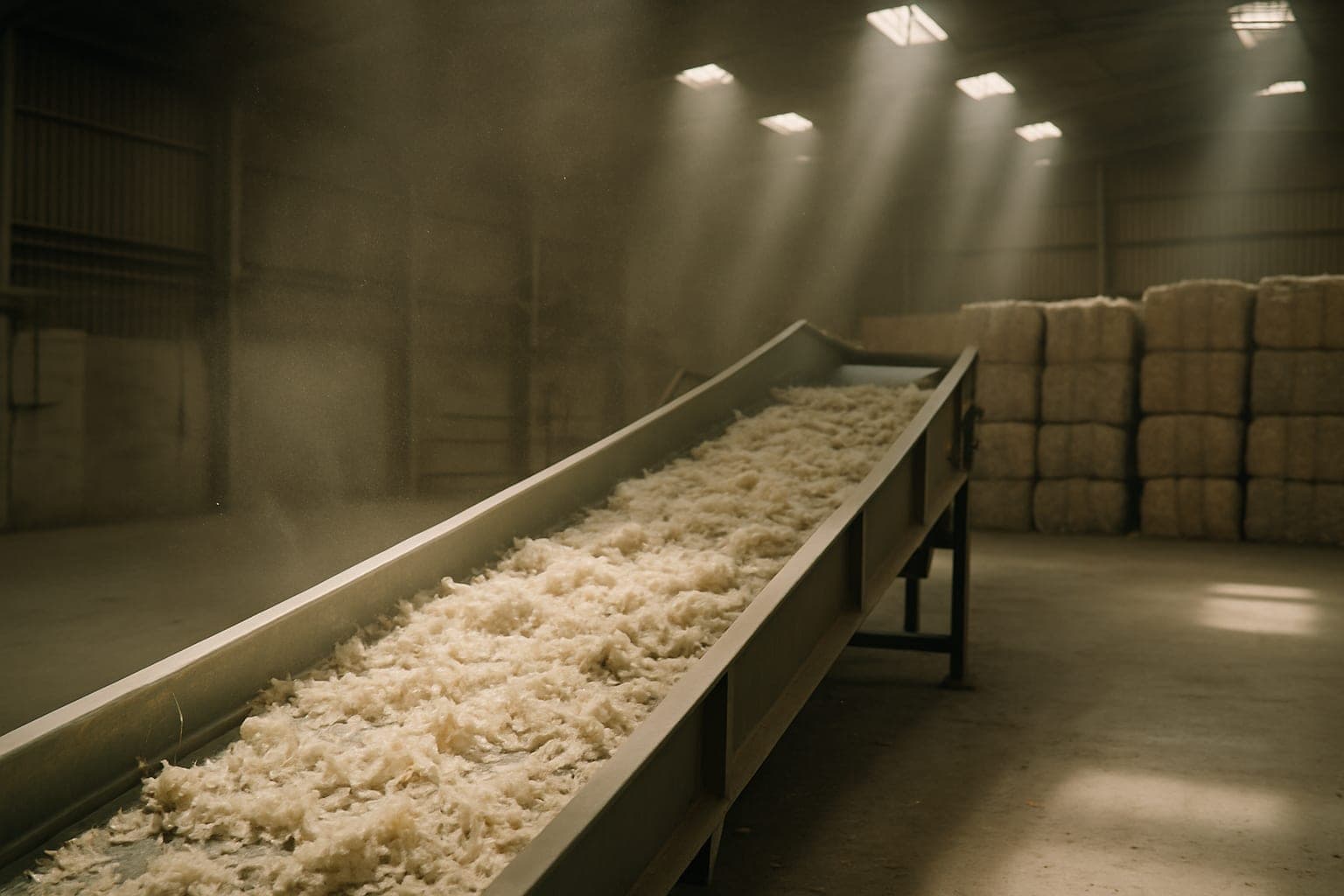
A UAE cement kiln will take your non-recyclable residue as fuel when it arrives dry, shredded to 30 to 50 mm, and under roughly 1% chlorine, the class 3 boundary in EN 15359. The spec is the easy part. Whether the trade beats a Dubai landfill gate of around AED 100 per tonne depends on haul distance and bulk density.
Who actually buys RDF in the UAE?
A peer reviewed study published in Sustainability on 27 June 2025, drawing on GCCA and Getting the Numbers Right data plus UAE plant sustainability reports, counted 12 cement manufacturing plants in the country. Not all of them burn alternative fuel, and none of them publish a price list. Offtake is bilateral, and most kilns prefer a supplier with a production history over a single warehouse offering 40 tonnes a month.
The visible starting point is the set of memoranda signed on 12 October 2022 between the Ministry of Climate Change and Environment, Emirates RDF and four producers: Fujairah Cement Industries, JSW Cement, Lafarge Emirates and Star Cement. The 2025 study describes a wider group of six, adding Ras Al Khaimah Cement and Emirates Cement. In Sharjah, the Bee'ah SRF plant at Al Sajaa has fed Sharjah Cement Factory under a long term contract announced on 25 November 2020, diverting a stated minimum of 73,000 tonnes a year from Sharjah landfills.
Demand sits in the north. Khor Khwair in Ras Al Khaimah holds four cement plants and two of the largest quarries in the country, including Gulf Cement, RAK Cement and Union Cement. Skip the white cement works there, which has produced around 900,000 tonnes a year since 1984: whiteness is the product, and iron and trace metals in fuel ash discolour clinker. If you want to see who is moving industrial residue before you commit capital to a shredder, browsing our industrial listings costs nothing.
One claim we could not stand up, and you will see it repeated: that Ras Al Khaimah mandates a fixed share of alternative fuel in cement kiln burners. We looked for the instrument from RAK EPDA, RAK Municipality and the RAK Waste Management Agency and found no published mandate, percentage or date. Until one surfaces, treat the UAE alternative fuel push as commercial and MoU driven, not as a quota you can lean on in a negotiation.
Emirates RDF at Umm Al Quwain remains the reference plant. It operates as a public private partnership between the ministry, the Emirate of Umm Al Quwain and a joint venture of BESIX, Ajman based Tech Group Eco and Finland's Griffin Refineries on a 15 year concession, processing household waste from Ajman and Umm Al Quwain on BMH Technology shredding lines. Published capacity ranges from 1,000 to 1,500 tonnes a day of intake and 300,000 to 350,000 tonnes a year of output, but those figures date from 2019 to 2021. Call the plant before you quote them, and ask directly whether it accepts third party commercial and industrial feedstock.
What does a kiln acceptance spec actually look like?
Every plant writes its own. The table below is the industry typical envelope you should expect to be measured against rather than any single UAE plant's published sheet, and the first thing to ask a prospective buyer for is theirs, in writing, with the test methods named.
| Parameter | Typical main burner limit | Why the kiln cares |
|---|---|---|
| Net calorific value, as received | 15 to 18 MJ/kg minimum, above 20 preferred | Sets substitution value against petcoke |
| Moisture | Under 15 to 20%, often under 12% | Wet fuel steals heat and destabilises the flame |
| Chlorine | Under 1.0%, commonly under 0.8%, under 0.5% with no bypass | Alkali chloride build up in the preheater |
| Sulphur | Under 1.0 to 2.5% | Depends on the plant's raw mix sulphur balance |
| Ash | Under 15 to 20% | Enters clinker chemistry directly |
| Mercury | Very tight, often set in mg per MJ | Emissions limit with no capture route |
| Heavy metals | Sum limits, plant specific | Cd, Tl, Sb, As, Pb, Cr, Co, Cu, Mn, Ni, V, Sn |
| Particle size | 30 to 50 mm burner, 80 to 100 mm calciner | Burnout time in the flame |
| Bulk density | Above 150 kg/m3 | Pneumatic and screw feeding |
| Hard rejects | None accepted | Metals, glass, stone, inert fines, PVC, batteries, aerosols, free liquids |
Why 1% chlorine is the line
Chlorine volatilises in the burning zone and recondenses further up the preheater, forming alkali chloride rings that restrict gas flow and eventually force an unplanned stop. A kiln fitted with an alkali bypass can bleed part of that gas stream and tolerate more, at the cost of bypass dust it must then dispose of and clinker output it loses. The cap you are quoted is therefore not a property of your fuel. It is your share of a total chloride balance across raw meal, petcoke and every other alternative fuel the plant burns. Two kilns 40 km apart can quote caps 0.4 percentage points apart and both be correct, and a plant whose limestone carries more chloride has less room for you.
EN 15359 turns the same logic into classes, grading solid recovered fuel on net calorific value, chlorine and mercury across five bands each. Below 1% chlorine is the class 3 boundary. Design your process around that number rather than around one buyer's limit, because a recognised class gives you more than one possible offtaker. The standard has more than one edition, so cite the year whenever you put a class on a certificate.
Consistency beats a headline calorific value
Burner operators do not reward peaks. Steady 16 MJ/kg at 12% moisture with chlorine at 0.5% is worth more than erratic 22 MJ/kg material touching 0.9%, because the second load forces bypass operation and preheater cleaning. Sell your standard deviation, not your maximum.
Why do loads get rejected at the gate?
PVC is the first and worst cause. It dominates the chlorine load in commercial and industrial residue, and the shortcut instruction to keep all plastics out is wrong, because polyethylene and polypropylene film and rigids are the best components in the mix. The rule is stream specific: yes to PE, PP and PS, no to PVC, and treat unidentified flexible sheet, cable sheathing, gaskets, hoses, faux leather trim and blister packaging as suspect until an NIR check or a lab result clears them.
Salt is the source most people miss. Food manufacturing and catering residue carries sodium chloride, so a load that is chemically free of PVC can still fail on chlorine because of brine, seasoning and salted packaging waste. Wet organics are the third cause. They raise moisture, pull net calorific value down and, left baled for three weeks in a Musaffah yard in July, they self heat. That fire risk is why storage time limits appear in fuel supply contracts.
After the chemistry come the mechanical refusals: ferrous and non ferrous metal that damages feed equipment, glass and stone that report straight to ash, inert fines under 10 mm carrying grit and sand, plus batteries, aerosols and free liquids, which are safety rejections rather than quality ones.
How do you get mixed commercial waste to a fluff that passes?
Ten steps, in this order. The sequence matters more than the equipment brand: pull fines and metals before the secondary shredder or you destroy knives and drive ash up.
- Segregate at source. Pull metals, glass, cardboard and clean film for recycling, and quarantine PVC, batteries, aerosols and liquids.
- Coarse pre-shred to roughly 200 to 300 mm to open bags and expose contaminants.
- Magnetic separation for ferrous.
- Eddy current separation for non ferrous.
- Trommel or star screen to drop inert fines below 10 mm.
- NIR sorting or a manual picking station for PVC and remaining hard rejects.
- Air classification to lift the light combustible fraction away from stone, ceramics and glass.
- Drying, only where moisture exceeds about 20%, since it is the most expensive step per tonne.
- Secondary shred to 30 to 50 mm for main burner feed.
- Densify into bales or briquettes, store under cover, and run stock rotation against self heating.
Step ten is where the money is, for the same reason briquetting changes the economics of machining swarf: you are paying to move air otherwise.
Who tests, how often, and what belongs on the certificate of analysis?
The European method set is what UAE buyers and labs generally work to: EN 15442 for sampling, EN 15443 for sample preparation, EN 15400 for calorific value, EN 15408 for sulphur, chlorine, fluorine and bromine, EN 15411 for trace elements, EN 15414 for moisture and EN 15403 for ash. ASTM D5231, D5865 and the D4239 family cover the same ground where a buyer works to US methods.
Commercial practice is layered. Full characterisation at qualification, a certificate of analysis per production lot thereafter, a buyer composite taken at the weighbridge on arrival, and a retained referee sample that a third party lab arbitrates if the two disagree. Moisture is usually checked per shift because it moves fastest. The full heavy metals and mercury suite typically runs monthly or quarterly, since it is the expensive test.
Write the rejection mechanics into the contract, not into an email. Name the method, the threshold, the re-test right, whether an off-spec load is repriced or returned, and who pays the return haulage on a 90 cubic metre trailer that has already driven 180 km. On our marketplace the 48 hour buyer inspection window does the same job on a first consignment that a referee sample does inside a long term supply agreement.
Gate fee, paid fuel or tolling?
Gate fee means you pay the kiln or the pre-processor per tonne accepted. It is the most common structure for unproven suppliers and small tonnages, and it competes directly against the landfill gate rather than against petcoke. Paid fuel means the kiln pays you, ideally per gigajoule delivered rather than per tonne, with quality steps and penalty bands for chlorine and moisture. That structure is reserved for contracted, consistent, pre-processed volume. Tolling keeps title with you: you pay a processor a conversion fee, keep any offtake revenue and, importantly, keep the diversion tonnage on your own books.
The ceiling on what any kiln can pay is thermal parity with petcoke. On an assumed US$110 per tonne for 32 MJ/kg petcoke, energy costs about AED 12.62 per gigajoule, which values 18 MJ/kg RDF at roughly AED 227 per tonne gross. Real offers land far below that, because the buyer deducts dosing and feeding capex, throughput loss at high substitution rates, bypass dust and its own sampling programme. Use the parity figure to recognise an unreasonable offer, not to set your asking price, and replace our assumed petcoke number with a dated Argus or Platts quote before you take it into a meeting. There is no exchange contract for RDF, so nobody can show you a settlement price.
Negotiate these terms explicitly: minimum annual tonnage and any take or pay, the quality spec with methods named, rejection and return liability, the title and risk transfer point, storage time limits, force majeure covering the kiln's annual shutdown when it stops taking fuel for weeks while you keep generating, and a price review tied to a published coal or petcoke index.
What does haulage cost on a low density load?
RDF is a volume problem, not a weight problem. The table below assumes a 90 cubic metre walking floor trailer and an assumed AED 1,600 per round trip on a Dubai to Ras Al Khaimah run. Substitute your own contractor rate.
| Form | Bulk density | Tonnes filling 90 m3 | Haulage per tonne |
|---|---|---|---|
| Loose fluff, 30 to 50 mm | 110 kg/m3 | 9.9 t | AED 162 |
| Fluff compacted in trailer | 160 kg/m3 | 14.4 t | AED 111 |
| Baled and wrapped | 350 kg/m3 | 31.5 t by volume | AED 51 by volume |
| Briquette or pellet | 500 kg/m3 | 45.0 t by volume | AED 36 by volume |
The last two rows overstate the saving, because the trailer runs out of legal payload long before it runs out of space. At a 25 tonne payload the real figure for baled or briquetted material is about AED 64 per tonne. Even so, densification moves haulage from AED 162 to roughly AED 64 per tonne, a swing close to the entire Dubai landfill gate fee. That is why a RAKEZ Al Ghail or Al Hamra tenant sitting 30 to 50 km from four kilns is structurally a better RDF seller than a Dubai Industrial City site shipping loose fluff 180 km.
Does co-processing actually beat the landfill gate?
Dubai Municipality moved to per tonne charging on 17 May 2018, starting at AED 80 per tonne for general waste and escalating AED 10 a year toward AED 100 by 2020. Current published figures circulating in the market put general waste at around AED 100 per tonne and hazardous streams far higher, with one widely quoted figure of AED 550 per tonne that we could not trace to a primary Dubai Municipality schedule. Treat AED 100 as workable for modelling and confirm your own rate on your licensed contractor's invoice, where gate and haulage are usually bundled into one line. For Abu Dhabi, the AED 225 per tonne charge on companies generating more than 250 tonnes a year, capped at AED 50,000, was reported in January 2023 and needs checking against the current Tadweer Group tariff. Construction and demolition residue follows a separate rulebook, covered in our guide to Dubai's 50% diversion requirement.
Here is a year of residue from a Dubai warehouse and light manufacturing site: 1,200 tonnes after recyclables are pulled, 75% RDF yield, 25% reject. Landfill baseline is AED 100 gate plus AED 95 haulage, so AED 195 per tonne, or AED 234,000 a year. The RDF route assumes AED 90 per tonne processing on all 1,200 tonnes of input, AED 140 per tonne haulage on the 900 tonnes of finished fuel, and the 300 tonnes of reject still going to landfill at AED 195.
| Kiln commercial terms | Total cost per year | Versus landfill | Cost per tonne generated |
|---|---|---|---|
| Kiln pays you AED 120/t | AED 184,500 | AED 49,500 saved | AED 154 |
| Kiln pays you AED 60/t | AED 238,500 | AED 4,500 worse | AED 199 |
| Free tip at the kiln | AED 292,500 | AED 58,500 worse | AED 244 |
| You pay a AED 120/t gate fee | AED 400,500 | AED 166,500 worse | AED 334 |
The kiln has to pay you about AED 65 per tonne delivered before co-processing wins on cost alone. That is an uncomfortable number, and it is the honest one at these assumptions. Four things flip it: proximity, so a northern emirates generator wins where a Dubai one does not; densification, worth close to AED 100 per tonne of haulage; stream value, because the case is immediate for anything charged as hazardous rather than general waste; and contracted scale, which pushes processing toward AED 60 per tonne. If none of those apply to you, the honest answer is to keep tipping and spend the money on segregation instead.
What paperwork do you need, and what can you claim?
In Dubai, use contractors on the municipality's approved registry and keep the digital waste transfer notes they issue. In Abu Dhabi, generators contract licensed waste service providers through the Bolisaty system, transporters and treatment facilities need Environment Agency Abu Dhabi approval, and gate access to Tadweer facilities requires a topped up Tadweer Group Wallet. Appendix 1 of the Tadweer Group Services Guide published in July 2025 lists the waste types managed and the permit attached to each, which is the classification lookup an Abu Dhabi generator actually needs. In Sharjah, work through Bee'ah licensed operators. A load leaving Al Quoz for Khor Khwair crosses three jurisdictions, and the carrier permits must be valid at both ends, not just at origin. Also check the 5% VAT treatment if the material leaves a designated zone such as JAFZA, Hamriyah or KEZAD for a mainland processor.
On the reporting side, claim the net tonnage the kiln accepted, not the gross tonnage that entered pre-processing. In the model above that is 900 tonnes of diversion and 300 tonnes that still went to landfill with their own disposal manifests. Overstating this is the most common error we see in UAE sustainability reports on co-processing. Keep weighbridge tickets from both ends, signed manifests, carrier permit numbers, the kiln's acceptance confirmation and every lot certificate of analysis.
One classification trap deserves a call with your assurance provider. Under GRI 306 from 2020, section 306-5 treats incineration with energy recovery as disposal, not diversion. The argument for booking kiln co-processing under 306-4 as another recovery operation is that the mineral fraction of your fuel is absorbed into clinker and leaves no bottom ash or residue, which is materially different from mass burn. Agree the treatment before you publish, particularly as waste related Scope 3 reporting tightens under UAE climate law.
Frequently asked questions
What chlorine level do UAE cement kilns accept in RDF?
Most acceptance specs cap chlorine below 1% of dry mass, and many sit at 0.8% or lower. Under EN 15359, below 1% is the class 3 boundary. Kilns without an alkali bypass may ask for 0.5% or less, because the cap reflects the plant's total chloride balance across raw meal and all fuels, not your fuel in isolation.
Is it cheaper to send residue to a cement kiln or to a Dubai landfill?
On a Dubai to Ras Al Khaimah haul with loose fluff, usually not. At around AED 100 per tonne for general waste at the landfill gate, our model shows the kiln has to pay you roughly AED 65 per tonne delivered before co-processing wins on cost alone. It flips when you densify, when the kiln is close, or when the stream would otherwise be charged as hazardous.
Why do RDF loads get rejected in the UAE?
PVC, salted food residue and wet organics are the three usual causes. PVC drives chlorine above spec, salt does the same with no plastic involved, and wet organics cut calorific value and self heat in storage. Metals, glass, stone and inert fines under 10 mm are the standard mechanical rejections.
Can I count RDF sent to a cement kiln as diverted waste in ESG reporting?
You can count the net tonnage the kiln accepted, not the gross tonnage that entered pre-processing. Under GRI 306 from 2020 the classification needs care, since 306-5 treats incineration with energy recovery as disposal. The argument for booking kiln co-processing under 306-4 rests on the mineral fraction entering clinker and leaving no bottom ash, so agree the treatment with your assurance provider before publishing.
What minimum volume do UAE cement kilns want?
Kilns contract for continuous supply rather than one off loads, so single sites producing under a few hundred tonnes a year normally sell through an aggregator or pre-processor. Ask about minimum annual tonnage, take or pay obligations, and what happens during the kiln's annual shutdown, when it stops accepting fuel for weeks while you keep generating.
Should I price RDF per tonne or per gigajoule?
Per gigajoule delivered, if the buyer will agree. Per tonne pricing lets moisture work in your favour on a wet load and against you on a dry one, while per gigajoule prices the energy you actually deliver and makes quality bands easier to draft. Expect penalty bands for chlorine and moisture under either structure.

Comments(0)
Sign in to join the conversation.