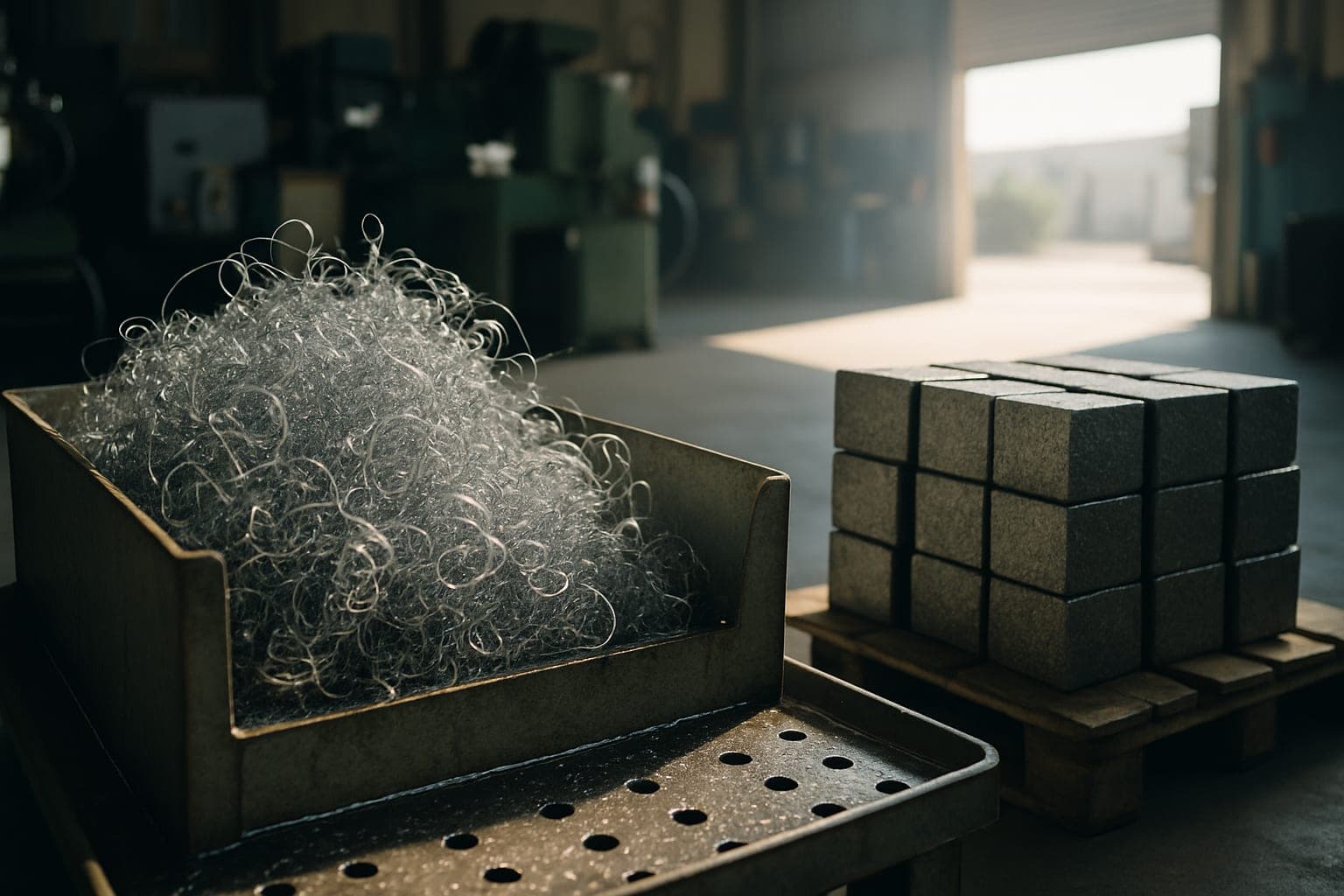
Loose oily turnings are not priced as a grade. They are priced as a discount off the metal exchange, because a cubic decimetre of aluminium swarf weighs roughly 0.25 kg and carries oxide film plus cutting fluid straight into the furnace. Drain or centrifuge the coolant, keep alloys apart, densify, then state oil and moisture by measurement method. That is what turns a provisional offer into a firm bid.
Why do UAE remelters discount loose turnings so heavily?
The physics is settled and it is not flattering. Work published in the Journal of Materials Processing Technology 209 (2009), pages 5195 to 5203, by researchers at the University of Minho, records aluminium swarf as a low-density product at 0.25 kg/dm³ normally coated with a thin film of aluminium oxide and machining fluid, and reports a very low metal recovery rate when it is melted without preparation. The same study examined how briquette compaction pressure affects recovery and dross generation in melts run at 850 °C. That paper is 17 years old, so treat it as engineering fundamentals rather than a market signal.
Compare 0.25 kg/dm³ against solid aluminium at 2.70 kg/dm³. That is close to an eleven-fold densification gap, and every bit of it is air the buyer pays freight on and the furnace has to heat.
There is a claim circulating on UAE dealer blogs that CNC turnings earn a better rate per kilo than mixed demolition scrap because the alloy is known and the material is uncontaminated. It is only true for dry, segregated, single-alloy turnings. For a skip of wet mixed swarf sitting in Sharjah Industrial Area with coolant pooling at the bottom, it is the opposite of true.
What number is the buyer actually working from?
Not a scrap price list. Fastmarkets publishes its turnings assessment as an LME discount, literally titled "Aluminium scrap group 7 turnings, LME discount, delivered consumer works, UK", code MB-AL-0286. The value sits behind a paywall, but the structure is the point: the buyer starts at exchange value and subtracts for burn-off, moisture and oil. Briquetting is how you shrink the subtraction.
For a working anchor, LME aluminium cash was around USD 3,229.50 per tonne on approximately 27 August 2026, with the day's range roughly 3,212 to 3,248 (figure taken from a third-party LME tracker rather than the exchange itself, so verify before you quote it to a buyer). At the pegged rate of AED 3.6725 to the dollar, that is about AED 11.86 per kg. The LME's own day-delayed display of the Argus UBC aluminium scrap contract sat at 2,562.87 in August 2026, roughly AED 9.41 per kg, or 79.4 per cent of primary. Clean, known-alloy scrap trades near 80 per cent of exchange value. Oily loose turnings trade well below that.
| Share of LME value | Implied AED/kg (calculated) | What typically sits here |
|---|---|---|
| 79.4% | 9.41 | Argus UBC scrap contract level, August 2026 |
| 70% | 8.30 | Dry, single-alloy, briquetted, characterised |
| 60% | 7.12 | Dry, segregated, loose |
| 50% | 5.93 | Damp, segregated, loose |
| 40% | 4.74 | Wet, mixed alloy, unknown history |
Those percentages are an illustrative ladder built on the 27 August 2026 exchange basis, not quotes from any named yard. Use them to size the prize. Moving from 45 per cent to 65 per cent of LME on that basis is worth roughly AED 2.35 per kg, which on 20 tonnes a month is real money against the cost of a press.
Does the Dubai export ban strengthen or weaken your hand?
It strengthens the buyer's. Dubai imposed a four-month ban on exports of certain iron, copper and aluminium scrap categories, in force from 10 June 2026 and running to 8 October 2026, as reported by Recycling International citing the Bureau of International Recycling and by IndexBox in late June 2026. The measure renews automatically unless a further notice cancels it. Exemptions exist for pre-ban contracts and public-interest cases, and violations carry penalties.
Mir Mujtaba, president of the Bureau of Middle East Recycling and Dubai-based, called it bad news for recyclers and traders, arriving just as the Strait of Hormuz was reopening, and suggested it followed pressure from local smelters wanting to keep material domestically. Read the commercial consequence plainly. With export routes constrained, UAE foundries are closer to being the buyer of last resort, so they can afford to be fussy about oil and alloy. Quality preparation is the only lever you still control.
Check the ban's status the day you list. The published end date is 8 October 2026 and the renewal mechanism is automatic, so the position can flip either way inside a week.
The duty layer underneath
The federal export duties introduced when the UAE lifted its outright ferrous export ban, announced in January 2024 and confirmed as still operating by Shanghai Metals Market on 6 June 2026, are asymmetric in a way that matters for swarf sellers:
- Ferrous scrap, HS 7204 headings: AED 400 per tonne
- Copper waste and scrap, HS 7404.00: AED 400 per tonne
- Aluminium waste and scrap, HS 7602.00: AED 100 per tonne
AED 100 per tonne on aluminium is under one per cent of exchange value. AED 400 per tonne against a processed HMS price near AED 1,191 per tonne is around a third of the cargo's worth. Steel borings are effectively domestic material. On our reading, brass turnings classify under 7404 as copper-alloy waste and therefore attract the AED 400 rate rather than anything lower, but confirm that with your customs broker rather than taking it from a blog, including ours. Note also that a dealer page dated May 2025 puts the duty announcement in January 2025. That is wrong by a year and the error is spreading.
What does the workshop actually have to do?
- Segregate at the machine, not at the skip. One bin per alloy family per machine. 6xxx extrusion offcut turnings and LM-series cast turnings must never share a container, because the buyer will price the whole lot as the lower value.
- Get the coolant out before the swarf leaves the bay. Perforated drain pans under every chip bin as the minimum, a centrifuge if your volumes justify it. Recover the fluid to your coolant system where the supplier's spec allows. Free liquid in the bottom of a skip is the fastest way to a provisional quote.
- Keep it under cover. An open bin in Al Quoz in August picks up moisture and dust that you then sell by weight and get penalised for by grade. The same discipline applies to any oxide-bearing aluminium stream, as we set out in our guide on how aluminium dross sells in the UAE if you keep it dry and sealed.
- Densify. Briquetting achieves up to 90 per cent volume reduction according to press manufacturer WEIMA, a figure independently repeated by Okon Recycling in December 2025, and it drives excess coolant out while producing uniform shapes that melt more efficiently. Presses handle aluminium, magnesium, copper, brass and bronze, plus grinding sludge and powdered special alloys. Closed-box designs such as Imabe's produce prismatic briquettes and are used on both steel and aluminium shavings.
- Expect brass and aluminium to behave differently. WEIMA noted in September 2024 that brass machining generally produces discontinuous chips because of the alloy's brittle behaviour at small cutting angles and low speeds, while high-speed turning and drilling produce long curled chips that tangle into wads. Your handling and your press settings follow the chip, not the metal's name.
- Weigh and record every batch. Bin weight, drained fluid volume, briquette count and average briquette weight, dated. That log is what converts your listing from a description into evidence.
If the numbers on a press look marginal at your volumes, the argument is the same one we made about foam: densification is often less about the machine's payback than about becoming a counterparty a remelter will actually quote. See our piece on why you must densify EPS foam before UAE recyclers will quote on it.
How do you describe oil and moisture so buyers quote firm?
Stop using adjectives. "Dry", "clean" and "minimal oil" are worthless in a listing because every seller writes them. Give the method and the number.
A workable listing block looks like this: alloy designation and source part number; process route (drain pan only, or centrifuged, model and date commissioned); residual oil stated as a percentage by weight with the test method named, or as "loss on drying, sample dried at 105 °C, result X per cent"; briquette dimensions, average unit weight and measured bulk density in kg/dm³; free-liquid statement; storage conditions and covered or uncovered; batch tonnage and date range of generation.
We deliberately do not publish a target density or a residual-oil threshold, because no UAE foundry specification for either is in the public domain and inventing one would cost you money at the weighbridge. Ask your two nearest remelters one question before you buy a press: what oil and moisture figures do you need to see in a listing to quote firm instead of provisional? Then engineer to their answer and put it in the listing text. On our metals marketplace, that specificity is what makes the 48-hour buyer inspection window a formality instead of a renegotiation, and it is why escrow release goes smoothly.
What do Sharjah and Ajman yards actually pay for briquettes?
Here is the honest answer. There is no published, dated AED price for machining turnings or metal briquettes anywhere in the UAE market, and we are not going to fabricate one. What exists is adjacent, and it still tells you something.
| Grade | Price | As at | Source and reliability |
|---|---|---|---|
| Fabrication scrap (ferrous) | AED 1,320/t | Week of 27 Jan 2024 | Kallanish, trade press, ex-VAT delivered buyer's yard |
| HMS sheared | AED 1,325/t | Week of 27 Jan 2024 | Kallanish |
| HMS 80:20 | AED 1,225/t | Week of 27 Jan 2024 | Kallanish |
| Light and HMS blended | AED 1,050/t | Week of 27 Jan 2024 | Kallanish |
| Processed HMS 80:20 | approx AED 1,191/t | Page dated 4 May 2025 | Dealer site, low reliability |
| Aluminium, all grades | AED 1.3 to 12/kg | Page states April 2026 | Dealer marketing page, low reliability |
| Brass | AED 24 to 25/kg | Page states April 2026 | Dealer marketing page, low reliability |
The ferrous lines are two and a half years old, so read them as a spread rather than a level. That spread is the argument: fabrication scrap at AED 1,320 against light blended at AED 1,050 is a 26 per cent premium for known, clean, single-source prompt material. Turnings are prompt scrap too. They just arrive in the worst possible physical form, and briquetting is the fix.
To get real numbers for your own material, call three yards in Sharjah Industrial Area or Al Sajaa and three in Ajman Industrial Area 1 and 2 on the same morning, and ask each for AED per tonne, ex-VAT, delivered, on loose aluminium turnings by alloy family, briquetted aluminium, loose steel borings and loose brass turnings. Write down the yard, the date and whether the quote is firm or provisional. Do not assume a primary producer is in the market at all. Smelters generally specify clean, low-oil feed and many will not touch oily machining swarf, so verify acceptance specs before you plan a route around one.
What permits sit over oily swarf?
Federal Law No. 12 of 2018 on Integrated Waste Management, issued 18 December 2018, covers industrial waste through production, sorting, transport, storage, recycling, treatment and disposal, and it makes the competent local authority in each emirate responsible within its own area. That single clause is why a machine shop in Dubai Industrial City and one in Ajman Industrial Area 2 face different paperwork for the same skip of swarf.
Whether oil-contaminated turnings are classified as hazardous waste in your emirate, and therefore who may legally haul them and on what manifest, is not something you should take from a website. Confirm it with the municipality or MOCCAE for your location. Dubai operators should start with the permit structure, which we broke down in our explainer on how Dubai Resolution 253 splits waste permits into three licences. On tax, 5 per cent VAT applies to domestic scrap sales; whether a domestic reverse charge now applies specifically to scrap metal supplies is worth a call to the Federal Tax Authority, because it changes how you invoice a briquette load.
Frequently asked questions
Can I still export aluminium turnings from the UAE?
Dubai banned exports of certain iron, copper and aluminium scrap categories from 10 June 2026 to 8 October 2026, and the measure renews automatically unless cancelled by a further notice. Exemptions apply to pre-ban contracts and public-interest cases. Separately, federal export duties of AED 100 per tonne on aluminium waste and scrap under HS 7602.00 and AED 400 per tonne on ferrous and copper scrap remain in place, so confirm both the ban status and the exact HS codes with Dubai Customs before you commit a cargo.
How much does briquetting actually add to the price?
No UAE yard has published a briquette premium in AED, so any figure you see quoted is guesswork. What is documented is the mechanism: turnings are assessed as a discount off LME rather than as a standalone grade, briquetting delivers up to 90 per cent volume reduction according to press makers, and clean known-alloy scrap trades near 80 per cent of exchange value. On an LME basis of about AED 11.86 per kg in late August 2026, moving from 45 to 65 per cent of exchange value would be worth roughly AED 2.35 per kg.
What briquette density should I aim for?
There is no published UAE foundry specification for briquette density or residual oil content, so ask your two nearest remelters directly what figures they need before you buy or configure a press. Get the answer in writing and quote it in your listing. As a physical reference, loose aluminium swarf sits at about 0.25 kg per cubic decimetre against 2.70 for solid aluminium, which is the headroom a press is working with.
Should I combine alloys to make up a full truckload?
No. Mixing 6xxx extrusion turnings with LM-series cast turnings means the buyer prices the whole load at the lower value, and it can push you from a firm quote to a provisional one pending analysis. Keep one bin per alloy family at each machine and list smaller lots separately. Verified counterparties on a marketplace will take a characterised part load over an unknown full load.
Do I need a permit to store and transport oily metal swarf?
Federal Law No. 12 of 2018 covers industrial waste across storage and transport and assigns responsibility to the competent local authority in each emirate, so requirements differ between Dubai, Sharjah and Ajman. Whether oil-contaminated swarf is treated as hazardous in your emirate determines who can legally haul it and what manifest travels with it. Confirm with your municipality or MOCCAE rather than relying on a general answer.
Comments(0)
Sign in to join the conversation.