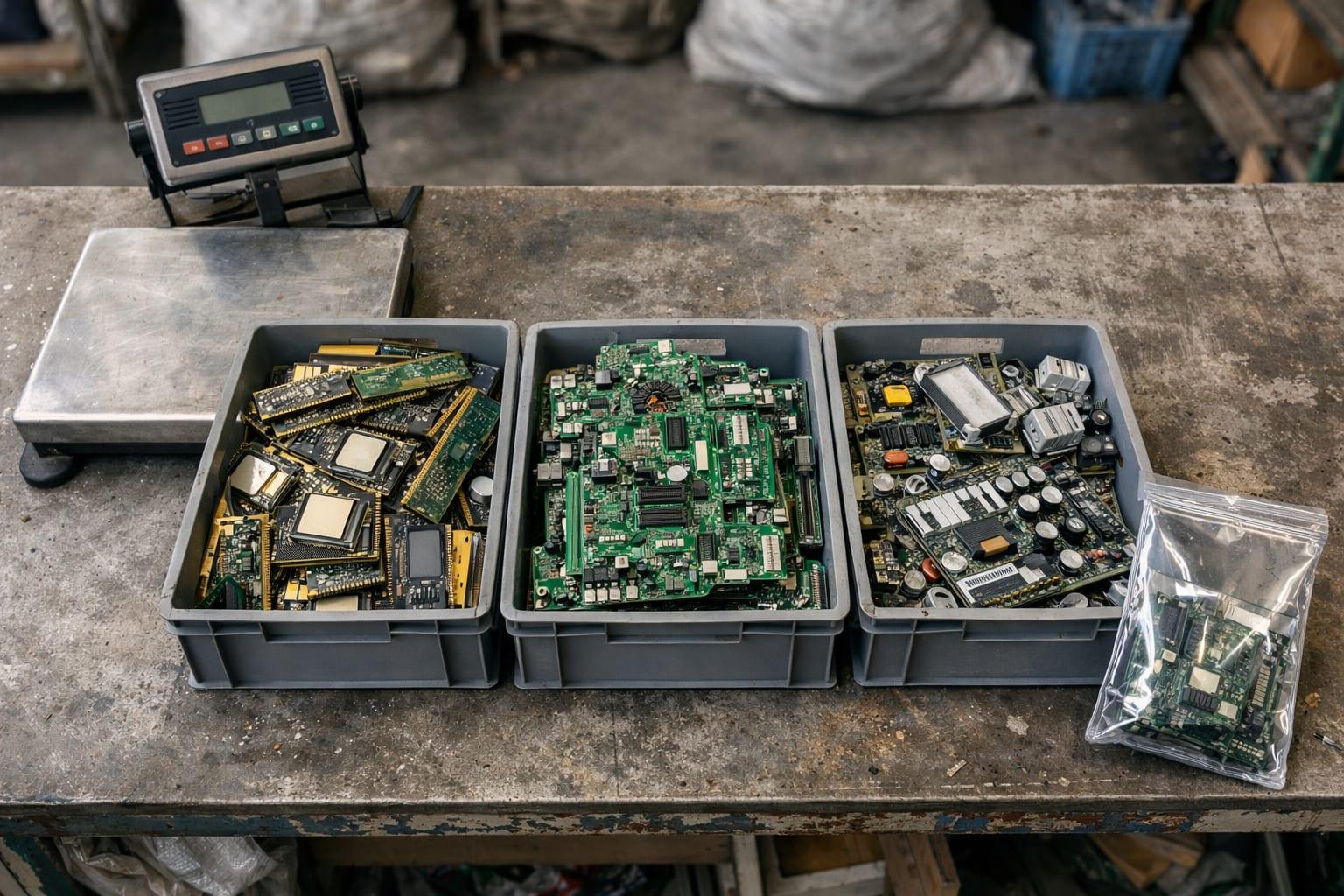
A kilo of gold-bearing telecom backplane and a kilo of LED driver board are not the same commodity, yet most UAE yards pay one flat rate for both. Refiners settle on assay: grams per tonne of gold, palladium and silver, percent copper, less treatment and refining charges. On five tonnes, grading first is worth six figures in dirhams.
Why will nobody quote you a reliable price per kilo?
Because a per-kilo quote prices the substrate, not the metal. UAE scrap price pages carried a line called electronic scrap at AED 6.00 per kg and cable scrap at AED 14.00 per kg (scrappricetoday.com, page dated around August 2026). A Dubai estimator page put clean bare-bright copper at up to AED 26 per kg, iron at AED 0.80 to 1.50 per kg and aluminium at AED 3.80 to 6.00 per kg depending on alloy and form (dubaiwaste.com, page dated around April 2026). Clean 6063 extrusion has been quoted to sellers on our desk at AED 4.50 to 5.50 per kg in early November 2026.
Set those numbers against the exchange and the drift is obvious. LME copper Grade A cash was quoted at USD 13,961 per tonne on 8 November 2026, which at the dirham peg of AED 3.6725 to the dollar works out at AED 51.27 per kg of contained copper. A bare-bright quote of AED 26 per kg is therefore about 51% of exchange cash, cable at AED 14 is 27%, and the electronic scrap line at AED 6 is under 12%. Re-check both ends of that comparison on the day you trade. Our copper note tracks how far UAE yard pricing has followed the LME run.
Loose quoting is normal in this stream. A JAFZA-based trader lists mixed-grade FR-4 board scrap on a B2B directory at USD 500 without stating whether that is per tonne, per lot or per container. Buyers advertising High, Mid and Low grade sorting across Dubai, Sharjah and Abu Dhabi still settle with instant on-site scale payouts (800scrap.ae, page dated around August 2026). The grading vocabulary exists in this market. The settlement mechanism mostly does not.
What is one gram per tonne actually worth today?
Board value is arithmetic, not opinion. The table below converts benchmark metal levels retrieved on 9 November 2026 into the only unit that matters for a board lot: what one gram per tonne of contained metal is worth in one tonne of feed. These are aggregator quotes rather than the official LBMA and LME pages, so re-pull the benchmark before you sign anything.
| Metal | Level, 9 November 2026 | AED per gram | Value of 1 g/t in one tonne of boards |
|---|---|---|---|
| Gold | USD 4,125.80 / oz | 487.15 | AED 487 |
| Palladium | USD 1,043.52 / oz | 123.21 | AED 123 |
| Silver | USD 52.96 / oz | 6.25 | AED 6.25 |
| Copper | USD 13,961 / tonne (LME cash) | AED 51.27 per kg | AED 513 per 1% Cu |
Two practical notes. Gold quotes on the same morning ranged from USD 4,099.44 (BullionVault) to USD 4,143.10 (APMEX), a spread of roughly USD 44 per ounce, so your contract has to name one reference and one time, not a market. LBMA runs the gold benchmark auction twice a day at 10:30 and 15:00 London, with platinum and palladium at 09:45 and 14:00; LME Copper Grade A is quoted in US dollars per tonne on 25-tonne lots at minimum 99.9935% purity. Platinum, which shows up in a small number of industrial and sensor boards, was quoted at USD 1,555.10 per ounce the same morning.
Hold that AED 487 figure in your head. Every single gram per tonne of gold in your boards is worth that much in contained metal before a single payable is applied. A telecom stream assaying 250 g/t carries about AED 121,800 per tonne of contained gold on its own.
Which grade family do your boards belong to?
Published trace-metal ranges for printed circuit boards run from 5 to 500 g/t gold, 100 to 1,200 g/t silver and 5 to 50 g/t palladium (marketplace PCB recycling guide, page dated around July 2026). That spread of two orders of magnitude on gold is the whole argument. The table below uses three illustrative grade families and the 9 November 2026 prices above. Treat the assays as a model for structuring your sort, not as a quote; your boards will assay where they assay.
| Grade family | Typical content | Au g/t | Ag g/t | Pd g/t | Cu % | Contained value per tonne |
|---|---|---|---|---|---|---|
| High | Telecom backplanes, server boards with gold edge fingers, RAM-populated boards | 250 | 700 | 60 | 18% | AED 142,784 |
| Mid | Desktop and laptop motherboards, mixed IT boards | 90 | 350 | 20 | 20% | AED 58,749 |
| Low | Power supply, LED driver, inverter and appliance boards | 15 | 80 | 2 | 14% | AED 15,231 |
The physical tells that separate those families are visible on a sorting bench. Layer count is the first: boards of eight layers or more carry higher gold and palladium density. Copper weight is the second, measured in ounces per square foot, where standard FR-4 runs 1 oz/ft² and high-current boards 2 to 3 oz/ft². Gold edge fingers, ceramic packages and dense multilayer ceramic capacitor arrays are the third. Our illustrative 60 g/t palladium for the high family sits above the published 50 g/t top end and reflects older telecom boards; drop it if your population is recent.
Two figures circulate in this market that you should strike out. The claim that high-grade board scrap is worth about USD 1,200 per tonne is a legacy number from a sub-USD-1,500 gold era and is inconsistent with the same sources that publish the ppm ranges. The claim that a PCB is 60 to 70% copper by weight is also wrong as stated: that is copper's share of the recovered metal fraction, not of the board.
How does assay settlement actually work?
A refiner contract is a sequence of subtractions. An open-source e-scrap assay calculator published on GitHub (author Adriancu91, undated) mirrors the structure used in European smelter contracts and is the clearest public worked example of it: deduction equals the greater of assay multiplied by one minus the recovery yield, or a stated minimum deduction; payable grade equals assay less deduction, multiplied by the payment percentage for that metal; value equals payable metal multiplied by the bid price; then a refining charge is applied per kilogram of payable metal and a treatment charge per dry metric tonne of feed. That model carries a treatment charge of EUR 550 per dry tonne and a sampling charge of EUR 950 per lot below 10 tonnes, falling to EUR 650 at 10 tonnes and above.
Read that fee structure twice. A small lot pays a fixed sampling fee that does not scale plus a per-tonne treatment charge, which is exactly why a two-tonne trial lot settles worse per tonne than contract volume and why nobody should judge an assay route on trial economics alone.
The lines to fix in writing before the first truck moves
- Weight basis: dry metric tonne, with the moisture determination method stated.
- Sampling protocol: shred, mill to homogenise, riffle split, and a three-way division into your sample, the buyer's sample and a sealed umpire sample.
- Splitting limits: the assay difference that triggers an umpire, and the rule that the party further from the umpire result pays for it.
- Payable percentage per metal, copper included. Older refiner terms paid nothing at all on copper, which hands over the base metal for free.
- Minimum deductions per metal, which can matter more than the payable percentage on low-grade feed.
- Treatment charge per dry tonne, refining charge per payable kilogram, lot or sampling fee and the tonnage at which it drops.
- Pricing basis: which LBMA auction, which LME cash date, and the quotational period.
- Provisional payment percentage and days from arrival, then the final settlement date after assay.
One caution on numbers you may be shown. Payables of 97 to 98% on gold and silver and 97% on platinum and palladium, a USD 350 lot charge, a USD 1.00 per pound treatment charge and a 5,000 lb (roughly 2.3 tonne) minimum lot all come from refiner terms posted on trade forums between about 2008 and 2011. Those are 15 to 18 years old. They tell you which line items exist. They do not tell you today's rates, and we could not verify published terms from any named refiner serving the UAE, so get every percentage in your own contract.
What happens to a five-tonne lot when you grade it?
Here is the comparison, built on the 9 November 2026 metal prices and the illustrative assays above. Assumed payables are 95% gold, 90% silver, 90% palladium and 60% copper, with a treatment charge of EUR 550 per dry tonne taken at roughly AED 2,200. Every assumption here is a model input, so rebuild it with your own buyer's terms.
| Grade family | Gross contained per tonne | Payable before charges | Net after treatment charge |
|---|---|---|---|
| High | AED 142,784 | AED 131,827 | AED 129,627 |
| Mid | AED 58,749 | AED 51,991 | AED 49,791 |
| Low | AED 15,231 | AED 11,920 | AED 9,720 |
Scenario A is the flat sale. Five tonnes of unsorted boards at the AED 6 per kg electronic scrap line returns AED 30,000. At a better mixed-board yard rate of AED 12 per kg it returns AED 60,000, and at AED 18 per kg for picked boards, AED 90,000.
Scenario B takes the same five tonnes, sorted 15% high, 45% mid and 40% low, and settles each stream on assay.
| Line | Amount |
|---|---|
| 0.75 t high grade at AED 129,627/t | AED 97,220 |
| 2.25 t mid grade at AED 49,791/t | AED 112,028 |
| 2.00 t low grade at AED 9,720/t | AED 19,440 |
| Less sampling, three lots at about AED 3,800 | (AED 11,400) |
| Less sorting labour and freight at AED 1,500/t | (AED 7,500) |
| Net on assay settlement | AED 209,788 |
Against the AED 12 per kg flat sale, that is roughly 3.5 times the money, a difference of about AED 149,800 on a single five-tonne lot. Note where it comes from: the 0.75 tonne of high-grade board is 15% of the weight and just under 40% of the gross contained value. The error that destroys this trade is not mispricing the low-grade pile. It is letting high-grade boards fall into the mid pile, which costs about AED 8,000 for every 100 kg misplaced. Precious-metal-driven scrap behaves the same way across categories, which is why converter sellers who price by unit rather than by assay get the same surprise in reverse.
Does stripping CPUs, memory and heatsinks raise or destroy value?
Both, depending on what you strip and when you agree the specification. Ceramic and gold-lid processors, gold-finger memory modules and gold-plated edge connectors concentrate the precious metal in a tiny mass, and sold as separately declared commodities they generally return far more than they contribute as a grade uplift inside a mixed board lot. Aluminium heatsinks, steel brackets, transformers and large electrolytic capacitors do the opposite. They dilute the assay and inflate the treatment charge you pay per tonne, because you are paying EUR-denominated processing on dead weight.
The trap is sequencing. If the buyer quoted on an unstripped board population and you pull the processors and memory after the quote, you have changed the material and you will be repriced, often by more than the stripped parts fetch on their own. Agree the strip specification before the quote, in writing, with photographs of a representative sample. Separately, if a board is worth more as a tested working spare than as feedstock, that is a different sale with a different buyer and it should never enter a scrap lot at all.
How do you run a two-lot test before committing a year of volume?
- Sort one representative month of arisings into three streams at source and weigh each stream. Photograph and record board counts and types per stream so you can prove what you shipped.
- Retain a sealed sample of each stream before the trucks move. Without your own retained sample you have nothing to put in front of an umpire.
- Ship lot one to buyer A and lot two to buyer B in the same week, so both settle against comparable metal prices. Keep each lot above the tonnage threshold where the sampling fee drops if you can.
- Require a settlement sheet showing assay by metal, deductions, payable percentages, dry weight, treatment and refining charges, and the exact price reference and date used.
- Score each settlement against the contained-value table you built from live benchmarks, not against another yard's per-kilo quote. The yard quote is the thing you are trying to escape.
- Only then commit annual volume, and re-bid at least quarterly while gold and copper move this fast.
Counterparty risk is the other half of the test, because a trial lot is a shipment made on trust to a buyer you have not settled with before. On our side that is what KYC verification through UAE PASS, escrow through MyFatoorah and the 48-hour buyer inspection window are for: the commercial analogue of an incoming sampling check, with the money held until the material is confirmed. Listing your high, mid and low streams as three separate listings rather than one mixed lot is the thesis of this article expressed as an instruction, and it is how electronics lots on the marketplace attract refinery-grade bids instead of yard-grade ones.
What paperwork follows the boards, and how big is the stream?
Federal Law No. 12 of 2018 on Integrated Waste Management, issued 18 December 2018, puts responsibility for products and their residual waste on the producer and supplier, including the financial cost, under Article 5. Cabinet Resolution No. 39 of 2021, its executive regulation, defines e-waste as discarded or damaged electrical and electronic equipment or any of its components, obliges suppliers to accept e-waste back free of charge and report quantities and treatment method, and prohibits landfilling of e-waste outright. In Abu Dhabi, waste licensing, permitting, vehicle tracking, the tariff system and inspection moved from Tadweer Group to the Environment Agency, Abu Dhabi in June 2024, so any guidance telling you to apply to Tadweer for a permit is out of date. Moving waste out of the emirate needs a one-time-use permit per shipment, and non-Abu Dhabi counterparties register in the BOLISATY system.
Export is a separate conversation and a short one here: hazardous waste leaving the UAE must move in line with the Basel Convention and with ministry consent, which we cover in detail elsewhere. One claim doing the rounds, that a AED 300 per tonne federal fee applies to scrap electronics, does not match any instrument we could verify. Do not budget for it without a primary source.
As for volume, the honest answer is that the UAE does not publish a board-scrap tonnage. The most-quoted country figure, 134,000 tonnes of e-waste and 17.2 kg per person, comes from Global E-waste Monitor data for 2016 and is now a decade old. The Regional E-waste Monitor for the Arab States, published in December 2021 on 2019 data, recorded regional generation rising from 1.8 Mt in 2010 to 2.8 Mt in 2019, while formally collected e-waste across four reporting economies including the UAE totalled 2.2 kilotonnes, or 0.01 kg per inhabitant. That collection gap, not the headline tonnage, is the number that should interest you. Processing capacity exists locally, with the main Dubai Industrial City e-waste plant variously published at 39,000 tonnes a year in its 2017 agreement, up to 40,000 tonnes at its March 2018 opening and 100,000 tonnes in later releases. Those figures conflict, and we have not been able to reconcile them.
Frequently asked questions
What is the price per kg for circuit board scrap in the UAE?
There is no single defensible number, which is the point. UAE price pages listed electronic scrap at AED 6.00 per kg around August 2026, but at 9 November 2026 metal prices a high-grade telecom board assaying 250 g/t gold carries about AED 142,784 per tonne of contained metal, or roughly AED 143 per kg before payables and charges. Ask for payables on assay, not a rate per kilo.
How much gold is actually in a circuit board?
Published ranges for printed circuit boards run from 5 to 500 grams per tonne of gold, 100 to 1,200 g/t silver and 5 to 50 g/t palladium, depending on layer count, connector plating and board age. At the 9 November 2026 gold level of about USD 4,126 per ounce, each gram per tonne is worth roughly AED 487 of contained metal in one tonne of feed. That is why a 250 g/t stream and a 15 g/t stream cannot share a price.
Should I remove CPUs, memory and heatsinks before selling boards?
Strip aluminium heatsinks, steel brackets and transformers, because they dilute the assay and increase the treatment charge you pay per tonne. Processors, gold-finger memory and gold-plated connectors usually return more sold as separately declared commodities than as grade inside a mixed lot. Agree the strip specification before the buyer quotes, because stripping after a quote on unstripped material normally triggers a repricing larger than the parts are worth separately.
What is the minimum lot size for assay-based settlement?
Minimums are set by the economics of sampling rather than by a rule. Published models carry a sampling fee of around EUR 950 per lot below 10 tonnes falling to EUR 650 at 10 tonnes and above, plus a treatment charge per dry tonne, and refiner terms from 2008 to 2011 quoted a minimum of roughly 2.3 tonnes. Expect trial lots of two to three tonnes to settle worse per tonne than contract volume.
How long does assay settlement take to pay?
Longer than a yard scale, and you should assume weeks rather than days: weigh-in, shredding and milling to homogenise, riffle splitting, then assay before a final figure exists. Most contracts offer a provisional payment on arrival with final settlement after assay, so fix the provisional percentage, the days from arrival and the final settlement date in writing. If a split-sample dispute goes to an umpire, add further time.
How do I know the buyer will pay at all?
Run a two-lot test with two verified buyers in the same week before committing annual volume, and keep your own sealed retained sample of each stream. On our marketplace, counterparties are KYC-verified through UAE PASS, payment sits in escrow with MyFatoorah, and the 48-hour inspection window gives both sides a defined checkpoint before funds release. That is the commercial equivalent of an incoming sampling check.


Comments(0)
Sign in to join the conversation.