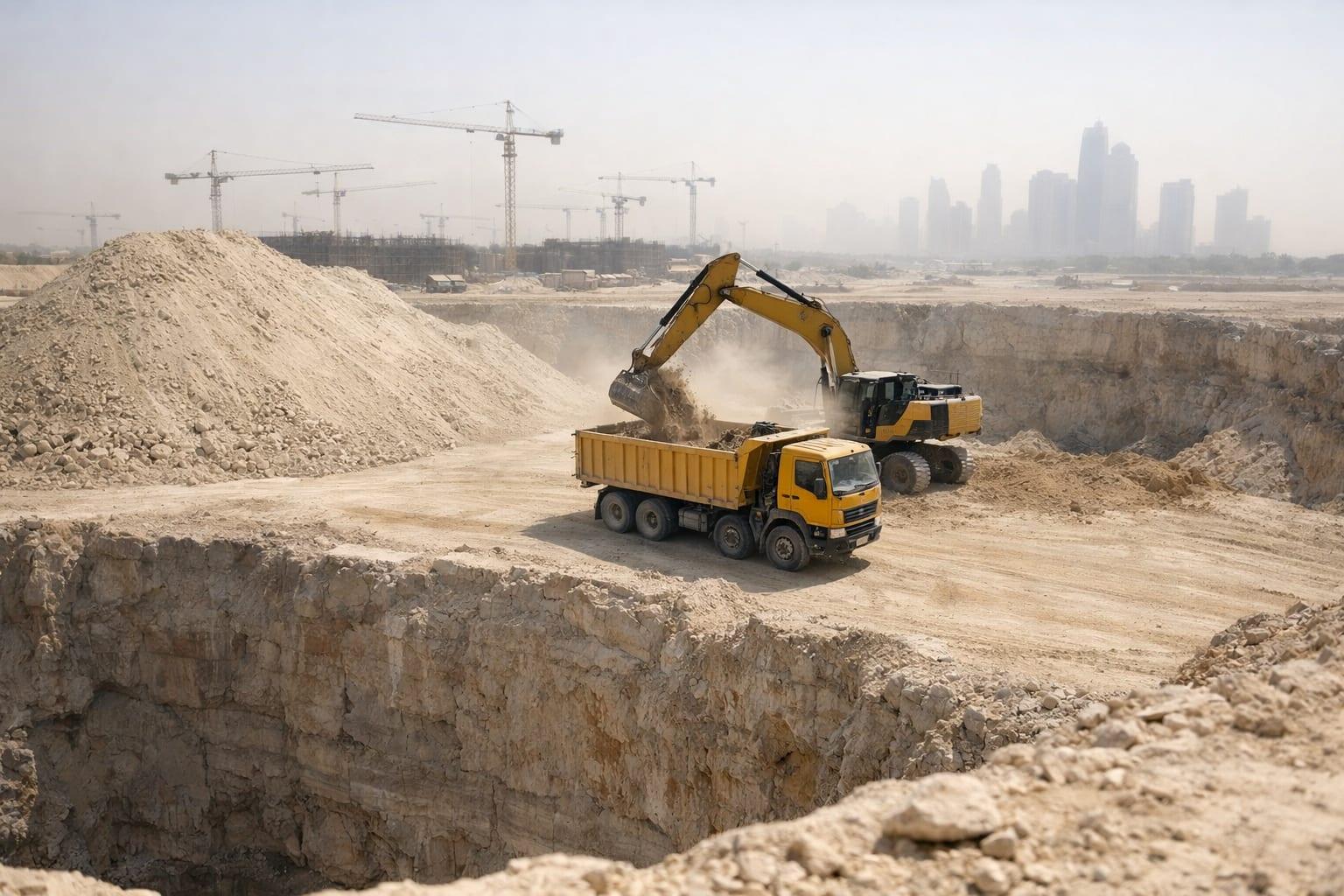
Dubai's gazetted C&D landfill fee is AED 10 to 20 per tonne under Executive Council Resolution No. 58 of 2017, so the money was never in the gate. It is in the trip. With Al Qusais scheduled to close by 2027, haul distances lengthen, and selling clean inert spoil to a nearby site starts to beat paying to dump it.
Why is excavation spoil worth trading in Dubai in 2027?
Because the digging and the filling peak in the same year, a few kilometres apart, under different contracts. The Al Maktoum International expansion was approved by Sheikh Mohammed bin Rashid in April 2024 at AED 128 billion, covering 70 square kilometres, five passenger terminals and up to 400 aircraft gates. Dubai Media Office said in June 2026 that contracts worth more than AED 13 billion were already under execution, with further strategic packages valued above AED 55 billion expected to be awarded before the end of 2026. Awards at that scale at the end of 2026 put the heaviest earthworks and bulk fill demand squarely into 2027.
The Metro Blue Line runs on a parallel clock. The AED 20.5 billion line covers 30 kilometres with slightly more than half underground, 14 stations, and an opening date of 9 September 2029. Tunnelling was inaugurated in May 2026 and the first tunnelling phase was completed in two months, according to The National on 9 July 2026, with Dubai Media Office stating in May 2026 that completion would reach 30 per cent by the end of 2026. Behind it sits the Gold Line at AED 34 billion, opening 9 September 2032.
Then there is the Dubai Strategic Sewerage Tunnels programme, approved by the Executive Council in mid-2023 at roughly AED 30 billion of initial capital expenditure and around AED 80 billion over its lifecycle, per AGBI on 10 April 2025. The Phase II Links Package covers about 75 kilometres of deep tunnels, the 50 kilometre Bur Dubai Deep Tunnel and the 25 kilometre Deira Deep Tunnel, with bids due 30 April 2026. Around 140 kilometres of supporting link tunnels run up to 90 metres below ground. Package W, covering Warsan, includes 16 kilometres of tunnels, a terminal pumping station and roughly 46 kilometres of link pipelines.
On the demand side, read Palm Jebel Ali correctly. The 13.4 square kilometre scheme with 16 fronds and 91 kilometres of beachfront is past its reclamation phase. A Nakheel RERA inspection dated 18 June 2026 put Fronds A to F at roughly 4.0 to 4.4 per cent progress, while Fronds K to P had foundations and structures complete by August 2026 with infrastructure around three quarters done. Frond O moved from 22 per cent in October 2025 to 56 per cent in August 2026. An AED 3.5 billion award covers 544 villas on Fronds A to F, with first units targeted for late 2027. That is a market for landside select fill, roads, trenching and structural backfill, not reclamation sand. Dubai Islands reads the same way: 18.6 square kilometres across five islands with about 57 kilometres of coastline, and an AED 527 million primary infrastructure and utilities contract for Island B awarded to Al Nasr Contracting Company on 20 April 2026.
The asset your disposal plan assumes is closing
Dubai Municipality awarded the Al Qusais Landfill Gas Extraction and Treatment Network to Cleanco Waste Treatment LLC with BEIL Infrastructure Limited. The works involve capping roughly 390,000 square metres and are described as a prerequisite for the planned closure of the Al Qusais landfill by 2027, according to Waste & Recycling Magazine on 2 May 2025. If your 2027 spoil budget is built on a short run to Al Qusais, it is built on an asset scheduled to retire inside the same window.
What does it really cost to make a load of spoil disappear?
Start with the gazetted numbers, because they are the only ones in this market published by the government. Executive Council Resolution No. 58 of 2017, issued in Dubai on 18 October 2017, sets the fee schedule for waste disposal in the emirate.
| Item | Route | Published fee (AED/tonne) | Per 25-tonne tipper load |
|---|---|---|---|
| Construction and demolition waste | Landfilling | 10.00 / 15.00 / 20.00 | AED 250 to 500 |
| Municipal waste | Landfilling | 80.00 / 90.00 / 100.00 | AED 2,000 to 2,500 |
| Recyclable material free of organics | Sorting stations | 20.00 / 25.00 / 30.00 | AED 500 to 750 |
| Difficult waste, liquid or semi-liquid | Designated route | 20.00 | AED 500 |
| Waste in drums | Storage or landfill | 700.00 | Priced by tonne |
The resolution publishes three figures for each landfilled stream. They read as a phased escalation from the 2017 issue date, which would land C&D at AED 20 per tonne, but we could not retrieve the column headers from the published PDF, so confirm the current column with Dubai Municipality before you price a job on it. Add the disposal site entry fee of AED 10 per vehicle, and the C&D collection and transportation service permit at AED 1,000 per activity. The fines in the same resolution are worth memorising: AED 2,000 for entering a general waste disposal site without a permit, AED 1,000 for disposing of waste at other than the designated site for that waste type, and AED 20,000 for bringing hazardous waste into a disposal site from outside the emirate.
Now the number you should distrust. A band of AED 30 to 80 per tonne for construction debris tipping circulates widely on commercial waste-services websites. It is not traceable to any government source, it sits an order of magnitude above the gazetted inert rate, and the same site publishing it quotes AED 2 to 100 per tonne on one page and AED 150 to 400 per tonne on another. That last band is honest about what it measures: it explicitly includes skip hire and haulage, so it is a delivered service price, not a gate fee. Treat it as the all-in cost of making a load vanish, and you suddenly see where the margin actually lives. If you are buying that service under a framework agreement, the same logic applies to how your waste contract is tendered.
Where is the break-even haul radius?
There is no LME equivalent for fill. No index, no screen, no settlement price. Spoil and fill are priced purely by distance to the nearest alternative source and the local gate fee, which is why the governing variable is a radius, not a rate. We were not able to verify current delivered prices for fill sand, select fill or construction-grade sweet sand per cubic metre in Dubai at the time of writing, so take three quotes from suppliers serving your corridor and plug your own numbers into the arithmetic below. Note also that "sweet sand" carries two meanings in the UAE: a horticultural growing medium sold in 20 kg bags, and low-salinity non-saline construction fill. You want the second one, and search results are polluted with the first.
The conversion you need first. A 25-tonne tipper payload of dry sand at a loose bulk density of roughly 1.4 to 1.5 tonnes per cubic metre is about 17 to 18 loose cubic metres, and at a compacted in-situ density of 1.6 to 1.8 tonnes per cubic metre that same tonnage places roughly 14 to 15.5 cubic metres of fill. Bulking on excavation runs around 10 to 15 per cent for sand, 20 to 30 per cent for clayey and silty soils, and 30 to 50 per cent for ripped or blasted rock. These are standard earthworks ranges, not UAE-specific measurements, so treat them as indicative and confirm against your own in-situ testing.
Then the formula. Additional one-way distance you can afford to haul to a buyer equals the gate fee avoided per load plus the sale price per load, divided by twice the haulage cost per kilometre per load. Run the full net position as well: trade value equals tipping fee plus haul-to-landfill cost plus landfill queue time plus sale revenue, minus haul-to-buyer cost, testing, stockpile handling and double-handling. That last term is the one contractors forget. Spoil that goes to a stockpile and then to a buyer is loaded twice, and on short radii the second load-out routinely costs more than the gate fee you saved. Direct dig-to-site transfer, with the receiving contractor's compaction crew waiting, is worth far more than any stockpile strategy.
Two local realities compress the radius further. RTA heavy-vehicle restrictions govern which corridors you can use and when, so cycle time, not distance, is often the binding constraint between Al Quoz and Dubai South. And with Al Qusais heading for closure, the baseline haul leg in your comparison gets longer during 2027, which pushes the break-even radius outward in your favour.
What do buyers test before they accept your spoil?
No competent buyer accepts a classification on your word. They test, and the test regime in the UAE has one local obsession: soluble salts.
| Test | Typical standard | What it decides |
|---|---|---|
| Particle size distribution, with hydrometer for fines | ASTM D6913 / D7928 | Percentage passing 75 microns. Tight for structural fill, far looser for general backfill |
| Atterberg limits | ASTM D4318 | Liquid limit and plasticity index. Plastic fines disqualify structural use |
| Modified Proctor compaction | ASTM D1557 | Maximum dry density and optimum moisture, then field density as a percentage of MDD |
| California Bearing Ratio | Project specification | Acceptance under pavement or as subgrade |
| Chloride and sulphate content | Acid-soluble SO3, water-soluble SO4, chloride | Reinforcement corrosion and sulphate attack on buried concrete |
| Hydrocarbon and contamination screen | TPH, BTEX, PAH, heavy metals, pH | Triggered by site history: fuel stations, workshops, older industrial plots |
| Organic content | Visual and laboratory | Wood, roots and buried vegetation |
Near Palm Jebel Ali, Dubai Islands, Jebel Ali and anything within reach of the coastal sabkha belt, assume salinity is the first question the buyer asks and the last one that kills the deal. We have set out the framework here rather than numerical limits, because the applicable chloride, sulphate, fines and compaction thresholds come from the project specification and the Dubai Municipality earthworks requirements, with Trakhees applying its own regime across the Jebel Ali and Palm jurisdictions. Get the governing specification in writing before you book laboratory work.
Which classifications make a load worthless
- Sabkha. Saline, compressible, collapsible on wetting. Effectively unsaleable as structural fill.
- High-plasticity clays and silts classified CH or MH. General landscaping at best.
- Gypsiferous soils. Dissolution and sulphate risk under buried concrete.
- Hydrocarbon-contaminated soil above the regulatory threshold. This flips the material from inert to a controlled stream with a higher gate fee and restricted routes.
- Asbestos-containing material from demolition-adjacent excavation.
- Inert mixed with non-inert. One skip of gypsum board, plastic sheeting or timber tipped into a clean inert stockpile reclassifies the whole pile, loses the buyer and sends it to a more expensive gate. Segregation at the dig face is the entire value proposition.
- Conditioned TBM muck. Slurry and EPB arisings from the DSST are mixed with bentonite, foams and polymers and arrive at very high moisture content. They are not drop-in structural fill. On that programme the tradeable open-cut material sits in the shaft excavations and the roughly 46 kilometres of link pipelines in Package W, not in the deep tunnel spoil.
Who owns the spoil, and who signs for it?
Before anyone books a truck, read the Particular Conditions and the Earthworks section of the Specification, not the standard form. Under FIDIC-based contracts common in Dubai, surplus excavated material is usually either declared the Contractor's property with an obligation to dispose of it off site at its own cost, or retained as the Employer's property and directed to a nominated location. Search the documents for the phrases "surplus material" and "disposal off site". The first position makes a resale legally clean. The second means the main contractor cannot sell the material at all, only move it where the Employer says. Do not confuse either with the fossils and articles of value clauses, which vest archaeological and geological finds in the Employer regardless.
The permitting chain runs through Dubai Municipality. Law No. 18 of 2024 Regulating Waste Management in the Emirate of Dubai requires a permit from the Municipality before any waste management activity is conducted, and it applies across the whole emirate including Special Development Zones and Free Zones, naming the DIFC expressly. Working inside a free zone does not put you outside the regime. The reported penalty ceiling is AED 500,000, doubled for a repeat offence within one year, which we sourced from secondary commentary rather than the primary text, so verify it before you quote it to a client. An implementing bylaw, reported as Administrative Resolution No. 34 of 2026 effective around 10 March 2026, may carry an updated fee schedule superseding Resolution 58 of 2017. Confirm that directly with the Municipality. Above all of it sits Federal Law No. 12 of 2018 on Integrated Waste Management and its executive regulations under Cabinet Resolution No. 39 of 2021, issued 21 April 2021.
Keep the transfer note trail intact from generator to transporter to receiving facility, with load weights, classification, test certificates and the receiving site's acceptance. That paper is what turns a spoil movement into an auditable diversion event rather than an unexplained truck leaving your gate. It is also what lets you report the tonnage you kept out of landfill. The same discipline applies to everything else leaving a site at handover, which we covered in selling surplus site materials before demobilisation.
What changes when the load crosses into Sharjah or Abu Dhabi?
Article 17 of Dubai Law 18 of 2024 is the clause to know. No person may import waste or recyclable materials into the emirate, or export them from it, without first obtaining authorisation from Dubai Municipality. The requirement attaches to recyclable materials, not only to waste, so a clean inert load destined for a buyer in Al Sajaa or Musaffah is caught by it. Article 18 separately bars importing waste into Dubai for final disposal, with narrow exceptions.
Then there is the receiving end. Tadweer, the Abu Dhabi Waste Management Centre, has no licensing jurisdiction in Dubai, and a Dubai permit does not travel. We could not verify current Abu Dhabi or Sharjah gate tariffs or the exact inter-emirate movement procedure at the time of writing, so confirm those with Tadweer and with the relevant Sharjah authorities before you commit a price that assumes a cross-border buyer. The practical rule has not changed: you need clearance at both ends, and the one you forget is usually the destination.
How do you sequence a spoil trade before the trucks are booked?
The failure mode is always timing. By the time the excavator is running, the disposal subcontract is signed, the tipper fleet is committed and nobody has time to run a chloride test. Work backwards from that.
- Declare surplus volumes at programme stage, not at excavation. Your cut-and-fill balance exists in the design model months before the first bucket moves. Publish the net surplus by phase.
- Establish ownership in writing. Confirm whether the contract gives you title to surplus material or directs it to a nominated location.
- Characterise early. Run PSD, Atterberg, chloride, sulphate and a contamination screen on the geotechnical investigation samples, not on the stockpile. You will know what is saleable before you price the disposal line.
- Segregate at the dig face. Separate inert horizons from topsoil, organics and anything with site-history risk. One contaminated bucket reclassifies a whole stockpile.
- Build a stockpile and haul-window plan that accounts for RTA heavy-vehicle hours, available laydown area and the real cost of double-handling. If you can route dig-to-site, do that instead.
- List the material with classification, test results, volume in cubic metres and tonnes, and firm availability dates, so a receiving contractor can match it to their fill programme. Volumes posted on the construction category of our marketplace carry those fields, and buyers are KYC-verified through UAE PASS.
- Agree acceptance terms up front: who tests on arrival, what the rejection threshold is, who pays for a turned-back load, and whether payment sits in escrow until the receiving site confirms.
- Record every transfer note and weighbridge ticket, and reconcile them monthly against your diversion reporting.
Do that and the question stops being where to dump 180,000 cubic metres from a shaft in Warsan. It becomes which of the three contractors within 18 kilometres needs structural backfill in the same quarter, and what they will pay delivered.
Frequently asked questions
What does it cost to dispose of excavation spoil in Dubai?
Executive Council Resolution No. 58 of 2017 publishes construction and demolition waste landfilling at AED 10, 15 and 20 per tonne, which reads as a phased escalation from the 2017 issue date, plus an AED 10 per vehicle site entry fee. That is AED 250 to 500 for a 25-tonne tipper load at the gate. The all-in commercial cost including skip hire and haulage is far higher, and should be priced separately from the gate fee.
Can I sell excavated material from my Dubai construction site?
Only if the contract gives you title to it. Check the Particular Conditions and the Earthworks specification for the phrases surplus material and disposal off site. If surplus is declared the Contractor's property with an obligation to dispose of it off site, a resale is clean. If it is retained as the Employer's property, you can only move it where the Employer directs.
Do I need a permit to move soil from Dubai to Sharjah?
Yes. Article 17 of Dubai Law No. 18 of 2024 prohibits importing or exporting waste or recyclable materials across the emirate's border without prior authorisation from Dubai Municipality, and that wording covers recyclable material, not only waste. You then need whatever the receiving emirate requires. A Dubai permit has no effect in Abu Dhabi, where Tadweer is the competent authority.
What test results does a buyer want before accepting spoil as fill?
Particle size distribution with fines passing 75 microns, Atterberg limits for plasticity, Modified Proctor compaction characteristics, and chloride and sulphate content. A hydrocarbon and heavy metals screen is added where the site history justifies it. In coastal Dubai, salinity is usually the first result a buyer looks at and the most common reason a load is refused.
Is tunnel muck from the sewerage tunnels usable as fill?
Generally not without treatment. Slurry and EPB tunnel boring machine arisings are conditioned with bentonite, foams and polymers and arrive at very high moisture content, so they are not drop-in structural fill. On the Dubai Strategic Sewerage Tunnels programme, the tradeable material is the open-cut spoil from shafts and the link pipeline trenches, such as the roughly 46 kilometres of link pipelines in the Warsan package.
Is Al Qusais landfill still an option for inert material in 2027?
Plan as if it is not. Dubai Municipality awarded a landfill gas extraction and treatment network at Al Qusais to Cleanco Waste Treatment LLC with BEIL Infrastructure Limited, involving capping of roughly 390,000 square metres, described as a prerequisite for the planned closure of the site by 2027 according to Waste & Recycling Magazine on 2 May 2025. Confirm the current position with the Municipality and price a longer haul leg into 2027 budgets.


Comments(0)
Sign in to join the conversation.