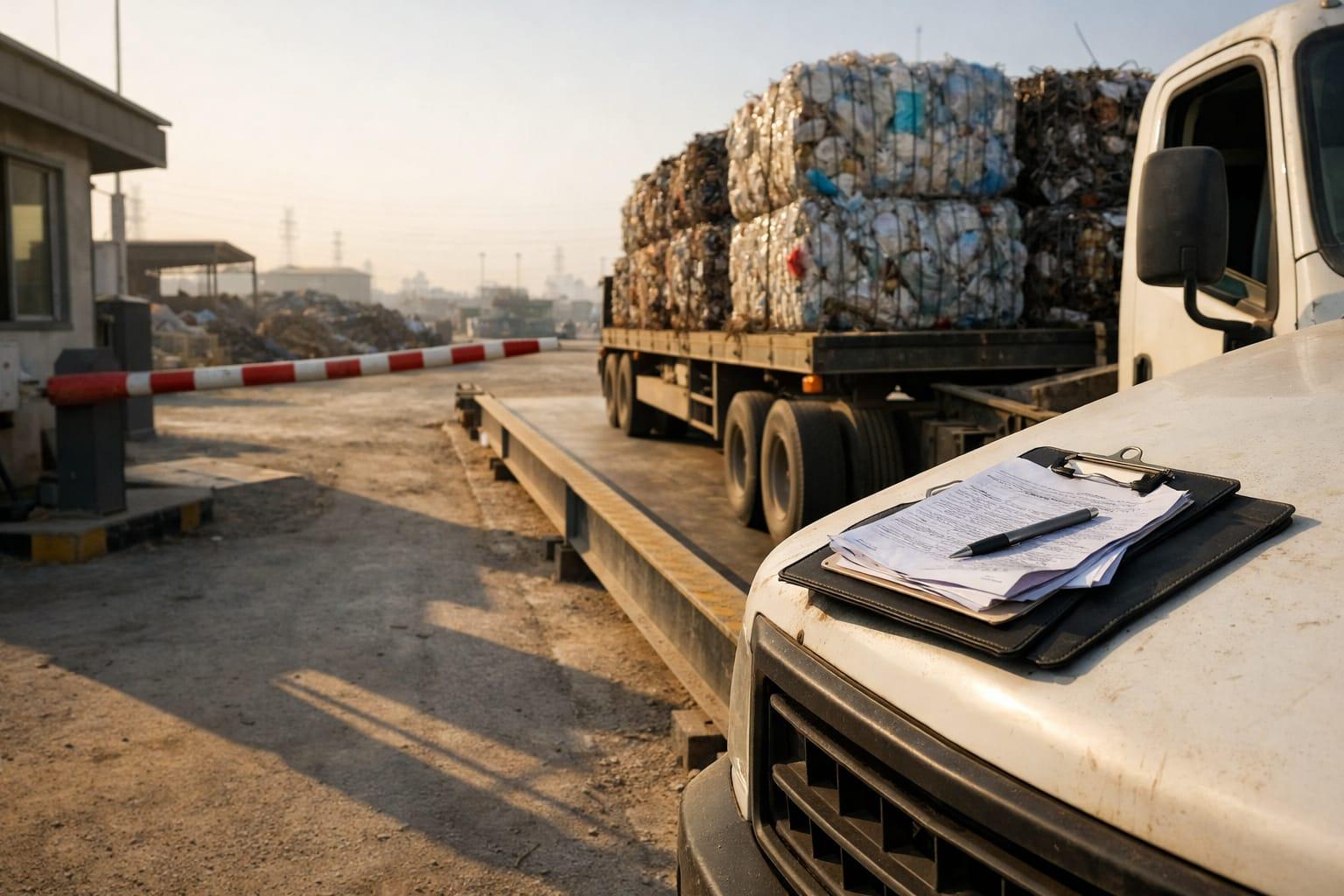
A waste load that crosses an emirate border needs clearance at both ends. Federal Cabinet Resolution No. 39 of 2021 requires the carrier to be licensed in the emirate the waste leaves, the vehicle to be authorised for that specific waste type, and the receiving facility to time and certify the hand-over. Abu Dhabi issues its export approval per trip, and makes receivers outside the emirate register in its own system.
Which law decides whether a cross-border load is legal?
Federal Cabinet Resolution No. 39 of 2021 sits above the emirate rulebooks. Its Article 6 carries the title Controls and Conditions for Waste Transport in the State Emirates and has been in force since 21 April 2021. That single article is what turns a local licensing question into a two-ended one.
What it asks for, in substance: the carrier holds a licence issued in the exporting emirate; the vehicle is authorised for the specific waste type rather than for waste in general; a tracking device is fitted; the receiving facility records the time of transfer; and a complete hand-over certificate is filed with the competent authority. Article 6 also contains an express provision covering an unacceptable shipment of waste arriving at a facility. In other words, the rejected load is already a regulated event at federal level, not just a commercial argument between you and your hauler.
One caveat we will not paper over. Our reading came from a truncated extract of Article 6, so before you brief counsel or rewrite a haulage contract, pull the full text from the federal legislation portal and read the unacceptable shipment clause word for word. Everything below is what the emirates layer on top of that floor.
What does Abu Dhabi require before a load leaves the emirate?
Two things changed in June 2024 and a great deal of market guidance still has not caught up. Licensing, permitting, vehicle tracking, fee setting and inspection moved from Tadweer to the Environment Agency, Abu Dhabi. TAMM now lists the service as Issue Permit to Export Waste Outside Abu Dhabi under EAD. Tadweer Group kept profession licences and disposal permits.
The friction is linguistic as much as administrative. The standard operating procedures are still written in Tadweer and Centre for Waste Management language, and they are hosted on the EAD domain. Expect your transport provider to be bounced between two bodies at least once before someone issues the paper.
Read the permit type carefully, because this is where schedules break. SOP CWM.SOP.PR/02 defines the out-of-emirate approval as a special one time use permit, issued per trip or per shipment. An annual facility approval does not cover the movement. Every truck heading for Al Quoz, Ras Al Khor or Al Sajaa needs its own authorisation, which has to be built into the dispatch routine rather than handled once a year by the compliance team.
EAD policy EAD-EQ-PR-P-04 goes further. Waste may not be moved out of or into Abu Dhabi without a permit, in both directions. And receiving facilities located outside Abu Dhabi must register in the BOLISATY system. That is the two-ended rule in its most literal form: a Dubai or Sharjah recycler that wants Abu Dhabi feedstock has to appear in an Abu Dhabi government system before the first load is weighed.
The construction and demolition route may not work the way you assume
The published Abu Dhabi C&D standard operating procedure restricts transport to Tadweer-licensed facilities inside Abu Dhabi. Taken at face value, that blocks the common plan of sending Musaffah or KEZAD demolition arisings to a Dubai crusher. We have not been able to confirm whether EAD grants exceptions in practice, so treat it as a question to put to the authority in writing before you tender the haulage, not as a settled position. If you are working a demolition programme, the record-keeping that underpins an Abu Dhabi demolition NOC is the same evidence trail that will be tested at the gate.
What does Dubai require of an inbound load?
Dubai Law No. 18 of 2024 and Administrative Resolution No. 34 of 2026 together regulate waste-related activities, carrier licensing, container and on-site storage standards, and electronic transfer records. We have dealt with Dubai's producer register, its digital transfer notes and its licence classes elsewhere, so this section covers only the money and the vehicles.
The waste-related activity permit is priced at AED 1,000 per activity, and the activities are counted separately. Metal scrap trade, plastic scrap trade, paper scrap trade and glass scrap trade are four permits, not one, so a four-stream trader is looking at AED 4,000 before a single truck moves. The penalty schedule we traced shows AED 5,000 for a non-conforming load and AED 10,000 for carrying out a waste activity without a permit.
Now the health warning. Those figures come from Dubai Executive Council Resolution No. 58 of 2017, which predates both the 2024 law and the 2026 resolution, and we could not confirm that the 2017 schedule is still the operative one. Use them as order of magnitude and confirm the current amounts with Dubai Municipality before you put them in a budget or a contract indemnity.
On the vehicle side, the same source gives RASID registration at AED 150 to 200 per vehicle, GPS at AED 780 per vehicle per year, and a weighing sensor at AED 1,000. For a twelve truck fleet the GPS line alone is AED 9,360 a year before registration or sensors. That is a real number to put against a haulage tender, and it is one of the reasons a cheap per-trip rate from an unlicensed operator is not actually cheap.
How do Sharjah and the Northern Emirates fit in?
Sharjah operates a managed collection system, which matters commercially more than it matters legally: collection and transport rights over a given stream in a given area may already be allocated, so a generator cannot always appoint whichever carrier quotes lowest. The 76% diversion figure quoted widely in Sharjah coverage traces back to reporting from 2019 and 2020 and should not be presented as a current performance number in an ESG deck.
We are also going to be straight about the limits of what we verified. Our source for Sharjah's permit service naming was a property portal rather than the municipality, so we are not printing service names we cannot stand behind. The same applies to Ajman, Umm Al Quwain, Ras Al Khaimah and Fujairah, where we could not verify authority names or permit titles. The practical instruction is unglamorous and effective: email the municipality, ask which permit covers inbound and outbound movement of your specific stream, and keep the reply in the job file.
Where does each leg of the journey need paperwork?
| Leg | Authority at the time of writing | What the sender needs | What the receiver needs | How solid is this |
|---|---|---|---|---|
| Out of Abu Dhabi | EAD, via TAMM, since June 2024 | Export permit per trip or shipment, per SOP CWM.SOP.PR/02 | Registration in BOLISATY even if located in another emirate | Verified |
| Into Abu Dhabi | EAD, policy EAD-EQ-PR-P-04 | Permit required for inbound movement too | Receiving facility licensed in Abu Dhabi | Verified |
| Abu Dhabi C&D | EAD, published C&D SOP | Transport restricted to Tadweer-licensed facilities inside Abu Dhabi | In-emirate licence | Published text verified, exceptions unconfirmed |
| Into or out of Dubai | Dubai Municipality, Law No. 18 of 2024 and Resolution No. 34 of 2026 | Licensed carrier, RASID vehicle fit-out, electronic transfer record | Permitted activity, AED 1,000 per activity | Law verified, fee schedule provenance 2017 |
| Sharjah | Managed collection system | Check allocation of collection rights for the stream | Confirm with municipality | Service names not verified |
| Northern Emirates | Municipality level | Confirm in writing | Confirm in writing | Not verified |
| Hazardous or Basel-listed | MOCCAE, plus both emirate authorities | Federal export permit, AED 500 | Emirate approvals still apply | Fee verified |
When does this become a federal ministry matter?
If the stream is hazardous or Basel-listed, MOCCAE enters the chain and its hazardous waste export permit is priced at AED 500. The point traders miss is that the federal permit sits on top of the emirate approvals rather than replacing them, so a drum of spent solvent moving from Dubai Industrial City to a treatment facility in another emirate still needs the carrier licence, the vehicle authorisation and the hand-over certificate that Article 6 demands. Our guide to Basel permits for UAE exports sets out how the notification side works once the material leaves the country.
There is a fourth boundary that gets forgotten entirely. A load ending at a Jebel Ali or JAFZA exporter crosses a customs line as well as an emirate line, and the customs documentation is a separate requirement from the environmental one. We do not have verified free zone waste permitting data to publish, but the customs side is well established and is covered in our piece on free zone scrap sales and the bill of entry.
Who carries the liability when the gate refuses the load?
Start from the uncomfortable fact: a rejected load does not stop being your waste. The generator is normally the producer of record, the carrier holds the transport authorisation and the manifest, and the receiving facility holds absolute discretion at the weighbridge. If the paperwork is short, the truck turns around with a full bed and a driver on the clock.
Because Article 6 of Cabinet Resolution No. 39 of 2021 addresses unacceptable shipments directly, this is not a question your contract can answer alone, but the contract still decides who pays. Four clauses are worth having in every haulage and offtake agreement: a written rejection protocol naming who is called within what period; an allocation of return haulage and waiting time cost; a re-testing and re-presentation procedure with who pays for the sample; and a named alternative destination that is itself permitted to receive the stream.
This is part of why we hold funds in escrow through MyFatoorah and give buyers a 48-hour inspection window on AlKhiidma listings. A gate rejection becomes a documented dispute inside the platform between two UAE PASS verified parties, rather than an unpaid invoice and a phone number that stops answering.
What must the chain of custody show for an audit?
An assurance provider is not testing whether you believe the material was recycled. It is testing whether you can evidence it. For each movement, the file needs to show origin site and generator identity, the waste classification used, net weight from a calibrated bridge, the carrier's licence number and issuing emirate, vehicle plate and the authorisation covering that waste type, driver identity, departure and arrival timestamps, the receiving facility's permit reference, a signed hand-over certificate, and the final treatment outcome.
Miss the last field and the tonne is uncountable. A load can be physically recycled in Al Sajaa and still be struck out of your diversion rate because nothing in the file proves what happened after the gate. We are deliberately not citing an instrument number for the UAE climate disclosure requirement, because we could not verify which one applies to a given entity, and an invented citation in a compliance article is worse than no citation.
What should you hand your transport provider before dispatch?
- Written confirmation of the waste classification for the load, not just a trade name such as mixed plastics.
- The receiving facility's permit reference, and for Abu Dhabi outbound, evidence it is registered in BOLISATY.
- The per-trip export permit where the origin is Abu Dhabi, issued for that shipment, not a facility approval.
- The carrier's licence issued in the exporting emirate, with expiry date checked that week.
- The vehicle authorisation naming the specific waste type, plus plate number matching the truck at the loading bay.
- Proof the tracking device is live, and for Dubai, RASID registration and weighing sensor status.
- A pre-printed hand-over certificate with sender fields already completed.
- The weighbridge ticket from origin, where the generator weighs.
- Safety data sheet and any analysis certificate where the stream is hazardous, contaminated or borderline.
- A named rejection contact with a mobile number answered outside office hours.
What does getting it wrong actually cost?
Three cost layers, and only one of them is a fine. The verified Dubai penalties we traced are AED 5,000 for a non-conforming load and AED 10,000 for operating a waste activity without a permit, both from the 2017 schedule and both to be reconfirmed. That is the visible layer.
The second layer is operational and usually larger: return haulage on a loaded vehicle, driver hours, demurrage at the origin yard when the truck comes back and there is nowhere to tip, and a slot lost at the receiving facility. We are not going to print a per-trip haulage figure we have not verified. Get your carrier to quote the return-trip rate and the hourly waiting charge in writing at tender stage, then you have a real number for the rejection scenario instead of an argument after the event.
The third layer is the one that shows up in March, when the sustainability report is being assured. Every tonne with an incomplete transfer record is a tonne you cannot claim. A site that diverted 4,000 tonnes and can evidence 3,100 reports a diversion rate built on 3,100, and the gap is not recoverable after the fact because the hand-over certificate was never filed. More regulation coverage is where we track changes to these instruments as the authorities publish them.
Frequently asked questions
Does a waste carrier licence from one emirate cover the whole UAE?
No. Each emirate licenses waste activities separately, and Federal Cabinet Resolution No. 39 of 2021 requires the carrier to hold a licence issued in the emirate the waste is leaving. The receiving facility must also be permitted in its own emirate to accept that stream. A load that is fully compliant at origin can still be refused at the destination gate.
Is Abu Dhabi's out-of-emirate waste permit annual or per trip?
Per trip. SOP CWM.SOP.PR/02 defines it as a special one time use permit issued per trip or per shipment, so an annual facility approval does not cover the movement. Since June 2024 the permit is issued by the Environment Agency, Abu Dhabi through TAMM, not by Tadweer, although the SOP documents are still written in Tadweer language.
Does a Dubai recycler need to register with an Abu Dhabi system?
Yes, if it wants Abu Dhabi feedstock. EAD requires receiving facilities located outside Abu Dhabi to register in the BOLISATY system, and EAD policy EAD-EQ-PR-P-04 states that waste may not be moved out of or into the emirate without a permit. Sort the registration before you contract, not when the first truck is at the gate.
Who pays when a receiving facility rejects a load?
Article 6 of Cabinet Resolution No. 39 of 2021 contains an express provision on unacceptable shipments arriving at a facility, so the event is regulated, but the cost allocation comes from your contract. Agree in advance who pays return haulage and waiting time, who re-tests the material, and which permitted alternative facility the load goes to. Without those clauses the generator usually absorbs it.
Can I count a tonne in my diversion rate if the transfer record is incomplete?
Not in an assured report. The auditor tests the evidence chain rather than the physical outcome, so a tonne without a signed hand-over certificate, a receiving facility permit reference and a treatment outcome gets removed. The material may genuinely have been recycled and still fail to count, and the gap cannot be closed retrospectively.
When does MOCCAE get involved instead of the emirate authority?
When the stream is hazardous or Basel-listed. MOCCAE's hazardous waste export permit is priced at AED 500. The federal permit sits on top of the emirate approvals rather than replacing them, so the carrier licence, vehicle authorisation and hand-over certificate required at both ends still apply to a domestic inter-emirate movement.


Comments(0)
Sign in to join the conversation.