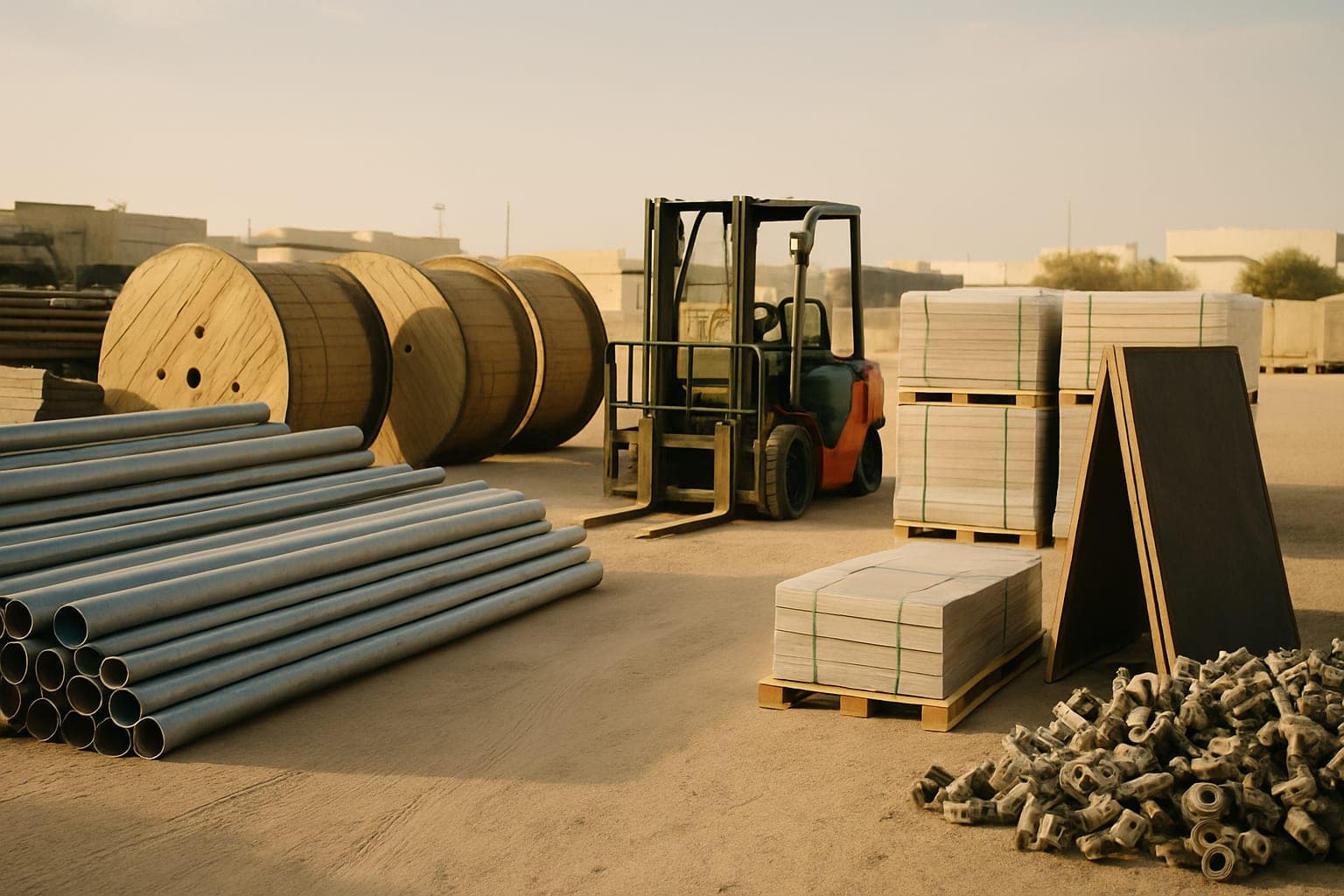
A demobilising site usually holds six figures of never-installed material, and it gets skipped because the decision has no owner. Assign one. Then reconcile BOQ against MTO to find true surplus, confirm title before you list anything, document each lot, and sell bundled by trade at 25% to 60% of replacement cost while the yard is still manned.
Why does a full laydown yard get skipped in the last 60 days?
Three people could make the call and none of them does. The QS is closing the final account, the project manager is chasing snags and defects, and the procurement lead moved to the next job six weeks ago. So the yard sits. Security demobilises, the storekeeper's visa transfers, and on the last Thursday a muck-away contractor clears the lot into tippers.
You pay for that twice: once for material you already bought and certified, once per tonne at the gate. Executive Council Resolution No. (58) of 2017, issued on 18 October 2017 and still the governing fee and fine instrument for waste disposal in Dubai, states in Article 1 that a part of a tonne is rounded up to a full tonne. Light, bulky items like boxed FCUs and plywood bill at full units.
The material that carries value at closeout is predictable across almost every UAE project we see:
- Part drums and full drums of LV cable, plus unused distribution boards, MCCBs and spare switchgear modules
- GI and uPVC pipe in standard lengths, fittings, gate and butterfly valves, strainers
- Boxed fan coil units, pumps, dampers and grilles that arrived against a scope later value engineered out
- Porcelain and ceramic tile overage, sanitaryware, mixers, ironmongery
- Film-faced formwork ply, scaffold boards, cuplock standards, ledgers and loose fittings
How do you separate genuine surplus from material you still owe?
Start with the paperwork, not the yard. Pull the final MTO against the as-built installed quantity and against delivered quantity from the GRNs. The gap is where over-ordering lives: wastage allowances on cable and tile that were never consumed, breakage allowances on sanitaryware, minimum order multiples that forced a full drum or a full pallet, and material bought against scope that a variation deleted after procurement had already committed.
Then walk the yard with the storekeeper and photograph every stack before anyone touches it. A one-page register per lot, quantity, size, brand, batch or serial number, packaging condition and storage exposure, is what turns a vague pile into a sellable listing later. Do this at day 90, not day 20, because at day 20 the storekeeper has gone.
The four title questions to settle in writing
- Free-issue client material. It is the employer's property unless the contract says otherwise. Most FIDIC-based forms in use here deal with ownership of plant and materials and with what happens to surplus at completion, so read the particular conditions and get a written instruction before anything leaves the gate.
- Consignment or sale-or-return stock. Unopened pallets from a supplier may still be returnable for credit, which usually beats resale. Ask before you list.
- Retained spares. If an item appears in the spare parts schedule of the O&M manual, it belongs to the handover pack, not to the sale. Reconcile the sale list against that schedule line by line.
- Hired temporary works. Scaffolding, props and formwork panels are frequently on hire, not owned. Selling hired kit is theft, and the hire company will invoice the replacement value anyway.
Everything that survives those four checks is yours to sell. Get it signed off by the commercial manager on one sheet, because that sheet is also your defence if anyone queries a disposal six months later.
What is surplus site material actually worth?
In practice, documented surplus clears at roughly a quarter to two thirds of replacement cost. That band is practitioner experience, not a published index, and where a lot lands inside it is decided almost entirely by evidence. Original packaging intact, batch and mill certificates attached, datasheets, serial numbers, a photo set showing storage out of direct sun, and a named brand that sits on local approved vendor lists will push a lot toward the top. Loose, unlabelled, sun-bleached and part-used material sits at the bottom, and some of it is honestly scrap.
Cable is where the money is lost most often. Refined copper is the benchmark that every buyer prices against, and LME official cash was USD 14,505 per tonne on 6 October 2026 as reported by FT Mercati, about AED 53.27 per kilogram at the pegged rate. A sealed, certificate-backed drum of XLPE cable is not a copper-content sale, it is a goods sale that should be benchmarked against the price of new cable from the same supplier. Compare that with the stale export quotes still circulating, including UAE supplier pages advertising Millberry wire scrap near USD 7,500 per tonne, roughly half LME cash, and you can see the anchor a lowballing buyer brings to a demobilising site. Our note on how UAE copper scrap tracks the LME run sets out the benchmark in more detail.
There is no published UAE scrap or surplus index, which is exactly why bidding beats negotiating. Commercial price pages contradict each other badly: one site quoted insulated copper cable at AED 8 to 12 per kg around August 2026 while another quoted AED 8 to 18 per kg around April 2026, and general copper scrap ranges on those same pages run from AED 18 to 47 per kg depending on grade. Treat all of them as directional noise, not as a reference price.
Illustrative worked example, one mid-rise fit-out yard
| Bundle | Contents | Illustrative replacement cost (AED) | Documented resale at 25% to 60% |
|---|---|---|---|
| Electrical | 3 part drums LV cable, 2 unused DBs, spare MCCBs | 42,000 | 10,500 to 25,200 |
| Mechanical | GI and uPVC pipe, valves, 4 boxed FCUs | 31,000 | 7,750 to 18,600 |
| Finishes | 180 sq m porcelain tile, 6 WC suites, mixers | 18,000 | 4,500 to 10,800 |
| Temporary works | Film-faced ply, scaffold boards, loose fittings | 14,000 | 3,500 to 8,400 |
| Total | 105,000 | 26,250 to 63,000 |
Those figures are an illustration built from typical closeout registers, not market data. Substitute your own purchase order values and the method still works. Bundling by trade matters more than most teams expect, because an MEP contractor in Dubai Industrial City will take the whole electrical lot in one movement, while four separate buyers for four separate items means four site visits, four gate passes and three deals that never close.
Which lots are worth moving, and which should the buyer lift?
Lifting and haulage decide whether a lot is worth touching, and there is no public rate card for crane or hiab hire and flatbed trips in the UAE, so get three written quotes against the actual weights before you commit to anything. Our working rule is simple: if the cost of moving a lot exceeds about 30% of its expected net realisation, do not move it, sell it ex-yard and let the buyer lift, load and transport.
Ex-yard sales need a short logistics note in the listing: collection window, gate pass lead time, HSE induction requirement, whether a forklift and banksman are still available on site, and the latest date the buyer can collect before the site goes dark. Demobilising sites lose their crane first, then their power, then their security. Sell against that sequence and you will not end up paying for a mobile crane in week 12 to recover a lot you could have released in week 4.
Do you charge VAT, or is it scrap?
This changed on 14 January 2026. Cabinet Decision No. (153) of 2025 applied the reverse charge mechanism to local supplies of scrap metal between VAT-registered persons, moving responsibility for accounting for the VAT from the supplier to the recipient. It was announced in December 2025 and reported by Khaleej Times on 19 December 2025, with tax alerts from the major firms the same month. The underlying authority is Article 48 of Federal Decree-Law No. (8) of 2017 on VAT, as amended.
So the same drum has two tax outcomes depending on how you sell it. Sell a never-installed, warrantied FCU or a sealed cable drum as goods and it is an ordinary taxable supply at 5%, invoiced the normal way. Sell the same copper into a scrap stream to another VAT-registered business and the reverse charge applies instead. The decision's own definition of scrap metal, and the declarations the recipient has to give you, are the part to confirm with your tax advisor against the published text before you raise the invoice. Capture the buyer's TRN either way.
Commercially, the goods route usually wins twice. You get a higher price and a cleaner invoice trail, and the buyer gets a redeployable asset rather than furnace feed.
Does resale count toward Dubai's 50% diversion target?
Yes, and this is the part most teams under-claim. Al Sa'fat, Dubai's green building system introduced in 2010 and updated in 2017, requires a minimum of 50% by volume or weight of construction and demolition waste to be diverted from landfill, and the wording is that diverted material must be recycled or reused. Resale into reuse sits on the right side of that line. Reporting on the current scope also indicates that excavated soil, land-clearing debris and hazardous waste are excluded from the calculation, and that the requirement applies to new buildings outside the CBD area, so confirm the live thresholds with Dubai Municipality Building Permits for your specific permit.
| System or authority | Where it applies | Diversion threshold | Reuse counted |
|---|---|---|---|
| Al Sa'fat (Dubai Municipality) | New buildings, CBD area excluded | Minimum 50% by volume or weight | Yes, recycled or reused |
| Estidama Pearl (Abu Dhabi) | Abu Dhabi projects | 1 credit at 50%, 2 credits at 70% final recycling or salvage rate | Yes, plan must state intended use for salvaged material |
| Trakhees EHS (PCFC) | Projects in PCFC free zone jurisdiction | 1 point at 50%, 2 points at 75% | Yes |
| Dubai Integrated Waste Management Strategy 2041 | Emirate-wide policy target | 100% landfill diversion, recycling at least 56% | Policy level |
Threshold figures above come from a regulatory comparison published in Engineering, Construction and Architectural Management in late 2024 and from the Dubai Government Media Office release of 27 October 2025, which also launched Circle Dubai, a programme built around 17 strategic projects, 26 performance indicators and 9 target sectors. One caution on Abu Dhabi: a separate 2024 source reports a mandatory 30% diversion floor under Estidama with no credit awarded, which sits alongside rather than instead of the 50% and 70% credit tiers. Reconcile the two with your Pearl Qualified Professional before you write a number into the report.
Estidama is also the strongest argument for doing this properly. The general contractor must produce a construction and demolition waste management plan before activities start, naming the materials for diversion, the segregation method and the intended use for salvaged materials. Resale is not a workaround to that plan, it is what the plan is supposed to describe. On the Abu Dhabi side, the same evidence feeds your demolition record, and Abu Dhabi demolition NOCs hinge on C&D waste records covers what that file needs to contain.
Keep the evidence pack as you sell, not afterwards: weighbridge tickets, transfer notes, buyer TRN and trade licence, photographs of each lot loading out, and the signed sale record. Every AlKhiidma transaction produces an audit-ready record you can drop straight into the diversion file.
What does skipping it cost instead?
Nobody can tell you a single honest tipping figure for Dubai C&D waste, because the market-facing sources disagree by a factor of thirteen. One commercial site quoted AED 30 to 80 per tonne for C&D debris in 2026, another quoted AED 150 to 400 per tonne for construction waste around August 2026. Neither is official. The authoritative reference remains the fee schedules to Resolution No. (58) of 2017, and the only number that matters to your cost plan is the rate in your own waste contractor's current schedule. Pull it before you decide.
The penalty side is clearer. Dubai Municipality's waste segregation guidance, published in late 2024, cites a AED 5,000 fine on private organisations and commercial, residential and industrial complexes for failing to provide waste segregation facilities, and Resolution 58 of 2017 allows the authority to suspend waste-related activity for up to six months or revoke the permit in addition to fines. If your disposal cost line looks wrong for the tonnage you are generatingretendering the waste contract is usually the faster win.
What does a 90-day disposal countdown look like?
- Day 90. Name the owner of the disposal decision in writing. One person, usually the QS or the site commercial lead, with authority to approve a sale.
- Day 88 to 80. Reconcile final MTO against installed and delivered quantities. Produce the draft surplus register.
- Day 80 to 72. Run the four title checks. Issue the free-issue list to the client for instruction and the consignment list to suppliers for return credit.
- Day 72 to 65. Walk the yard, photograph every lot, collect batch certificates, mill certificates, datasheets and serial numbers into one folder per bundle.
- Day 65 to 58. Bundle by trade, electrical, mechanical, finishes, temporary works. Weigh or estimate each bundle and get three lifting and haulage quotes.
- Day 58 to 50. Set reserve prices against replacement cost, then publish. Listings with certificates and full photo sets attract bids instead of lowball offers, and you can post yours in the construction category on the marketplace.
- Day 50 to 30. Run the bidding, verify counterparties through UAE PASS KYC, and confirm each buyer's TRN and trade licence.
- Day 30 to 20. Collections begin. Escrow through MyFatoorah holds funds until the buyer's 48-hour inspection window closes, which also protects you from a post-collection quantity dispute.
- Day 20 to 10. Residual lots that attracted no bid go to the scrap route under the correct VAT treatment. Record weights.
- Day 10 to 0. Final clearance of genuine waste, close the evidence pack, file the diversion calculation against Al Sa'fat, Estidama or Trakhees criteria as applicable.
Run that sequence once and it becomes a closeout template. Run it late and you are negotiating from a yard with no forklift, no power and a demobilisation date you cannot move, which is precisely when buyers bid 15% of replacement cost and get it.
Frequently asked questions
Can I sell free-issue material left over from a UAE project?
Not without written instruction. Free-issue material supplied by the client remains the employer's property unless your contract transfers title, and most FIDIC-based forms used in the UAE address ownership of materials and the treatment of surplus at completion. Issue the client a list of unused free-issue items and ask for a documented instruction to return, hand over or dispose. Keep that instruction in the closeout file.
Do I charge VAT when I sell surplus construction material in the UAE?
It depends on whether you are selling goods or scrap. A never-installed, documented item sold as goods is an ordinary taxable supply at 5%. From 14 January 2026, Cabinet Decision No. (153) of 2025 applied the reverse charge mechanism to local supplies of scrap metal between VAT-registered persons, so the recipient accounts for the VAT instead of you. Confirm the definition of scrap metal and the recipient declarations against the published text with your tax advisor.
Does reselling material count toward Dubai's 50% diversion requirement?
Yes. Al Sa'fat requires a minimum of 50% by volume or weight of construction and demolition waste to be diverted, and the diverted material must be recycled or reused, so material sold for reuse qualifies. Reporting on the current scope indicates excavated soil, land-clearing debris and hazardous waste are excluded from the calculation. Confirm the live thresholds for your permit with Dubai Municipality.
What is surplus site material actually worth?
Documented surplus typically clears at roughly 25% to 60% of replacement cost, which is practitioner experience rather than a published index. Original packaging, batch certificates, datasheets, serial numbers and a clear photo set move a lot toward the top of that band. Loose, part-used and undocumented material sits at the bottom, and some of it genuinely is scrap.
How much does it cost to tip construction waste in Dubai instead?
There is no single reliable public figure. Market-facing sources quoted anywhere from AED 30 to 80 per tonne to AED 150 to 400 per tonne for construction waste during 2026, a spread too wide to plan against. The governing instrument is Executive Council Resolution No. (58) of 2017, which also rounds any part tonne up to a full tonne, so use the rate in your own waste contractor's current schedule.


Comments(0)
Sign in to join the conversation.