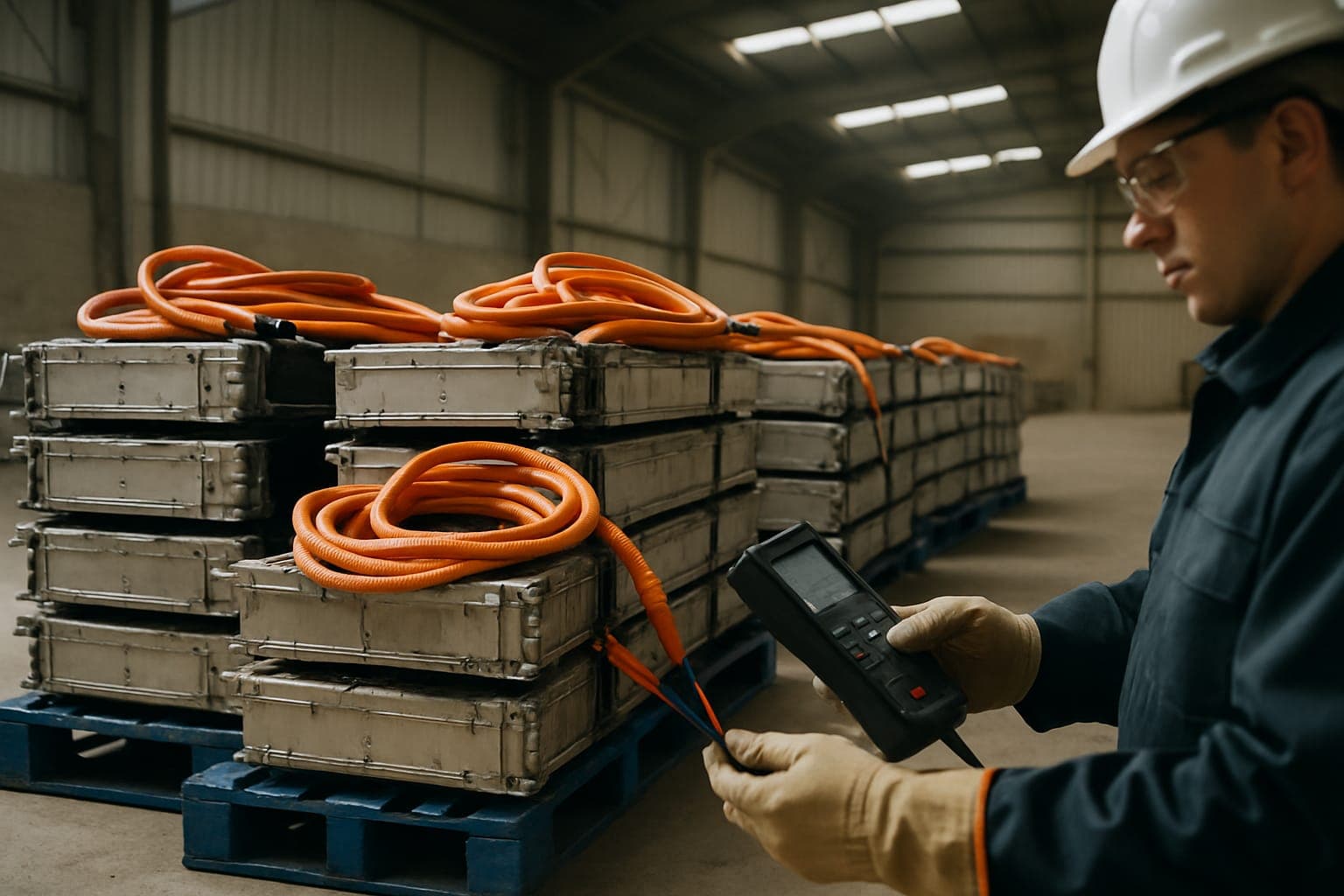
The UAE's first lithium-ion recycling route is being built at BEEAH's Al Saja'a complex in Sharjah, under a joint venture the Ministry of Energy and Infrastructure announced with BEEAH and Lohum on 15 January 2026. Year-one capacity is 1,500 tonnes. Fleets holding end-of-life packs have a domestic option, but chemistry, state-of-health evidence and an inter-emirate transport permit decide what you earn.
What did BEEAH, the Ministry and Lohum actually announce?
At the World Future Energy Summit, on the sidelines of Abu Dhabi Sustainability Week, the Ministry of Energy and Infrastructure said it planned to form a joint venture with BEEAH and Lohum, the Indian producer of sustainable critical minerals and advanced materials. The venture will develop the UAE's first large-scale facility for electric vehicle battery recycling and second-life repurposing, inside BEEAH's integrated Waste Management Complex at Al Saja'a in Sharjah. The technology covers EV packs and other lithium-ion battery types, not only automotive cells.
The capacity guidance is specific. BEEAH says the plant aims to process 1,500 tonnes of lithium-ion batteries in 2026 and to double its processing capacity by the third year of operations. One Sharjah outlet reported a trebling by year three; BEEAH's own release says double, so use double. Earlier coverage from 2022 to 2024 described an 80,000 sq ft site handling up to 3,000 tonnes a year plus 15 MWh of repurposed capacity, using Lohum's hydrometallurgical NEETM process. Treat 3,000 tonnes as the earlier design figure, not current guidance.
One more caution before you build a plan around a gate date. The January 2026 news was a joint venture formation and development announcement, not a commissioning notice, and we could not verify construction status as of the third quarter of 2026. Ask BEEAH directly for an acceptance window before you schedule a pack removal campaign.
The policy driver is on record. MoEI Undersecretary for Energy and Petroleum Affairs Eng. Sharif Al Olama linked the plant to the Global EV Market initiative and its aim of raising electric vehicles to 50% of all vehicles on UAE roads by 2050. Every one of those vehicles carries a pack that eventually stops holding charge.
Why does a Sharjah plant change your disposal maths?
Until now, a UAE fleet with a pallet of dead modules had two realistic paths. Stockpile them in a warehouse corner and defer the decision, or arrange an export, which engages the Basel Convention. The UAE has been a Basel member state since 1990, movement of hazardous waste by sea, land or air inside the country is banned without written permission from MOCCAE, and MOCCAE has issued a ministerial decision prohibiting the passage and export of hazardous waste across the country's borders. The federal portal does not publish that decision's number, so request the reference in writing when you apply.
A domestic processor changes the question from "can I legally move this" to "which route pays best". That is optionality, and it is worth more than tonnage headlines. Note the scale though. A 1,500-tonne first year is modest against a national bus, taxi, forklift and telecom backup population, so the operators who get assay terms and an intake slot are the ones who start the conversation in 2026. Everybody else keeps paying to store.
How is a used lithium-ion pack priced?
Black mass, the shredded electrode powder that comes out of pre-treatment, does not have a flat price. It has a payable. Fastmarkets' pricing methodology notice of 14 April 2026 sets NCM black mass indicators as a percentage of a benchmark: nickel as a percentage payable of the LME nickel cash official price, cobalt against Fastmarkets' standard-grade cobalt low end, and lithium against its lithium carbonate 99.5% price, on a maximum 5% moisture, CIF South Korea basis. The same notice said import flows into China had increased since summer 2025 and traded specifications had shifted with higher black mass quality.
So any UAE offer you receive is really a metal basket minus freight, minus moisture and off-spec deductions, minus the cost of discharging and dismantling packs that were never designed to come apart. For historical calibration only: Fastmarkets reported NCM payables heard at 74 to 75% DDP on 14 April 2025, with lithium carbonate 99.5% battery grade EXW China at 70,000 to 71,000 yuan per tonne, roughly AED 35,150 to 35,650 at the 3.6725 peg. In late September 2023 the same house put NCM and NCA nickel and cobalt payables at 66 to 70% CIF Southeast Asia and a black mass mid-point at USD 4,914 per tonne CIF Korea, about AED 18,050. None of that is a 2026 quote. We could not verify any UAE-quoted dirham price per kilogram for scrap packs, modules or black mass, and it is entirely possible a local processor charges a gate fee on low-value chemistries rather than paying you.
If your instinct is that batteries are batteries, drop it. The economics here look nothing like the lead-acid stream, where recovery rates and refining routes are settled and the buyer pool is defined by licensed smelter capacity rather than payable percentages.
Contained value by chemistry
The clearest published comparison of chemistries comes from a Fastmarkets article dated 10 November 2025, but the underlying figures are based on May 2023 prices, so they are more than two years old and directional only. Dirham equivalents are our conversion at the 3.6725 peg.
| Chemistry | Contained value per tonne of cells (May 2023 prices) | AED equivalent | Practical route |
|---|---|---|---|
| LCO | USD 11,130, lithium 11% by weight and 42% by value | ~AED 40,900 | Black mass recovery, worth assaying properly |
| NCM, averaged mix | USD 8,700, lithium 14% by weight and 55% by value | ~AED 31,950 | Black mass recovery, payable-driven |
| LFP | USD 3,170, least valuable black mass | ~AED 11,650 | Second life first, otherwise expect a gate fee |
Contained value is not what a fleet receives. It is the ceiling above payables, freight, discharge, dismantling and testing. Read the LFP line carefully if you run buses, electric forklifts or telecom energy storage, because LFP dominates those applications and it is also the chemistry most exposed to falling lithium carbonate prices, since lithium is the primary recovery target from end-of-life LFP.
Second life or black mass?
State of health decides this, and it has to be measured, not estimated from vehicle mileage or install date. A pack that still holds a usable fraction of nameplate capacity is a stationary storage asset. A pack below that threshold is feedstock. Where a fleet loses money is running the two decisions on the same timeline, because every month of storage narrows the second-life window while the recovery value tracks metal prices you do not control.
Two gaps are worth naming plainly. We could not verify who in the UAE issues an accepted state-of-health certificate, what a per-pack test costs, or whether the joint venture's tagging platform accepts third-party test data. We also could not verify the current status of the 15 MWh repurposing line described in the 2022 to 2024 coverage. Put both questions to the buyer in writing before you commit a batch, and keep the module-level test records, because that is what turns a pallet of used modules into a specified lot rather than an unknown risk. Sellers listing surplus and end-of-life equipment in our electronics category get further with a documented lot than with a photograph and a weight.
The teardown itself has value you should not give away in a single mixed price. Pack disassembly yields copper busbars, aluminium housings, steel casings and engineering plastics, and those fractions have established UAE buyers independent of any black mass payable. Price them separately in the contract.
What paperwork moves a pack from a Dubai depot to Al Saja'a?
Understand what you are doing before you book a truck. A Dubai or Abu Dhabi fleet trucking packs to Sharjah is carrying out an inter-emirate hazardous waste movement, governed by Federal Law No. 12 of 2018 on Integrated Integrated Waste Management and its executive regulations in Cabinet Resolution 39 of 2021, whose 13 articles cover producer and supplier responsibility, hazardous waste management, transport between the emirates, by-product reuse and administrative penalties. Hazardous waste itself is defined in Federal Law No. 24 of 1999. Under the federal colour-coded container regime published by MOCCAE in July 2021, red is the hazardous stream.
- Obtain approval for the movement from the concerned authority in the emirate you are shipping from.
- Hire a carrier that holds a valid waste transport permit issued in the exporting emirate, not just a commercial trucking licence.
- Confirm the vehicle is licensed for that specific waste type and fitted with GPS tracking, both of which MOCCAE lists as conditions for inter-emirate movement.
- Hold a valid contract with the receiving facility before the first pallet leaves your yard.
- If you are shipping out of Abu Dhabi, follow EAD's standard operating procedure for transporting waste outside the emirate: a laboratory test report with a maximum three-month validity, updated photographs of the waste, and an e-manifest completed in the BOLISATY system by both producer and transporter, with the receiving facility registered in BOLISATY.
- Agree the UN classification with your carrier in advance. Lithium cells and packs normally travel under the UN lithium battery entries, and damaged or defective packs attract stricter packing provisions. We could not verify which packing instructions UAE authorities enforce for damaged packs, so get the answer in writing from the carrier and the permitting authority.
Two regulator changes catch people out. Since 30 May 2024, licensing, permitting, vehicle tracking, fee setting, inspections and the sector regulatory function in Abu Dhabi sit with the Environment Agency, Abu Dhabi, with Tadweer Group as operator, so any Tadweer-era tariff sheet you have on file, including the AED 225 per tonne figure from a December 2017 page, is nine years old and should not be quoted as current. On the Dubai side, permit categories have been restructured, and we cover how the emirate now splits waste permits into three licences. Sharjah-level requirements, including EPAA permitting and BEEAH's commercial gate-fee schedule at Al Saja'a, we could not verify in this research pass, so confirm them with both bodies directly.
One more compliance thread to watch. The UAE introduced the region's first formal extended producer responsibility pilot, covering electrical equipment, batteries and packaging in Abu Dhabi and Dubai, reported in July 2025. Whether that pilot has become binding, and whether batteries fall inside any mandatory 2026 phase, we could not confirm. If you are a producer or importer as well as a fleet, that is a question for your legal team this quarter.
Why does waiting cost you money?
Stored packs consume racking, floor area and insurance cover in the same Sharjah and Dubai industrial zones where you would rather keep spare parts. They also carry fire-load conditions from Civil Defence that vary by quantity and layout, and we did not verify the current code thresholds or the insurance loading, so price them with your broker rather than assuming. What we can say from the pricing structure above is that the two clocks run against you: second-life value depends on remaining state of health, and recovery value depends on nickel, cobalt and lithium benchmarks that have moved sharply in both directions since 2023.
There is a reporting argument too. The joint venture says it will offer producers end-to-end traceability, from collection and tagging of end-of-life lithium-ion batteries through to recycling and repurposing, so that producers stay compliant. That is the same chain of custody your auditors and your tender documents keep asking for, and fleets that already had to prove disposal for other regulated streams will recognise the pattern from tyre quota compliance. On our side, KYC verification through UAE PASS, escrow settlement and a 48-hour inspection window exist for exactly this problem: high-value, high-liability material where neither party wants to move first.
Do three things this quarter. Inventory every pack you hold by chemistry, nameplate capacity and removal date. Get state-of-health tested on anything you think has second-life value, and get it in a document. Then open the intake and paperwork conversation with a licensed receiver while first-year capacity is still being allocated.
Frequently asked questions
Where can a UAE commercial fleet send end-of-life lithium-ion batteries?
The Ministry of Energy and Infrastructure, BEEAH and Lohum announced on 15 January 2026 that they plan to form a joint venture to develop a lithium-ion and EV battery recycling and second-life facility at BEEAH's Waste Management Complex in Al Saja'a, Sharjah. It aims to process 1,500 tonnes in 2026. Because that was a development announcement rather than a commissioning notice, confirm acceptance dates and accepted chemistries with BEEAH before you plan a removal campaign.
What is a used EV battery pack worth in the UAE?
We could not verify any UAE dirham price per kilogram for scrap lithium packs, modules or black mass, and low-value chemistries may attract a gate fee rather than a payment. Black mass is priced as a payable percentage of benchmarks, nickel against the LME cash official price, cobalt against a standard-grade assessment and lithium against lithium carbonate 99.5%, on a maximum 5% moisture basis per Fastmarkets' April 2026 methodology. Ask any buyer to state chemistry, moisture and payable basis, or the number will not survive assay.
Do I need a permit to move lithium batteries from Dubai to Sharjah?
Yes, treat it as an inter-emirate hazardous waste movement. MOCCAE's conditions include approval from the concerned authority, a carrier holding a waste transport permit issued in the exporting emirate, and vehicles licensed for that specific waste type and fitted with GPS tracking. Movement of hazardous waste inside the country without written ministry permission is banned, in line with the Basel Convention, which the UAE joined in 1990.
For LFP forklift and telecom batteries, does second life pay more than recycling?
Usually yes, if state of health supports it. Using May 2023 prices, Fastmarkets put LFP contained value at about USD 3,170 per tonne of cells, roughly AED 11,650, against about USD 8,700 for an averaged NCM mix, making LFP the least valuable black mass. For LFP-heavy fleets the realistic choices are repurposing into stationary storage or paying a gate fee, so test before you decide.
Who issues a battery state-of-health certificate in the UAE?
We could not verify which UAE laboratories or service providers issue an accepted state-of-health certificate, what a per-pack test costs, or whether the Al Saja'a joint venture's tagging platform accepts third-party test data. Put all three questions to the receiving facility in writing before committing a batch. Keep module-level records regardless, because documented capacity is what separates a specified lot from an unpriced risk.

Comments(0)
Sign in to join the conversation.