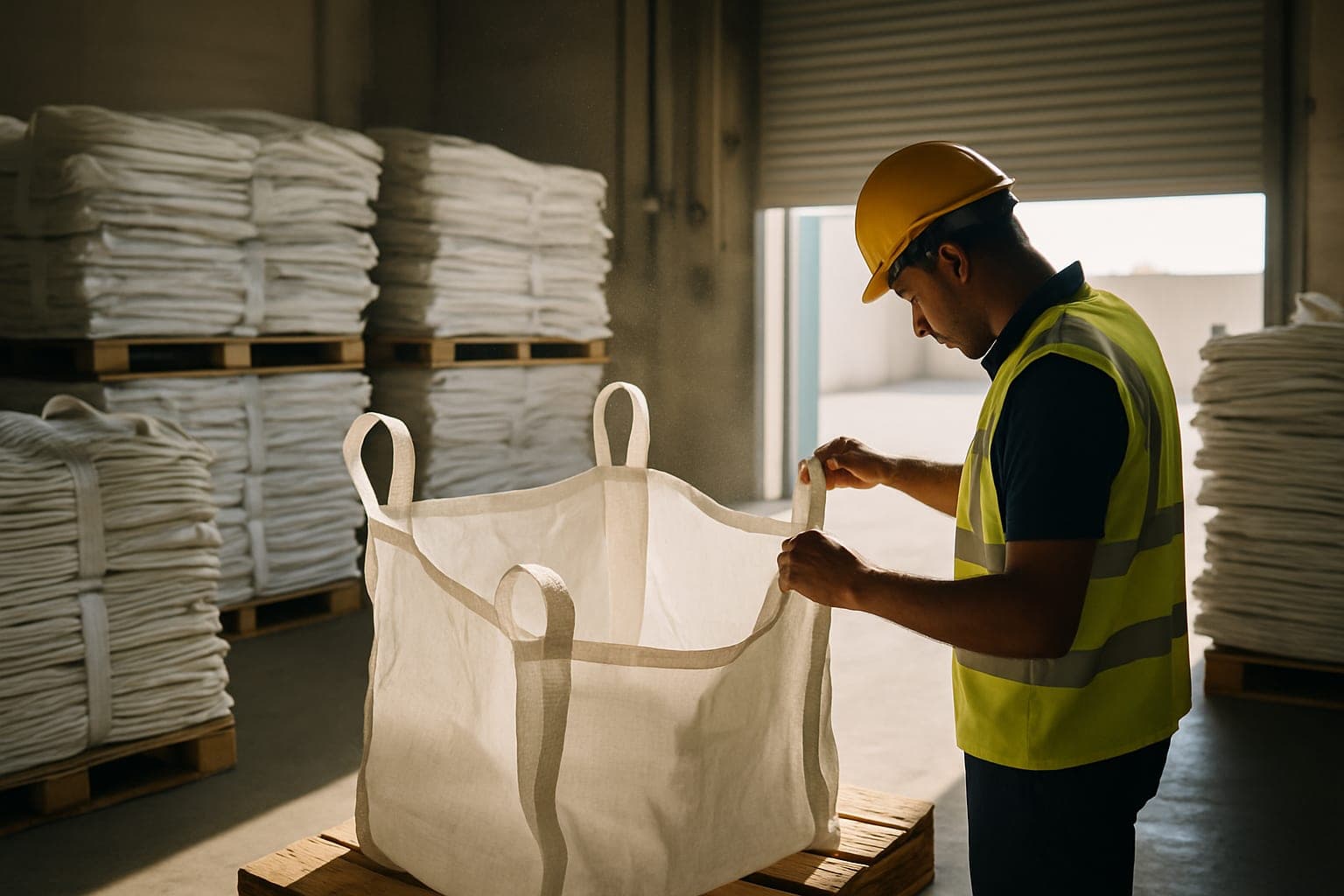
A used FIBC sells on its prior contents, not on how it looks. Bags that carried food, minerals or resin, kept the polyethylene liner intact and stayed out of direct sun can go back into service or into PP regrind. Bags with chemical residue, a torn liner or chalky sun-bleached fabric are a disposal cost.
Who buys used jumbo bags in the UAE, and for what?
There are two buyer types and they want different things. A reconditioner buys the bag as a bag: it inspects for defects and structural integrity, repairs or rejects, replaces the liner and resells into service. Bulk Bag Reclamation, a US specialist with 25 years in FIBC reclamation, describes exactly that model on its own site, buying, reconditioning to compliance standards and reselling. A regrinder buys the bag as woven polypropylene fabric, and everything except the fabric is a deduction.
Here is the honest gap in the UAE picture. As of August 2026 we could not confirm that a dedicated FIBC reconditioning line operates inside the country, as opposed to shredders, washers and regrinders. What we see moving through Al Quoz, Al Sajaa in Sharjah and the industrial belt around Musaffah is regrind-bound tonnage, plus export lots sold on for reuse markets abroad. So ask the buyer one question before you quote: are you reusing these or shredding them? The answer changes the grading, the paperwork and the price. The same split shows up in rigid packaging, where reconditioned IBCs consistently outsell scrap HDPE drums in the same chemical hubs.
Regrind buyers have a fixed process cost you should understand, because it comes out of your price. Equipment vendors covering post-consumer woven PP lines state that bags must be washed and dried before extrusion and pelletising, that nylon straps and labels have to be removed because they degrade pellet quality, and that lines target residual moisture below 0.5% (Polystar and Retech, both undated; Wanrooe, February 2025). Those same vendors quote wash-line throughputs of 300 to 3,000 kg per hour, which tells you the scale at which a regrinder becomes interested. Forty bags on a pallet is a favour. A baled 40-foot container is a purchase.
What decides the grade: single-trip or multi-trip?
Start with the label sewn onto the bag, not with a visual guess. It carries the safe working load, the safety factor and, on antistatic bags, the type. The industry convention widely cited is a 5:1 safety factor for single-trip bags and 6:1 for multi-trip or reusable construction, tied to ISO 21898. We have not verified that against the standard text, so treat it as the question you put to the converter or the buyer rather than a claim you make in your offer document.
Antistatic classification is a live spec in this market, not a technicality imported from a European catalogue. Jazeera International, a UAE supplier marketing jumbo bags to Dubai buyers, lists Type A, B, C and D bags, polyethylene liners for moisture-sensitive materials, food-grade options for agri-exporters and sizes from 90x90x100 cm to 110x110x120 cm on a page dated December 2025. Type C bags depend on a continuous ground path through conductive threads. If those threads are cut, abraded or the grounding tab is missing, the bag is unsafe to reuse in a flammable atmosphere even when it is spotless inside.
| Grade | What it means in practice | Likely destination | What kills the grade |
|---|---|---|---|
| Reuse, food or feed history | One prior fill, food or feed contents, liner intact and sealed, no odour, label legible, seams sound | Reconditioner or export reuse buyer | Missing prior-contents record, liner cut out, any odour |
| Reuse, industrial benign | One or two fills of minerals, resin pellets, aggregates or fertiliser; multi-trip construction; ground path verified on Type C | Reconditioner, or direct reuse by another generator | UV chalking, torn lift loops, damaged conductive threads |
| Clean regrind | Sorted by colour where possible, straps and labels stripped, dry, baled, liners separated | PP washing and pelletising line | Damp fabric, mixed liners, sand load, unstripped hardware |
| Mixed regrind | Unsorted, some UV damage, dusty residue of non-hazardous product | Shredder, low offer or toll processing | Volume too small to interest a wash line |
| Chemical residue | Prior contents hazardous or unknown; liner breached; residue visible in seams | Licensed treatment route, not a commodity sale | Hazardous-waste requirements apply, not commercial grading |
Why does the liner decide the price?
The liner is what separates a bag that can be sold from a bag that has to be washed or destroyed. Keep the polyethylene liner in place, tied at the neck, and the fabric behind it stays free of product. Cut the liner out to speed up discharge, which is what happens on most busy shifts, and residue goes straight into the weave and the seam folds. That is why prior-contents history, not visual condition, is the real grading variable. One US reseller has for years marketed bags used a maximum of one time and free from chemical odours as a distinct product line from general reconditioned stock, a page dated 2019, which is old and US retail, but it shows how the trade thinks.
Where prior contents were chemical, stop treating the bags as scrap. Federal Law No. 12 of 2018 on Integrated Waste Management sets requirements for sound management of hazardous waste, including segregation, treatment and reduction under the supervision of the competent authority. A bag holding chemical residue can fall inside that regime rather than trading freely as woven PP. Get a written view from the buyer and, where relevant, from the regulator before the truck is booked.
What documentation does a reuse buyer need?
For reuse rather than shredding, the pack a serious buyer will ask for is broadly the same as in other markets: a letter of previous contents or prior-use declaration per lot, the filling site's food safety status such as ISO 22000 or HACCP where food contact is claimed, a liner change record, a cleaning certificate where cleaning was carried out, and UN/13H marking evidence where the bag was used for dangerous goods. Be clear on the status of that list. It is standard industry practice, and we have not found a single UAE authority document that sets it out for FIBCs. If you are selling food-grade reuse, confirm the current requirement with the Dubai Municipality food safety function and with MOCCAE before you put the claim in writing.
Which permits apply when bags move between emirates?
Cabinet Resolution No. 39 of 2021, the executive regulations to Federal Law No. 12 of 2018, runs to 13 articles and two annexes. Article 2 sets the waste producer's and supplier's responsibilities for proper disposal, Article 5 covers hazardous waste, and Article 6 sets rules and conditions for transporting waste between the emirates. Article 6 is the one that bites here, because a load of empty bags going from a Jebel Ali warehouse to a Sharjah processor is an inter-emirate movement, not an internal transfer.
In Abu Dhabi the mechanics are documented. Tadweer Group's Services Guide, dated July 2025, sets out a Waste Disposal Permit issued to waste producers for the waste types listed in Appendix 1, and the registration of a waste transportation contract with an environmental service provider, both handled through the TAMM platform. There is also a standard operating procedure for transporting waste outside the Emirate of Abu Dhabi, which is the step a KEZAD generator needs before shipping bags to a Dubai or Sharjah buyer. The same guide records a waste disposal fee of AED 300 where waste is sent to Tadweer-managed landfills, which is your avoided-cost benchmark for any bag you fail to sell.
Dubai has restructured its own permit architecture, and if you generate or transport in the emirate you should read how Resolution 253 splits waste permits into three licences before assuming your existing paperwork covers the movement. For Sharjah, we were not able to verify current commercial-waste permit requirements or tipping fees in this research round, so confirm them with the buyer and with the municipality rather than relying on a blog, including ours.
Do the UAE single-use plastic bans cover FIBCs?
No, and this is the most common reader error on this topic. Dubai Executive Council Resolution No. 124 of 2023 phased out single-use consumer items: plastic carrier bags in the 2024 phases, then Styrofoam containers, straws and stirrers in 2025, with the final phase from 1 January 2026 prohibiting the import, production and trade of plastic plates, beverage cups and lids and single-use cutlery. Abu Dhabi banned single-use plastic bags on 1 June 2022 and a UAE-wide prohibition took effect at the start of 2024. Industrial flexible bulk containers are a different product class and are not covered.
Extended producer responsibility is the development worth tracking instead. MOCCAE signed a memorandum with Tadweer Group in July 2025 for a six-month EPR pilot in Dubai and Abu Dhabi covering packaging, electrical and electronic equipment and batteries, described in trade coverage at the time as the region's first formal EPR pilot. Whether industrial packaging such as FIBCs sits inside that packaging scope is not something we can confirm from published material, and we have not seen an outcome report. Anyone telling you UAE EPR is already a binding obligation on bag fillers is ahead of the evidence.
How do you stop bags degrading in a UAE summer yard?
Nobody has published a defensible figure for how fast UV-stabilised woven PP loses strength under Gulf summer irradiance at 45 to 50 degrees Celsius, and we are not going to invent one. Ask your converter for a written exposure tolerance in hours and hold them to it. In the meantime, the discipline below is what separates a sellable pallet from a bale that gets rejected on inspection.
- Empty and shake out within the same shift, into the same product's silo or skip, so residue never dries into the seams.
- Leave the liner in place and tie the neck. Do not slit liners out for discharge speed unless the bag is already destined for shredding.
- Store under cover. Direct sun in an open yard from May to September is the single biggest destroyer of reuse value.
- Keep bales off the ground on pallets. Sand and standing water after a wash-down both push you from reuse grade to regrind grade.
- Segregate by prior contents and by bag type before baling. Mixing a food history lot with a fertiliser lot devalues both.
- Strip nylon straps, tags and non-PP labels for regrind lots. That is work the buyer would otherwise price against you.
- Band bales to a consistent count and cap stack height at the converter's written limit. If you do not have one, keep it low enough that the bottom row shows no deformation.
- Label every bale with prior contents, count, bag type and the date emptied. The date matters, because a buyer reads a six-month-old bale differently from a three-week-old one.
What should you expect to be paid?
We are not going to quote an AED per piece or per kilo, because no verified UAE price series for used FIBCs or for PP raffia scrap was available at the time of writing, and importing a US number would mislead you. Price off three references instead, all dated. First, virgin PP homopolymer raffia grade contract levels in the Gulf, which regional producers set and which ICIS and ChemAnalyst publish; regrind trades at a discount to that, less wash, dry and pelletising cost. Second, the local new-bag replacement cost per piece from a UAE converter; reconditioned bags price as a discount to new. Third, the AED 300 Tadweer landfill disposal fee from July 2025, which is what doing nothing costs you in Abu Dhabi.
For scale only, and clearly labelled as old US retail data rather than a UAE benchmark: one US e-commerce seller advertised new FIBCs from $5.70 each in bulk on a page dated February 2023 and marketed used bags as roughly 50% cheaper than new on a page dated 2019. Directional at best. Do not build a budget on either. And remember that in Dubai the alternative to selling is increasingly thermal, which is why Warsan Phase 2 competes for the plastic film recyclers want and why holding cheap tonnage rarely gets cheaper.
When you are ready to test the market, list the lot with prior contents, bag type, count, dimensions, liner status and photographs of the label and the seams on our plastics marketplace. Counterparties are KYC-verified through UAE PASS, payment sits in escrow with MyFatoorah, and the 48-hour inspection window matters more on FIBCs than on almost any other plastic lot, because grading disputes here are almost always about residue rather than weight.
Frequently asked questions
Who buys used FIBC bulk bags in the UAE?
Two groups: PP regrinders and traders who buy the fabric for washing and pelletising, and reuse buyers who want the bag intact. Regrind capacity is visible around Al Quoz, Al Sajaa in Sharjah and the Musaffah industrial belt. As of August 2026 we could not confirm a dedicated FIBC reconditioning line operating inside the UAE, so reuse lots are often sold for export.
Can food-grade bulk bags be reused?
Only with documentation. A reuse buyer will normally want a prior-contents declaration per lot, evidence of the filling site's food safety status such as ISO 22000 or HACCP, a liner change record and a cleaning certificate where cleaning happened. That list is standard industry practice rather than a published UAE rule, so confirm the current requirement with Dubai Municipality food safety and MOCCAE before you advertise food-grade reuse.
What is the difference between single-trip and multi-trip FIBCs?
Construction and safety factor. The convention widely cited in the trade is a 5:1 safety factor for single-trip bags and 6:1 for multi-trip or reusable ones, linked to ISO 21898. We have not verified that against the standard text, so read the sewn-in label on the bag and get written confirmation from the converter or buyer instead of assuming.
Do I need a permit to sell used bulk bags in the UAE?
Movement is regulated even when the material is saleable. Cabinet Resolution No. 39 of 2021 sets producer and supplier responsibilities and, in Article 6, rules for transporting waste between emirates. In Abu Dhabi, Tadweer's July 2025 Services Guide sets out a Waste Disposal Permit and a registered waste transportation contract through TAMM, plus a procedure for moving waste outside the emirate.
Does the UAE single-use plastics ban apply to FIBCs?
No. Dubai Executive Council Resolution No. 124 of 2023 targets consumer items, ending with plates, beverage cups and lids and single-use cutlery from 1 January 2026, and Abu Dhabi's bag ban started on 1 June 2022 with a UAE-wide prohibition from the start of 2024. Industrial flexible bulk containers are a separate product class and continue to trade.
How long can empty bags sit in an open yard before they lose value?
There is no published UAE figure for UV degradation of woven PP at Gulf summer temperatures, and we will not guess at one. Ask your bag supplier for a stated exposure tolerance in hours and treat direct sun between May and September as the main risk. Practically, store bales under cover, off the ground and date-labelled so buyers can see age.

Comments(0)
Sign in to join the conversation.